
Tag Archives: Children’s Rights

Republicans introduce new federal legislation to expand school choice

If I were giving advice to the Republican party about how to win in 2020, I would advise them to focus on three priorities. Lowering unemployment, reforming the criminal justice system, and expanding school choice. They should also paint the Democrats as the party of infanticide, Green New Deal and elimination of private health insurance.

So far, Trump has done an excellent job of encouraging private sector job creators to create millions of new jobs. Unemployment is at a record low, and that’s important for persuading Black and Hispanic voters to vote for smart policies instead of tribal identity and envy. I don’t agree with with reforming criminal justice to favor criminals, but that will help with minority voters as well. But what we really need to do is provide Black and Hispanic voters with a way to get their children out of failing public schools. Public schools are filled with lazy, unionized Democrat teachers and administrators who care more about indoctrinating kids with Democrat propaganda than teaching them job skills that will make them independent, self-sufficient adults.

The Republican party knows that school choice is a win for them, and they are doing something about it.

Here’s the latest from the American Enterprise Institute, a think tank that promotes fiscally conservative policies:

Today, Secretary of Education Betsy DeVos joined Senator Ted Cruz (R-TX), and Rep. Bradley Byrne (R-Ala.), to announce new federal legislation that would establish a federal tax-credit expanding school choice. The proposal would give dollar-for-dollar tax credits to individuals and corporations who donate to state designated scholarship granting organizations (SGOs). While its particulars bear scrutiny, the “Education Freedom Scholarship” (EFS) proposal’s overall design is a solid attempt to walk a tightrope of backing state efforts at school choice while protecting against federal meddling now and in the future. Unfortunately, a number of critics on the right are too quick to react on their fears, and too slow in remembering what is holding back school choice.

Some conservatives and libertarians worry that solving the problem of underforming schools from the top down is a political overreach, but the AEI policy analyst writing the article says that the Republican bill doesn’t have that problem:

As I wrote back in 2017, backing state developed tax-credit scholarships is the best, and probably only, way the federal government could support state efforts without overreaching.  It would not be a federal program, but a tax credit that supports programs where states are explicitly responsible for policy particulars.

[…]No doubt, the bill would need to be explicitly structured to ensure the states’ primary role, and durably prevent federal overreach; fortunately defending states’ role is a paramount feature of the bill’s design.

School choice is a nice issue for Republicans, because it allows them to point out the hypocritical nature of Democrat politicians. Democrat politicians are essentially hypocritical. They want to ban guns for you, but they have armed security to protect themselves. It’s the same thing for education. They want to ban private schools for your children, but their own children all attend private schools.

Top Political Contributors in 2016 election cycle
The top Political Contributors in 2016 election cycle includes two teacher unions

Democrats are obligated by teacher unions, (e.g. – the National Education Association and the American Federation of Teachers), to vote against parents who want their children to get a better education. That’s because teacher unions are some of the biggest Democrat donors. Teacher unions just want more salary and bigger benefits, despite the evidence that clearly shows that more education spending doesn’t produce better student achievement.
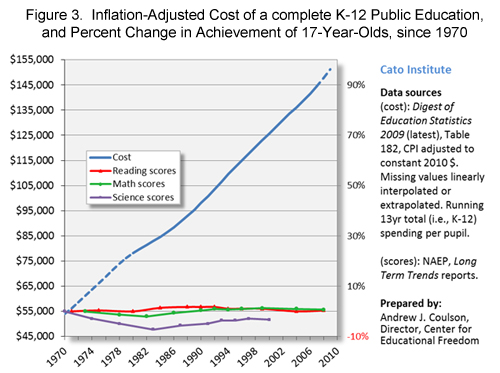
Education spending has tripled since 1970

Here’s a study from 2012 published in the journal “Education and Urban Society“. It says:

The possibility is examined that school choice programs could be a means to reducing the achievement gap. Data based on meta-analytic research and the examination of nationwide data sets suggest that school choice programs that include private schools could reduce the achievement gap by 25%. The propounding of this possibility is based on research indicating that the achievement gap in faith-based schools is generally 25% narrower than one finds in public schools. Results of these studies suggest that both the racial achievement gap and the socioeconomic achievement gap are reduced by the same degree (25%). The significance of these results is discussed, especially as it pertains to the attitudes that people frequently have toward school choice.

Not only do children do better in non-public schools, but the competition forces public schools to focus less on leftist indoctrination, and more on reading, writing and math.

This study from the on-partisan National Bureau of Economic Research (NBER) explains why.

It says:

A school that is more productive is one that produces higher achievement in its pupils for each dollar it spends. In this paper, I comprehensively review how school choice might affect productivity. I begin by describing the importance of school productivity, then explain the economic logic that suggests that choice will affect productivity, and finish by presenting much of the available evidence on school choice and school productivity. The most intriguing evidence comes from three important, recent choice reforms: vouchers in Milwaukee, charter schools in Michigan, and charter schools in Arizona. I show that public school students’ achievement rose significantly and rapidly in response to competition, under each of the three reforms. Public school spending was unaffected, so the productivity of public schools rose, dramatically in the case in Milwaukee.

School choice makes public schools perform better because competition between providers always lowers the cost and increases the quality of services and products being provided to the consumers. Consumers always suffer when there is a monopoly. This is why people are more satisfied purchasing goods from Amazon and Netflix than they are lining up at the post office or the department of motor vehicles. The free market serves the consumer.

I was raised in a poor background, and I am a visible minority. If Republicans want to get the votes of people in my community, it makes sense to put in place policies that allow people like me to get a good education so we can get good jobs and do better than our parents did. Republicans should be all about equipping people to be independent and self-sufficient. These are conservative goals.

Study: children of same-sex couples do less well than those of married couples

A family praying and reading the Bible

The Public Discourse reports on a recent study out of Canada.

Excerpt:

A new academic study based on the Canadian census suggests that a married mom and dad matter for children. Children of same-sex coupled households do not fare as well.

There is a new and significant piece of evidence in the social science debate about gay parenting and the unique contributions that mothers and fathers make to their children’s flourishing. A study published last week in the journal Review of the Economics of the Household—analyzing data from a very large, population-based sample—reveals that the children of gay and lesbian couples are only about 65 percent as likely to have graduated from high school as the children of married, opposite-sex couples. And gender matters, too: girls are more apt to struggle than boys, with daughters of gay parents displaying dramatically low graduation rates.

Unlike US-based studies, this one evaluates a 20 percent sample of the Canadian census, where same-sex couples have had access to all taxation and government benefits since 1997 and to marriage since 2005.

While in the US Census same-sex households have to be guessed at based on the gender and number of self-reported heads-of-household, young adults in the Canadian census were asked, “Are you the child of a male or female same-sex married or common law couple?” While study author and economist Douglas Allen noted that very many children in Canada who live with a gay or lesbian parent are actually living with a single mother—a finding consonant with that detected in the 2012 New Family Structures Study—he was able to isolate and analyze hundreds of children living with a gay or lesbian couple (either married or in a “common law” relationship akin to cohabitation).

So the study is able to compare—side by side—the young-adult children of same-sex couples and opposite-sex couples, as well as children growing up in single-parent homes and other types of households. Three key findings stood out to Allen:

children of married opposite-sex families have a high graduation rate compared to the others; children of lesbian families have a very low graduation rate compared to the others; and the other four types [common law, gay, single mother, single father] are similar to each other and lie in between the married/lesbian extremes.

Employing regression models and series of control variables, Allen concludes that the substandard performance cannot be attributed to lower school attendance or the more modest education of gay or lesbian parents. Indeed, same-sex parents were characterized by higher levels of education, and their children were more likely to be enrolled in school than even those of married, opposite-sex couples. And yet their children are notably more likely to lag in finishing their own schooling.

[…]The truly unique aspect of Allen’s study, however, may be its ability to distinguish gender-specific effects of same-sex households on children. He writes:

the particular gender mix of a same-sex household has a dramatic difference in the association with child graduation. Consider the case of girls. . . . Regardless of the controls and whether or not girls are currently living in a gay or lesbian household, the odds of graduating from high school are considerably lower than any other household type. Indeed, girls living in gay households are only 15 percent as likely to graduate compared to girls from opposite sex married homes.

Thus although the children of same-sex couples fare worse overall, the disparity is unequally shared, but is instead based on the combination of the gender of child and gender of parents. Boys fare better—that is, they’re more likely to have finished high school—in gay households than in lesbian households. For girls, the opposite is true. Thus the study undermines not only claims about “no differences” but also assertions that moms and dads are interchangeable. They’re not.

With a little digging, I found the abstract of the study:

Almost all studies of same-sex parenting have concluded there is “no difference” in a range of outcome measures for children who live in a household with same-sex parents compared to children living with married opposite-sex parents. Recently, some work based on the US census has suggested otherwise, but those studies have considerable drawbacks. Here, a 20% sample of the 2006 Canada census is used to identify self-reported children living with same-sex parents, and to examine the association of household type with children’s high school graduation rates. This large random sample allows for control of parental marital status, distinguishes between gay and lesbian families, and is large enough to evaluate differences in gender between parents and children. Children living with gay and lesbian families in 2006 were about 65 % as likely to graduate compared to children living in opposite sex marriage families. Daughters of same-sex parents do considerably worse than sons.

The author of the study is a professor of economics at Simon Fraser University in British Columbia. His PhD in economics is from the University of Washington. A previous study had shown that gay relationships typically have far more instability (they last for more shorter times). That’s not good for children either. Another study featured in the Atlantic talked about how gay relationships have much higher rates of domestic violence. That’s not good for children either. So we have three reasons to think that normalizing gay relationships as “marriage” would not be good for children.

The reason I am posting this is because I want people to understand why social conservatives like me propose these laws defining and promoting marriage. We do favor natural marriage for the same reason that we oppose no-fault divorce, and for the same reason why we oppose welfare for single mothers (it encourages single motherhood). We don’t want to encourage people to deprive children of their mother or their father. We look at the research, and we decide that children need their mother and father. Given the choice between the needs of the child and restraining the freedom of the adults, we prefer the child’s need for her mother and father. It’s not just arbitrary rules, there is a reason behind the rules.

But children are not commodities. They have certain needs right out of the box. Adults should NOT be thinking about how to duct-tape a child onto any old relationship that doesn’t offer the same safety and stability that opposite sex marriage offers. We should be passing laws to strengthen marriage in order to protect children, not to weaken it. Libertarians don’t want to do that, because they want adults to be free to do as they please, at the expense of children.  Libertarians think that the adults should be able to negotiate private contracts and have no obligations to any children who are present, or who may be present later.

Related posts

Study: children of same-sex couples do less well than those of married couples

A family praying and reading the Bible

The Public Discourse reports on a recent study out of Canada.

Excerpt:

A new academic study based on the Canadian census suggests that a married mom and dad matter for children. Children of same-sex coupled households do not fare as well.

There is a new and significant piece of evidence in the social science debate about gay parenting and the unique contributions that mothers and fathers make to their children’s flourishing. A study published last week in the journal Review of the Economics of the Household—analyzing data from a very large, population-based sample—reveals that the children of gay and lesbian couples are only about 65 percent as likely to have graduated from high school as the children of married, opposite-sex couples. And gender matters, too: girls are more apt to struggle than boys, with daughters of gay parents displaying dramatically low graduation rates.

Unlike US-based studies, this one evaluates a 20 percent sample of the Canadian census, where same-sex couples have had access to all taxation and government benefits since 1997 and to marriage since 2005.

While in the US Census same-sex households have to be guessed at based on the gender and number of self-reported heads-of-household, young adults in the Canadian census were asked, “Are you the child of a male or female same-sex married or common law couple?” While study author and economist Douglas Allen noted that very many children in Canada who live with a gay or lesbian parent are actually living with a single mother—a finding consonant with that detected in the 2012 New Family Structures Study—he was able to isolate and analyze hundreds of children living with a gay or lesbian couple (either married or in a “common law” relationship akin to cohabitation).

So the study is able to compare—side by side—the young-adult children of same-sex couples and opposite-sex couples, as well as children growing up in single-parent homes and other types of households. Three key findings stood out to Allen:

children of married opposite-sex families have a high graduation rate compared to the others; children of lesbian families have a very low graduation rate compared to the others; and the other four types [common law, gay, single mother, single father] are similar to each other and lie in between the married/lesbian extremes.

Employing regression models and series of control variables, Allen concludes that the substandard performance cannot be attributed to lower school attendance or the more modest education of gay or lesbian parents. Indeed, same-sex parents were characterized by higher levels of education, and their children were more likely to be enrolled in school than even those of married, opposite-sex couples. And yet their children are notably more likely to lag in finishing their own schooling.

[…]The truly unique aspect of Allen’s study, however, may be its ability to distinguish gender-specific effects of same-sex households on children. He writes:

the particular gender mix of a same-sex household has a dramatic difference in the association with child graduation. Consider the case of girls. . . . Regardless of the controls and whether or not girls are currently living in a gay or lesbian household, the odds of graduating from high school are considerably lower than any other household type. Indeed, girls living in gay households are only 15 percent as likely to graduate compared to girls from opposite sex married homes.

Thus although the children of same-sex couples fare worse overall, the disparity is unequally shared, but is instead based on the combination of the gender of child and gender of parents. Boys fare better—that is, they’re more likely to have finished high school—in gay households than in lesbian households. For girls, the opposite is true. Thus the study undermines not only claims about “no differences” but also assertions that moms and dads are interchangeable. They’re not.

With a little digging, I found the abstract of the study:

Almost all studies of same-sex parenting have concluded there is “no difference” in a range of outcome measures for children who live in a household with same-sex parents compared to children living with married opposite-sex parents. Recently, some work based on the US census has suggested otherwise, but those studies have considerable drawbacks. Here, a 20% sample of the 2006 Canada census is used to identify self-reported children living with same-sex parents, and to examine the association of household type with children’s high school graduation rates. This large random sample allows for control of parental marital status, distinguishes between gay and lesbian families, and is large enough to evaluate differences in gender between parents and children. Children living with gay and lesbian families in 2006 were about 65 % as likely to graduate compared to children living in opposite sex marriage families. Daughters of same-sex parents do considerably worse than sons.

The author of the study is a professor of economics at Simon Fraser University in British Columbia. His PhD in economics is from the University of Washington. A previous study had shown that gay relationships typically have far more instability (they last for more shorter times). That’s not good for children either. Another study featured in the Atlantic talked about how gay relationships have much higher rates of domestic violence. That’s not good for children either. So we have three reasons to think that normalizing gay relationships as “marriage” would not be good for children.

The reason I am posting this is because I want people to understand why social conservatives like me propose these laws defining and promoting marriage. We do favor natural marriage for the same reason that we oppose no-fault divorce, and for the same reason why we oppose welfare for single mothers (it encourages single motherhood). We don’t want to encourage people to deprive children of their mother or their father. We look at the research, and we decide that children need their mother and father. Given the choice between the needs of the child and restraining the freedom of the adults, we prefer the child’s need for her mother and father. It’s not just arbitrary rules, there is a reason behind the rules.

But children are not commodities. They have certain needs right out of the box. Adults should NOT be thinking about how to duct-tape a child onto any old relationship that doesn’t offer the same safety and stability that opposite sex marriage offers. We should be passing laws to strengthen marriage in order to protect children, not to weaken it. Libertarians don’t want to do that, because they want adults to be free to do as they please, at the expense of children.  Libertarians think that the adults should be able to negotiate private contracts and have no obligations to any children who are present, or who may be present later.

Related posts