
Tag Archives: Children

Woman explains what she was told about having children when she was young

Man teaching woman proper marksmanship

This article is by Ellie Bufkin, writing for the The Federalist. I always had a suspicion that women were being told not to marry too early, and not to have kids too early, but to instead enjoy their freedom. (With all that that entails) In some cases, it was their own mothers telling them this. Here is the story of one woman who was told to follow her dreams – as long as they didn’t involve marriage and children.

Excerpt:

Since I was young, I’ve heard a non-stop stream of encouragement for me, as a “modern woman,” to take charge of my own life, live independently, and chase my dreams. This seems like the obvious advice we should give children, except that many people spent so much time chasing their dreams and creating their bespoke lives that they forgot to have children.

While growing up in the suburbs, my post-scholastic dream did not consist of finding a partner and having babies. I wanted to see the world, experience many cultures, and live without having to worry about caring for anyone else. I ended up in a fast-paced career with a propensity for hard partying, late hours, and a taste for travel and luxury.

As years ticked by, I assumed my perfect life would simply fall into place when I was ready, my career would steadily improve, and I would be swept off my feet by a perfect man. I had many friends with the exact same expectations for their lives, and today, we are pretty much all still single and childless.

We set our expectations so high that we never achieved them. We dated people with the same hope for impossibly perfect lives and moved from city to city, hoping we could achieve a greatness that was not to be.

[…]Liberal feminists widely consider it to be morally wrong to have children in your twenties, or to have more than two children, or to continue any unplanned pregnancy. As a species, shouldn’t we want to reproduce? If we continue to reinforce the idea that having kids is a taboo choice, how long will it be before there are no children?

Many of the women I went to primary and high school with never left our little hometown, and now have their own children in the exact suburb I couldn’t wait to get away from. In my twenties, I pitied them. How could they be so uncurious as to never leave home? Weren’t we all raised to believe that women had choices now?

The next thing I want to do is to give you some facts about infertility, and whether women have accurate beliefs about infertility.

Dina sent me this UK Daily Mail article a while back, but I held onto it until I could find something to pair it with.

It says:

One of Britain’s top NHS fertility specialists last night issued a stark warning to women: Start trying for a baby before you’re 30 – or risk never having children.

In a strongly worded letter to Education Secretary Nicky Morgan, consultant gynaecologist Professor Geeta Nargund has also demanded that teenagers are taught about the dangers of delaying parenthood, because of the spiralling cost to the taxpayer of IVF for women in their late 30s and 40s.

[…]Prof Nargund said last night: ‘Ideally, if a woman is ready for a child, she should start trying by the time she is 30. She should consider having a child early because as a woman gets older, her fertility declines sharply.’

If a woman started trying early enough, doctors would still have time to diagnose problems and take action before it was too late, she said.

Her comments were endorsed by Professor Allan Pacey, outgoing chair of the British Fertility Society.

‘You need to be trying by 30 because if there is a problem and you need surgery, hormones or IVF, then you’ve got five years to sort it out,’ he said. ‘If a woman starts trying at 35, doctors have got to sort it out when she is already on a slippery fertility slope’.

My friend Drew found a study reported on by ABC News, that explained why the age of 30 is so important.

Excerpt:

By the time a woman hits 30, nearly all of her ovarian eggs are gone for good, according a new study that says women who put off childbearing for too long could have difficulty ever conceiving.

The study published by the University of St. Andrews and Edinburgh University in Scotland found that women have lost 90 percent of their eggs by the time they are 30 years old, and only have about 3 percent remaining by the time they are 40.

Now, do most women know what the experts say about infertility?

Consider this article from Aeon magazine.

It says:

Many studies show that women are not only woefully ignorant when it comes to fertility, conception and the efficacy of assisted reproductive technologies (ART) – but they overestimate their knowledge about the subject. For instance, a 2011 study in Fertility and Sterility surveyed 3,345 childless women in Canada between the ages of 20 and 50; despite the fact that the women initially assessed their own fertility knowledge as high, the researchers found only half of them answered six of the 16 questions correctly. 72.9 per cent of women thought that: ‘For women over 30, overall health and fitness level is a better indicator of fertility than age.’ (False.) And 90.9 per cent felt that: ‘Prior to menopause, assisted reproductive technologies (such as IVF) can help most women to have a baby using their own eggs.’ (Also false.) Many falsely believed that by not smoking and not being obese they could improve their fertility, rather than the fact that those factors simply negatively affect fertility.

[…]According to a 2011 study in Human Reproduction, which surveyed 410 undergraduate students, most overestimated a women’s chances of spontaneous pregnancy in all age groups, but particularly after receiving IVF beyond age 40. Only 11 per cent of the students knew that genetic motherhood is unlikely to be achieved from the mid-40s onward, unless using oocytes or egg cells frozen in advance. ‘This can be explained by technological “hype” and favourable media coverage of very late pregnancies,’ the authors concluded.

So, I guess now I’ll issue my advice to women in their 20s on how to avoid being single and childless at 35.

Money gives men confidence to pull the trigger on marriage, so you should focus your efforts on men with a solid balance sheet and a gap-less resume. Beware of men who paint a rosy picture of their finances in the future that makes you feel good, but who have not demonstrated their ability to earn or save. It’s much better to focus your time on a man who can marry you right now. The best way to tell if a man is capable of marriage is not by listening to confident words, it’s by looking to see how he has prepared to perform his roles, one of which is provider.

Be debt free. Study STEM in school, update your resume, and get a job that pays well. Jobs are not meant to be fun or fulfilling. You need to be preparing financially for marriage, and that means a normal 8-4:30 job in an office with 3% annual raises and 401K matching. The more you save to help your man with the down payment on your house, the better. Pursuing fun and spending money on frivolous things like travel makes you addicted to fun, which is unsuitable for the hard work and responsibilities in marriage. Working a hard job is a good way to break down your selfishness, and prepare you to take your obligations to others seriously. Don’t live in the moment, do sacrifice for the future. Believe me: a woman’s debt is a serious damper on a man’s willingness to marry her.

If you went to college, chances are that you absorbed a lot of feminism. Feminism emphasizes being free of constraints, feeling happy, having fun, career over family, and independence from the needs of men and children. And most of all, it teaches mistrust and disrespect of male leadership. Not every man can be trusted and respected as a leader, and that’s why it’s on you to choose a man who can be trusted and respected as a leader. Most married women will tell you that leadership in moral and spiritual areas is the most difficult and valuable quality to get in a man. Get yourself a marriage mentor, ask for book recommendations that will educate you about the challenges and rewards of marriage. A good marriage mentor will explain to you why marriage is a better plan than the feminist plan, and will emphasize self-denial, self-sacrifice, self-control and serving others. It’s only by getting specific about marriage and parenting that your heart will change to want to work on marriage rather than work on the things that the feminist culture prefers. I recommend Dr. Laura’s book on husbands, and lectures by Dr. Jennifer Roback Morse.

This talk of infertility made me think of a woman I know who just turned 30. She spent most of her 20s in relationships with huge, tall burly men. Race car drivers, etc. She liked to travel, especially to the beach. She liked ride around with in boats with buff guys. Now, at 30, she is very jaded about men and struggling to even get a date. In my experience, men are most open to marrying a woman who is young, athletic, and doesn’t have baggage from fun-seeking with hot bad boys. Sexual baggage usually builds impatience, mistrust, disrespect and controlling behavior in a woman. Men prefer to marry virgins who are calm, stable and not addicted to alcohol or drugs. The time to focus on serious marriage-minded providers and leaders is when you have what men need from a woman for a marriage.
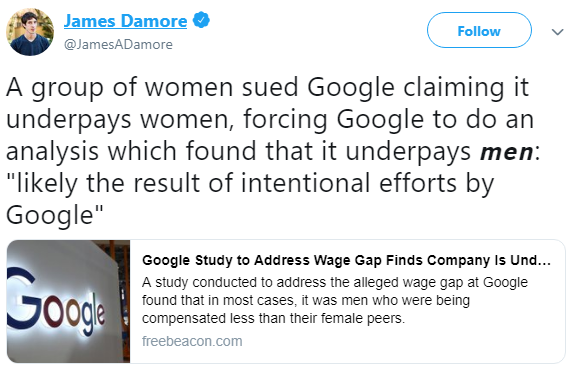

Wage gap: are women paid less than men because of discrimination?

Google pays men less than women
Far-left social media giant Google pays men less than women

Liberal feminist Hanna Rosin takes a look at this question in the far-left Slate, of all places.

Excerpt:

The official Bureau of Labor Department statistics show that the median earnings of full-time female workers is 77 percent of the median earnings of full-time male workers. But that is very different than “77 cents on the dollar for doing the same work as men.” The latter gives the impression that a man and a woman standing next to each other doing the same job for the same number of hours get paid different salaries. That’s not at all the case. “Full time” officially means 35 hours, but men work more hours than women. That’s the first problem: We could be comparing men working 40 hours to women working 35.

How to get a more accurate measure? First, instead of comparing annual wages, start by comparing average weekly wages. This is considered a slightly more accurate measure because it eliminates variables like time off during the year or annual bonuses (and yes, men get higher bonuses, but let’s shelve that for a moment in our quest for a pure wage gap number). By this measure, women earn 81 percent of what men earn, although it varies widely by race. African-American women, for example, earn 94 percent of what African-American men earn in a typical week. Then, when you restrict the comparison to men and women working 40 hours a week, the gap narrows to 87 percent.

But we’re still not close to measuring women “doing the same work as men.” For that, we’d have to adjust for many other factors that go into determining salary. Economists Francine Blau and Lawrence Kahn did that in a recent paper, “The Gender Pay Gap.”.”They first accounted for education and experience. That didn’t shift the gap very much, because women generally have at least as much and usually more education than men, and since the 1980s they have been gaining the experience. The fact that men are more likely to be in unions and have their salaries protected accounts for about 4 percent of the gap. The big differences are in occupation and industry. Women congregate in different professions than men do, and the largely male professions tend to be higher-paying. If you account for those differences, and then compare a woman and a man doing the same job, the pay gap narrows to 91 percent. So, you could accurately say in that Obama ad that, “women get paid 91 cents on the dollar for doing the same work as men.”

I believe that the remainder of the gap can be accounted for by looking at other voluntary factors that differentiate men and women.

The Heritage Foundation says that a recent study puts the number at 95 cents per dollar.

Excerpt:

Women are more likely than men to work in industries with more flexible schedules. Women are also more likely to spend time outside the labor force to care for children. These choices have benefits, but they also reduce pay—for both men and women. When economists control for such factors, they find the gender gap largely disappears.

A 2009 study commissioned by the Department of Labor found that after controlling for occupation, experience, and other choices, women earn 95 percent as much as men do. In 2005, June O’Neil, the former director of the Congressional Budget Office, found that “There is no gender gap in wages among men and women with similar family roles.” Different choices—not discrimination—account for different employment and wage outcomes.

A popular article by Carrie Lukas in the Wall Street Journal agrees.

Excerpt:

The Department of Labor’s Time Use survey shows that full-time working women spend an average of 8.01 hours per day on the job, compared to 8.75 hours for full-time working men. One would expect that someone who works 9% more would also earn more. This one fact alone accounts for more than a third of the wage gap.

[…]Recent studies have shown that the wage gap shrinks—or even reverses—when relevant factors are taken into account and comparisons are made between men and women in similar circumstances. In a 2010 study of single, childless urban workers between the ages of 22 and 30, the research firm Reach Advisors found that women earned an average of 8% more than their male counterparts. Given that women are outpacing men in educational attainment, and that our economy is increasingly geared toward knowledge-based jobs, it makes sense that women’s earnings are going up compared to men’s.

When women make different choices about education and labor that are more like what men choose, they earn just as much or more than men.

Should government get out of the marriage business?

Dr. Jennifer Roback Morse

Here are three articles by Jennifer Roback Morse posted at The Public Discourse. The articles answer the charge from social liberals and libertarians that government should “get the government out of marriage”.

Here’s the first article which talks about how government will still be involved in marriage, even if we get rid of the traditional definition of marriage, because of the need for dispute resolution in private marriage contracts. She uses no-fault divorce as an example showing how it was sold as a way to get government out of the divorce business. But by making divorce easier by making it require no reason, it increased the number of disputes and the need for more government intervention to resolve these disputes.

Here’s the second article which talks about how the government will have to expand to resolve conflicts over decisions about who counts as a parent and who gets parental rights. With traditional marriage, identifying who the parents are is easy. But with private marriage contracts where the parties are not the biological parents, there is a need for the state to step in and assign parental rights. Again, this will require an expansion of government to resolve the disputes.

Here’s the third article which talks about how marriage is necessary in order to defend the needs and rights of the child at a time when they cannot enter into contracts and be parties to legal disputes.

The third article was my favorite, so here is an excerpt from it:

The fact of childhood dependence raises a whole series of questions. How do we get from a position of helpless dependence and complete self-centeredness, to a position of independence and respect for others? Are our views of the child somehow related to the foundations of a free society? And, to ask a question that may sound like heresy to libertarian ears: Do the needs of children place legitimate demands and limitations on the behavior of adults?

I came to the conclusion that a free society needs adults who can control themselves, and who have consciences. A free society needs people who can use their freedom, without bothering other people too much. We need to respect the rights of others, keep our promises, and restrain ourselves from taking advantage of others.

We learn to do these things inside the family, by being in a relationship with our parents. We can see this by looking at attachment- disordered children and failure-to-thrive children from orphanages and foster care. These children have their material needs met, for food, clothing, and medical care. But they are not held, or loved, or looked at. They simply do not develop properly, without mothers and fathers taking personal care of them. Some of them never develop consciences. But a child without a conscience becomes a real problem: this is exactly the type of child who does whatever he can get away with. A free society can’t handle very many people like that, and still function.

In other words I asked, “Do the needs of society place constraints on how we treat children?” But even this analysis still views the child from society’s perspective. It is about time we look at it from the child’s point of view, and ask a different kind of question. What is owed to the child?

Children are entitled to a relationship with both of their parents. They are entitled to know who they are and where they came from. Therefore children have a legitimate interest in the stability of their parents’ union, since that is ordinarily how kids have relationships with both parents. If Mom and Dad are quarreling, or if they live on opposite sides of the country, the child’s connection with one or both of them is seriously impaired.

But children cannot defend their rights themselves. Nor is it adequate to intervene after the fact, after harm already has been done. Children’s relational and identity rights must be protected proactively.

Marriage is society’s institutional structure for protecting these legitimate rights and interests of children.

I recommend taking a look at all three articles and becoming familiar with the arguments in case you have to explain why marriage matters and why we should not change it. I think it is important to read these articles and to be clear that to be a libertarian doctrine does not protect the right of a child to have a relationship with both his or her parents.  Nor does libertarianism promote the idea that parents ought to stick together for their children. Libertarianism means that adults get to do what they want, and no one speaks for the kids.

The purpose of marriage is to make adults make careful commitments, and restrain their desires and feelings, so that children will have a stable environment with their biological parents nearby. We do make exceptions, but we should not celebrate exceptions and we should not subsidize exceptions. It’s not fair to children to have to grow up without a mother or father just so that adults can pursue fun and thrills.