
Tag Archives: Children

What do research studies say about the bond between fathers and daughters?

Texas senator Ted Cruz, his wife Heidi Cruz and their two daughters

Many people today think that biological fathers are not essential for raising daughters. In fact, we even support this view by passing no-fault divorce laws, single-mother welfare laws, and by opposing shared parenting laws. The story goes that children do fine without their biological father in the home. Having children is something that women decide to do, and the man is superfluous. So I thought it might be a good idea to take a look at the research.

Here is a recent article from the centrist Institute for Family Studies.

It says:

The dynamic between fathers and their daughters has been characterized by one expert as the most “fragile and unstable” when compared to other parent-child relationships.1 It can be further described as one of the most powerful and vital relationships to individuals, communities, and nations. For instance, fathers have a profound impact on their daughters’ body image,clinical depression, eating disorders,self-esteem, and life satisfaction,to name but a few.

But of all the unique contributions a father makes in his daughter’s life, perhaps there is none of greater significance than in the area of sexual development and activity and romantic relationships.

  • Numerous studies have discovered female pubertal timing occurs later in girls whose fathers are consistently present in their life.5
  • An extensive body of research has revealed that early pubertal maturation in girls is associated with a variety of negative biological, psychological, and social outcomes, including, mood disorders,substance abuse,adolescent pregnancy,and a variety of cancers of the reproductive system.9
  • Fatherless daughters are seven times more likely to become pregnant as teens.10

[…]The conditions in our culture of both rampant fatherlessness and sexual promiscuity are incompatible with forming secure and healthy relationships with boys and with establishing stable families for the next generation. A young girl’s sexual development can significantly outpace her neurological and emotional development—the very resources needed to guide her sexual choices.

Herein lies the danger. Much of our culture today promotes sexual activity but void of healthy attachment or true intimacy. There is a great deal of evidence to suggest that high levels of father involvement (regardless of dad’s marital status) are predictive of high levels of intimacy, commitment, and trust in young female adults’ romantic relationships; whereas low levels of father involvement are predictive of the opposite.11

And:

How a father treats both his daughter and her mother can help a young woman feel safe and secure in her relationships with the boys and men in her life, including her future husband. Family scientists and evolutionary psychologists have discovered that girls appear to be born with an emotional, relational, and evolutionary void that a father is designated to fill. If left vacant, girls will be more likely to seek to fill it in with other, unhealthier substitutes. The father-daughter relationship is the one that best teaches young women about true love and intimacy, self-worth, and respect.

Professor Linda Nielsen summarized this in one profound sentence: “[T]he father has the greater impact on the daughter’s ability to trust, enjoy, and relate well to the males in her life.”

So, a father’s love keeps her from getting into relationships with boys before the boys are ready to commit to her. By the way, I don’t think that boys should even be allowed to TALK to girls about a relationship, unless they have a STEM degree, and two years of private sector work experience. I really hate when unemployed, penniless boys waste a girl’s time when they can’t afford to commit to her. People think I am pretty rough on women, but I really am much meaner to men who don’t have STEM degrees and gapless resumes. (I guess a skilled trade would work as well, in place of the STEM degree – something like electrician, for example).

Anyway, back to the research. When a woman is deciding which men to have sex with, she has to be thinking of more than just her own needs. She has to choose a man who is going to stick around long enough to raise her daughters, so that they grow up with the confidence to resist the advances of boys who aren’t ready to commit. To be pro-woman means to be pro-daughter, and that means that women need to be persuaded to be careful about the choice of sex partner, and the timing of sexual activity. This is why people used to keep sex for marriage in the past: to protect children by making sure that they would get the stability and engagement they need from their parents.

Also, I have talked about the research about father-son bond in a different post.

If you want to do right for your children, then you need to control yourself and make wise choices. And if you’re struggling to make good choices, then don’t leave it up to your emotions and peer approval. Disregard your emotions. Disregard peer approval. Instead, let your decision-making be guided by your Christian convictions, and strengthened with scientific evidence. The Bible tells you not to have sex before you’re married, and science tells you why this is good policy. The Bible gives you the goals, and science tells you how to how the world works, so you know how to make plans that will make sure you are never in a place where you are pressured to do the wrong thing. The more science you pack into your head, the easier it will be for you to convince yourself to do the right thing, and to convince your partner to do the right thing. Science takes moral decision-making outside the realm of feelings and opinions.

And if your partner says “I don’t care about the needs of our future children”, then you have a good reason to dump them and move on. You can’t be in a relationship with someone who thinks that children’s needs are less important than adult desires. In fact, the whole design for relationships should start with what children need from the marriage and parents, and work backward from there to the obligations on the man and the woman. And men and women ought to discuss this. What are we trying to achieve with this relationship anyway? And what is the right way to achieve it? This is where the research comes in – it shows you how to do it right.

Research from the Heritage Foundation
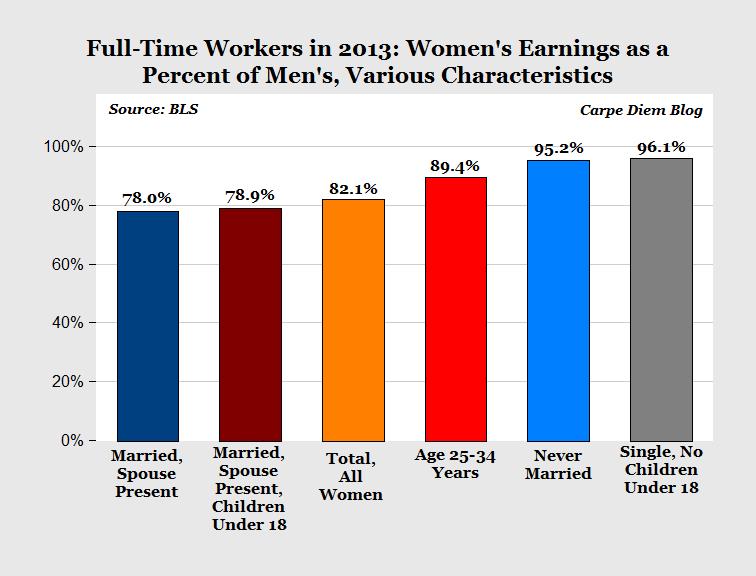
Wage gap: are women paid less than men because of discrimination?

The pay gap is caused by women's own choices
The pay gap is caused by women’s preference for having children

Liberal feminist Hanna Rosin takes a look at this question in the far-left Slate, of all places.

Excerpt:

The official Bureau of Labor Department statistics show that the median earnings of full-time female workers is 77 percent of the median earnings of full-time male workers. But that is very different than “77 cents on the dollar for doing the same work as men.” The latter gives the impression that a man and a woman standing next to each other doing the same job for the same number of hours get paid different salaries. That’s not at all the case. “Full time” officially means 35 hours, but men work more hours than women. That’s the first problem: We could be comparing men working 40 hours to women working 35.

How to get a more accurate measure? First, instead of comparing annual wages, start by comparing average weekly wages. This is considered a slightly more accurate measure because it eliminates variables like time off during the year or annual bonuses (and yes, men get higher bonuses, but let’s shelve that for a moment in our quest for a pure wage gap number). By this measure, women earn 81 percent of what men earn, although it varies widely by race. African-American women, for example, earn 94 percent of what African-American men earn in a typical week. Then, when you restrict the comparison to men and women working 40 hours a week, the gap narrows to 87 percent.

But we’re still not close to measuring women “doing the same work as men.” For that, we’d have to adjust for many other factors that go into determining salary. Economists Francine Blau and Lawrence Kahn did that in a recent paper, “The Gender Pay Gap.”.”They first accounted for education and experience. That didn’t shift the gap very much, because women generally have at least as much and usually more education than men, and since the 1980s they have been gaining the experience. The fact that men are more likely to be in unions and have their salaries protected accounts for about 4 percent of the gap. The big differences are in occupation and industry. Women congregate in different professions than men do, and the largely male professions tend to be higher-paying. If you account for those differences, and then compare a woman and a man doing the same job, the pay gap narrows to 91 percent. So, you could accurately say in that Obama ad that, “women get paid 91 cents on the dollar for doing the same work as men.”

I believe that the remainder of the gap can be accounted for by looking at other voluntary factors that differentiate men and women.

The Heritage Foundation says that a recent study puts the number at 95 cents per dollar.

Excerpt:

Women are more likely than men to work in industries with more flexible schedules. Women are also more likely to spend time outside the labor force to care for children. These choices have benefits, but they also reduce pay—for both men and women. When economists control for such factors, they find the gender gap largely disappears.

A 2009 study commissioned by the Department of Labor found that after controlling for occupation, experience, and other choices, women earn 95 percent as much as men do. In 2005, June O’Neil, the former director of the Congressional Budget Office, found that “There is no gender gap in wages among men and women with similar family roles.” Different choices—not discrimination—account for different employment and wage outcomes.

A popular article by Carrie Lukas in the Wall Street Journal agrees.

Excerpt:

The Department of Labor’s Time Use survey shows that full-time working women spend an average of 8.01 hours per day on the job, compared to 8.75 hours for full-time working men. One would expect that someone who works 9% more would also earn more. This one fact alone accounts for more than a third of the wage gap.

[…]Recent studies have shown that the wage gap shrinks—or even reverses—when relevant factors are taken into account and comparisons are made between men and women in similar circumstances. In a 2010 study of single, childless urban workers between the ages of 22 and 30, the research firm Reach Advisors found that women earned an average of 8% more than their male counterparts. Given that women are outpacing men in educational attainment, and that our economy is increasingly geared toward knowledge-based jobs, it makes sense that women’s earnings are going up compared to men’s.

When women make different choices about education and labor that are more like what men choose, they earn just as much or more than men.

Are you ready for marriage? 10 questions to find out how prepared you are

Marriage and family
Marriage and family

Would you like your marriage to be long-lasting and fulfilling? Well, check out the questions below and see if you are ready for life-long wedded bliss.

1. Are you opposed to no-fault divorce laws?

No-fault divorce laws allow one spouse to leave the marriage at any time, for any reason, or for no reason at all. If you support no-fault divorce, then your view of marriage is that it’s something to be entered into lightly, because it can be exited easily. You’ll be walking down the aisle thinking “oh well, if it doesn’t work out, I can always get a divorce”. If you oppose no-fault divorce laws, then your view of marriage is that there is no escape hatch. You’ll probably be a lot more careful about getting married. Since you are convinced that marriage is built to last forever, you’ll have a courtship of at least 6 months, and involve both sets of parents in the process. If you put commitment above happiness, you’re ready for marriage.

2. Are you opposed to abortion laws?

Abortion laws basically make it easy for two people to have recreational sex, and then get rid of any complications that result quickly and easily. This way, both the people that created the effect can escape the responsibility for what they did, and keep right on pursuing their goals and dreams. If you support abortion laws, you’re really saying that you can engage in recreational sex with people who are unwilling to accept responsibility for any children that result. If you are pro-life, then you’re saying that people should be careful about having sex, and be ready to take responsibility for a child, should one appear. Being responsible is good preparation for marriage.

3. Are you supportive of daycare for young kids?

Daycare services are essential for couples who need both the father and the mother to be working. The advantage of both parents working is that you can afford lots of shiny new stuff – like vacations, boats, shoes and handbags. Studies show that children don’t die during daycare, although if you put a child in daycare, there will be effects on the child’s behavior, such as higher anxiety and aggression. If you oppose daycare, you’re putting the needs of your children above your need for shiny stuff. Putting the needs of children first is a sign that you are ready for the self-sacrifice that marriage requires.

4. Are you in favor of smaller government?

If you’re in favor of smaller government, then you would rather keep taxes low so that more money stays in the family. If you support bigger government, then you think that government knows how to spend your money better than you and your spouse do. Additionally, government usually likes to spend more money than they take in. For example, in  Obama’s 8 years, we added $10 trillion dollars to the debt, which doubled from 10 to 20 trillion under his watch. If you oppose higher taxes and bigger government, then you want government to pass on less debt to your children. Putting your kids’ financial well-being over your own is pro-marriage.

5. Are you in favor of school choice?

If you’re opposed to school choice, then you think that government should decide which schools your children will attend. School choice laws allow parents to give money to the schools they think are best for the children. If a school has excellent teachers and teaches students skills that they can use in their professional lives, then parents can choose that school. Schools have to compete to provide higher quality to parents, for lower cost. If you support giving parents more choice, then you put the needs of children – especially poor, minority children – above the needs of education administrators and teacher unions. Putting kids first is pro-marriage.

6. Are you in favor of premarital sex?

Premarital sex is really fun (so I’m told). You can have sex with people who are just really attractive, even if these people have lousy character. Your friends will be impressed, and you’ll feel more attractive – like you were climbing a ladder of attractiveness with each new partner. If you combine sex with being drunk, then you can’t remember anything after. And you can’t feel guilty if the booze made you do it, right? On the other hand, if you present yourself to your spouse as a virgin, you are telling them that you have self-control, that you take sex as communication rather than recreation, and that they can trust you to be faithful by keeping sex inside the marriage. Trust is important for a good marriage.

7. Are you in favor of welfare for single mothers?

Sometimes, women find themselves pregnant before they are married. If you think that giving taxpayer money to women who have babies before they have husbands is a good idea, then you are rewarding behavior that creates fatherless children. Raising a child without a father causes serious behavioral problems. Boys tend to become more violent, and are more likely to commit crimes. Girls tend to engage in sex at earlier ages. If you oppose encouraging fatherlessness with welfare, you want women to get married before they have kids. Taking the needs of children seriously is pro-marriage.

8. Are you in favor of same-sex marriage?

When a man and a man get married and acquire children, those children will not be raised with their birth mother. Similarly with lesbians, the children will not grow up with their birth father. Studies show that children suffer from not being raised by their biological parents. For example, children of same-sex parents have lower graduation rates than children raised by heterosexual couples. If you think that children have a right to a stable relationship with their biological mother and father, then you place a higher value on the needs of children as opposed to the needs of adults. That’s a good sign you’re ready for marriage.

9. Are you in favor of radical feminism?

Feminism shows that you think the purpose of marriage is to make women happy, and not to work as a team to serve God and raise good children. Indeed. Marriage doesn’t work if the woman approaches it as an accessory. Marriage is about a man and a woman sacrificing their own interests and compromising in order to work together as a team. Husbands and children have needs that women should care about. Feminism teaches women that husbands and children are less important than their careers, hobbies and interests. Feminism is anti-marriage.

10. Are you responsible with earning, budgeting and saving money?

This one comes to us from Bob P. He says that marriages work better when both spouses are “committed to financial planning, budgeting and a renunciation of debt to support a lifestyle. Disagreement about financial issues is one of the greatest causes of marital stress.” If you’re able to choose a college major or a trade that you don’t like, but that pays well, that’s a positive. If you’re able to string together jobs so that your resume is gap-less, that’s a positive. If you’re able to save money even though it means you’re having less fun, that’s a positive. If you’re able to give away money to others to support them, that means you’re able to sacrifice your interests for the benefit of others. That’s pro-marriage.

Well, how did you do? Leave your ideas for more policies and points of view that are marriage-friendly in the comments.