
Tag Archives: 2011

Conservative MP’s bill to repeal Section 13 moves to committee

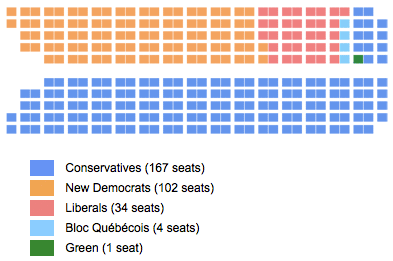
Canada 2011 Federal Election Seats
Canada 2011 Federal Election Results

Andrew sent me this article from the Chronicle Herald.

Excerpt:

To protect freedom of expression in Canada, sometimes you need a majority government in Ottawa.

That’s the moral of the story of a Conservative backbencher’s private member’s bill — which has now cleared second reading in the House of Commons and gone to committee — seeking to repeal Section 13 of the Canadian Human Rights Act.

Let’s recall the exact wording of that infamous clause. Hate messages, according to Section 13 (1), are communications “likely to expose a person or persons to hatred or contempt by reason of the fact that that person or those persons are identifiable on the basis of a prohibited ground of discrimination.”

In other words, if I were to write something critical about Islam, for example, and someone reading my column felt it “likely” that my words could provoke “contempt” towards Muslims, they could lodge a complaint against me with one of Canada’s government-created human rights commissions.

Truth would not be a defence. Neither would my intent. And the person complaining wouldn’t even have to be a Muslim.

That’s because, on top of the appallingly loose wording of this section of federal human rights law — a clause echoed in its provincial counterparts — any complaints are adjudicated by government-appointed tribunals, where the standard protections afforded any accused in a court of law don’t necessarily apply.

When complainants’ cases go forward, taxpayers pick up the tab. Meanwhile, those accused must pay to defend themselves out of their own pockets.

It’s a system ripe for abuse. And that’s exactly what has happened. We’ve seen comics fined for insulting hecklers (B.C. human rights tribunal), former publishers spend $100,000 in legal fees over three years to defend themselves for printing “offensive” cartoons (Alberta human rights commission), and Maclean’s magazine investigated by three human rights bodies (federal, Ontario and B.C.) for running an article on Muslim demographics in Europe.

The Conservatives have long opposed Section 13, but didn’t feel they had the support they needed from the other parties, as a minority government, to push the issue legislatively.

They also were concerned, with good reason, that some opponents might twist the issue for political advantage, slamming the Tories for being soft on hate.

Yes, Bill C-304, which aims to repeal Sections 13 and 54 (dealing with penalties under S.13), was put forward by Alberta MP Brian Storseth (Westlock-St. Paul) and is a private member’s bill, but the legislation has the justice minister’s endorsement. So there’s a good chance the bill will be back in the Commons this spring for final reading, then on to the Senate and, hopefully, passage and royal assent.

The bill, if made law, would take effect a year after receiving royal assent.

Canada does not protect free speech right now. Repealing Section 13 would be good, but Canada is not a good place for families to raise children. Even if they get Section 13 repealed, there is still the recent unanimous Supreme Court decision affirming that the provincial governments have a right to decide what children will believe – not parents. The Supreme Court was mostly selected by the previous Liberal governments.

Will McGuinty revive plan for no-parental-notification, no-opt out sex education?

Remember a while when I blogged about the Ontario Liberal government’s plan to push sex education onto kindergarden and elementary children, with no parental notification and no opt-out option for parents? The end result of that was that Dalton McGuinty, the Liberal leader, backed down. But, apparently there is an election going on up there, and McGuinty might get another chance to appease his gay-rights special interest groups with some new education proposals put forward by the Toronto District School Board.

Here’s Michael Coren explaining: (H/T Blazing Cat Fur)

Brian Lilley interviews a Toronto pastor about McGuinty’s plan: (H/T Blazing Cat Fur)

Prince Albert now explains what’s in the proposed standards:

Excerpt:

As the Ontario election campaign moved into the final two weeks Friday, Dalton McGuinty, the self-proclaimed education premier, was accused of keeping parents in the dark about a new policy to combat homophobia in schools.

The Toronto District School Board developed a 219-page curriculum resource guide for the new school year to cover kindergarten through Grade 12 called “Challenging Homophobia and Heterosexism.”

Among other things, it recommends schools not advise parents when teachers will be introducing concepts such as gender discrimination, homophobia and non-traditional families in the classroom.

[…]The school board guide recommends schools not send home notes or permission slips before starting any class work on lesbian, gay, bisexual transgendered or queer issues.

If a school treats sexual orientation or anti-homophobia differently from the other curriculum topics “this could be construed as discriminatory practice,” concludes the curriculum guide.

The guide also says there should be no accommodations for parents who want their children exempted from the anti-homophobia discussions because of religious reasons or for teachers who feel it contradicts their beliefs.

“If a parent asks for his or her child to be exempted for any discussions of LGBTQ family issues as a religious accommodation, this request cannot be made because it violates the human rights policy,” states the guide.

I think that this proposal will become Ontario law if the Ontario Liberal Party wins the election on October 6th.

McGuinty is also pushing the cap-and-trade carbon tax, which will wreck the Canadian economy even more by raising the price of electricity even higher than he already has raised it, with his existing green energy policies.

What could Stephen Harper teach Michele Bachmann about winning elections?

Michele Bachmann should adopt Stephen Harper's plan

Michele Bachmann is soliciting questions for her townhall meeting on her Facebook page. Please “like” her page and then like my question, so that it will be asked.

The post that she is asking for questions in has this text:

Excited to join Tim Scott for Congress for a town hall live on Facebook from Charleston, SC tomorrow at 7PM ET, where we’ll be taking questions from our community of constitutional conservatives. Have a question? Please ask in the comments below:

My question is reproduced below:

Mrs. Bachmann, in the 2011 Canadian federal election, Stephen Harper, a conservative, managed to win a majority in a country that is only one-third conservative. He did this by creating N-point plans that clearly laid out his plans for each term.

The reason I think this is important is because he was able to neutralize the attacks of the media and the three left-leaning political parties because they were not able to accuse him of having a “hidden agenda”. My question for you is, have you considered laying out a clean, specific N-point plan for what you would do as President of the United States? You could even have 3 plans, one for social issues, one for fiscal issues, and one for foreign policy.

If you like my question, please like the “TeamBachmann” Facebook page, and then go to her post asking for questions, and like my question.

Here are the Harper plans:

2006: (won minority)

  • Cleaning up government by passing the Federal Accountability Act
  • Cutting the GST (the national sales tax)
  • Cracking down on crime
  • Increasing financial assistance for parents
  • Working with the provinces to establish a wait-times guarantee for patients

2008: (won minority)

  • The minister of finance and the Bank of Canada will constantly monitor financial markets and the impact of developments in other countries.
  • The global financial crisis will be discussed at the Canada-European Union Summit, which Harper will attend on Friday.
  • Parliament will be summoned to meet this fall and the minister of finance will table an economic and fiscal update before the end of November.
  • Canada will be represented at the meeting of G-20 finance ministers scheduled for early November in Brazil. Canada has also called for a second meeting of G-7 finance ministers.
  • Government spending will be focused and kept under control as the strategic review of departmental spending — now in the second year of a four year review – continues.
  • Harper will hold a first ministers meeting on the economy to discuss with premiers and territorial leaders a joint approach to the global financial crisis.

2011: (won majority)

  • Creating jobs through training, trade and low taxes.
  • Supporting families through our Family Tax Cut and more support for seniors and caregivers.
  • Eliminating the deficit by 2014-2015 by controlling spending and cutting waste.
  • Making our streets safe through new laws to protect children and the elderly.
  • Standing on guard for Canada by investing in the development of Canada’s North, cracking down on human smuggling and strengthening the Canadian Armed Forces.

Actually, Canadian conservatives are much more liberal than we Republicans are – they are soft on social issues. Harper himself is an evangelical Christian, though, but his hands are tied when it comes to social issues. He tries to support stronger families as a way to reduce abortion and to ensure that children grow up with mothers and fathers. Even Stephen Harper is not able to do anything about same-sex marriage and abortion, which are both legal in Canada.

I think Michele would do well to pretend that she was running for office in Canada, and then create her plans that way. All the conservatives already know that she is a solid evangelical and a Tea party stalwart. What she needs to do is come up with a list of specific smart policies that will win over two-thirds of the independents.

Some things I would like to see: transparency in government, sensible spending cuts, tort reform, cut employer payroll tax to 0%, cut federal funding for abortion/Planned Parenthood, increased tax credits for MARRIED couples, matching grants for states that create voucher programs, etc, a federal right-to-work law, a tax credit, usable at any time in the future, for all salary income earned by young people under the age of 22. Etc.