Irony: the young men who voted for Obama now suffer from record unemployment

This article from the Wall Street Journal explain why men are in decline. (H/T Mary, Tom)

Excerpt:

Few groups were hit harder by the recession than young men… The unemployment rate for males between 25 and 34 years old with high-school diplomas is 14.4%—up from 6.1% before the downturn four years ago and far above today’s 9% national rate. The picture is even more bleak for slightly younger men: 22.4% for high-school graduates 20 to 24 years old. That’s up from 10.4% four years ago.

[…]The share of men age 25-34 living with their parents jumped to 18.6% this year, up from 14.2% four years ago and the highest level since at least 1960, according to the Census Bureau.

Suzanne Venker comments on the consequences of this data for women for National Review.

Full text:

New data from the U.S. Census Bureau shows the percentage of men between the ages of 25 and 34 living at home rose from 14 percent in 2005 to 19 percent in 2011. Women, on the other hand, are doing just fine. Not only do they dominate today’s college campuses, they have little trouble staying away from mom and dad’s place. That’s because women are flourishing in the workforce while men are not. Writers and pundits blame this phenomenon on the economy, but the trend reflects a much larger sociological problem. America is in the midst of a sea change: Never before has it been more difficult for men and women to find their way to one another, settle in for the long haul, and build strong families together.

To read about it, you’d think the entire mess is out of our hands. You’d think the circumstances involving the roles of men and women in society have happened to us, rather than the other way around. The truth is that we created this new world — and while we may not be able to undo it, we can certainly stop the freight train from running off the tracks.

Hardly a day goes by that we aren’t made aware of this heartbreaking reality. It is so acute we now have not one but six new television series dedicated to men’s social demotion. In these programs, husbands are made to look like fools — while the wives wield a power so ugly it’s no wonder marriage has become so elusive. The modern generation has been sold a bill of goods about human nature, and the result is that men now have no idea how to be men. Why? Because women won’t let them.

There is a large and powerful group of women who see this shift in gender roles as a good thing. Hanna Rosin’s provocative piece in The Atlantic, called “The End of Men,” and Kate Bolick’s new piece “All the Single Ladies” (which may now become a TV series) make light of the demise of masculinity and the role men once played in society. They represent the kind of movers and shakers who help lead the feminist fight. Pointing to the latest statistics about men, they’d be likely to respond, “See how hopeless men are? Everything we’ve been saying about men all these years has proven to be true.”

But the laugh will be on them — if not for their own families, then for their children’s. The feminist policies that were put in place to help women flourish outside the home have suffocated men’s opportunities for economic self-sufficiency. In short, men’s desire to be good workers and family providers has been undermined. This is more than unfortunate; it is a loss of catastrophic proportions, for it is men’s consistent, full-time, year-round work that women depend on in order to live that ever-coveted “balanced life.” What too many women don’t understand (because they’ve been unduly influenced by feminist groupthink) is that male nature is ultimately beneficial to them, for women continue to put family — not career — at the center of their lives and are thus dependent on men to pick up the slack at the office.

It is a dangerous thing to create a society of frustrated young men. Feminists have no idea what a can of worms they’ve created — and what it’s about to do to our nation.

I think if we want men to marry, not only do we have to ask why the recession is affecting men disproportionately, but why the education system isn’t working for boys. We need to ask whether men learn better from female teachers or male teachers. We need to ask whether boys learn better in all-boys schools or in co-ed schools. We need to ask whether the promotion of sex education and contraception, which produces freely available sex, is the best way to encourage young men to prove themselves to women by trying hard to fit the traditional roles of protector, provider and moral/spiritual leader. We need to ask whether the denial of male-female differences encourages men to take on traditional male roles, and whether women are encouraged to prefer men who take on those roles. We need to ask whether our energy and economic policies favor job creation in areas dominated by men. We need to ask whether stimulus programs should be slanted towards industries dominated by women.  We need to ask whether affirmative action for women in education and at work helps men to be able to provide for a family. We need to ask whether men are well-served by no-fault divorce laws and biased domestic violence laws that promote false charges – especially during custody hearings. And lastly, we need to ask whether church serves men when it accepts or rejects postmodernism, anti-intellectualism and moral relativism.

But can’t we just tell men to “Man Up”?

The answer to the discincentives facing marriage-minded men is not a lazy, ignorant pronouncement for men to “Man Up”. That doesn’t solve any of the problems that cause men not to marry.

I think the desire of certain people to remove every incentive and capacity for men to perform as husbands and fathers – and then to nevertheless demand they marry and take on the traditional roles of men anyway without incentives or capacities – is the height of narcissism. Men are people too – we are not inanimate objects. We are not sperm donors and wallets. And if society decides to go in a direction where the traditional roles of men are replaced with  government social programs funded by high taxes and deficit spending, then marriage will die in this society.
Brian Auten interviews Dr. Angus Menuge on philosophy of mind

Click here for the interview. It’s up at Apologetics 315!

Details:

Today’s interview is with Dr. Angus Menuge, Professor of Philosophy  at Concordia University, and author of Agents Under Fire: Materialism and the Rationality of Science. He talks about his background and work, the philosophy of mind, what reason (or reasoning) is, what materialism is as a worldview, things excluded from a materialistic worldview, methodological naturalism and materialism, accounting for free will, materialistic accounts of reason, the epistemological argument from reason, the ontological argument from reason, finding the best explanation for reason, problems with methodological naturalism, implications of materialism, practical application of the argument from reason, advice for apologists, the International Academy of Apologetics, and more.

If what Dr. Menuge says in this interview is true, and I think it is, then a person who believes in materialism can neither ground free will nor rationality! So atheism wouldn’t really be freethought so much as it would be… un-free… non-thought.

In case people don’t want to listen to the podcast, then I’ve got some things for you to read below.

The ontological argument from reason

Dr. Menuge presented a paper at the real Evangelical Philosophical Society conference for students and professors of philosophy, and you can download the paper here in Word format. (here’s a PDF version I made)

Here is the introduction to the paper that Dr. Menuge read at the EPS conference:

The argument from reason is really a family of arguments to show that reasoning is incompatible with naturalism. Here, naturalism is understood as the idea that foundationally, there are only physical objects, properties and relations, and anything else reduces to, supervenes on, or emerges from that. For our purposes, one of the most important claims of naturalism is that all causation is passive, automatic, event causation (an earthquake automatically causes a tidal wave; the tidal wave responds passively): there are no agent causes, where something does not happen automatically but only because the agent exerts his active power by choosing to do it. The most famous version of the argument from reason is epistemological: if naturalism were true, we could not be justified in believing it. Today, I want to focus on the ontological argument from reason, which asserts that there cannot be reasoning in a naturalistic world, because reasoning requires libertarian free will, and this in turn requires a unified, enduring self with active power.

The two most promising ways out of this argument are: (1) Compatibilism—even in a deterministic, naturalistic world, humans are capable of free acts of reason if their minds are responsive to rational causes; (2) Libertarian Naturalism—a self with libertarian free will emerges from the brain. I argue that neither of these moves works, and so, unless someone has a better idea, the ontological argument from reason stands.

The paper is 11 pages long, and it is helpful for those of you looking for some good discussion of one of the issues in the area of philosophy of mind.

You may also be interested in Alvin Plantinga’s epistemological argument from reason, which is related to this argument. It shows that even to have the ability to think, you have to have a certain anthropology and you have to have mental faculties that are designed for reason, not survival.

Methodological naturalism

Dr. Menuge also wrote an article entitled “Is methodological materialism good for science?”.

Intro:

Should science by governed by methodological materialism? That is, should scientists assume that only undirected causes can figure in their theories and explanations? If the answer to these questions is yes, then there can be no such thing as teleological science or intelligent design. But is methodological materialism a defensible approach to science, or might it prevent scientists from discovering important truths about the natural world? In my contribution to The Waning of Materialism (Oxford University Press, 2010), edited by Robert Koons and George Bealer, I consider twelve of the most common arguments in favor of methodological materialism and show that none of them is convincing.

Of these arguments, perhaps the most prevalent is the “God of the gaps” charge, according to which invoking something other than a material cause is an argument from ignorance which, like a bad script writer, cites a deus ex machina to save our account from difficulty. Not only materialists, but also many Christian thinkers, like Francis Collins, worry that appeal to intelligent design commits the God of the gaps fallacy.

As I argue, however, not only is an inference to an intelligent cause not the same as an inference to the supernatural, it is a mistake to assume that all gap arguments are bad, or that only theists make them. If a gap argument is based solely on ignorance of what might explain some phenomenon, then indeed it is a bad argument. But there are many good gap arguments which are made both by scientific materialists and proponents of intelligent design.

So how do you make an argument like that?

As Stephen Meyer has argued in his Signature in the Cell, intelligent design argues in just the same way, claiming not merely that the material categories of chance and necessity (singly or in combination) are unable to explain the complex specified information in DNA, but also that in our experience, intelligent agents are the only known causes of such information. The argument is based on what we know about causal powers, not on what we do not know about them.

Since the inference is based on known causal powers, we learn that the cause is intelligent, but only further assumptions or data can tell us whether that intelligence is immanent in nature or supernatural. It is a serious mistake to confuse intelligent design with theistic science, and the argument that since some proponents of design believe that the designer is God, that is what they are claiming can be inferred from the data, is a sophomoric intensional fallacy.

If you think this is interesting, then do have a listen to the podcast. Dr. Menuge is not an ordinary academic – he is very direct. He calls materialism “a catastrophe” in the podcast! Not a shrinking violet.

FARC terrorist leader Alfonso Cano killed by Colombian armed forces

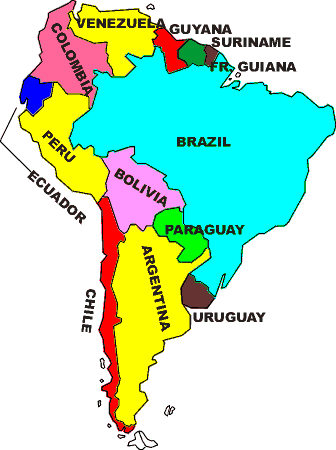
Map of South America

From the Heritage Foundation.

Excerpt:

The armed forces of Colombia have scored a major battlefield victory. They finally hunted down, confronted, and killed the leader of the narco-terrorist Revolutionary Armed Forces of Colombia (FARC), Guillermo Leon Saenz, widely known by his alias Alfonso Cano.

A guerrilla for decades, Cano assumed the top leadership of the FARC following the natural death of founder Manuel Marulanda (2008) and the elimination of senior figures Raul Reyes (2008) and Jorge Briceno (aka Mono Jojoy, 2010).

Seen by some as a modern-day version of the “good revolutionary,” Cano—a life-long advocate of armed violence and terrorism—fell in combat with the Colombian armed forces as they rappelled their way into his secret jungle hideout. Cano was also indicted in a U.S. court for drug trafficking along with dozens of other FARC leaders and had a $5 million price on his head.

FARC is a Marxist terrorist group.

The Economist reports that the Colombian economy is also doing well.

Excerpt:

WHEN the figures are finally tallied, Colombia may prove to have weathered the world recession better than any other of the larger Latin American countries. After a slight contraction at the end of 2008, the economy has been growing modestly this year. This resilience stems from continued foreign investment, an increase in government spending on public works and easier money: since December the central bank has cut interest rates by six percentage points, to 4%, a steeper drop than anywhere in the region outside Chile.

[…]President Álvaro Uribe’s security policies have helped to restore confidence. Investment soared, from 15% of GDP in 2002 to 26% last year, says Mr Zuluaga. Private business has retooled. After many delays, the government has issued licences to expand several ports; this month it hopes to award a contract for the first of four big road schemes, costing a total of $7.5 billion over four years. It hopes for investment of up to $50 billion in mining and oil over the next decade.

And liberal MSNBC has more on the booming Colombian economy.

Excerpt:

…Colombia’s revival is benefiting U.S. economic and political rivals as much as or more than the U.S. itself.

The long delay in signing the treaty allowed Latin America’s fourth-largest economy to strengthen ties with China. It also damaged U.S. credibility in the region, says Eric Farnsworth, vice-president of the Council of the Americas in Washington. “The delay in passing this called into question the United States’ reliability as a partner,” Farnsworth says. “There’s a strategic component to this. It’s not just about economics and trade.”

[…]As talks between the U.S. and Colombia dragged on, Colombia and China forged plans for a rail link between the Pacific and Caribbean that could draw freight away from the Panama Canal. Colombian President Juan Manuel Santos aims for a trade deal with South Korea. To tighten his connections to high-growth Asia, he’s also seeking membership in the Asia-Pacific Economic Cooperation group. “While Washington was debating whether the accord with Colombia was opportune, we advanced in our foreign policy strategy,” says Trade Minister Sergio Diaz-Granados.

Santos has cooperated more with his South American neighbors, organizing a meeting of finance ministers to discuss ways to protect their currencies and economies from the debt crisis in the U.S. and Europe. He supports a stock trading platform with Colombia, Chile, and Peru and wants to bring Mexico and Panama on board. Exports to Brazil have surged tenfold. While the U.S. remains Colombia’s biggest export market, with $16.8 billion in 2010 sales, up 30 percent from a year earlier, sales to China more than doubled last year, to $1.2 billion. Sales to the European Union are also rising, to $5.4 billion this year through August, more than in all of 2010. An EU trade accord could come next year.

The government has reduced cocaine cultivation 37 percent and halved the number of insurgents to about 8,000. Improved security has spurred enough growth to win an investment-grade credit rating from Standard & Poor’s as well as investment from billionaires. Colombia’s victories over the guerrillas opened up swathes of countryside to exploration for oil, gold, and coal. Mexican billionaire Carlos Slim’s push into crude has helped fuel foreign investment that the government says may reach a record $12 billion this year. The economy grew 5.2 percent in the second quarter.

The U.S. faces more competition from Colombia’s neighbors and Canada. In 2010, U.S. agricultural exports to Colombia fell more than 50 percent from 2008, to $827 million, as Argentina’s more than doubled, to $1 billion, according to a report by Senator Richard Lugar’s staff. Diaz-Granados attributes the U.S. setback to the delay in the free-trade agreement.

An August accord reduces or ends Colombian tariffs on Canadian wheat, paper, and machinery. Bank of Nova Scotia, Canada’s third-largest lender, agreed in October to buy 51 percent of Banco Colpatria Red Multibanca Colpatria for about $1 billion—Scotiabank’s largest international takeover. “This is not the Colombia of old,” says Brian J. Porter, group head of international banking for Scotiabank. “The more we looked at Colombia, the more excited we got about the economic potential.”

We really should have signed that trade deal 3 years ago – it would have helped out economy a lot.  But unions got Obama elected, and the unions decided that the trade deal needed to be held up for 3 years. And that’s one of the reasons why we’ve had over 9% unemployment. Our economic policy is being set by unions, not by economists. But in Colombia, economic policy is set by economists, not unions.