IAEA report expected to show that Iran now has the ability to build a nuclear bomb

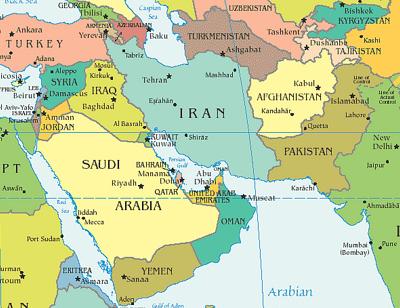
Map of the Middle East

From Fox News.

 Pakistan, North Korea and a former weapons scientist from the Soviet Union reportedly all helped Iran with its nuclear weapons quest, according to an impending U.N. nuclear watchdog report expected to show the Islamic regime has mastered the science of building a bomb.

The International Atomic Energy Agency’s report due out this week will lay out findings collected over years of intelligence gathering. It is expected to reinforce concerns that Iran didn’t actually abandon its weapons-related research in 2003, as indicated by a 2007 National Intelligence Estimate given to then-President George W. Bush.

U.S. intelligence agencies reported in 2007 that they believed Tehran halted its experiments in response to international and domestic pressures. But an ongoing investigation by the Fox News Specials Unit concludes that more than 600 entities were working inside Iran to support its program, and at least 40 sites where the work is taking place are suspected to exist across the country.

For British, French and American investigators, one of the most concerning sites is the Qom uranium enrichment construction site, hidden deep in the mountains. The latest intelligence shows that security walls have doubled around the site. Its scale cannot be explained by any known civilian nuclear energy use.

David Albright, a former IAEA official and president of the Washington-based Institute for Science and International Security who reviewed the intelligence files, told The Washington Post that Iran’s nuclear weapons program “never really stopped” and also concluded that Iran “has sufficient information to design and produce a workable implosion nuclear device.”

Western diplomats and nuclear experts briefed on the findings in the IAEA report also told the Post that foreign scientists offered assistance in overcoming key technical hurdles.

The documents reportedly show that a former Soviet weapons scientist named Vyacheslav Danilenko allegedly tutored Iranians for several years on building high-precision detonators needed to trigger a nuclear chain reaction. The Post reported that Pakistani and North Korean officials also gave to Iran mathematical formulas and codes as well as a so-called neutron initiator, which shoots a stream of atomic particles into the weapon’s fissile core at the start of the chain reaction.

There are two things to point out about this story. The first thing is that it was a strategic disaster for us to back out of Iraq, because that’s where we need to be to be able to gather intelligence, mount covert ops, run interdiction on attempts to transfer WMDs to Syria, etc. We really need to be in theater in order to deal with Iran, Syria and groups like Hezbollah, Iran’s Quds force and Muqtada Al Sadr’s Mahdi Army.

Unfortunately, I think that David Axelrod is running our national security now, which is why Obama pulled out forces out of Iraq.

Excerpt:

Three years, two abject failures. The first was the administration’s inability, at the height of American post-surge power, to broker a centrist nationalist coalition governed by the major blocs — one predominantly Shiite (Maliki’s), one predominantly Sunni (Ayad Allawi’s), one Kurdish — that among them won a large majority (69 percent) of seats in the 2010 election.

Vice President Biden was given the job. He failed utterly. The government ended up effectively being run by a narrow sectarian coalition where the balance of power is held by the relatively small (12 percent) Iranian-client Sadr faction.

The second failure was the SOFA [Status of Forces Agreement] itself. U.S. commanders recommended nearly 20,000 troops, considerably fewer than our 28,500 in Korea, 40,000 in Japan and 54,000 in Germany. The president rejected those proposals, choosing instead a level of 3,000 to 5,000 troops.

A deployment so risibly small would have to expend all its energies simply protecting itself — the fate of our tragic, missionless 1982 Lebanon deployment — with no real capability to train the Iraqis, build their U.S.-equipped air force, mediate ethnic disputes (as we have successfully done, for example, between local Arabs and Kurds), operate surveillance and special-ops bases, and establish the kind of close military-to-military relations that undergird our strongest alliances.

The Obama proposal was an unmistakable signal of unseriousness. It became clear that he simply wanted out, leaving any Iraqi foolish enough to maintain a pro-American orientation exposed to Iranian influence, now unopposed and potentially lethal. Message received. Just this past week, Massoud Barzani, leader of the Kurds — for two decades the staunchest of U.S. allies — visited Tehran to bend a knee to both President Mahmoud Ahmadinejad and Ayatollah Ali Khamenei.

The second thing to point out is the question of what we should be doing to restrain Iran’s nuclear ambitions. Click here for a run-down of some of our options. There are a lot of things we could do short of all-out war, but that would require that we had a statesman in the White House – someone who takes foreign policy seriously and treats it as more than a political issue.

A previous post I wrote showed how arms that China sells to Iran make their way to Hezbollah to be used against Israeli assets. That’s what we can expect will happen with nuclear weapons that Iran develops. Are we willing to accept that? There is also the matter of the Mexican drug cartels, the Quds force, Hugo Chavez in Venezuela and our porous border with Mexico. Are we willing to risk that?

We need to take the gloves off our national security agencies, especially the CIA, and do what has to be done.

Obamacare contains billions of dollars in pork for Obama’s union allies

From Investors Business Daily. (H/T Jan)

Excerpt:

According to a new Government Accountability Office report, the federal government has so far handed out $2.7 billion out of a $5 billion program squirreled away in ObamaCare.

The Early Retiree Reinsurance Program is advertized as a way to “stabilize the availability of employer-sponsored coverage for early retirees,” according to a Health and Human Services memo.

The argument goes that companies are increasingly dropping retiree health benefits, leaving those who retire before becoming eligible for Medicare in a jam — either they face exorbitant rates for insurance or expose themselves to potentially catastrophic health costs.

[…]According to figures obtained by IBD, 10 of the top 12 recipients are either unions or public employee groups. In fact, the biggest single recipient was the UAW Retiree Medical Benefits Trust, which alone grabbed more than 8% of all the funds handed out so far. Other union beneficiaries include the United Food and Commercial Workers, the United Mine Workers and the Teamsters.

Meanwhile, almost half of the money doled out has gone to state and local governments, the GAO found.

[…]The problem is that these groups are the least likely to drop their retiree health benefits, calling the lie to the Obama administration’s whole “stabilizing” excuse.

In fact, over the past 10 years, the share of state and local governments offering retiree benefits increased — climbing to 83% from 80% in 2001, according to an annual Kaiser Family Foundation health benefits survey.

That’s at a time when private companies have been dropping retiree health plans to cut costs, with the share of large firms offering such benefits falling to 26% this year from 37% in 2001, the Kaiser survey shows.

So this ObamaCare money is really being used mainly to pay off unions and governments that would have provided these benefits anyway.

While the law forbids employers from using the funds for anything other than retiree health costs, money is fungible, freeing up union and government resources for other uses like, say, helping Obama get re-elected.

And what will the unions do with that money? IBD explains.

Excerpt:

United Steelworkers President Leo Gerard, speaking on radio host Ed Schultz’s show last Monday, declared, “What we need is more militancy.” Asked to clarify, Gerard said: “I think we’ve got to start a resistance movement. If Wall Street Occupation doesn’t get the message, I think we’ve got to start blocking bridges and doing that kind of stuff.”

The Canadian union leader then denounced Americans’ 2008 election of Tea Party representatives to the House as “nut jobs,” and called for more force and illegality: “We ought to be doing more than occupying parks. We ought to start occupying bridges. We ought to start occupying the banks’ places themselves.”

[…]Two months ago another White House ally, Teamsters chief Jimmy Hoffa, openly called for his members to “take these sons of bitches out” in Congress, as Obama stood silently at his side. “They got a war with us and there’s only going to be one winner,” he growled.

Hoffa’s Teamsters, it should be noted, have the most violent record of all labor unions, clocking in 454 incidents of violence since 1991, according to the National Institute for Labor Relations Research in Washington.

Then there’s the SEIU-linked Acorn, which has made OWS its latest cause. The Obama-tied group had supposedly disbanded, but now operates as New York Communities for Change (NYCC), using the strong-arm political tactics of community organizer Saul Alinsky.

Since it was discovered that NYCC was a prime funder and director of the Occupy movement, Fox News reports that the group has been shredding documents, firing staff, offering up alibis and surveilling Fox News personnel.

One starts to wonder: Is Occupy Wall Street a grass-roots movement, or a corrupt, violent organization whose real center is the Obama administration itself? One thing’s for sure: It isn’t interested in democracy.

You can see the full list of Occupy Wall Street crimes here – it’s up to 167 crimes right now, including rape. The unions are heavily involved in the Occupy Wall Street protests.

I’m concerned that the government is getting too closely involved with groups of people who are not peaceful and law-abiding.

Some arguments for substance dualism, and one objection

Philosophy of mind is not something I’ve studied very much, but I do know about the different views like physicalism, epiphenomenalism, property dualism and substance dualism. I also know some of the basic arguments for and against each view.

In this post, I just wanted to show people a little bit about how you argue for substance dualism, using philosophical and scientific arguments. I find this topic to be really really dry, and I can barely stay awake when J.P. Moreland talks about it in lectures. But I hope a little bit of exposure won’t put you all to sleep.

Philosophical arguments

Let’s start with this old paper by John Depoe.

He writes about the persistent identity argument:

Another argument supporting substance dualism is that one maintains personal identity through change. Even though one is continuously going through physical changes and experiencing different mental states, a person continues to be the same person. If persons were identical with their physical parts or mental states, they would cease to be the same persons as these changes occurred. Therefore, it is necessary to postulate an immaterial, substantial self that endures through change.

Suppose that someone believes that people do not maintain identity through change and concludes that the previous argument for substance dualism fails. This denial of personal identity through change, I contend, presents untenable difficulties. First, there is one’s own awareness of being the same person through change. Moreover, if one is not literally the same person through these changes, how can a person maintain long-term goals and desires?

If you are your body, and your body is always changing, then you aren’t the same person now as 5 minutes ago.

There are more arguments for substance dualism here, from J.P. Moreland.

Experimental evidence

Doug Groothuis talks about some experimental evidence in this paper.

Excerpt:

Dr. Wilder Penfield was known for his ground-breaking work with epilepsy. His work involved stimulating brain tissue in conscious patients in order to find the causes of epilepsy. During these sessions Penfield found that the prodding of certain areas of the brain triggered vivid memories of past events. The patients reported remembering clearly such things as the taste of coffee. One patient, while on an operating table in Montreal, Canada, remembered laughing with cousins on a farm in South Africa. What amazed Penfield was that his patients, who were not under anesthetic, were simultaneously conscious of the re-experienced memories and of being prodded by an electrode in an operating room. Penfield called this a “double consciousness” wherein a memory was stimulated physically but was attended to and recognized as a memory by a conscious patient. Penfield likened this to the patient watching a television program while remaining aware that it wasn’t now happening.

Penfield repeated these results on hundreds of epileptic patients and concluded that a separable mind was able to track what the brain was doing as a result of the artificial stimulation. One’s mind in a sense could transcend the operations of the brain, monitoring memories without actually placing oneself in the situation remembered. Penfield noted that “The mind of the patient was as independent of the reflex action as was the mind of the surgeon who listened and strove to understand. Thus, my argument favours independence of mind-action.” Penfield also stated that if we liken the brain to a computer, it is not that we are a computer, but that we have a computer.

Penfield, who began his research as a materialist, switched to dualism after extensive research with epileptic patients. He said, “Something else finds its dwelling place between the sensory complex and the motor mechanism. . . . There is a switchboard operator as well as a switchboard.”

Although nonepileptic patients do not respond similarly to brain stimulation, other researchers, such as Sir John Eccles, a neurobiologist, have similarly concluded that the brain alone cannot account for a many phenomena. Eccles’ hypothesis is that the self-conscious mind is an independent entity that is actively engaged in reading from the multitude of active centres in the modules of the liaison areas of the dominant cerebral hemisphere. The self-conscious mind selects from these centres in accord with its attention and its interests and integrates its selection to give unity of conscious experience from moment to moment.

Thus, Eccles’ conclusions agree with Penfield’s, and his areas of research extend farther than that of epileptic patients. Eccles deems the “monist materialist” hope for an eventual physical explanation for mental events as wrongheaded in principle because mental events are not “simply derivative of aspects of nerve endings. There is no evidence for this whatever.” Further, Eccles argues that his “strong dualist-interactionist hypothesis . . . has the recommendation of its great explanatory power. It gives in principle at least explanations of the whole range of problems relating to brain-mind interaction.”Eccles notes that it has been impossible to develop a materialist explanation of “how a diversity of brain events come to be synthesized so that there is a unified conscious experience of a global or gestalt character.” Given this impasse, Eccles proposed that “the self-conscious mind” serve to integrate the apparently disparate brain processes into a unified consciousness.

I think that Alvin Plantinga, Keith Yandell, J.P. Moreland, William Lane Craig, Stephen Davis, John Depoe, Douglas Groothuis and Charles Taliaferro all defend substance dualism. I’m a substance dualist, myself.

What’s the objection to substance dualism?

The big objection to substance-dualism is the problem of how you get the non-physical substance to interact with the physical substance. It’s like how people put forward the grounding objection when talking about middle knowledge and where God’s knowledge of counterfactuals of creaturely freedom comes from. I wonder if anyone can post a comment for me to point me to a resource on answering the interaction problem in the comments.

UPDATE: One of my elite special forces ninja commenters writes:

Here’s Ed Feser on the Interaction Problem:

http://edwardfeser.blogspot.com/2008/10/interaction-problem.html

and

http://edwardfeser.blogspot.com/2009/04/interaction-problem-part-ii.html

The thrust of his argument is that, if the soul is the extension of the body’s “form” without matter, then it interacts with the more material parts of us in the same way that forms in general interact with matter- this approach involves rethinking our metaphysical understanding of matter, rather than coming up with a clever idea of the soul, and it does get rather involved in Thomistic metaphysics, but I think it’s pretty interesting.