When the Pevensie family are evacuated out to the country, they are unaware of the adventure they will encounter. During a game of hide and seek, the youngest daughter, Lucy (Henley) discovers a wardrobe which transports her to the land of Narnia. Covered in snow, Narnia is full of weird and wonderful creatures, but is watched over by the evil White Witch, Jadis (Swinton). When all four Pevensie children end up through the wardrobe, they discover that it was meant to be, as two daughters of Eve and two sons of Adam must join with the mighty lion, Aslan (Neeson) to defeat the evil White Witch.
One version of this movie has over 1 million views on Youtube, so I am assuming that the movie company is OK with it being posted now.
From the Financial Post, an editorial by Ross McKitrick of the University of Guelph. He is an expert reviewer for the UN’s Intergovernmental Panel on Climate Change. (H/T ECM)
Excerpt:
[I]n 2008 and 2010, a team of hydrologists at the National Technical University of Athens published a pair of studies comparing long-term (100-year) temperature and precipitation trends in a total of 55 locations around the world to model projections. The models performed quite poorly at the annual level, which was not surprising. What was more surprising was that they also did poorly even when averaged up to the 30-year scale, which is typically assumed to be the level they work best at. They also did no better over larger and larger regional scales. The authors concluded that there is no basis for the claim that climate models are well-suited for long-term predictions over large regions.
A 2011 study in the Journal of Forecasting took the same data set and compared model predictions against a “random walk” alternative, consisting simply of using the last period’s value in each location as the forecast for the next period’s value in that location. The test measures the sum of errors relative to the random walk. A perfect model gets a score of zero, meaning it made no errors. A model that does no better than a random walk gets a score of 1. A model receiving a score above 1 did worse than uninformed guesses. Simple statistical forecast models that have no climatology or physics in them typically got scores between 0.8 and 1, indicating slight improvements on the random walk, though in some cases their scores went as high as 1.8.
The climate models, by contrast, got scores ranging from 2.4 to 3.7, indicating a total failure to provide valid forecast information at the regional level, even on long time scales. The authors commented: “This implies that the current [climate] models are ill-suited to localized decadal predictions, even though they are used as inputs for policymaking.”
Indeed. Nor is the problem confined just to a few models. In a 2010 paper, a co-author and I looked at how well an average formed from all 23 climate models used for the 2007 IPCC report did at explaining the spatial pattern of temperature trends on land after 1979, compared with a rival model that all the experts keep telling me should have no explanatory power at all: the regional pattern of socioeconomic growth. Any effects from those factors, I have been told many times, are removed from the climate data before it is published. And yet I keep finding the socioeconomic patterns do a very good job of explaining the patterns of temperature trends over land. In our 2010 paper we showed that the climate models, averaged together, do very poorly, while the socioeconomic data does quite well.
The computer models have to be able to predict changes in specific regions, otherwise we have no reason to trust that they are accurate. We have to be able to evaluate whether the models work by testing them. When we can test them to predict climate change in specific regions, they fail.
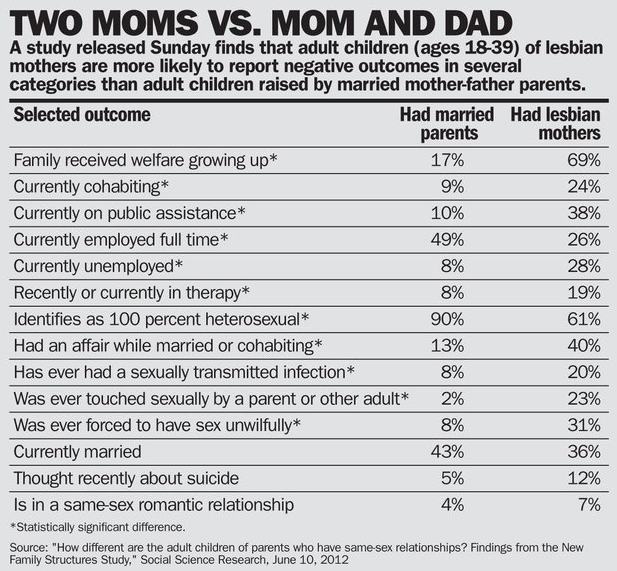
Here’s the abstract from a study published in the peer-reviewed journal “Social Science Research“.
Abstract:
In 2005, the American Psychological Association (APA) issued an official brief on lesbian and gay parenting. This brief included the assertion: “Not a single study has found children of lesbian or gay parents to be disadvantaged in any significant respect relative to children of heterosexual parents” (p. 15). The present article closely examines this assertion and the 59 published studies cited by the APA to support it. Seven central questions address: (1) homogeneous sampling, (2) absence of comparison groups, (3) comparison group characteristics, (4) contradictory data, (5) the limited scope of children’s outcomes studied, (6) paucity of long-term outcome data, and (7) lack of APA-urged statistical power. The conclusion is that strong assertions, including those made by the APA, were not empirically warranted. Recommendations for future research are offered.
And some the findings:
26 of 59 APA studies on same-sex parenting had no heterosexual comparison groups.
In comparison studies, single mothers were often used as the hetero comparison group.
No comparison study had the statistical power required to detect a small effect size.
Definitive claims were not substantiated by the 59 published studies.
In fact, the assertions of the APA are contradicted by a recently released large-scale study of gay and lesbian parenting.
A former president of the American Psychological Association (APA), who also introduced the motion to declassify homosexuality as a mental illness in 1975, says that the APA has been taken over by “ultraliberals” beholden to the “gay rights movement,” who refuse to allow an open debate on reparative therapy for homosexuality.
Dr. Nicholas Cummings was President of the APA from 1979 to 1980, and also served as a member of the organization’s Council of Representatives. He served for years as Chief of Mental Health with the Kaiser-Permanente Health Maintenance Organization, and is the author of the book “Destructive Trends in Mental Health: The Well-Intentioned Path to Harm.”
In an interview with representatives of the National Association for Research and Therapy of Homosexuality (NARTH) in late April, Cummings said that the organization’s problems began with the rejection of the Leona Tyler Principle, which required that all public positions of the APA be supported by scientific evidence.
The APA “started changing pretty drastically by the late 1980s,” said Cummings. “By the mid 1990s, the Leona Tyler principle was absolutely forgotten, that political stances seemed to override any scientific results. Cherry-picking results became the mode. The gay rights movement sort of captured the APA.”
Cummings says that the movement for “diversity” in the APA, which he endorsed, had resulted in a lack of diversity regarding heterosexuals.
“If I had to choose now, I would see a need to form an organization that would recruit straight white males, which are underrepresented today in the APA,” he said.
Cummings says that he personally is not in opposition to the homosexual movement, including gay “marriage,” pointing out that he was the author of the motion to strike homosexuality from the APA’s list of mental illnesses. However, he is distressed at the loss of scientific objectivity at the organization.
More evidence against same-sex marriage is available in this research paper from the Family Research Council think tank, compiled from mainstream statistics like the Census Bureau and the Department of Justice.

 WINTERY KNIGHT