
Tag Archives: Welfare

A Dad: the tenth most popular gift requested by children at Christmas

Dina sent me this sad article from the UK Telegraph.

Excerpt:

A study of 2,000 British parents found most children will put a new baby brother or sister at the top of their Christmas list, closely followed by a request for a real-life reindeer.

A “pet horse” was the third most popular choice, with a “car” making a bizarre entry at number four.

Despite their material requests, the tenth most popular Christmas wish on the list was a “Dad”.

[…]A request for a “mum” reached number 23 on the list.

It’s sad. I think that there is a perception among many young women today that it is OK to have recreational premarital sex that may lead to having a child out of wedlock. Many unmarried women have an intuition (not supported by data) that a child will turn out fine without a father in the home. Some think (against the data) that fathers can be substituted with a government welfare check and that children won’t notice the difference. But the research shows that this is a false belief.

Excerpt:

Census data and the Fragile Families survey show that marriage can be extremely effective in reducing child poverty. But the positive effects of married fathers are not limited to income alone. Children raised by married parents have substantially better life outcomes compared to similar children raised in single-parent homes.

When compared to children in intact married homes, children raised by single parents are more likely to have emotional and behavioral problems; be physically abused; smoke, drink, and use drugs; be aggressive; engage in violent, delinquent, and criminal behavior; have poor school performance; be expelled from school; and drop out of high school.[19] Many of these negative outcomes are associated with the higher poverty rates of single mothers. In many cases, however, the improvements in child well-being that are associated with marriage persist even after adjusting for differences in family income. This indicates that the father brings more to his home than just a paycheck.

The effect of married fathers on child outcomes can be quite pronounced. For example, examination of families with the same race and same parental education shows that, when compared to intact married families, children from single-parent homes are:

  • More than twice as likely to be arrested for a juvenile crime;[20]
  • Twice as likely to be treated for emotional and behavioral problems;[21]
  • Roughly twice as likely to be suspended or expelled from school;[22] and
  • A third more likely to drop out before completing high school.[23]

The effects of being raised in a single-parent home continue into adulthood. Comparing families of the same race and similar incomes, children from broken and single-parent homes are three times more likely to end up in jail by the time they reach age 30 than are children raised in intact married families.[24] Compared to girls raised in similar married families, girls from single-parent homes are more than twice as likely to have a child without being married, thereby repeating the negative cycle for another generation.[25]

Finally, the decline of marriage generates poverty in future generations. Children living in single-parent homes are 50 percent more likely to experience poverty as adults when compared to children from intact married homes. This intergenerational poverty effect persists even after adjusting for the original differences in family income and poverty during childhood.[26]

And here’s a bit more data showing that having government replace fathers via higher taxes and more redistribution of wealth doesn’t take away the bad effects of fatherlessness:

Children from low-income, two-parent families outperform students from high-income, single-parent homes. Almost twice as many high achievers come from two-parent homes as one-parent homes. Source: “One-Parent Families and Their Children;” Charles F. Kettering Foundation (1990).

Children reared by a divorced or never-married mother are less cooperative and score lower on tests of intelligence than children reared in intact families. Statistical analysis of the behavior and intelligence of these children revealed “significant detrimental effects” of living in a female-headed household. Growing up in a female-headed household remained a statistical predictor of behavior problems even after adjusting for differences in family income. Source: Greg L. Duncan, Jeanne Brooks-Gunn and Pamela Kato Klebanov, “Economic Deprivation and Early Childhood Development,” Child Development 65 (1994).

After taking into account race, socioeconomic status, sex, age, and ability, high school students from single-parent households were 1.7 times more likely to drop out than were their corresponding counterparts living with both biological parents. Source: McNeal, Ralph B. Jr.”Extracurricular Activities and High School Dropouts.” Sociology of Education 68(1995): 62-81.

I think that these are significant in light of the recent shooting in Connecticut:

In studies involving over 25,000 children using nationally representative data sets, children who lived with only one parent had lower grade point averages, lower college aspirations, poor attendance records, and higher drop out rates than students who lived with both parents. Source: McLanahan, Sara and Gary Sandefur. Growing up with a Single Parent: What Hurts, What Helps. Cambridge: Harvard University Press, 1994.

A 1988 Department of Health and Human Services study found that at every income level except the very highest (over $50,000 a year), children living with never-married mothers were more likely than their counterparts in two-parent families to have been expelled or suspended from school, to display emotional problems, and to engage in antisocial behavior. Source: James Q. Wilson, “In Loco Parentis: Helping Children When Families Fail Them,” The Brookings Review, Fall 1993.

72% of adolescent murderers grew up without fathers. 60% of America’s rapists grew up the same way. Source: D. Cornell (et al.), Behavioral Sciences and the Law, 5. 1987. And N. Davidson, “Life Without Father,” Policy Review. 1990.

The likelihood that a young male will engage in criminal activity doubles if he is raised without a father and triples if he lives in a neighborhood with a high concentration of single-parent families. Source: A. Anne Hill, June O’Neill, “Underclass Behaviors in the United States,” CUNY, Baruch College. 1993.

The shooter in Connecticut hadn’t spoken to his father in two years:

Peter Lanza, the father of Sandy Hook shooter, hadn’t spoken to his son for more than two years and his father is at a loss for what drove Adam to kill 20 students and six teachers at his old elementary school.

[…]Adam, 20, had not spoken to his brother Ryan or father for upwards of two years at the time of the shooting. Adam reportedly distanced himself from his father Peter when he started to become serious with his new girlfriend, and current wife.

Peter and Adam’s mother Nancy split in 2001 but did not formally divorce until November 2008. Court records made the split appear amicable as both parties agreed to put their sons needs above any bitterness, but Adam was apparently the one to cut ties with his father in 2010.

Women need to think ahead and realize that the little children will be impacted by her choice of man, as well of her choice of whether to have recreational premarital sex with a man. If she doesn’t test him adequately and makes poor choices, then the children will be deprived of a father in the home. I don’t think that the sentiment “he makes me happy and horny and my friends approve of him” necessarily translates into “he can do the job of protecting, providing and leading on moral and spiritual issues”. Those are two different sets of criteria, and often at cross-purposes in a culture that despises traditional male roles as “sexist”.
Sandy Hook CT school shooting shows need for tougher fatherlessness laws

If we were really serious about stopping gun crime, then we should go after the root cause of gun crime. So what is that root cause? The answer might surprise you.

Here is Dr. Robert Rector of the Heritage Foundation to explain:

Census data and the Fragile Families survey show that marriage can be extremely effective in reducing child poverty. But the positive effects of married fathers are not limited to income alone. Children raised by married parents have substantially better life outcomes compared to similar children raised in single-parent homes.

When compared to children in intact married homes, children raised by single parents are more likely to have emotional and behavioral problems; be physically abused; smoke, drink, and use drugs; be aggressive; engage in violent, delinquent, and criminal behavior; have poor school performance; be expelled from school; and drop out of high school.[19] Many of these negative outcomes are associated with the higher poverty rates of single mothers. In many cases, however, the improvements in child well-being that are associated with marriage persist even after adjusting for differences in family income. This indicates that the father brings more to his home than just a paycheck.

The effect of married fathers on child outcomes can be quite pronounced. For example, examination of families with the same race and same parental education shows that, when compared to intact married families, children from single-parent homes are:

  • More than twice as likely to be arrested for a juvenile crime;[20]
  • Twice as likely to be treated for emotional and behavioral problems;[21]
  • Roughly twice as likely to be suspended or expelled from school;[22] and
  • A third more likely to drop out before completing high school.[23]

The effects of being raised in a single-parent home continue into adulthood. Comparing families of the same race and similar incomes, children from broken and single-parent homes are three times more likely to end up in jail by the time they reach age 30 than are children raised in intact married families. [24] Compared to girls raised in similar married families, girls from single-parent homes are more than twice as likely to have a child without being married, thereby repeating the negative cycle for another generation.[25]

Finally, the decline of marriage generates poverty in future generations. Children living in single-parent homes are 50 percent more likely to experience poverty as adults when compared to children from intact married homes. This intergenerational poverty effect persists even after adjusting for the original differences in family income and poverty during childhood.[26]

People on the left claim that poverty causes crime, but they don’t look for the root cause of poverty. The root cause of poverty is the decline of marriage. But people on the left favor that, so they can’t admit the truth.

Dr. Michael Tanner of the libertarian Cato Institute explains one of the causes of fatherlessness in his testimony to Congress:

Welfare contributes to crime in several ways. First, children from single-parent families are more likely to become involved in criminal activity. According to one study, children raised in single-parent families are one-third more likely to exhibit anti-social behavior.(3) Moreover, O’Neill found that, holding other variables constant, black children from single- parent households are twice as likely to commit crimes as black children from a family where the father is present. Nearly 70 percent of juveniles in state reform institutions come from fatherless homes, as do 43 percent of prison inmates.(4) Research indicates a direct correlation between crime rates and the number of single-parent families in a neighborhood.(5)

As Barbara Dafoe Whitehead noted in her seminal article for The Atlantic Monthly:

The relationship [between single-parent families and crime] is so strong that controlling for family configuration erases the relationship between race and crime and between low income and crime. This conclusion shows up time and again in the literature. The nation’s mayors, as well as police officers, social workers, probation officers, and court officials, consistently point to family break up as the most important source of rising rates of crime.(6)

At the same time, the evidence of a link between the availability of welfare and out-of-wedlock births is overwhelming. There have been 13 major studies of the relationship between the availability of welfare benefits and out-of-wedlock birth. Of these, 11 found a statistically significant correlation. Among the best of these studies is the work done by June O’Neill for the U.S. Department of Health and Human Services. Holding constant a wide range of variables, including income, education, and urban vs. suburban setting, the study found that a 50 percent increase in the value of AFDC and foodstamp payments led to a 43 percent increase in the number of out-of-wedlock births.(7) Likewise, research by Shelley Lundberg and Robert Plotnick of the University of Washington showed that an increase in welfare benefits of $200 per month per family increased the rate of out-of-wedlock births among teenagers by 150 percent.(8)

The same results can be seen from welfare systems in other countries. For example, a recent study of the impact of Canada’s social-welfare system on family structure concluded that “providing additional benefits to single parents encourages births of children to unwed women.”(9)

The poverty that everyone complains about is not the root cause of crime. The poverty is caused by fatherlessness. The fatherlessness is caused by welfare. Fatherlessness is also caused by laws and policies that make it easier for people to divorce, e.g. – no-fault divorce laws. Again, it’s people on the left who push for no-fault divorce laws. So the left is pushing two policies, welfare and no-fault divorce, which cause crime.

What happened in Sandy Hook

The Connecticut shooter came from a broken home (H/T Tom) and had not spoken to his father in two years (H/T Dina). If we are serious about stopping school shootings, then we need to go after the source.

How do we stop this? We go after the laws and policies that promote fatherlessness. No-fault divorce laws make it easy to get out of a marriage, which means that people rely on “chemistry” and peer-approval to decide who to marry instead of choosing the right person for the actual duties of the job. The divorce court system rewards the person who files for divorce first, which is the women in about 70% of the cases. The incentives all favor fatherlessness.

If we were serious about fixing fatherlessness, we should reform divorce laws to make people take marriage more seriously. Instead of giving alternatives to marriage  the same benefits as marriage, we should give benefits to people who are able to get married, stay married and produce productive, law-abiding children.

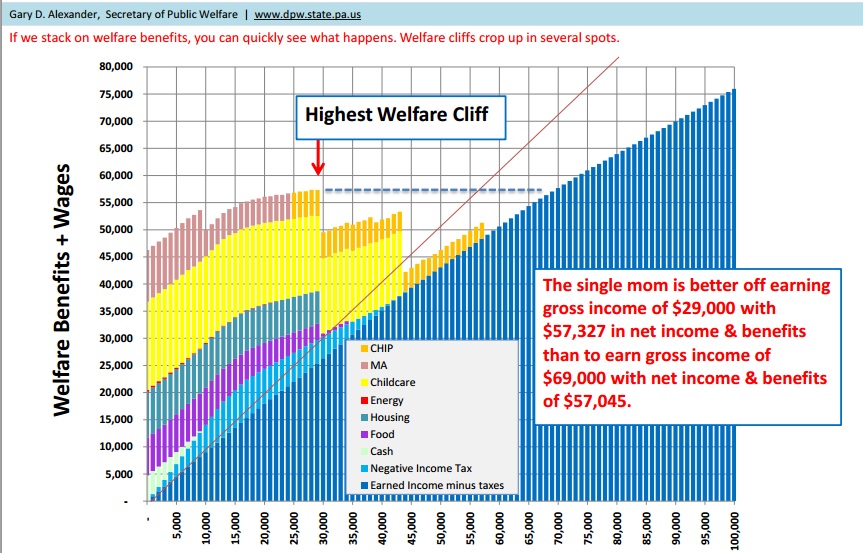
Single mothers are better off with a $29,000 job and welfare than with a $69,000 job

Socialism subsidizes single motherhood by choice

(click for larger image)

James Pethokoukis of the American Enterprise Institute explains how the welfare state discourages women from getting married before they have children.

Excerpt:

The U.S. welfare system sure creates some crazy disincentives to working your way up the ladder. Benefits stacked upon benefits can mean it is financially better, at least in the short term, to stay at a lower-paying jobs rather than taking a higher paying job and losing those benefits. This is called the “welfare cliff.”

Let’s take the example of a single mom with two kids, 1 and 4. She has a $29,000 a year job, putting the kids in daycare during the day while she works.

As the above chart  – via Gary Alexander, Pennsylvania’s secretary of Public Welfare — shows, the single mom is better off earning gross income of $29,000 with $57,327 in net income and benefits than to earn gross income of $69,000 with net income & benefits of $57,045.

It would sure be tempting for that mom to keep the status quo rather than take the new job, even though the new position might lead to further career advancement and a higher standard of living. I guess this is something the Obama White House forgot to mention in its “Life of Julia” cartoons extolling government assistance.

Fatherlessness is absolutely horrible for children across the board. Not just in terms of their development, but also their material well-being and their physical safety. Fatherlessness is a loss in three ways for children. The federal government should NOT be taking money from good married households and transferring it to women who decline to marry before choosing to have reckless, irresponsible recreational sex.