Tag Archives: University

What’s behind the epidemic of false rape accusations on campus?

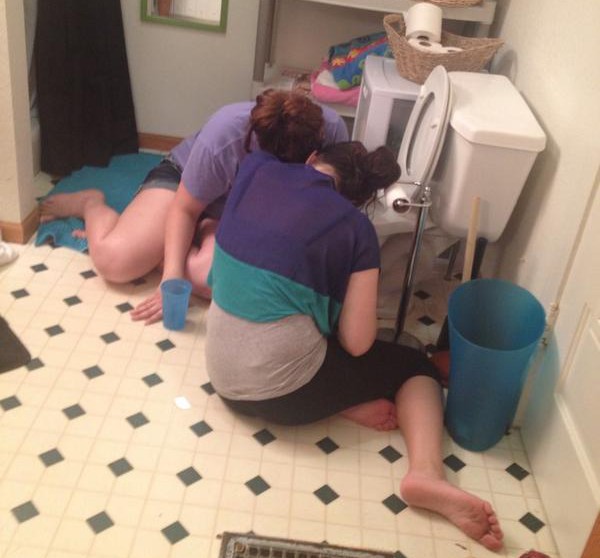
College students puking in toilet

Heather McDonald is concerned about the feminist left’s effort to undermine the presumption of innocence for men accused of rape. She makes an argument in the prestigious City Journal that there is actually a reason why we should not believe women’s rape claims, especially in an age of feminism, until we have the evidence that proves that the man being accused is guilty.

First, she gives an example of the fake rape charge made by the Columbia University student Emma Sulkowicz. I’ll omit the history of consent before, during, and after the sex and go straight to the reason for the false accusation:

It wasn’t until eight months after their August 2012 coupling that Sulkowicz filed a campus-rape charge, alleging that Nungesser had anally raped her while she struggled and told him to stop. She claims that she waited so long to file so as to avoid re-traumatizing herself. Nungesser argues that she was simply chagrined that they had not become an exclusive couple.

Reason magazine actually reported that she texted Nungesser to come over and “f*** me in the butt”. We have that text, and we know that this happened. So what happened? She had painful sex with a guy, and the relationship ended, and she wanted to shame him for breaking up with her after she gave him recreational sex. She felt she was entitled to a relationship after doing so much.

Here’s another one where the consent was documented before during and after the act, and the woman made a false accusation after because she was disappointed that the sex did not result in a relationship:

In September 2013, two freshmen at Occidental College in Southern California had sex after both had been on a 24-hour drinking binge.

Jane reported their coupling to campus authorities only after seeing that John was unaffected emotionally by it, whereas she, having lost her virginity, felt distracted and unable to concentrate.

He was found guilty of rape and expelled.

In another case:

In another case, a female student was caught by her boyfriend while cheating on him with another male student. She then filed a complaint of assault against that second male. The morning after their sexual encounter, they had exchanged texts. He wrote: “How do I compare with your boyfriend?” She responded to the boy she later accused of rape: “You were great.”

Saying no to the hot guy would have deprived her of a pleasurable experience. The rape charge got her out of being sanctioned by her boyfriend and judged by her peers. She probably couldn’t even understand why her boyfriend was angry, or why her friends thought less of her. After all, it’s her right to pursue happiness, and nobody should judge her.

So, what’s really happening? What’s really happening is that women are consenting to sex, sometimes after having chosen to get drunk, then when they sober up and realize how it makes them look to others – their boyfriends, their peers, their family, their pastors – they use rape charges as an excuse to rehabilitate their reputation. Regret over consensual sex is driving the rape accusations.

MacDonald explains:

Our booze-fueled hook-up culture has made relations between men and women messier than ever, leaving many girls and women with pangs of regret—but those regrets do not equal rape. If we were actually in the midst of an “epidemic of sexual assault,” as New Jersey senator Cory Booker asserted the evening of the Ford-Kavanaugh hearings, we would presumably have seen women and girls take protective actions, such as avoiding frat parties and flocking to single-sex schools. None of those protective actions has occurred, however. Either women are too clueless to avoid patent danger, or the epidemic of sexual assault is a fiction. All evidence points to the latter conclusion.

I have some thoughts about this, too.

In my experience dealing with women on college campuses, they tend to want a relationship, but the only men they are attracted to are hot bad boys who refuse to commit to them with marriage before having sex. So, the women give the hot non-committing bad boys the sex, thinking that the sex will be so good that it will lead to a relationship. The alcohol is used to provide an excuse later on, if the sex doesn’t result in a relationship. And if it doesn’t result in a relationship, they accuse the hot bad boy of rape in order to restore their reputation with their friends, (“I’m not a slut”), and punish the hot bad boy for not committing to them.

The more distrust there is between men and women, the fewer men and women will get married. What should we do? We should encourage women to stop drinking so much, to stop choosing men for fun and thrills, to stop having recreational sex, and to stop blaming their own poor choices on men.

UPDATE: Glenn found a great article at The Federalist which talks about women making poor choices, then blaming the bad men they freely chose:

But in the Me Too era and under the burgeoning expectation of enthusiastic consent, the first questions asked are something like, “What kind of horrible man would do this?” and, “How can we make him pay for this crime yucky way he behaved toward women?” Any attempt to ask why a woman would invite a man into her bedroom late into the evening if she didn’t want to have sex with him, accept the offer of a third date after she really didn’t enjoy the first two, or continue a years-long sexual relationship even though sometimes the sex made her feel bad, are considered victim blaming. It is as though we are to believe that the woman involved has no agency, no free will, and no control over her own choices.

A lot of harmful and costly social outcomes happen when women choose bad men, and do bad things with those men. Abortion, divorce, single mother welfare, fatherlessness, and deterring good men from having relationships (because women are seen as crazy and irresponsible). We’d better start holding women accountable to make better decisions about men, and prioritize marriage over fun and thrills.


Jennifer Roback Morse lectures on sex and sexuality at Harvard University

Dr. Jennifer Roback Morse

Dr. Morse delivers a talk based on her book “Smart Sex” at Harvard University.

The MP3 file is here. (21 Mb) (Link in case that doesn’t work)

Topics:

  • the hook-up culture and its effects on men and women
  • cohabitation and its effect on marriage stability
  • balancing marriage, family and career
  • single motherhood by choice and IVF
  • donor-conceived children
  • modern sex: a sterile, recreation activity
  • the real purposes of sex: procreation and spousal unity
  • the hormone oxytocin: when it is secreted and what it does
  • the hormone vassopressin: when it is secreted and what it does
  • the sexual revolution and the commoditization of sex
  • the consumer view of sex vs the organic view of sex
  • fatherlessness and multi-partner fertility
  • how the “sex-without-relationship” view harms children

52 minutes of lecture, 33 minutes of Q&A from the Harvard students. The Q&A is worth listening to – the first question is from a gay student, and Dr. Morse pulls a William Lane Craig to defeat her objection. It was awesome! I never get tired of listening to her talk, and especially on the topics of marriage and family.

The Mysterious Drew lectures on Christianity and the culture war in Defenders

Investigation in progress

Drew taught Dr. William Lane Craig’s Defenders class for two weeks in a row while Dr. Craig was in Australia. He chose to focus on secularism.

Note: Drew has some problems with the microphone for the first 2.5 minutes of part 1. Be patient.

Part 1 deals with how Europe and America became secular in different ways.

Part 1 topics:

  • Secularism: the attempt to take values based on religion (e.g. – Judeo-Christian values) out of the public square
  • Television programs that are targeted to more thoughtful viewers favor secular or liberal worldviews
  • Consider the sexual revolution – a new set of beliefs about sex are being pushed into the culture
  • Sex revolution includes: same-sex marriage, pornography, hookup culture, no-fault divorce
  • The effect of the sexual revolution has been to introduce widespread fatherlessness, which is very bad for children
  • The sexual revolution is being pushed in the popular culture, but also in the school sexual education programs
  • You can see where secularism has led to by looking at Europe, which has largely rejected its Christian roots
  • For example, Germany and Sweden are very aggressive about stamping out homeschooling
  • They do this because they are trying to push a government-approved set of beliefs and meanings onto children
  • How bad could it get? You can look at how Orthodox Judaism was persecuted in Russia after the communist revolution
  • How did Europe become so secular?
  • Wars in Europe between Protestants and Catholics caused people to think that theistic religion was bad
  • Secularists first attacked theism philosophically by trying to replace it with deism – the view that miracles do not occur
  • Secularists then pushed a radical empirism which attempted to reduce religious claims to meaningless irrationality
  • The Christian church responded by retreating from philosophical and theological claims and focusing on moral claims
  • That’s how Europe became secular, but how did America become secular?
  • America became secular because Christianity was transformed from a knowledge tradition to an emotional tradition
  • Pastors started to move away from presenting Christianity as true and instead presented it as emotionally fulfilling
  • Pastors emphasized personal experiences instead of philosophical theology and apologetics
  • European ideas arrived: deism, Darwinism, Bible criticism, etc.
  • Christianity responded to this by abandoning the centers of learning it had founded (universities) into pious isolation
  • As the universities became more secular, they turned out the next generation of influencers, including the media
  • This retreat from intellectual engagement was augmented by a fixation on end-times speculation (e.g. Left Behind)
  • (Drew talks to Jeremy, a philosophy student at Georgia State University, about whether Christianity is respected in his classes)
  • How politicians and the media used the Scopes Monkey Trial to marginalize Christianity as anti-science
  • The perception of Christians in the public square changed – they were viewed as ignorant, irrational and anti-science
  • Instead of causing Christians to work harder at science, they became even more fundamentalist, and less influential
  • Christians today are a tiny minority of influential groups, e.g. – scientists, media, etc.
  • In contrast, secular Jews, who tend to grow up in a culture that values learning, have a much greater influence
  • Even if Christians try to retreat to the country where they can homeschool, there is no hiding from the Internet
  • Which organizations are working against secularism today?
  • Example of what Christians can do: Plantinga’s refutation of the problem of evil
  • Example of what Christians can do: widespread use of ultrasound to move people to the pro-life view
  • Example of what Christians can do: Liberty University’s effort to produce Christians who can work in media
  • A story about William Lane Craig and a secular physicist who had lost her faith

People must have liked what they heard and saw in the first week, because he got a big turnout in the second week.

Part 2 deals with practical tips for engaging in the culture.

Topics in Part 2:

  • The real root cause of opposition to Christianity is from the sexual revolution
  • For example, moral relativism is so popular in the university, but it is almost entirely driven by sexual liberation
  • Evangelism and culture-shaping are not the same thing – each requires a different set of skills
  • Where do people get their information? Public school, news media, late night comedy shows, etc.
  • Two things for every Christian need to do: 1) Get informed, and 2) Get involved
  • First: you do not need to be smarter than average. Dr. Craig is a leading scholar because he studies 9 hours a day
  • Implying that people with influence are “smart” just provides us with an excuse not to try if we are not “smart”
  • Ordinary Christians need to be willing to give up fun more than they need to be naturally “smart”
  • Asks Cody: what about that Christian apologist who hung out mostly with internet atheists and then became one
  • Famous quantum chemist: you’re right, I am not much smarter than most people, I just work a lot harder at it
  • Drew: to get informed, you should follow good Christian blogs like Apologetics 315 and Wintery Knight
  • Drew knows Wintery Knight personally and WK is someone who knows apologetics but he also knows other things
  • WK connects the Christian worldview to lots different things, e.g. = marriage – he can find you the right people and books
  • (Drew holds up “What is Marriage?” book) This is the best book to argue the same-sex marriage issue
  • (Drew hold up “The Case for Life” book) This is the best book to argue the pro-life position
  • Slacktivism: don’t just send people links that you find on the Internet – read the articles and books and then talk about them
  • (Drew holds up the Lee Strobel “Case for” books) These are the best introductory books on basic Christian apologetics
  • Audio books are a great way for people to take in the information, and you can get them for free from the library
  • The Internet is not the best place for arguing about the things you learn – face to face conversations are much better
  • Biola’s apologetics certificate program is an excellent resource, and it’s all audio lectures so you just listen to them
  • You can get free apologetics audio from Apologetics 315 and Phil Fernandes
  • We also need to learn how to how to change the culture and how the other side changes the culture
  • To really make a difference, then a graduate degree might be for you – especially the M.A. in apologetics from Biola
  • The university is also very important – Christianity needs to be represented in the university
  • Influential people like Supreme Court justices come out of the university, which is why we need to be there
  • The Discovery Institute is doing the most to provide a credible rival to naturalistic science
  • They have a budget of $4 million dollars and they are punching way above their weight
  • If every evangelical sent them $20, they’d have a budget of $1.2 billion – what could they do with that?
  • (Drew puts a check for $20 for Discovery Institute in an envelope and seals it, to show how it’s done)
  • The Truth Project, which is put out by Focus on the Family – it’s another excellent training resource
  • When it comes to politics, focus on discussing policy issues, not on pushing particular candidates
  • If every evangelical Christian just pulled their own weight, it would make a big difference
  • It all starts by making the decision to take some leisure time to do things that really work

I could not agree with him more on his selections on the marriage debate and the abortion debate. I have bought at least a half-dozen of each of those for people. And I highly recommend getting the Strobel books on audio, especially the Case for a Creator. Love that book. Listen to it a bunch a times and you will start to talk like Lee Strobel.

I listened to all the Biola University lectures before they even had the certificate program, along with the Stand to Reason Masters Series in Christian Thought and about 60 Veritas Forum leture sets. Those things probably did the most for me to become a capable defender of Christianity.

The point he made about giving money to the Discovery Institute is important. In the last month, I sent out $300 to a Ratio Christi chapter for a lecture they gave, and $500 for a Christian group in Canada that put on an apologetics conference.

I think he’s right when he talks about everyone pulling their own weight. I spend about 2-3 hours a day reading and blogging. I donate a portion of my earnings to Christian scholars who study and/or speak at the university. I support Christian students who are doing degrees in philosophy, science and engineering. In church, I don’t anything yet, but I have a network of friends who do things in church, like organize lectures, debates and apologetics book studies. My current pastor is aware of my abilities, and he’s already asked me to help them with an evangelism program they are starting up.

I got started on apologetics by putting in the time on some of the things he mentioned in part 2 of his talk. The basic things to do are reading introductory books on apologetics, especially the ones on philosophy of religion, historical Jesus and physical sciences. If you can’t read, then at least get hold of lectures from Biola University and listen to those, along with Lee Strobel audio books, Brian Auten interviews, William Lane Craig debates. Just put them in the car and listen, and soon you’ll be sounding just like them.