
Tag Archives: Study

Do children raised by gays and lesbians do as well as those of married parents?

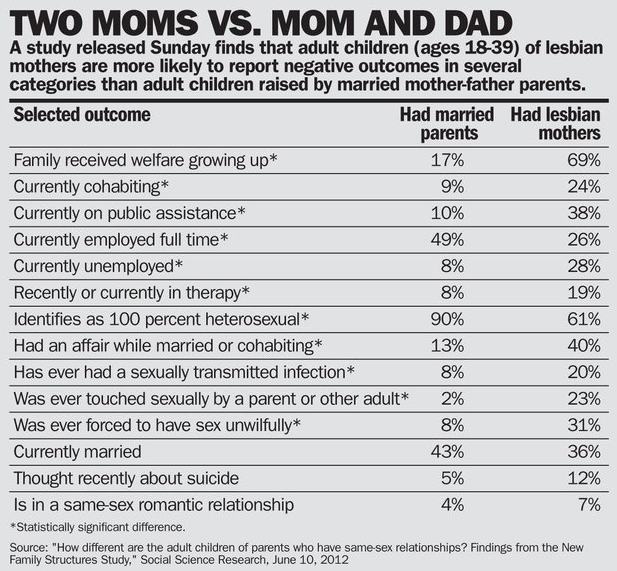
Straight vs. lesbian parenting (click for larger image)

ECM pointed out to me that some more information about the two studies that were just published in the mainstream science journal Social Science Research appeared in National Review.

Excerpt:

The mainstream academic journal Social Science Research has just published two articles that expose and challenge the schlock social science on gay parenting that has been uncritically embraced and propagated by so many people eager to advance the cause of gay marriage.

In “Same-sex parenting and children’s outcomes: A closer examination of the American Psychological Association’s brief on lesbian and gay parenting,” LSU professor Loren Marks addresses a puzzle: On the one hand, studies based on “large, representative samples” have shown that “[c]hildren who grow up in a household with only one biological parent are worse off, on average, than children who grow up in a household with both of their biological parents.” On the other hand, “social science research with small convenience samples has repeatedly reported no significant differences between children from gay/lesbian households and heterosexual households.” (Pp. 735-736 (emphasis added).)

Marks’s essential answer to the puzzle is that the studies “with small convenience samples” are unreliable. Among other things:

1. “[S]ocial researchers examining same-sex parenting have repeatedly selected small, non-representative, homogeneous samples of privileged lesbian mothers to represent all same-sex parents.” (P. 739 (emphasis added).)

2. “[I]n selecting heterosexual comparison groups for their studies, many same-sex parenting researchers have not used marriage-based intact families as heterosexual representatives, but have instead used single mothers.” (P. 741 (emphasis added).) Despite the broad claims made on behalf of the research, “with rare exceptions, the research does not include studies comparing children raised by two-parent, same-sex couples with children raised by marriage-based, heterosexual couples. (P. 742.)

3. The American Psychological Association’s claim that “not a single study has found children of lesbian or gay parents to be disadvantaged” fails to take account of the largest study that actually examined “children’s developmental outcomes.” (Pp. 742-743.)

4. The same-sex parenting studies have failed to address a range of outcomes for children that are usually the focus of national studies on children, including drug and alcohol abuse, truancy, sexual activity, and criminality. (Pp. 743-744.)

These new studies contradict the politically correct pronouncements of the APA. But evidence came out last week that they are “controlled” the gay rights movement, according to a former President of the APA, who is himself pro-same-sex-marriage.

We should not be redefining marriage if it is going to hurt vulnerable children. I made the case before from the research that same-sex unions are not the same as heterosexual married couples. And now we have direct evidence that the differences matter to children.

New study finds that children do best in traditional mother-father families

Straight vs. lesbian parenting (click for larger image)

From the Washington Times. (H/T Jonathan)

Excerpt: (links removed)

Two studies released Sunday may act like brakes on popular social-science assertions that gay parents are the same as — or maybe better than — married, mother-father parents.

“The empirical claim that no notable differences exist must go,” Mark Regnerus, a sociology professor at the University of Texas at Austin, said in his study in Social Science Research.

Using a new, “gold standard” data set of nearly 3,000 randomly selected American young adults, Mr. Regnerus looked at their lives on 40 measures of social, emotional and relationship outcomes.

He found that, when compared with adults raised in married, mother-father families, adults raised by lesbian mothers had negative outcomes in 24 of 40 categories, while adults raised by gay fathers had negative outcomes in 19 categories.

Findings such as these do not support claims that there are “no differences” between gay parenting and heterosexual, married parents, said Mr. Regnerus, who helped develop the New Family Structures Study at the university.

Instead, “children appear most apt to succeed well as adults when they spend their entire childhood with their married mother and father, and especially when the parents remain married to the present day,” he wrote.

Mr. Regnerus‘ study of 2,988 persons ages 18 to 39 — including 175 adults raised by lesbian mothers and 73 adults raised by gay fathers — marks the first research from the new dataset, which initially included some 15,000 persons.

The second study, also in Social Science Research, takes a critical look at the basis of an oft-cited American Psychological Association (APA) report on gay parenting.

The APA brief says, “Not a single study has found children of lesbian or gay parents to be disadvantaged in any significant respect relative to children of heterosexual parents,” said Loren Marks, associate professor at the School of Human Ecology at Louisiana State University.

However, after looking at the 59 studies that undergird this assertion, “the jury is still out,” Mr. Marks said. “The lack of high-quality data leaves the most significant questions [about gay parenting] unaddressed and unanswered.”

Problems with the APA-cited studies were their tiny size; dependence on wealthy, white, well-educated lesbian mothers; and a failure to examine common outcomes for children, such as their education, employment and risks for poverty, criminality, early childbearing, substance abuse and suicide. Instead, the APA studies often looked at children’s gender-role behaviors, emotional functioning and sexual identity.

This story was also reported on Science Daily, with the predictable liberal spin.

Here is my previous post on the data that shows why same-sex unions are not good for raising children.

Marcia Segelstein’s article on chastity in the newest issue of Salvo magazine

Here’s the article that is available online on the Salvo Magazine web site.

Here’s a bit about the author, Marcia Segelstein:

Marcia Segelstein, a senior editor of Salvo, is a part-time writer and a full-time mother. A former senior producer for CBS News, she has also written for First Things, Touchstone, and OneNewsNow.

And here’s a snippet from the article:

Dr. Jenell Williams Paris is the author of The End of Sexual Identity: Why Sex Is Too Important to Define Who We Are. She told Relevant that Christians need more than rules to live chastely. What’s often missing, Paris believes, is a compelling story and an understanding of the “whys” behind the rules. To explain what she means, she uses the example of parents teaching their little girl to look both ways before crossing a street:

A young child may follow this rule solely because of the power of her parents’ authority, which is appropriate. As she grows, the child [continues to look both ways,] but for a deeper reason that she owns for herself. She sees the broader context of traffic, understands the benefits and dangers, and makes choices accordingly. Rules are external and authority-bound: Maturity requires knowledge of why to do the right thing, not just what the right thing is.

Chris Jessee is the Youth and Family Pastor at First Baptist Church in Waynesville, Ohio. Last year, he organized an event in conjunction with True Love Waits, an organization that promotes abstinence till marriage, and several area churches. Unlike other such events he’s been involved with, he included parents in this one. “Every year we did True Love Waits without the parents, we were missing out on a critical aspect of it,” he explained in an interview. “I believe parents are the key element when it comes to discussions of purity with teens.”

In his view, the church’s role should be to encourage and train parents to address abstinence issues with their children. Echoing Dr. Paris’s approach, Jessee believes a critical aspect of that training is providing both parents and their teens with the “whys” they need to defend their faith and its practices. Merely laying out the rules isn’t enough.

Statistics back up Jessee’s views on the crucial role of parents. A study conducted by the National Campaign to Prevent Teen and Unplanned Pregnancy, titled “With One Voice 2010,” asked teens aged 12 to 19 who is most influential when it comes to decisions about sex. Almost half, 46 percent, said their parents were most influential, with friends coming in second at 20 percent.

That’s exactly right – we need to have reasons and evidence when talking about chastity – and call young people up to a higher standard of romance, intimacy and commitment. They need to know what they are getting by embracing chastity, and not just what they are giving up. On my blog, I often post about the research that shows the benefits of chastity, as in this previous post. I love chastity and I highly recommend it – especially to Christian men.

And yes – I really did write the sidebar for this article, and you can see it online. The sidebar is about practical tips for chastity. It’s based on some of my previous posts on how to be chaste. The older I get, the more I thank God that I still have my wits about me when it comes to women. Chastity allows you to be very circumspect about women and to make sure that they really are as good as you think they are and that they really can do the things that you need them to do in a marriage.