I noticed this story in Australia’s Daily Telegraph.
Excerpt:
Shocking figures have revealed that the number of women who have been charged with domestic violence-related assault has soared by 159 per cent over the past eight years.
The figures, from the NSW Bureau of Crime Statistics, show 2336 women faced court on charges of domestic violence in 2007, mainly for bashing their husbands, compared with just 818 in 1999.
….The figures show that although the number of women prosecuted for general assault remained stable between 1999 and 2007, there was an increase of 11 per cent a year in the number of women prosecuted for domestic violence.
During the same period, domestic violence charges against men rose by 2.3 per cent a year.
I am at a loss to understand why this is. Does anyone have a theory about why this is happening? Leave a comment if you do.
I wrote before about the problem of domestic violence against males, on the first day I started my blog. It turns out that these Australian numbers are echoing the numbers in Canada and the UK that I cited in that post:
In the event, the CASI method found relatively high levels of male victimisation, to the extent that men appear to be at equal risk to women of domestic assault (4.2% of both sexes reported an assault in the last year).
An estimated 7% of women and 6% of men in a current or previous spousal relationship encountered spousal violence during the five years up to and including 2004, according to a comprehensive new report on family violence.
Here is a related research paper on the problem of domestic violence against men, writen by Dr. Linda Kelly, a professor of Law at Indiana University School of Law.
I found this research paper at the Family Research Council web site. The paper compares same-sex couples and heterosexual married couples, in the following ways:
relationship duration
monogamy vs. promiscuity
relationship commitment
number of children being raised
health risks
rates of intimate partner violence
Are there really significant differences between the two arrangements? Let’s take a look at the some of the data.
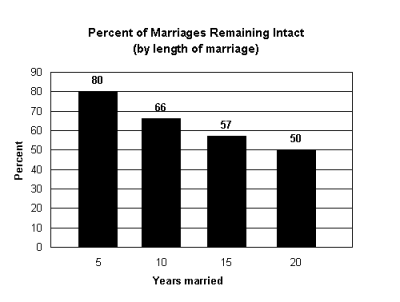
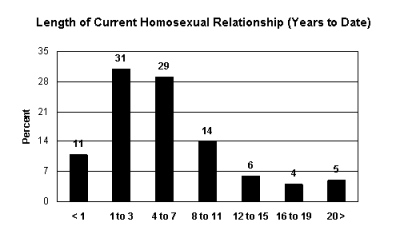
Relationship duration
% of Marriages Remaining Intact
Source: National Center for Health Statistics, Centers for Disease Control and Prevention (2001)
Length of Current Homosexual Relationship
Source: 2003-2004 Gay/Lesbian Consumer Online Census
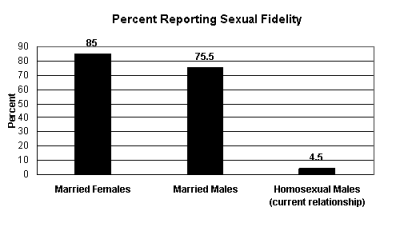
Monogamy vs Promiscuity
% Reporting Sexual Fidelity
Sources:Laumann, The Social Organization of Sexuality, 216; McWhirter and Mattison, The Male Couple: How Relationships Develop (1984): 252-253; Wiederman, “Extramarital Sex,” 170.
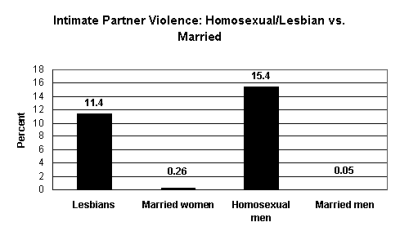
Rates of intimate partner violence
Intimate Partner Violence
Sources: “Extent, Nature, and Consequences of Intimate Partner Violence,” U.S. Department of Justice: Office of Justice Programs: 30; “Intimate Partner Violence,” Bureau of Justice Statistics Special Report:11.
Conclusion
Marriage is a relationship that has a specific purpose. That purpose is to bind together two opposite natures and to produce children that are biologically linked to the parents. The children gain the benefits of being parented by the two different natures, so they get two perspectives. The fact that the children are genetically linked to two parents helps to ensure the stability of the commitment, as we see in the animal kingdom where animals protect their young.
The goal of marriage is not to increase the happiness of the adults, or to “recognize” the love of adults. The goal of marriage is have two people enter into a relationship where they understand that it is not about adults being fulfilled. Marriage is about people having a goal of raising children, which are tremendously stressful to raise. Marriage requires self-denial and sacrifice in order to raise those children – that is the main point of it. It also requires fidelity and chastity, so that the environment is kept stable for the children over a long period of time.
Children benefit from the stability that is more common in traditional marriages than it is in other arrangements, including heterosexual co-habitation which is similarly unstable (50% greater chance of divorce, more domestic violence, etc.). Therefore, it is important to keep the concept of marriage separate from other kinds of relationships so that the focus on commitment for the sake of the children is clear to those who contemplate marriage. Society needs to give special recognition to married couples, in view of their child-focused commitment.
I apologize in advance if this post causes anyone any harm or distress, I am just trying to explain why people have that opinion. They could be wrong, but that is the case they make. Obviously, married couples fall short of the goal, but that is their goal.

 WINTERY KNIGHT