Tag Archives: Risk

Does legalized abortion increase or decrease child abuse?

Neil Simpson has created a round-up of links on his blog. All the stories in his round-up are interesting, but this one by Randy Alcorn caught my eye. It’s entitled “The Rise of Child Abuse as a Result of Abortion”. You have to skip down a bit to get to the main point as he first talks for a while about his evil twin.

Here is his thesis:

My belief is that when people believe it’s okay to kill a child before he’s born, because an adult has rights over his life, then inevitably it will become more acceptable to beat him up once he’s born.

And here is his proof:

In 1973, when abortion was first legalized, United States child abuse cases were estimated at 167,000 annu­ally. According to the U.S. Department of Health and Human Services, approximately 903,000 children were victims of abuse during 2001, a number more than five times greater.

Obviously, this is not counting the 49 million murders of actual children.

Now you might say: “Wintery! Doesn’t abortion decrease child abuse by eliminating unwanted children?”.

Randy says no:

University of Southern California professor Edward Lenoski conducted a landmark study of 674 abused chil­dren. He discovered that 91 percent of the parents admitted they wanted the child they had abused.

“Studies indicate that child abuse is more frequent among mothers who have previously had an abortion.” Dr. Philip Ney’s studies indicate that this is partially due to the guilt and depression caused by abortion, which hinders the mother’s ability to bond with future children. He documents that having an abortion decreases a parent’s natural restraint against feelings of rage toward small children.

The attitude that results in abortion is exactly the same attitude that results in child abuse. Furthermore, if she doesn’t abort, the mother can look at her difficult three­-year-old and think, “I had the right to abort you.” The child owes her everything; she owes the child nothing. This causes resentment of demands requiring parental sacrifice. Even if subconscious, the logic is inescapable: If it was all right to kill the same child before birth, surely it’s all right to slap him around now.

I think we need to realize what is going through the mind of young women: they want to be happy and they are willing to murder innocent children in order to secure their own happiness. They do not see why anyone else’s rights should limit their own pursuit of happiness. After all, it’s survival of the fittest. The majority of single women are pro-abortion. They believe that their own happiness matters more than moral values and moral duties.

Consider how women voted in 2008:

Unmarried women supported Barack Obama by a 70-to-29 percent margin, and they voted for Democratic House candidates by a similar margin — 64-to-29 percent. These margins mean that unmarried women edged out both younger voters and Hispanic voters as the demographic with the strongest support for President-elect Obama. These unmarried women voters joined with younger voters and people of color to create what GQR calls a “new American electorate” — voters with a decided preference for liberal candidates.

Overall, women strongly supported Senator Obama over Senator McCain (56 percent for Obama, 43 percent for McCain). Men split their votes about evenly between the two presidential candidates, with 49 percent for Obama and 48 percent for McCain.

Obama is the most pro-abortion President there has ever been.

In my series of posts on atheism and morality, I explain why moral relativism is the result of atheism. If you want to stop abortion, there are two things to do. 1) You need to start convincing women that God exists, that objective morality is real, and that moral obligations trump the pursuit of selfish happiness. 2) You need to vote to cut off all taxpayer subsidies for pre-marital sex; sex education, contraception, single motherhood and abortion.

CRISIS! Evaluating the leaked Democrat health care bill

Keith Hennessey is the go-to guy for analyzing economic policies. He takes a look at the leaked draft of the health care bill that I blogged about before. He lists 15 things you need to know about the draft bill.

Below I’ve listed a few of the scariest parts.

Mandatory coverage

The Kennedy-Dodd bill would create an individual mandate requiring you to buy a “qualified” health insurance plan, as defined by the government.  If you don’t have “qualified” health insurance for a given month, you will pay a new Federal tax.  Incredibly, the amount and structure of this new tax is left to the discretion of the Secretaries of Treasury and Health and Human Services (HHS), whose only guidance is “to establish the minimum practicable amount that can accomplish the goal of enhancing participation in qualifying coverage (as so defined).”  The new Medical Advisory Council (see #3D) could exempt classes of people from this new tax.  To avoid this tax, you would have to report your health insurance information for each month of the prior year to the Secretary of HHS, along with “any such other information as the Secretary may prescribe.”

Employer mandate

The bill would also create an employer mandate.  Employers would have to offer insurance to their employees.  Employers would have to pay at least a certain percentage (TBD) of the premium, and at least a certain dollar amount (TBD).  Any employer that did not would pay a new tax.  Again, the amount and structure of the tax is left to the discretion of the Secretaries of Treasury and HHS.

Mandatory services that I don’t use

A qualified plan would have to cover “essential health benefits,” as defined by a new Medical Advisory Council (MAC), appointed by the Secretary of Health and Human Services… The MAC would have to include items and services in at least the following categories:  ambulatory patient services, emergency services, hospitalization, maternity and new born care, medical and surgical, mental health, prescription drugs, rehab and lab services, preventive/wellness services, pediatric services, and anything else the MAC thought appropriate.

That’s just redistribution of wealth for elective services, right there. I wonder whether support for contraceptives and abortion would also be required.

Premiums not related to lifestyle risks

Health insurance plans could not charge higher premiums for risky behaviors:  “Such rate shall not vary by health status-related factors, … or any other factor not described in paragraph (1).”  Smokers, drinkers, drug users, and those in terrible physical shape would all have their premiums subsidized by the healthy.

Guaranteed issue and renewal

All health insurance would be required to have guaranteed issue and renewal, modified community rating, no exclusions for pre-existing conditions, no lifetime or annual limits on benefits, and family policies would have to cover “children” up to age 26.

…Guaranteed issue and renewal combined with modified community rating would dramatically increase premiums for the overwhelming majority of those Americans who now have private health insurance.  New Jersey is the best example of health insurance mandates gone wild.  In the name of protecting their citizens, premiums are extremely high to cover the cross-subsidization of those who are uninsurable.

Massive wealth redistribution, especially to Democrats

People from 150% of poverty up to 500% (!!) would get their health insurance subsidized (on a sliding scale).  If this were in effect in 2009, a family of four with income of $110,000 would get a small subsidy.  The bill does not indicate the source of funds to finance these subsidies.

…People in high cost areas (e.g., New York City, Boston, South Florida, Chicago, Los Angeles) would get much bigger subsidies than those in low cost areas (e.g., much of the rest of the country, especially in rural areas).  The subsidies are calculated as a percentage of the “reference premium,” which is determined based on the cost of plans sold in that particular geographic area.

Hennessey then goes on to explain all of the implications of his 15 points. READ IT ALL.

BONUS

Verum Serum has 2 posts up where they examine:

Comparing patient outcomes for cancer treatment in the USA vs Europe

Related chart:

Cancer mortality rates

AND:

Obama’s plan to pass the health care bill unilaterally, under a bi-partisan smokescreen

They have a plan to bypass the likely Republican filibuster. It’s a done deal.

Why do people oppose same-sex marriage?

UPDATE: The research paper seems to have expired from the FRC web site, but you can see the whole thing here.

I found this research paper at the Family Research Council web site. The paper compares same-sex couples and heterosexual married couples, in the following ways:

  • relationship duration
  • monogamy vs. promiscuity
  • relationship commitment
  • number of children being raised
  • health risks
  • rates of intimate partner violence

Are there really significant differences between the two arrangements? Let’s take a look at the some of the data.

Relationship duration

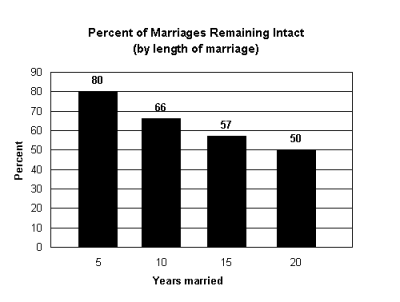
% of Marriages Remaining Intact

Source: National Center for Health Statistics, Centers for Disease Control and Prevention (2001)

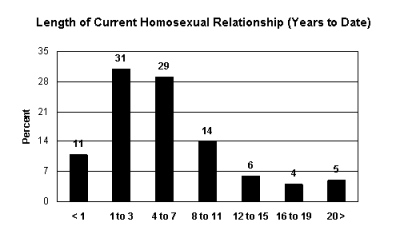
Length of Current Homosexual Relationship

Source: 2003-2004 Gay/Lesbian Consumer Online Census

Monogamy vs Promiscuity

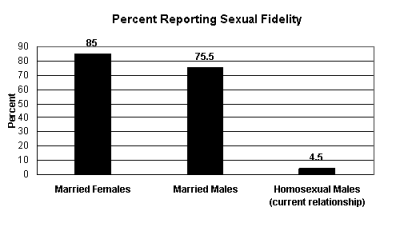
% Reporting Sexual Fidelity

Sources:Laumann, The Social Organization of Sexuality, 216; McWhirter and Mattison, The Male Couple: How Relationships Develop (1984): 252-253; Wiederman, “Extramarital Sex,” 170.

Rates of intimate partner violence

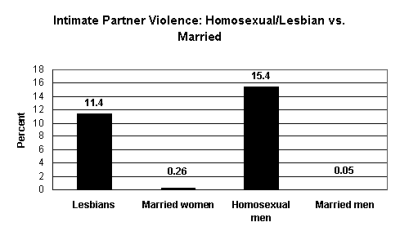
Intimate Partner Violence

Sources: “Extent, Nature, and Consequences of Intimate Partner Violence,” U.S. Department of Justice: Office of Justice Programs: 30; “Intimate Partner Violence,” Bureau of Justice Statistics Special Report:11.

Conclusion

Marriage is a relationship that has a specific purpose. That purpose is to bind together two opposite natures and to produce children that are biologically linked to the parents. The children gain the benefits of being parented by the two different natures, so they get two perspectives. The fact that the children are genetically linked to two parents helps to ensure the stability of the commitment, as we see in the animal kingdom where animals protect their young.

The goal of marriage is not to increase the happiness of the adults, or to “recognize” the love of adults. The goal of marriage is have two people enter into a relationship where they understand that it is not about adults being fulfilled. Marriage is about people having a goal of raising children, which are tremendously stressful to raise. Marriage requires self-denial and sacrifice in order to raise those children – that is the main point of it. It also requires fidelity and chastity, so that the environment is kept stable for the children over a long period of time.

Children benefit from the stability that is more common in traditional marriages than it is in other arrangements, including heterosexual co-habitation which is similarly unstable (50% greater chance of divorce, more domestic violence, etc.). Therefore, it is important to keep the concept of marriage separate from other kinds of relationships so that the focus on commitment for the sake of the children is clear to those who contemplate marriage. Society needs to give special recognition to married couples, in view of their child-focused commitment.

I apologize in advance if this post causes anyone any harm or distress, I am just trying to explain why people have that opinion. They could be wrong, but that is the case they make. Obviously, married couples fall short of the goal, but that is their goal.

Further study

Two much bigger challenges to marriage are big-government socialism and especially no-fault divorce. I also wrote about same-sex marriage and co-habitation before, in the context of European states like Sweden and Norway.

You may also be interested in a recent post about whether homosexuality is caused by a “gay gene”.