Tag Archives: Risk

What does universal health care really mean?

I think the point of universal health care (at least the government-run variety) is pretty clear. The goal is to equalize life outcomes so that people who work the hardest pay the most into the system, and people who live in risky/immoral lifestyles withdraw the most. The biggest losers in such a system are the productive people who make responsible, moral decisions about their lifestyle – they pay the most and withdraw the least. The biggest winners are people who don’t work at all but who withdraw a lot.

I think that universal health care makes people irresponsible. The driving force behind universal health care is the idea that people should be able to do anything they want to pursue happiness any way they please, and that the natural limits of reality should be circumvented by spending other people’s money to “equalize life outcomes”.

Socialized medicine proponents are funny people. They think that no one should have to deal with the costs of their own decisions as long as they are sincere in their pursuit of happiness – it’s just not possible to predict what decisions will lead to good outcomes and what decisions will lead to bad outcomes. I once had two Canadian women bragging to me in an airport about how great socialized medicine was until I explained to them that at my salary level I would be paying 50% of my salary to the government and I had not been to the doctor for anything other than a check-up in my entire life. They could not see why I might like to opt out of such a system even after I explained it to them. They apparently thought that at any moment I might develop the urge for an abortion or two and then who would pay for it? Life is so unpredictable for a Canadian woman – it’s better not to have to worry about it and just let someone else pay.

So, let’s see what passes for health care in various universal health care systems around the world.

  • Here’s my previous post on taxpayer-funded in vitro fertilization in Ontario, Canada. It’s a human right! And that means it’s FREEEEEE!
  • But there’s more. Sex-changes are also a human right in Ontario, Canada. It’s FREEEEEE! The taxpayer has loads of money for that.
  • Do you know what else is FREEEEEE! in socialist countries like the UK? Breast enlargements. Yeah, because it’s a human right!

And of course it goes without saying that abortion is a human right everywhere, and should be taxpayer-funded. It really is about playing on people’s fears, and buying votes with other people’s money. The reason that the socialists don’t want health care to be left to private companies instead of government is because private companies would insist that people pay based on their likelihood of filing a claim – as with car insurance. But that is too “judgmental” for the universal health care proponents – they think that no one should feel obligated to behave responsibly just because of petty things like money.

I wonder what my readers think about this.

Is it OK for some citizens to make decisions that are costly and risky as they pursue happiness in non-standard ways, and then assign blame and costs for the inevitable failures and expenses to their neighbors? Is there a right to pursue happiness at the expense of others? Is life predictable enough that people should be able to rationally assess the costs and risks of their own decisions? Would private insurers do a better job of holding people accountable to make good decisions about their own lifestyles? Should people choose how much health care they want based on the coverages they want and the risks they want to incur? Should a person be able to say that they don’t want to be covered for sex changes and have the amount they pay into the system reduced? Should a person be able to opt out of government health care entirely and just buy a medical insurance policy privately, based on their own needs?
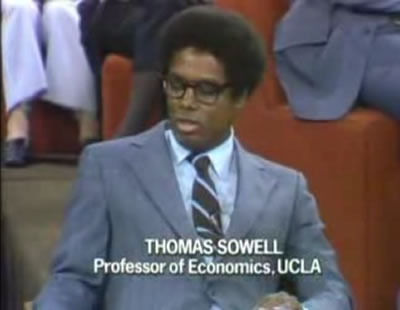
Thomas Sowell explains the concept of “moral hazard”

Young Thomas Sowell

From Real Clear Politics. (H/T Jojo)

Excerpt:

One of the things that makes it tough to figure out how much has to be charged for insurance is that people behave differently when they are insured from the way they behave when they are not insured.

In other words, if one person out of 10,000 has his car set on fire, and it costs an average of $10,000 to restore the car to its previous condition, then it might seem as if charging one dollar to all 10,000 people would be enough to cover the cost of paying $10,000 to the one person whose car that will need to be repaired. But the joker in this deal is that people whose cars are insured may not be as cautious as other people are about what kinds of neighborhoods they park their car in.

[…]Although “moral hazard” is an insurance term, it applies to other government policies besides insurance. International studies show that people in countries with more generous and long-lasting unemployment compensation spend less time looking for jobs. In the United States, where unemployment compensation is less generous than in Western Europe, unemployed Americans spend more hours looking for work than do unemployed Europeans in countries with more generous unemployment compensation.

People change their behavior in other ways when the government pays with the taxpayers’ money. After welfare became more readily available in the 1960s, unwed motherhood skyrocketed. The country is still paying the price for that– of which the money is the least of it. Children raised by single mothers on welfare have far higher rates of crime, welfare and other social pathology.

San Francisco has been one of the most generous cities in the country when it comes to subsidizing the homeless. Should we be surprised that homelessness is a big problem in San Francisco?

[…]We also hear a lot of talk about “the uninsured,” for whose benefit we are to drastically change the whole medical-care system. But income data show that many of those uninsured people have incomes from which they could easily afford insurance. But they can live it up instead, because the government has mandated that hospital emergency rooms treat everyone.

And here’s another Tom Sowell column making a related point.

Excerpt:

Much has been made of the fact that families making less than $250,000 a year will not see their taxes raised. Of course they won’t see it, because what they see could affect how they vote.

But when huge tax increases are put on electric utility companies, the public will see their electricity bills go up. When huge taxes are put on other businesses as well, they will see the prices of the things those businesses sell go up.

If you are not in that “rich” category, you will not see your own taxes go up. But you will be paying someone else’s higher taxes, unless of course you can do without electricity and other products of heavily taxed businesses. If you don’t see this, so much the better for the Obama administration politically.

This country has been changed in a more profound way by corrupting its fundamental values. The Obama administration has begun bribing people with the promise of getting their medical care and other benefits paid for by other people, so long as those other people can be called “the rich.” Incidentally, most of those who are called “the rich” are nowhere close to being rich.

[…]There was a time when most Americans would have resented the suggestion that they wanted someone else to pay their bills. But now, envy and resentment have been cultivated to the point where even people who contribute nothing to society feel that they have a right to a “fair share” of what others have produced.

The most dangerous corruption is a corruption of a nation’s soul. That is what this administration is doing.

Republicans prefer private voluntary charity as the best way to provide a safety net. Just because people on the left give less to charity than people on the right, it doesn’t mean that no one one gives to charity. Europe has the highest taxes, and they give the least in charity. Why not LOWER taxes for people who want to give MORE in charity? When government hands out money, it encourages people to be more dependent. But when a person in trouble has to go to a neighbor or a charity in their own community, it sends the right message – “this should be temporary – don’t let this become a habit”. It’s not GOOD for someone to depend on the government. People need to work in order to be happy.

Having the government take over the role of provider in the home is an insult to men. It’s not government’s job to replace men. They ought to stay right out of it. Leave money in the pockets of the working man so he can save for a rainy day himself. If you subsidize a behavior, you get more of it. If you tax a behavior, you get less of it. It makes no sense to subsidize irresponsible lifestyle choices and tax productive and moral lifestyle choices. You don’t want to make the rescue from bad decisions an anonymous and automatic affair. You want people to worry, so that they won’t want to make risky and irresponsible choices. Everybody goes through though times, but we shouldn’t make it normal. People ought to know that it’s not normal.

You may want to read about how government dependence makes people less happy than having a job. Don’t make people depend on government by taxing businesses and investment. We need more companies hiring – not less. And that means letting the profit motive provide an incentive for entrepreneurs to engage in more risk-taking and enterprise.

Dawn Stefanowicz explains her experience being raised by a gay parent

*** WARNING: This post is definitely for grown-ups only! ***

I was listening to the latest Dr. J podcast on “Why Marriage Matters”, and I heard about a woman named Dawn Stefanowicz, who was raised by her gay father in Toronto.

So, I looked around and found this interview with Dawn posted on MercatorNet. This is mature subject matter.

Intro:

Gay marriage and gay adoption are being fiercely debated in a number of countries. Usually these issues are framed as a human rights issue. But whose rights? Patrick Meagher, MercatorNet’s contributing editor in Canada, recently interviewed a woman who was raised by a homosexual father. She feels that her rights as a child were completely ignored.

Dawn Stefanowicz (www.DawnStefanowicz.com) grew up in Toronto. Now in her 40s, she has written a book, Out From Under: Getting Clear of the Wreckage of a Sexually Disordered Home, to be released later this year. Stefanowicz has now been married for 22 years, is raising a family, and also works as an accountant. She has also testified about same-sex marriage in Washington and Ottawa.

Sample:

MercatorNet: How did you feel about what was going on around you?

Stefanowicz: You become used to it and desensitised. I was told at eight years old not to talk about this but I knew that something was wrong. I was not thinking “this is right or wrong” but I was disturbed by what I was experiencing. I was unhappy, fearful, anxious and confused. I was not allowed to tell my father that his lifestyle upset me. You can be four-years-old and questioning, “Where is Daddy?” You sense women are not valued. You think Daddy doesn’t have time for you or Daddy is too busy to play a game with you. All this is hard because as a child this is the only experience you have.

MercatorNet: How did this affect your relationship with others?

Stefanowicz: I had a hard time concentrating in school on day-to-day subjects and with peers. I felt insecure. I was already stressed out by an early age. I’m now in my 40s. You’re looking at life-long issues. There is a lot of prolonged and unresolved grief in this kind of home environment and with what you witness in the subcultures.

It took me until I was into my 20s and 30s, after making major life choices, to begin to realise how being raised in this environment had affected me. Unfortunately, it was not until my father, his sexual partners and my mother had died, that I was free to speak publicly about my experiences.

And:

MercatorNet: Why do so few children speak out?

Stefanowicz: You’re terrified. Absolutely terrified. Children who open up these family secrets are dependent on parents for everything. You carry the burden that you have to keep secrets. You learn to put on an image publicly of the happy family that is not reality. With same-sex legislation, children are further silenced. They believe there is no safe adult they can go to.

I noticed that Bill Muehlenberg has an even more controversial review of Dawn’s book about her childhood, too. When I was doing research on these issues, I read Dr. Jeffrey Satinover’s “Homosexuality and the Politics of Truth” and Dr. Joseph Nicolosi’s “A Parent’s Guide to Preventing Homosexuality“. But I think I am going to buy Dawn’s book, too. It sounds like a tough read, but it may be necessary to understand what is really at stake, so my views can be formed by real data.

NOTE: Comments to this post will be strictly filtered in accordance with Obama’s hate crimes bill.

Related posts