Did you know that there is a real woman who inspired the feminist fairy tale TV show “Sex in the City”? She had an enormous influence on young women, who wanted the glamour, fun, and consequence-free sex with “high value” no-commitment men. Most women who adopted the values of the show probably thought that this path would eventually lead to marriage and children.
My friend Chris sent me this article from Fox News, which talks the woman who inspired the show’s storyline.
It says:
“Sex and the City” may have left a trailblazing legacy for women on television, but the book’s original author now thinks her independent lifestyle may not have been as rewarding.
Candace Bushnell, 60, who wrote the original 1997 novel which spawned the successful TV series for HBO, opened up to Sunday Times Magazine about her 2012 divorce, admitting it made her realize how not starting a family made her feel “truly alone.”
“When I was in my 30s and 40s, I didn’t think about it,” she recalled. “Then when I got divorced and I was in my 50s, I started to see the impact of not having children and of truly being alone. I do see that people with children have an anchor in a way that people who have no kids don’t.”
I do think that it’s important for young women to really consider where they want to be when they are 30, 40, 50, etc. A wise person should seek to pattern their decisions off of the decisions of people who have reached the goals that they themselves want to reach. Candace Bushnell clearly has failed to achieve her goals. And those who listen to her will, likewise, fail to achieve the goals of marriage and children.
Making decisions today to achieve goals tomorrow
It’s important not to put too much faith in TV shows. Or any fiction.
Whenever I see women reading books in the office, I always ask them: is that fiction or non-fiction? In 19 years of full-time work, I have never had a woman answer non-fiction. And they usually answer “romance”. Well, I supposed if you were a fictional character, then you might take the advice of fictional characters. But if you are a real person, then you should look at the way the world really works. You should read peer-reviewed research, and take the advice of real people who have come up from humble beginnings to achieve the goals that you want to achieve.
After all, if your goal was to retire at 50, wouldn’t it make sense to read books about investing, and take the advice of successful investors? It certainly would not make sense to imitate the characters in TV shows and movies made by Hollywood divorcers, adulterers, rapists and pedophiles. And yet so many women do the latter with marriage and children decision-making. They seem to derive some sort of unquestionable emotional delight from making important decisions based on appearances, intuitions, peer-approval, etc.
Why listen to celebrities, teachers, politicians, etc. who have infidelities, no children, failed marriages, etc.? Why make decisions by counting votes from your no-achievement peer group? If you want to reach a goal, then there is only one way to proceed, and that’s by consulting the evidence, and seeking guidance from those with demonstrated results.
For example, when I was choosing which state to live in, I made a spreadsheet and filled it with all sorts of rankings of the 50 states that I pulled out of research papers and reports. I looked at things like infrastructure, income tax, economic growth, business friendliness, cost of living, tax as a % of income, abortion laws, support for traditional marriage, single motherhood, gun laws, concealed carry laws, fiscal solvency, etc. I moved here, and I’ve become very wealthy as a result. And my state has actually moved upward in gun rights rankings, fiscal solvency rankings, tax rankings, etc. since I got here. We’re even trying to pass pro-life laws! When you make decisions using evidence and when you listen to good advice from people who have real achievements, you succeed.
Don’t make decisions about sex, marriage and children by “following your heart”. That’s the lesson.
Over the weekend I debated with Christian feminists about marriage on The Transformed Wife Facebook page. At one point, I asserted that Christian women ought to have some knowledge of how to defend their faith using scientific and historical evidence. Some women asked me: “are you joking?” In this post, I’ll explain why I’m serious, and then I’ll ask them some questions of my own.
Let’s start with Jesus. Jesus set an example by showing the importance of knowing how to answer questions and challenges from skeptics in the New Testament. His favorite way to answer a challenge was by using evidence to support his truth claims.
So, take this story that’s in Mark 2:1-12, Matthew 9:1-8 and Luke 5:17-26. This story is accepted even by skeptical historians because it’s in three different books, and one of them is early (Mark).
In each version of the story, there are 4 steps:
Jesus forgives the sins of a paralyzed man
The Pharisees say that he doesn’t have authority to forgive sins
Jesus miraculously heals the paralyzed man
Jesus explains the evidence of the healing supports his claim that he has authority to forgive sins
And this is an example that you will find repeated in many places in the life of Jesus. You can see it in the Old Testament as well, where God performs miracles so that people who don’t believe in his existence or respect the Scriptures can still be convinced.
Christian apologetics is the skill of being able to give a defense for the Christian worldview when presented with a challenge from a non-Christian.
15 But in your hearts revere Christ as Lord. Always be prepared to give an answer to everyone who asks you to give the reason for the hope that you have. But do this with gentleness and respect,
16 keeping a clear conscience, so that those who speak maliciously against your good behavior in Christ may be ashamed of their slander.
This passage applies to every one who claims to be a disciple of Jesus, whether they like to prepare a defense or not. How much work must you put into it? It depends on the sophistication of the challenges you get. In the mountains of Pakistan, you don’t need to know much because there might not be a sophisticated challenge. In an American society filled with college graduates, the challenges are more difficult. So you will need to prepare a lot more, because the challenges will be a lot harder.
Those who take this passage seriously are doing something difficult, and time-consuming, in order to serve Christ. Buying books costs money. Reading books takes time. Debating with non-Christians can make you look bad to others. But the Bible commands us to be ready with answers for the people around us. Sometimes, doing what the Bible says makes us feel bad, or look bad to others. But we have do what the Bible says anyway. Part of being a real Christian is being obedient even if it feels bad or makes you look bad.
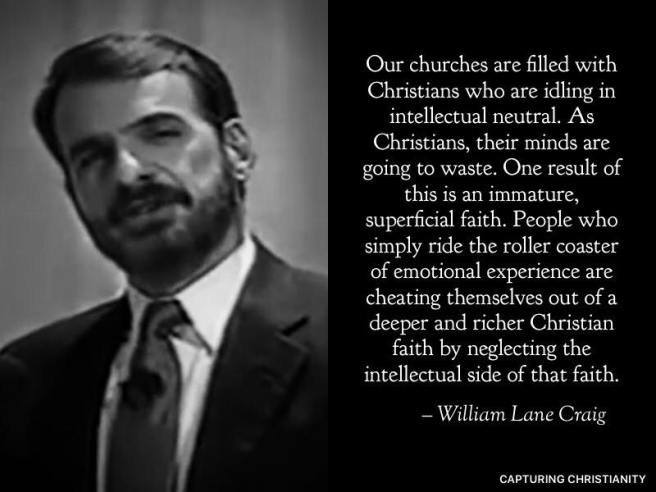
William Lane Craig on apologetics and the culture
What’s in an apologetics book?
So, with that said, let’s look at the table of contents of my favorite introduction to Christian apologetics, which is “Is God Just a Human Invention?” written by Sean McDowell and Jonathan Morrow.
In that book, you will find 18 topics.
Is Faith Irrational? (Commentary by: Gregory Koukl)
Are Science and Christianity at Odds? (Commentary by: John Warwick Montgomery)
Are Miracles Possible? (Commentary by: Gary R. Habermas)
Is Darwinian Evolution the Only Game in Town? (Commentary by: William A. Dembski)
How Did the Universe Begin? (Commentary by: R. Douglas Geivett)
How Did Life Begin? (Commentary by: Fazale R. Rana)
Why Is the Universe Just Right for Life? (Commentary by: Jay W. Richards)
Has Science Shown There Is No Soul? (Commentary by: Dale Fincher and Jonalyn Fincher)
Is God Just a Human Invention? (Commentary by: Garry DeWeese)
Is Religion Dangerous? (Commentary by: Douglas Groothuis)
Does God Intend for Us to Keep Slaves? (Commentary by: Paul Copan)
Is Hell a Divine Torture Chamber? (Commentary by: Frank Turek)
Is God a Genocidal Bully? (Commentary by: Clay Jones)
Is Christianity the Cause of Dangerous Sexual Repression? (Commentary by: Kerby Anderson)
Can People Be Good Without God? (Commentary by: Mark D. Linville)
Is Evil Only a Problem for Christians? (Commentary by: Randy Alcorn)
What Good Is Christianity? (Commentary by: Glenn S. Sunshine)
Why Jesus Instead of the Flying Spaghetti Monster? (Commentary by: Darrell L. Bock)
Prominent atheist scholars are quoted in each chapter to introduce the challenges, and then scholarly arguments and evidence are presented to defend the Christian worldview. The language is simple enough, but the material is solid enough to use in a real debate. I would say that introductory books like this one are more than enough to equip you for everyone who will challenge you.
Why are these 18 topics important? Because these are the questions that atheists ask. These are the questions that cause Christians to leave the faith. These are the questions that your children will face in high school and college, which might cause them to leave the faith.
Let’s start with chapter one. One of the most prominent arguments by atheists is that faith is irrational. This chapter allows you to define faith using the Bible’s definition of faith, which relies on logic and evidence.
Atheists also say that Christianity is at war with science. In chapter 2, they discuss the history of science and how Christianity provided the framework that allowed scientific method to take root and flourish.
Atheists like to claim that miracles are impossible. Chapter 3 defends the view that God, if he exists, is capable of interacting with his created world.
Atheists love to put forward Darwinism as means to deny that God is the designer of life. Chapter 4 explains the concept of intelligent design, and why intelligent design is a better explanation for the history of life.
Atheists love to talk about how the universe has always existed, and there’s no need for a Creator. Chapter 5 contains a philosophical argument that is supported by mainstream science to argue that the universe had a beginning, just like the Bible says.
Atheists love to argue that life can emerge from non-life, and the process is simple. Chapter 6 is written by a biochemist, and it takes a look at the real complexity of the simplest living cell.
Atheists like to argue that the universe itself is just an accident, and there is no need for a Designer. Chapter 7 introduces the scientific evidence for fine-tuning and habitability.
Atheists like to say that there is no soul and no afterlife. Chapter 8 gives some arguments for the existence of the soul.
Atheists like to argue that Christians invent God because God makes them feel good. But chapter 9 explains that having an all-powerful God who can hold humans accountable is the last thing any human would want to invent.
Atheists like to talk about how religion, with it’s habit of teaching to believe in things that can’t be tested, causes religious people to do a lot of harm. Chapter 10 takes a look at the real record of Christianity as a force for good in the world.
Atheists like to talk about slavery in the Bible. Chapter 11 talks about what the Bible really says, and provides some rational responses to the accusation.
Atheists like to talk about eternal punishment in Hell isn’t a just punishment for just getting a few questions wrong on a theology exam. Chapter 12 provides an explanation and defense of the concept of Hell.
Atheists love to talk about how God commanded the Israelites to attack their enemies in the Bible. Chapter 13 explains who their enemies really were, and what was really happening in those wars.
Atheists feel that unrestricted sexual activity is very healthy and normal, and that the Biblical prohibitions outside of male-female marriage are repressive and unhealthy. Chapter 14 explains why God has these rules in place, and supports his rules with evidence.
Atheists love to assert that they don’t need God, because they can behave morally on their own. Chapter 15 explains how to answer this claim by talking about how well atheism grounds objective moral values, objective moral duties, free will and moral accountability: the minimum requirements for objective morality.
Atheists think that the mere existence of natural disasters and human immorality are incompatible with the God of the Bible. Chapter 16 explains why this argument doesn’t work, and why even the concept of evil requires God to exist.
I have an atheist friend in my office who can’t defeat my scientific arguments for the origin of the universe, the fine-tuning and the origin of life. But still, he says to me, even if God exists, why would that matter to my life? Chapter 17 explains what difference Christianity makes in a person’s life.
Atheists think that the life of Jesus has no relevance to their life, and that he has nothing to offer them anyway. Chapter 18 explains the uniqueness of Jesus and explains why his resurrection is relevant to our lives today.
It’s important to understand that this book is not on the level of A. W. Tozer, G.K. Chesterton, Francis Chan, John Piper, etc. Those authors write for a Christian audience and therefore they do not equip you to answer realistic challenges from non-Christians. But the apologetics book we looked at actually equips you to answer challenges from non-Christians using logical arguments and evidence from mainstream history and science. You can use the material in that book in discussions outside the confines of your home and your church.
Dr. W. L. Craig: churches don’t prepare Christians to answer skeptics
Wife candidates ought to know apologetics
So, back to my original point about how some Christian feminists responded when I said that during courtship, I ask women questions about how much preparation they have done to answer objections from atheists, like the ones answered in this book. Am I joking?
Well, I think the problem is that Christian feminists don’t understand how Christian men view marriage. Christian men are interested in marriage because they think that their marriage will be an enterprise that produces a return for God. They like the idea of having a clean, comfortable home to host debate viewings and discussions over dessert with skeptics. They like the idea of raising children who will be effective and influential. Men don’t see marriage a means of making us feel better, or having fun, or getting our peers to approve of us. We see it as a way to promote Jesus’ agenda in the world. A Christian man loves his wife precisely because she is his partner in serving God.
So, some questions for all the Christian feminists out there. Are you aware of the actual objections that non-Christians have to the Christian worldview? Have you ever put in any effort to prepare to respond to these objections? Have you trained yourself to be calm and persuasive during discussions about Christianity?
Reading devotions or authors like Rachel Hollis, Beth Moore, and Jen Hatmaker won’t teach a Christian woman anything useful about defending the Christian worldview against atheist objections. And those books also won’t teach you how to evaluate a man to see whether he knows how to defend the Christian worldview, either. You have to study apologetics to know how to evaluate how much a candidate for husband and father roles knows about defending his faith. You have to protect yourself from men who lie about being Christians.
Having a rationally-grounded Christian worldview is essential to the roles of wife and mother. A Christian man cannot be confident about the trustworthiness of a Christian woman’s convictions unless she demonstrates her ability to defend those convictions to non-Christians in the ordinary way that she can surely defend other truth claims in areas where she does have the knowledge. If I ask a Christian nurse to defend the claim that germs are real, she will appeal to logic and evidence. I expect her to have put in as much work into defending the claims of Christianity, and to use the same methods: logic and evidence.
I used to think that if you were really good at your job, then it wouldn’t matter if you were serious about your Christian beliefs, because no one would fire you. But I guess that’s not true when it comes to the conflict between gay rights and the Bible. On Friday, an Australian rugby player had his contract canceled because he shared some Bible verses on social media.
Israel Folau says he ‘deeply saddened’ by Rugby Australia’s decision to tear up his $4million rugby contract, but his religious beliefs should not stop him from playing the sport.
The decision, which was announced on Friday afternoon, makes the devout Christian the first Australian athlete dismissed for expressing religious beliefs after sharing a homophobic Instagram post.
[…]’The Christian faith has always been a part of my life and I believe it is my duty as a Christian to share God’s word.
‘Upholding my religious beliefs should not prevent my ability to work or play for my club and country.’
The words he cited are from 1 Corinthians 6:9-14 which are about sin and repentance and who will be admitted to the Kingdom of God.
Just to be clear, the Christian position on sexuality is that you cannot have sex outside of marriage. And the Christian position on marriage is that it is one man and one woman for life. Authentic Bible-believing Christians may fail to live out that standard, but they can never take any other stance than that in public. If you are a Christian, you cannot say that sex outside of marriage is fine with God. If you are a Christian you cannot say that redefinitions of natural marriage are OK with God. There’s only one kind of authentic Christian, and that’s the kind that takes the Bible as authoritative, including on moral issues. Telling someone they can’t quote the Bible in public is essentially telling them that they can’t be a Christian in public.
Whenever things like this happen to Christians who are serious about their beliefs, I always try to find out what the people who take away their livelihood have to say about it. These people usually think of themselves as very tolerant and open-minded, so it’s interesting to hear how they keep their self-image after firing someone for their religious beliefs.
The article says:
In a press conference this afternoon, Rugby Australia CEO Raelene Castle said Folau was a ‘great player’ but that everyone has the right to be respected regardless of sexuality, race, gender or religion.
[…]’Our clear message today is that we need to stand by our values and the qualities of inclusion, passion, integrity, discipline, respect and teamwork.’
Ms Castle said she had told all rugby players in Australia that RA supports their rights to their own beliefs.
‘But when we are talking about inclusiveness in our game, we are talking about respecting differences as well,’ she said.
‘When we say rugby is a game for all, we mean it. People need to feel safe and welcoming in the game, regardless of their race, background or sexuality.
[…]’I’m confident because those players understand that everybody has a right to their own views or religious beliefs, and as long as they continue to express them in a respectful way we will continue to support them,’ she said.
[…]Ms Castle said she was ‘disappointed’ that Folau had not apologised.
So, did the rugby player have a right to be respected regardless of his religion? No, he needed to be fired. Did she respect his differences? No, she fired him. She says that authentic Christian quoting the Bible on social media is not being a Christian “in a respectful way”. So there’s a non-Christian telling a Christian how to behave like a Christian. And after she fires you, she’s disappointed that you didn’t apologize to her for not being Christian in a respectful way.
My thoughts
I have two thoughts about this. First, if you want to be public about your Christianity and keep your job, then you need to have an alias. Because of this intimidation from secular left fascists, Christians are refusing to speak out on moral issues on a daily basis. To help you to be more comfortable speaking out, you should have an alias. I have blogged about sexual issues and marriage many, many times on this blog, often citing peer-reviewed research in order to support the Christian position on these issues. And so far, no one has been able to get me fired. My goal is to have an influence. I want to do as much as I can without letting the fascists on the other side stop me.
Second, I’ve noticed that it’s increasingly common for Christians to side with the gay activists against other Christians. And that’s because Christianity has become so much about feelings and self-esteem that many people who claim to be Christians think that Christianity should always make them feel good and be popular. If all you have is feelings, it’s pretty easy to put your need to feel good above the need to defend what the Bible teaches.
For those who would like to be bolder but don’t know how, the Bible actually has an answer to that in 1 Pet 3:15. In order to be bold, you need to be prepared. By reading books outside of the Bible, you’ll equip yourself with evidence so that you can debate non-Christians who don’t accept the Bible. They may not accept the Bible, but they have to accept evidence, or they’ll look stupid and irrational.




 WINTERY KNIGHT