Tag Archives: Reason

Are feminists right to think that gender-neutral marriage makes women happier?

Male And Female Happiness After Feminism And Socialism
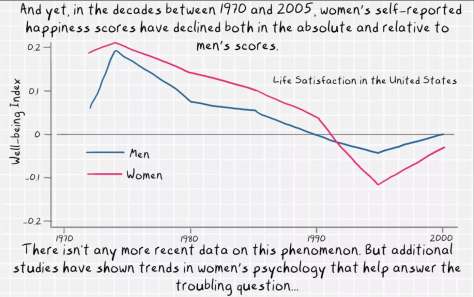
Male and female happiness throughout America’s adoption of radical feminism

I was reading this article by a feminist fiction writer on Vox, where she explains that although feminists have gotten what they wanted (careers, contraceptives, promiscuity, abortion, no-fault-divorce, daycare, etc. it hasn’t made them happier. So, what does this feminist fiction writer think would make feminists happier?

She gives two reasons why women women are still unhappy after feminism has been adopted by our society:

  • men don’t do enough housework
  • women are not as successful as men because they are discriminated against, the so-called “glass ceiling”

I think those complaints are pretty popular among feminists. Let’s take a look at some studies to see if her opinions are supported by peer-reviewed studies.

First study:

COUPLES who share housework duties run a higher risk of divorce than couples where the woman does most of the chores, a study has found.

The divorce rate among couples who shared housework equally was around 50 per cent higher than among those where the woman did most of the work.

“The more a man does in the home, the higher the divorce rate,” Thomas Hansen, co-author of the study entitled Equality in the Home, said.

Second study:

Researchers at the University of Illinois examined data on nearly 1,500 men and 1,800 women, aged between 52 and 60. Their well-being was evaluated through surveys.

The researchers first found that men’s well-being decreased once they had exited the workforce to become home-makers.

Meanwhile, the inverse was not so for women: Women’s psychological well-being was not affected by leaving their jobs to become stay-at-home mothers.

Third study:

A study called “Egalitarianism, Housework and Sexual Frequency in Marriage,” which appeared in The American Sociological Review last year, surprised many, precisely because it went against the logical assumption that as marriages improve by becoming more equal, the sex in these marriages will improve, too. Instead, it found that when men did certain kinds of chores around the house, couples had less sex. Specifically, if men did all of what the researchers characterized as feminine chores like folding laundry, cooking or vacuuming — the kinds of things many women say they want their husbands to do — then couples had sex 1.5 fewer times per month than those with husbands who did what were considered masculine chores, like taking out the trash or fixing the car. It wasn’t just the frequency that was affected, either — at least for the wives. The more traditional the division of labor, meaning the greater the husband’s share of masculine chores compared with feminine ones, the greater his wife’s reported sexual satisfaction.

Regarding the pay gap, that is entirely caused by women’s own choices. E.g. – the choice to study creative writing instead of petroleum engineering, the choice to work 35 hour weeks instead of 70 hour weeks, etc.

Fourth study:  (summarized by AEI economist)

When the [Bureau of Labor Statistics] reports that women working full-time in 2018 earned 81.4% of what men earned working full-time, that is very much different from saying that women earned 81.4% of what men earned for doing exactly the same work while working the exact same number of hours in the same occupation, with exactly the same educational background and exactly the same years of continuous, uninterrupted work experience, and with exactly the same marital and family (e.g., number of children) status. As shown above, once we start controlling individually for the many relevant factors that affect earnings, e.g., hours worked, age, marital status, and having children, most of the raw earnings differential disappears.

Fifth study:

This study leads to the unambiguous conclusion that the differences in the compensation of men and women are the result of a multitude of factors and that the raw wage gap should not be used as the basis to justify corrective action. Indeed, there may be nothing to correct. The differences in raw wages may be almost entirely the result of the individual choices being made by both male and female workers.

I think that women are entitled to make their own decisions, but they aren’t allowed to force the rest of us to subsidize their failures and celebrate their destructive outcomes.

I could go on, but I think enough has been said to show that research is very much at odds with feminist rhetoric. They feel they know what will make them happy and we gave them everything they asked for. They eliminated shaming of promiscuity with sex education. They get preferential treatment in the schools in a female-dominated education system. They are hired because of affirmative action quotas. They get expensive daycare, government schools, welfare and other programs. Taxes are raised to equalize outcomes for divorced women who choose men for feelings, and then nuke their own marriage enterprise. We have been on a long experiment of giving feminists everything they felt they wanted, at the expense of men’s rights and children’s rights, and it hasn’t even produced the results that feminists felt it would.

The social costs of feelings-based decision-making

Let’s look at two examples of policies that feminists asked for in the past, which didn’t work out the way they wanted.

I can understand why feminists would introduce sex education. They felt that “if everyone is having sex, then I won’t be the only one chasing attention from hot no-commitment bad boys by giving them recreational sex before marriage”.  They wanted to eliminate the standards of chastity and marriage-focused dating and normalize fun-focused drunken promiscuity. And they got that. But since they didn’t consult any research and evidence about how that would affect their future marriage stability and marriage happiness, they are even more unhappy than before.

How about no-fault divorce? No-fault divorce was brought in by a coalition of feminists, Marxists and trial lawyers. The Marxists want to destroy the family in order to increase dependence on the state. The trial lawyers wanted to make money. And the feminists thought that the standard approach to courting and marriage was just too much work. They didn’t want to be chaste. They didn’t want to be sober. They didn’t want to evaluate a man for traditional husband and father roles. The no-fault divorce laws gave them an escape from the messes caused by their own feelings-driven choices. But divorce just makes makes men and women much poorer, and passes the costs of supporting single mothers onto taxpayers.

And the costs of the failures of feminism are passed onto taxpayers.

Consider this study:

This paper examines the growth of government during this century as a result of giving women the right to vote. Using cross-sectional time-series data for 1870–1940, we examine state government expenditures and revenue as well as voting by U.S. House and Senate state delegations and the passage of a wide range of different state laws. Suffrage coincided with immediate increases in state government expenditures and revenue and more liberal voting patterns for federal representatives, and these effects continued growing over time as more women took advantage of the franchise. Contrary to many recent suggestions, the gender gap is not something that has arisen since the 1970s, and it helps explain why American government started growing when it did.

We are already $28 trillion in debt, partly because of feminism’s replacement of husbands and families with higher taxes and big government. Every time we transfer money from tax-paying men to feminists to fix their mistakes, it leaves less money in the hands of the men who actually want to get married. The declining value of marriage after feminism for men explains why marriage is being delayed, and why marriage rates are plunging.


William Lane Craig lectures on naturalistic alternatives to the Big Bang

Here’s the lecture, which was given in 2004 at the University of Colorado, Boulder.

This lecture might be a little advanced for beginners, but if you stretch your mind first, you shouldn’t tear anything. (Note: standard disclaimers apply if you do tear something!)

The description of the video states:

This is quite simply one of the best lectures William Lane Craig (a philosopher of science) has given. Craig explores the origins of the universe. He argues for a beginning of the universe, while refuting scientific models like the Steady State Theory, the Oscillating Theory, Quantum Vacuum Fluctuation Model, Chaotic Inflationary Theory, Quantum Gravity Theory, String Theory, M-Theory and Cyclic Ekpyrotic Theory.

And here is the description of the lecture from Reasonable Faith:

A Templeton Foundation lecture at the University of Colorado, Boulder, laying out the case from contemporary cosmology for the beginning of the universe and its theological implications. Includes a lengthy Q & A period which features previous critics and debate opponents of Dr. Craig who were in attendance, including Michael Tooley, Victor Stenger, and Arnold Guminski.

Craig has previously debated famous atheists Stenger and Tooley previously. And they both asked him questions in the Q&A time of this lecture. Imagine – having laid out your entire case to two people who have debated you before and who know your arguments well. What did they ask Craig, and how did he respond?

The scientific evidence

The Big Bang cosmology that Dr. Craig presents is the standard model for how the universe came into being. It is a theory based on six lines of experimental evidence.

Scientific evidence:

  1. Einstein’s theory of general relativity (GTR)
  2. the red-shifting of light from distant galaxies implies an expanding universe
  3. the cosmic background radiation (which also disproves the oscillating model of the universe)
  4. the second law of thermodynamics applied to star formation theory
  5. hydrogen-helium abundance predictions
  6. radioactive element abundance predictions

It’s probably a good idea to be familiar with these if you are presenting this argument, because experimental science is a reliable way of knowing about reality.

Published research paper

This lecture by Dr. Craig is based on a research paper published in an astrophysics journal, and was delivered to an audience of students and faculty, including atheist physicist Victor Stenger and prominent atheist philosopher Michael Tooley, at the University of Colorado at Boulder.

Here’s the peer-reviewed article that the lecture is based on.

Here’s the abstract:

Both cosmology and philosophy trace their roots to the wonder felt by the ancient Greeks as they contemplated the universe. The ultimate question remains why the universe exists rather than nothing. This question led Leibniz to postulate the existence of a metaphysically necessary being, which he identified as God. Leibniz’s critics, however, disputed this identification, claiming that the space-time universe itself may be the metaphysically necessary being. The discovery during this century that the universe began to exist, however, calls into question the universe’s status as metaphysically necessary, since any necessary being must be eternal in its existence. Although various cosmogonic models claiming to avert the beginning of the universe predicted by the standard model have been and continue to be offered, no model involving an eternal universe has proved as plausible as the standard model. Unless we are to assert that the universe simply sprang into being uncaused out of nothing, we are thus led to Leibniz’s conclusion. Several objections to inferring a supernatural cause of the origin of the universe are considered and found to be unsound.

The whole text of the article is posted online here.

Does peer-reviewed research support a naturalistic origin of life?

So, on Friday night, there was a debate between Dr. James Tour and Professor Dave, an atheist with a bachelors degree who makes YouTube videos. The atheist spent his entire opening speech attacking Tour’s character. When Tour asked him to show him origin of life chemistry, he refused. The atheist shuffled through papers he apparently found by Googling, and read the titles. When asked what was in them, he said that he couldn’t remember.

But I was trying to decide who won the debate. There was one place where the atheist claimed that the early Earth had no molecular oxygen. He needs that to be true, in order for the chemistry that creates the building blocks of life to work. So I thought I would talk about a paper that refutes that. After my argument, I’ll talk about another mistake that the atheist made in the debate. Based on those two mistakes, I concluded that the atheist was speaking errors either intentionally or unintentionally, and therefore lost the debate.

Here’s a paper published in the prestigious peer-reviewed science journal Nature, entitled “The oxidation state of Hadean magmas and implications for early Earth’s atmosphere”.

Evolution News explains what the paper is about.

Excerpt:

A recent Nature publication reports a new technique for measuring the oxygen levels in Earth’s atmosphere some 4.4 billion years ago. The authors found that by studying cerium oxidation states in zircon, a compound formed from volcanic magma, they could ascertain the oxidation levels in the early earth. Their findings suggest that the early Earth’s oxygen levels were very close to current levels.

[…]Miller and Urey conducted experiments to show that under certain atmospheric conditions and with the right kind of electrical charge, several amino acids could form from inorganic compounds such as methane, ammonia, and water. Several experiments have been done using various inorganic starting materials, all yielding a few amino acids; however, one key aspect of all of these experiments was the lack of oxygen.

If the atmosphere has oxygen (or other oxidants) in it, then it is an oxidizing atmosphere. If the atmosphere lacks oxygen, then it is either inert or a reducing atmosphere. Think of a metal that has been left outside, maybe a piece of iron. That metal will eventually rust. Rusting is the result of the metal being oxidized. With organic reactions, such as the ones that produce amino acids, it is very important that no oxygen be present, or it will quench the reaction. Scientists, therefore, concluded that the early Earth must have been a reducing environment when life first formed (or the building blocks of life first formed) because that was the best environment for producing amino acids. The atmosphere eventually accumulated oxygen, but life did not form in an oxidative environment.

The problem with this hypothesis is that it is based on the assumption that organic life must have formed from inorganic materials. That is why the early Earth must have been a reducing atmosphere. Research has been accumulating for more than thirty years, however, suggesting that the early Earth likely did have oxygen present.

[…]Their findings not only showed that oxygen was present in the early Earth atmosphere, something that has been shown in other studies, but that oxygen was present as early as 4.4 billion years ago. This takes the window of time available for life to have begun, by an origin-of-life scenario like the RNA-first world, and reduces it to an incredibly short amount of time. Several factors need to coincide in order for nucleotides or amino acids to form from purely naturalistic circumstances (chance and chemistry). The specific conditions required already made purely naturalist origin-of-life scenarios highly unlikely. Drastically reducing the amount of time available, adding that to the other conditions needing to be fulfilled, makes the RNA world hypothesis or a Miller-Urey-like synthesis of amino acids simply impossible.

If you read the paper’s abstract, it finds that molecular oxygen would have been present by the end of the Hadean era. The earliest signs of life we have are from just after the end of the Hadean era. So, its undeniable that molecular oxygen was present. Did professor Dave lie, or was he just ignorant? One thing for sure, he pronounced that there was no oxygen in the same confident, insulting voice that he used for the rest of his presentation.

OK, so with that out of the way, Professor Dave also cited a paper in the journal Science. And there is an article on Creation.com by Johnathan Sarfati, who has a PhD in chemistry, about that very paper.

His post says:

It’s likely that the media reports you mention were referring to the paper in Science journal by Tracey Lincoln and Gerald Joyce.1 Quite often, the media hype just doesn’t match what was actually discovered. To be fair, Joyce, a well known chemical evolutionist, made it clear that he and his Ph.D. student Lincoln had not produced life, despite the headlines.2 Much earlier, Joyce admitted:

“The most reasonable assumption is that life did not start with RNA … . The transition to an RNA world, like the origins of life in general, is fraught with uncertainty and is plagued by a lack of experimental data.”3

Joyce and Lincoln started off with a fairly long RNA molecule. Given that nothing like RNA appears in Miller–Urey experiments, this already shows unjustified interference from an intelligent investigator. In fact, not even the building blocks, ribonucleotides, appear in such experiments, and they do not spontaneously form RNA. In fact, there are numerous chemical difficulties with obtaining RNA by blind undirected chemistry, the only sort allowed on the hypothetical primordial earth, as chemical evolutionist A.G. Cairns-Smith points out in his book Genetic Takeover4 (see extract at Cairns Smith: Detailed criticisms of the RNA world hypothesis). And it’s a huge step from RNA to the genetic code, its major use today.

Furthermore, this paper didn’t demonstrate replication but ligation—joining two small RNA pieces, previously designed to be a match to the longer strand. So this research already assumed not just one but three RNA strands. For this to be relevant to chemical evolution, the two pieces just by chance had to have pretty close to the complementary base pairs of the first piece—natural selection could not be invoked before reproduction.

Furthermore, since polymerization is unfavorable, the RNA pieces must be chemically activated in some way. Note that a catalyst merely accelerates the approach to equilibrium; it doesn’t change it (see diagram and explanation in Dino proteins and blood vessels: are they a big deal?). The paper states that one of the two joining RNA strands has a triphosphate group on the end. This is very reactive, so would be an unlikely component of a primordial soup, and would not last long even if it appeared. So a supply of matching activated RNA pieces likewise shows unacceptable investigator interference.

See also Does ribozyme research prove Darwinian evolution? for a critique of an earlier Joyce paper on alleged ribozyme evolution, as well as Self-replicating peptides? which has many similarities to the recent Joyce claim.

Now Tour seemed to let this problem drop in the debate. It just seems that Professor Dave was assuming from the titles of the papers that they were relevant to the problem of life. Well, scientists always sound optimistic in their papers. I know, I had to write one for my masters degree thesis, and it was published. That’s why you have to look at the data and be skeptical. Sadly Dave wasn’t able to be skeptical. He wanted something to be true, so he just didn’t bother to interact with challenges to his view. The whole problem with the origin of life is that there are many counter-factual conditions, experimenter interferences, etc. that have to be done to make things work at all. Dave reads the titles of papers, but he just isn’t aware of how the experimenters have adjusted the experiments in ways that are not true to the conditions on the early Earth.

Dr. Tour lost his temper and shouted a lot during the debate, so I don’t think the debate is worth watching. However, if you want to watch a good debate on the origin of life, try this one between Dr. Fazale Rana vs Dr. Michael Ruse. And if you want to see a good explanation of the sequencing problem, check out this lecture by Dr. Stephen C. Meyer. (who has also debated atheists who didn’t lie, shout or insult him – and they even had doctoral degrees)