Tag Archives: Parenting

Are gay relationships typically stable and monogamous?

ECM sent me this post from The Public Discourse which explains a bit more about the two studies on gay parenting that were in the news last week. Some people are complaining that the study did not use enough long-term gay relationships. This quote explains why that was not feasible.

Excerpt:

The [NFSS] study found that the children who were raised by a gay or lesbian parent as little as 15 years ago were usually conceived within a heterosexual marriage, which then underwent divorce or separation, leaving the child with a single parent. That parent then had at least one same-sex romantic relationship, sometimes outside of the child’s home, sometimes within it. To be more specific, among the respondents who said their mother had a same-sex romantic relationship, a minority, 23%, said they had spent at least three years living in the same household with both their mother and her romantic partner. Only 2 out of the 15,000 screened spent a span of 18 years with the same two mothers. Among those who said their father had had a same-sex relationship, 1.1% of children reported spending at least three years together with both men.

This strongly suggests that the parents’ same-sex relationships were often short-lived, a finding consistent with the broader research on elevated levels of instability among same-sex romantic partners. For example, a recent 2012 study of same-sex couples in Great Britain finds that gay and lesbian cohabiting couples are more likely to separate than heterosexual couples.[3] A 2006 study of same sex marriages in Norway and Sweden found that “divorce risk levels are considerably higher in same-sex marriages”[4] such that Swedish lesbian couples are more than three times as likely to divorce as heterosexual couples, and Swedish gay couples are 1.35 times more likely to divorce (net of controls). Timothy Biblarz and Judith Stacey, two of the most outspoken advocates for same-sex marriage in the U.S. academy, acknowledge that there is more instability among lesbian parents.[5]

Therefore, while critics of the NFSS have faulted it for lacking comparisons between children of IBFs and the children of committed and intact gay or lesbian couples, this was attempted, but was not feasible. Despite drawing from a large, representative sample of the U.S. population, and despite using screening tactics designed to boost the number of respondents who reported having had a parent in a same-sex relationship, a very small segment reported having been parented by the same two women or two men for a minimum of three years. Although there is much speculation that today there are large numbers of same-sex couples in the U.S. who are providing a stable, long-term parenting relationship for their children, no studies based upon large, random samples of the U.S. population have been published that show this to be true, and the above-cited studies of different nations show that on average, same-sex couple relationships are more short-lived than those of opposite-sex couples.

Despite the lack of empirical evidence for the claim that today there are large numbers of stable, two-parent gay households, for the last ten years, contemporary gay parenting research has nevertheless claimed that there are “no significant differences” (and some benefits) to being raised by same-sex parents. Therefore, Regnerus analyzed the new NFSS data to verify this claim. In the end, he found the claim to be more plausible when comparing the grown children of parents who had a same-sex relationship to the grown children of divorced, adopted, single-parented, or step-parented arrangements. The claim is false if one compares the grown children of a parent who had a same-sex relationship to those from IBFs. While the study has been criticized for “comparing apples to oranges,” Regnerus’s work studies the reality of the population of children who were raised by parents who had same-sex relationships.

I think this is an important point to make – and it’s consistent with the research from previous studies. People have been getting their opinions about what the gay lifestyle is really like for children from biased sources and popular culture. But we need to look at research to really know what is true. Any leftist Hollywood producer with money can make a TV show in which all the religious/conservative people look like devils, and all the gay couples are faithful, committed, monogamous and non-violent. But that’s not research – that’s television.To really make policies that protect children, we have to look at the facts.

The right way to think about gay marriage is to think about it as an extension of no-fault divorce. The same feminists and leftists who pushed for the legalization of no-fault divorce told us back then that the children would be fine, that children are resilient. No-fault divorce was a change in the definition of marriage. The leftists said that divorce would never become widespread, and that it would not harm children in any way. It was all a pack of lies. If the practices of the gay lifestyle become conflated with marriage, then marriage will come to denote relationships engaged in for “love” not children, such that unchastity, infidelity, increased domestic violence and frequent break-ups are incorporated back into the definition of marriage.
The American Psychological Association (APA) on lesbian and gay parenting

Here’s the abstract from a study published in the peer-reviewed journal “Social Science Research“.

Abstract:

In 2005, the American Psychological Association (APA) issued an official brief on lesbian and gay parenting. This brief included the assertion: “Not a single study has found children of lesbian or gay parents to be disadvantaged in any significant respect relative to children of heterosexual parents” (p. 15). The present article closely examines this assertion and the 59 published studies cited by the APA to support it. Seven central questions address: (1) homogeneous sampling, (2) absence of comparison groups, (3) comparison group characteristics, (4) contradictory data, (5) the limited scope of children’s outcomes studied, (6) paucity of long-term outcome data, and (7) lack of APA-urged statistical power. The conclusion is that strong assertions, including those made by the APA, were not empirically warranted. Recommendations for future research are offered.

And some the findings:

  • 26 of 59 APA studies on same-sex parenting had no heterosexual comparison groups.
  • In comparison studies, single mothers were often used as the hetero comparison group.
  • No comparison study had the statistical power required to detect a small effect size.
  • Definitive claims were not substantiated by the 59 published studies.

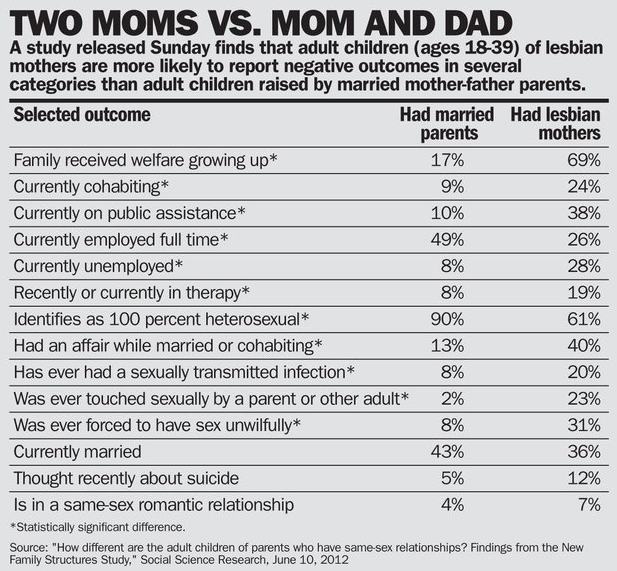
In fact, the assertions of the APA are contradicted by a recently released large-scale study of gay and lesbian parenting.

Here are the facts from a study released last Sunday:

Straight vs. lesbian parenting (click for larger image)
Heterosexual vs. gay parenting (click for larger image)

This data is not surprising – we know that fatherless children do far worse than children who have a father present, even when all the factors like income and wealth and education are corrected for. Children need a mother and a father.

Is the APA unbiased?

Why would the APA make pronouncements that go against the scientific facts? Well, consider what a former President of the APA says about the APA:

A former president of the American Psychological Association (APA), who also introduced the motion to declassify homosexuality as a mental illness in 1975, says that the APA has been taken over by “ultraliberals” beholden to the “gay rights movement,” who refuse to allow an open debate on reparative therapy for homosexuality.

Dr. Nicholas Cummings was President of the APA from 1979 to 1980, and also served as a member of the organization’s Council of Representatives. He served for years as Chief of Mental Health with the Kaiser-Permanente Health Maintenance Organization, and is the author of the book “Destructive Trends in Mental Health: The Well-Intentioned Path to Harm.”

In an interview with representatives of the National Association for Research and Therapy of Homosexuality (NARTH) in late April, Cummings said that the organization’s problems began with the rejection of the Leona Tyler Principle, which required that all public positions of the APA be supported by scientific evidence.

The APA “started changing pretty drastically by the late 1980s,” said Cummings.  “By the mid 1990s, the Leona Tyler principle was absolutely forgotten, that political stances seemed to override any scientific results. Cherry-picking results became the mode. The gay rights movement sort of captured the APA.”

Cummings says that the movement for “diversity” in the APA, which he endorsed, had resulted in a lack of diversity regarding heterosexuals.

“If I had to choose now, I would see a need to form an organization that would recruit straight white males, which are underrepresented today in the APA,” he said.

Cummings says that he personally is not in opposition to the homosexual movement, including gay “marriage,” pointing out that he was the author of the motion to strike homosexuality from the APA’s list of mental illnesses. However, he is distressed at the loss of scientific objectivity at the organization.

More evidence against same-sex marriage is available in this research paper from the Family Research Council think tank, compiled from mainstream statistics like the Census Bureau and the Department of Justice.

Here is my comprehensive case against gay marriage.

New large-scale UK study confirms the importance of fathers to children

Dina sent me this article from the UK Daily Mail.

Excerpt:

A father’s love is as important to a child’s emotional development as a mother’s, a large-scale study has confirmed.

Examining the cases of more than 10,000 sons and daughters revealed how a cold or distant father can damage a child’s life, sometimes for decades to come.

The review of 36 studies from around the world concluded that his love is at least as important to youngsters as that of their mothers.

Researcher Professor Ronald Rohner said that fatherly love is key to  development and hopes his findings will motivate more men to become involved in caring for their offspring.

‘In the US, Great Britain and Europe, we have assumed for the past 300 years that all children need for normal healthy development is a loving relationship with their mother,’ he said.

‘And that dads are there as support for the mother and to support the  family financially but are not required for the healthy development of the children.

‘But that belief is fundamentally wrong. We have to start getting away from that idea and realise the dad’s influence is as great, and sometimes greater, than the mother’s.’

His conclusions came after he examined data from studies in which  children and adults were asked how loving their parents were.

Questions included if they were made to feel wanted or needed, if their  parents went out of their way to hurt their feelings and if they felt loved.

Those taking part also answered questions about their personality. These ranged from ‘I think about fighting or being mean’ to ‘I think the world is a good, happy place’.

Tallying the results showed that those rejected in childhood felt more anxious and insecure as well as hostile and aggressive.

Many of the problems carried over into adulthood, reported the study  published in the journal Personality and Social Psychology Review.

Crucially, a father’s love was often just as important as a mother’s. In some cases, it was even more so. One reason for this may be that rejection is more painful when it comes from the parent the child regards as more powerful or respected.

You can read more about how fatherlessness damages children here.

I think the first question we should ask the people who want to redefine marriage is this: “which parent to do you think that a child can do without? the mother or the father?”. We must do everything we can as a society to keep both of a child’s natural parents in the home while the child grows up. If we really care about children, then we should prefer to meet their needs, even if the grown-ups have to be a bit more responsible in their decision making. if the conflict is between innocent children and selfish grown-ups, then the children should win.

We need laws and policies that promote traditional marriage, not laws and policies that break it down and destroy it. Repealing no-fault divorce, lowering subsidies for single motherhood, and making shared parenting the default position, would all help solve the problem. Policies like school choice and lower corporate tax rates helps men to be able to perform in their role as provider. We have to be practical and ask: “what makes men capable of marriage and parenting?” If we want strong fathers, then it makes sense to ask how to make fatherhood more reasonable: what do men need in order to do what we want them to do?

Christians should be especially concerned about the presence of fathers, given the evidence I blogged about before showing how the presence of quality fathers is essential for passing Christian beliefs on to children. Churches need to ask themselves tough questions: Are we teaching women how to choose men based on practical concerns and proven abilities in our churches? And are we doing a good job of attracting men to churches by promoting the masculine, practical aspects of Christianity that men like – like science, apologetics debates, economics and foreign policy?