
Tag Archives: Nature

Why do people oppose same-sex marriage?

UPDATE: The research paper seems to have expired from the FRC web site, but you can see the whole thing here.

I found this research paper at the Family Research Council web site. The paper compares same-sex couples and heterosexual married couples, in the following ways:

  • relationship duration
  • monogamy vs. promiscuity
  • relationship commitment
  • number of children being raised
  • health risks
  • rates of intimate partner violence

Are there really significant differences between the two arrangements? Let’s take a look at the some of the data.

Relationship duration
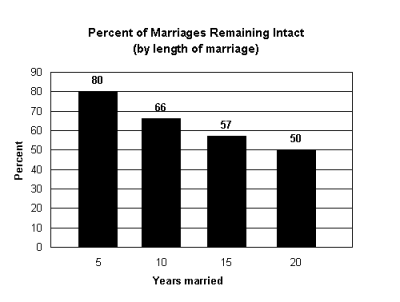
% of Marriages Remaining Intact

Source: National Center for Health Statistics, Centers for Disease Control and Prevention (2001)
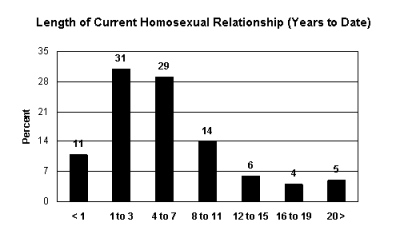
Length of Current Homosexual Relationship

Source: 2003-2004 Gay/Lesbian Consumer Online Census

Monogamy vs Promiscuity
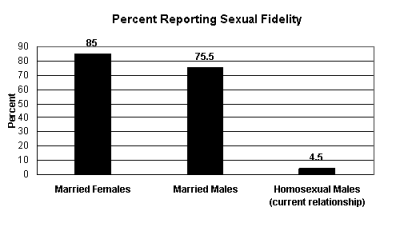
% Reporting Sexual Fidelity

Sources:Laumann, The Social Organization of Sexuality, 216; McWhirter and Mattison, The Male Couple: How Relationships Develop (1984): 252-253; Wiederman, “Extramarital Sex,” 170.

Rates of intimate partner violence
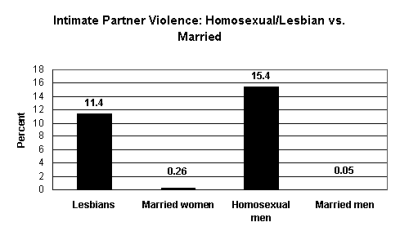
Intimate Partner Violence

Sources: “Extent, Nature, and Consequences of Intimate Partner Violence,” U.S. Department of Justice: Office of Justice Programs: 30; “Intimate Partner Violence,” Bureau of Justice Statistics Special Report:11.

Conclusion

Marriage is a relationship that has a specific purpose. That purpose is to bind together two opposite natures and to produce children that are biologically linked to the parents. The children gain the benefits of being parented by the two different natures, so they get two perspectives. The fact that the children are genetically linked to two parents helps to ensure the stability of the commitment, as we see in the animal kingdom where animals protect their young.

The goal of marriage is not to increase the happiness of the adults, or to “recognize” the love of adults. The goal of marriage is have two people enter into a relationship where they understand that it is not about adults being fulfilled. Marriage is about people having a goal of raising children, which are tremendously stressful to raise. Marriage requires self-denial and sacrifice in order to raise those children – that is the main point of it. It also requires fidelity and chastity, so that the environment is kept stable for the children over a long period of time.

Children benefit from the stability that is more common in traditional marriages than it is in other arrangements, including heterosexual co-habitation which is similarly unstable (50% greater chance of divorce, more domestic violence, etc.). Therefore, it is important to keep the concept of marriage separate from other kinds of relationships so that the focus on commitment for the sake of the children is clear to those who contemplate marriage. Society needs to give special recognition to married couples, in view of their child-focused commitment.

I apologize in advance if this post causes anyone any harm or distress, I am just trying to explain why people have that opinion. They could be wrong, but that is the case they make. Obviously, married couples fall short of the goal, but that is their goal.

Further study

Two much bigger challenges to marriage are big-government socialism and especially no-fault divorce. I also wrote about same-sex marriage and co-habitation before, in the context of European states like Sweden and Norway.

You may also be interested in a recent post about whether homosexuality is caused by a “gay gene”.

Bill Maher mocks Carrie Prejean’s stand on marriage

Spotted this video over at Hot Air, posted by AllahPundit, who is an atheist. He is beginning to question whether atheism leads to great heights of moral behavior. You’ll recall that this is one of the factors that convinced A.N. Wilson, as well as the Wintery Knight himself.

Atheism maintains that the universe is an accident, that there is no objective moral standard, no free will, no accountability when you die, no ultimate significance to our actions, no after-life, and no one to whom moral duty is owed. Bill Maher is a committed atheist. Let’s see what counts as morality on atheism.

And here is an excerpt from AllahPundit’s comments:

A quickie from last night’s show displaying all the charm and subtlety we’ve come to expect, and surely the first time in his life that he’s had an unkind word to say about breast implants. There’s something cosmically apt about him attacking her: No one in American media better embodies the lefty paradox of libertinism paired with judgmentalism, therefore no one’s better qualified to prosecute her for the left’s capital crime of hypocrisy.

Why are atheists making moral judgments in an accidental universe, where their moral standards are just their own personal preferences, or at best the arbitrary conventions of their society? Why even attribute blame to Carrie Prejean if she doesn’t even have free will, which is an impossibility on atheism, since we are just mindless matter?

There are some things that other people do that I don’t like based on personal preferences. For example, I do not like people who spend a lot of time following sports or watching popular movies in the theater. But I don’t insult them for not complying with my preferences. And that’s all morality is, on atheism. Individual preferences and cultural conventions.

You can only judge others if there is an objective standard that is binding on this other person. What sense does it make to mock and deride people who have different preferences than you do? It seems as if atheists do believe in objective morality, however inconsistently. But only when judging others, never when judging themselves.

Christianity and the birth of modern science

UPDATE: Welcome, visitors from Free Canuckistan! Did you know that Binks is a web elf? It’s true!

Super-commenter ECM sent me this post from Pamela Geller’s blog, Atlas Shrugs. I thought that this was something wonderful because this is not an area of expertise for me, although it is something that I do get questions about, because atheists believe that Christianity is anti-science, and I need to know how to respond. The post discusses an essay by the blogger Fjordman.

And here’s how it starts:

Neither Roman, Egyptian, Chinese nor Indian civilization created the Scientific Revolution; they all stagnated after making initial gains in knowledge. This is because the natural human tendency is to want immediate results. If the research does not yield reasonably quick benefits, interest wanes. Yet you needed a critical mass of accumulated knowledge before the Scientific Revolution could be ignited. The Bible commands mankind to subdue the Earth, but in order to do so, men need to understand how the world works. In addition to this, the Bible portrays God as a Creator who made the universe work according to rational laws. Since God’s laws are immutable, it remains for us to discover them. Many of the scholars who created modern science, including Galileo and Newton, believed that they were honoring God by studying his Creation. They saw science as a religious duty.

Now, I’ve blogged on the vital importance of scientific progress to the Christian worldview. Let me be clear. We are in a period of economic abundance which exacerbates arrogance, hedonism and disdain for theology and morality. We absolutely must avail ourselves of every sign of creative and/or intelligent activity in the natural world. And that means science must progress.

The essay then cites an Oxford University Press textbook by James Evans as follows:

“…Kepler went on to become the most outstanding mathematical astronomer of his generation. His greatest gifts were inexhaustible patience, great calculating ability, and a relentless drive to understand. But his motives for astronomical research always involved a quest for higher knowledge. Everywhere, he sought for connections between apparently disparate realms of thought. He wanted to know God’s plan for the cosmos….”

Fjordman then continues:

While leading scholars during the Scientific Revolution such as Galileo, Kepler and Newton were indeed inspired by the mathematics of the ancient Greeks, their Christian world view made the connection between mathematics and the natural world even more powerful and explicit. Isaac Newton spent a great deal of time looking for hidden codes in the Bible, and undoubtedly believed that he was studying both of God’s Books: The Bible and the Book of Nature. Nothing similar happened in East Asia, or indeed in any other civilization.

But wouldn’t any old monotheism do in order to ground natural laws? Agnostic sociologist Rodney Stark says no:

…Rodney Stark agrees that Islam does not have “a conception of God appropriate to underwrite the rise of science…Allah is not presented as a lawful creator but is conceived of as an extremely active God who intrudes in the world as he deems it appropriate. This prompted the formation of a major theological bloc within Islam that condemns all efforts to formulate natural laws as blasphemy in that they deny Allah’s freedom to act.”

Fjordman continues:

In contrast [with Islam], for Jews and Christians, God has created the universe according to a certain logic, which can be described. Kepler firmly believed the Solar System was created according to God’s plan, which he attempted to unlock. Sir Isaac Newton was passionately interested in religion and wrote extensively about it.

And it ends with this:

Does mathematics have an independent existence in nature or does the human mind invent it? The answer potentially has huge philosophical implications. The people who created modern science lived predominantly in Europe, an overwhelmingly Christian continent with an important Jewish minority. They apparently had an advantage when they assumed the universe to be designed by a rational Creator. I admit this is a challenging dilemma for those of us who are not religious: Why can nature apparently be described mathematically and rationally if it has not been designed by a rational Creator? As a non-religious man, this is the only religious argument that I find difficult to answer.

It’s an interesting essay. It made me think of this article by Walter Bradley in which he talks about the relationship between mathematics and nature as a pointer to an intelligent designer. For those interested in the relationship between Christianity and science, please take a look at the index of Christianity-related posts.