Tag Archives: Loans

Big government spending is suffocating the next generation with debt

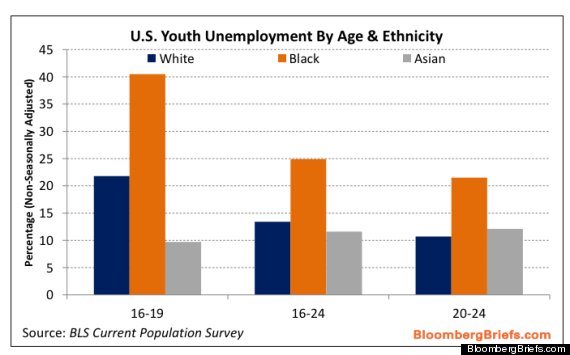
Youth unemployment by ethnicity (5/13)

Libertarian economist Veronique de Rugy writes about it in Reason magazine.

Excerpt:

A word of caution for kids heading off to college this year: Your degree may be worth less and cost more than you think. Your job prospects will likely be grim, whether or not you get that sheepskin. Oh, and you’re on the hook for trillions in federal debt racked up by your parents and grandparents.

Washington has willfully ignored the looming crisis of entitlement spending, knowingly consigning young Americans to a future of crushing debt, persistent underemployment, and burdensome regulation. Politicians on both sides of the aisle share the blame.

This summer, Congress made a big bipartisan show of cutting student loan rates to 3.4 percent from an already artificially low 6.8 percent. But even that seemingly helpful gesture will wind up hurting the Americans it claims to help. Federal student aid, whether in the form of grants or loans, is the main factor behind the runaway cost of higher education. Subsidies raise prices, leading to higher subsidies, which raise prices even more. This higher education bubble, like the housing bubble before it, will eventually pop. Meanwhile, large numbers of students will graduate with more debt than they would have in an unsubsidized market.

And when those new, debt-laden graduates head out into the labor market with their overpriced diplomas, they may not be able to find a job. According to data provided to me by my Mercatus Center colleague, former Bureau of Labor Statistics (BLS) commissioner Keith Hall, fewer than half of Americans today between the ages of 18 and 25 are employed. For those in that cohort actively on the job market, the unemployment rate is 16 percent, versus 6 percent for job-seekers aged 25 and above.

These young folks are also more likely to be long-term unemployed: While accounting for just 14 percent of the labor force, they make up 19 percent of the long-term unemployed, defined by the BLS as 27 weeks or longer.

The lucky few young’uns with jobs of some kind also suffer from rampant underemployment. In a recent blog post, Diana Carew of the Progressive Policy Institute wrote: “In July 2013, just 36 percent of Americans age 16-24 not enrolled in school worked full-time, 10 percent less than in July 2007.” In other words, of these 17 million young Americans, 5.6 million were working part-time, 3.2 million were unemployed, and 8.4 million were out of the labor force altogether.

I really recommend you read the rest of the article, especially if you aren’t following what Obama’s policies are doing to our economy. Special attention is given to the effects of Obamacare on job creation.

Just as a community service, I want to post for you young people (and your parents) a list of the majors that lead to higher paying jobs:

Top 10 highest-paid college majors

  1. Petroleum Engineering: $120,000
  2. Pharmacy Pharmaceutical Sciences and Administration: $105,000
  3. Mathematics and Computer Science: $98,000
  4. Aerospace Engineering: $87,000
  5. Chemical Engineering: $86,000
  6. Electrical Engineering: $85,000
  7. Naval Architecture and Marine Engineering: $82,000
  8. Mechanical Engineering: $80,000
  9. Metallurgical Engineering: $80,000
  10.  Mining and Mineral Engineering: $80,000

And here are some majors that you should avoid at all costs:

  1. Counseling Psychology: $29,000
  2. Early Childhood Education: $36,000
  3. Theology and Religious Vocations: $38,000
  4. Human Services and Community Organization: $38,000
  5. Social Work: $39,000
  6. Drama and Theater Arts: $40,000
  7. Studio Arts: $40,000
  8. Communication Disorders Sciences and Service: $40,000
  9. Visual and Performing Arts: $40,000
  10. Health and Medical Preparatory Programs: $40,000

So young people need to be careful what they study in order to get a job that will allow them to pay off all the government debts that their teachers were busy running up. Their teachers taught them that government spending was good, but their teachers aren’t going to be paying for the government spending. They are the beneficiaries of the increased government spending. The pupils are the ones who will have to work to pay for the spending on the social programs enjoyed by their teachers.

It’s very important for young Christians to understand that degrees are getting more expensive, and it’s important to choose a field that is going to produce a return on your investment. Not only do STEM (science, technology, engineering and math) degrees get you a job that pays, but it has other benefits. For example STEM degrees grind out every last bit of impracticality and entitlement-feeling out of you – because in a STEM program, no one cares about your “specialness”. You solve problems or you fail the class. It’s not a situation where you can just repeat what the professor says in order to get good grades, as is often (but not always) the case in the humanities. 

One-third of recent college graduates say they should have skipped college and gone to work

From Forbes magazine, a word of caution to young people, especially to young men who intend to marry and have children.

Excerpt:

Here’s an indication of how burdensome student loans have become: About one-third of millennials say they would have been better off working, instead of going to college and paying tuition.

That’s according to a new Wells Fargo study which surveyed 1,414 millennials between the ages of 22 and 32. More than half of them financed their education through student loans, and many say the if they had $10,000 the “first thing” they’d do is pay down their student loan or credit card debt.

That’s no surprise when you consider student borrowing topped the $100 billion threshold for the first time in 2010, and total outstanding loans exceeded $1 trillion for the first time in 2011.  Student loan debt now exceeds credit card debt in the U.S. which stands at about $798 billion.

The problem sometimes is that not all college educations are worth their cost since they can’t guarantee a high-paying job to help pay off that student debt. A report from the National Association of Consumer Bankruptcy Attorneys says the rising student debt problem can have a bad impact on the economy. Even in the best of economic times when jobs are plentiful, young people with considerable debt burdens end up delaying life-cycle events such as buying a car, purchasing a home, getting married and having children.

There’s nothing wrong with a good education in a trade school or community college.

The actual number for outstanding student loan debt is about $600 billion, and it’s gone up a lot under Obama.

Excerpt:

The outstanding balance for all of the direct student loans the federal government has issued topped $600 billion in April, according to newly released data from the U.S. Treasury.

The total balance hit $600.457 billion by the end of April, says the Treasury, up from $592.142 billion at the end of March.

The Federal Direct Student Loan Program already has built-in debt forgiveness plans for people who end up earning low incomes or for those who entered lines of work preferred by the government.

In January 2009, when Obama was inaugurated, the balance was $119.803 billion and has since increased more than fivefold.

The $480.654 billion increase since January 2009 in what is owed to the Treasury in direct student loans represents a climb of about 250 percent in just over four years.

Before Obama’s first term, federally guaranteed student loans were made both by the government directly and by private lenders using their own capital through what was called the Federal Family Education Loan program. Language inserted into the the Obamacare law signed in March 2010, however, abolished the latter type of federally guaranteed student loan, giving the U.S. Treasury a monopoly over those loans.

As the Congressional Research Service has described it, this Obamacare provision made the U.S. Treasury the exclusive “banker” for federally guaranteed student loans. Thus, U.S. taxpayers essentially own these loans.

The troubling thing is that since the schools have spent all the time teaching children about global warming and the proper use of contraceptives, it’s unlikely that they will be able to find real jobs in order to pay off their loans. They aren’t learning how to manage money in school, and parents aren’t taking the responsibility to teach kids about money at home. The sad thing is that they have been taught by their teachers to keep voting for more politicization of education and more government spending on fashionable causes. But at least they feel superior about it. For now.

A look at homeschooling and alternatives to college

I do think that college can still be a good deal as long as you are careful to choose a major that will re-coup the costs of your education in a timely fashion. That will probably mean a STEM degree in something like computer science or petroleum engineering. I myself have the BS and MS in computer science, and I think that those are excellent choices for a man to deliver on his obligation to provide for a family. But it was a much better deal back when tuition was very low, and salaries were very high. Plus, public schools used to me much better at preparing you to go to school to learn STEM subjects. These new problems: underperforming public schools, college debt, and a weak job market, it makes sense to consider alternatives to the mainstream education system.

Here’s an article about homeschooling – an alternative to brick-and-mortar schools – that was posted in the Wall Street Journal.

Excerpt:

Today in the U.S., some two million children are home schooled, growing at an annual rate of 7% to 15% for over a decade, according to the president of the National Home Education Research Institute. The term “home schooler” once implied “isolationist religious zealot” or “off-the-grid anarchist who makes her own yogurt.” Today, it also means military parents who hate to see their kids keep changing schools; or the family with a future Olympian who ice skates five hours a day; or your cousin whose daughter is gifted but has a learning disability. The average home schooler is no longer a sideshow oddity.

“I could never ever teach math,” more than a few parents told me in horror at the very idea of home schooling. Or science. Or a foreign language. But mostly, it was math. Here’s my secret: I can’t teach math either. Once they start calling them integers instead of numbers, I recoil as from a fat, angry snake, which is why Alice takes an online math class, with great lashings of help from her father.

But the biggest thing people want to talk about is socialization. Everyone is worried that I keep my child in a crate with three air holes punched in it and won’t let her have friends until she gets her AARP card. There’s a long answer, of course, but I’ll sum it up this way: Homo sapiens have walked the Earth for at least 130,000 years and, in this time, they learned to be human from their elders, not from their peers. Mandatory education in the U.S. is less than 150 years old. Learning to be a productive adult human by spending a third of every day with other kids might be a good idea, but it’s too soon to tell. I’m still unsure that the people best equipped to teach a 14-year-old boy how to be a man are other 14-year-old boys.

In fact, home-schooled kids are just as socialized as other children. They certainly seem to grow up to be, and feel, fully engaged. One study, by a Canadian home-schooling group, found that 67% of formerly home-schooled adult respondents said they are “very happy,” as opposed to the general population’s 43%. Another study, published in the Journal of College Admission, found that home-schooled students perform better on their ACTs, have higher college GPAs and are more likely to graduate in four years.

So how far would you go with alternatives to mainstream education? Well, the smartest engineer I know doesn’t even have a college degree in computer science – or the student loans that often go with them.

Just look at these numbers: (links removed)

Across the nation, graduates are tossing their caps into the air and investing their hopes of success in their sheepskins. Not since the Magna Carta has so much faith been put into a piece of paper; indeed, belief in the college diploma seems these days to outpace belief in the document that binds a man and a woman. For the past couple of generations, conventional wisdom has said that a college degree is the golden ticket to a great job. For a time, because of the simple laws of supply and demand, this was true.

In 1947, when just 5 percent of Americans age 25 and over held at least a bachelor’s degree, the supply was low, making demand for degreed employees higher. However, with easier access to college through taxpayer-funded student loans, today’s bachelor’s degree has become yesterday’s high-school diploma. Now that over 30 percent of Americans 25 and over have a college degree—and the President has called for that figure to grow to 60 percent—the supply is up, which might help explain why 53 percent of recent graduates are unemployed or underemployed.

What’s more, the burgeoning cost of college means that even for those who do land good jobs after graduation, payoff on their investment will be diminished and take more time. The graduation rates tripled between 1980 and 2010, rising 37 percent between 1999 and 2010. Two-thirds of bachelor’s degree recipients graduated with debt in 2008, compared with less than half in 1993. The average debt for last year’s college was $24,000, while the total outstanding national student debt has passed $1 trillion, more than the nation’s credit card debt. Not surprisingly then, the national student loan default rate is on the rise, too, hitting 8.8 percent for the 2009 budget year. Even the number of Ph.D. holders on public assistance has made recent headlines.

College still works for people, but you have to choose your major more carefully – or just choose to focus on practical skills and then attend a trade school. It’s probably a good idea to put more emphasis on getting work experience at an early age, no matter what you do after high school. Work experience is very important for getting a job, which is why the liberal fixation on higher minimum wage rates hurts younger workers. Sometimes, online degree options can be more cost effective than regular school, but again work has to be done to see where the jobs are and what skills are required before you make a decision.

People sometimes ask me whether this is it for civilization, and I point to new discoveries and feedback mechanisms like these alternatives to government-run or government-regulated schools as an example of how we can get things turned around. What taxpaying parents need to realize is that they have to start thinking practically about laws and policies that promote freedom in education. We have to vote for more choice and competition, and lower taxes, so that we can buy what we want instead of letting an ideologue who has spent his or her entire life in a bubble decide for us.