

Tag Archives: Feminism

54-year-old feminist angry at dating agency for not finding her a rich husband

Kate Mulvey at age 53 expects that rich men will want to marry her

A little while ago, I blogged about a 47-year-old mother of three who sued a dating agency for failing to find her a rich husband. That was pretty bad, but I found something even worse. A 54-year-old woman who spend all her savings on a dating agency. She expected them to find her loads of rich men who want to marry her – despite her never having invested anything in them.

The UK Telegraph reports:

Glass of wine in hand, the man sitting opposite me in the restaurant was in full flow. While he was droning on about his work commitments, I zoned in and out trying to work out how on earth I was going to get to through this first date. I had expected to meet an eligible bachelor, but he had turned out to be so boring that he made me want to stick asparagus up my nostrils.

This memory came flooding back when I read about, Tereza Burki, a City financier who, last week, successfully sued a Knightsbridge-based elite matchmaking service, for the return of her £12,600 annual fee after they failed to find her the man of her dreams.

A couple of years ago, I too joined an expensive matchmaking agency. I had just come out of a seven year relationship, and was on the wrong side of 50.

I soon tired of online dating and receiving messages from over weight baldies who peppered their emails with childish emojis. I hankered to find Mr Right-for-me, a man who was suitably educated and a successful professional.

And so this is how I found myself, throwing money (my entire savings to be precise) to an upmarket matchmaking agency in central London. The agency claimed to filter out the undesirables, the mediocre and give clients the personal touch, so I handed over the hefty sum of £6,000.

As I waited to be matched with someone from their ‘extensive database’, I idly imagined my handsome date, cashmere polo neck, a bit academic and kind. We’d eat steak tartare and swap notes on our latest clever box-set find and favourite novels.

The first indication that all was not as I had expected came when I met personal matchmaker at a Park Lane hotel for ‘tea and an interview’…  told her how I loved folk music, my favourite film was The Deer Hunter, and enjoyed weekends in the countryside.

[…]A few days later she emailed me with the details of W, “a successful entrepreneur who had travelled extensively and also liked folk music”. When I met him at a pub in Richmond, I was shocked. I was expecting a cultured and dynamic man, instead I got a man in a pair of jeans, a moth eaten jumper and the table manners of a modern day Baldrick.

And therein lies the rub. These agencies trade on their exclusivity, yet the men I met were far from the international super elite they promised.

Isn’t this terrible? Clearly the dating agency is to blame. It should be easy for a penniless, feminist hedonist to find rich men who want to spend all their money taking care of a 54-year-old woman who had literally nothing to do with the process by which they earned all that money.

One thing we know about her for sure is that she is impractical. She is 54 years old and has just spent her last savings on a dating agency. From her other comments about the type of men she is looking for, we can infer that she wasted a lot of money on travel, fine dining, and other frivolous experiences designed to produce feelings of sophistication without any practical plan for preparing for the financial demands of old age. What’s the point of having fun “in the moment” if you don’t have any plan to allow sustainable recreation in the future, when you’re too old to work?

I spent some time reading articles by Kate Mulvey, and here is what I was able to determine:

  • she has no useful degrees – she paid for useless degrees in Italian and French, instead of studying something useful, like computer science or nursing or petroleum engineering. Her “writing” is all about fashion, dating and “lifestyles”
  • her opinion on children: “uppity children take your time, emotions and energy” – she sees children as a detriment to her highest priority (her career). She says “I, however, have lived a life of unfettered freedom to take on projects, write books and travel”
  • she had loads of entertaining men “beating a path to [her] door” when she was younger
  • she spend thousands of pounds on plastic surgery
  • she blames her lack of marriage success on her being “brainier” than men
  • she turned down men who wanted to marry her, as late as age 33
  • her book is called “Accidental Singleton” because she thinks that her approach to life – anti-marriage hedonism – has “accidentally” left her single and penniless at age 54 (as if it wasn’t her fault!)

Although she talks a lot about being intelligent, it seems to me that an intelligent woman would have practical degrees, savings and an awareness of what men actually want from a woman – and WHEN they want it. Men want a woman to support them in their most difficult period, just after they graduate and hit the job market. Starting out in a career is hard because the man doesn’t have savings or a resume or references. The support of a young, attractive, virtuous woman means everything during those difficult years. This is when a wife has the most impact on her husband’s ability to earn and save, on his mental health, on his physical health, etc.

Somehow, this narcissist thinks that she can just show up in a man’s life, after he has done all his earning alone, and grab hold of the things that she never helped build. She wasted all her youth and beauty chasing experiences with attractive bad boys, but she thinks that it’s reasonable for a man to invest all his wealth in her. A woman has value to a man at the time when he is attempting to do difficult things, but lacks support.

What exactly is it that a woman like Kate has to offer a man, given her life choices? Does anyone think that this woman has marriage-character? Does anyone think that her life of selfishness and hedonism has prepared her to be a good wife? What kind of conversation about moral obligations could you have with someone who has only ever done what felt good to her in the moment? Has her string of failed relationships with hot bad boys prepared her to be trusting and unselfish? How about to be faithful? Or even to be content? What is it that she thinks that she is offering that would justify the heavy investment that she is asking for, especially in an age of no-fault-divorce and anti-male divorce courts?

I think people really underestimate how much goes into making a good wife. The character she has to develop. The skills that she has to develop. The way she treats her husband, which often comes from carefully cultivating virtues like chastity and sobriety. Her worldview, which affects whether she has practical abilities like love, forgiveness and self-control. Her ability to be good with money. Her ability to nurture others and make social connections consistent with marriage and homemaking. Her ability to bear children, and then nurture them during the critical first 5 years after – not to mention homeschooling, which is increasingly valuable in a time when underperforming government-run schools seek to indoctrinate, rather than educate, children.

Nothing about this woman makes me think that she has any marriage-related character traits or abilities. Any idiot can spend someone else’s money on their own feelings, fun and thrills. But it takes a carefully crafted woman to really do the work of a wife. Marriage isn’t there so that women can be happy. Marriage is an enterprise. Being selfish – doing what is easy, and what feels good moment by moment – doesn’t prepare a woman for the enterprise.
Wage gap: are women paid less than men because of discrimination?

The pay gap is caused by women's own choices
The pay gap is caused by women’s preference for having children

Liberal feminist Hanna Rosin takes a look at this question in the far-left Slate, of all places.

Excerpt:

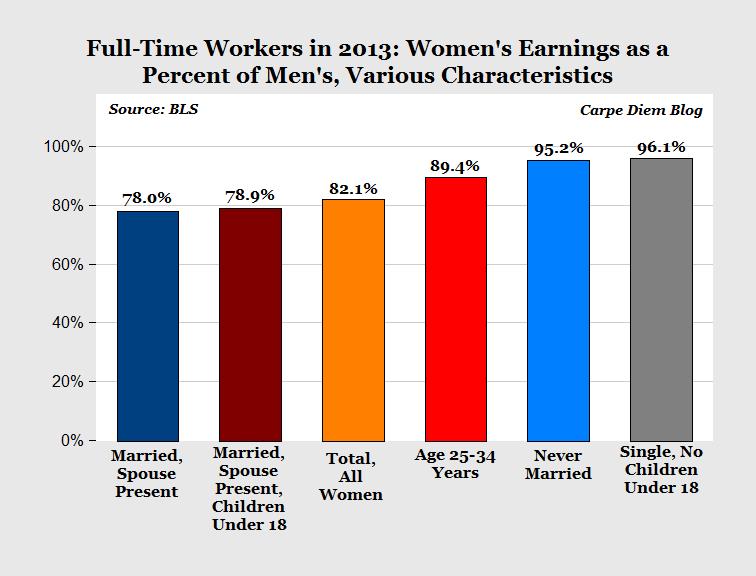
The official Bureau of Labor Department statistics show that the median earnings of full-time female workers is 77 percent of the median earnings of full-time male workers. But that is very different than “77 cents on the dollar for doing the same work as men.” The latter gives the impression that a man and a woman standing next to each other doing the same job for the same number of hours get paid different salaries. That’s not at all the case. “Full time” officially means 35 hours, but men work more hours than women. That’s the first problem: We could be comparing men working 40 hours to women working 35.

How to get a more accurate measure? First, instead of comparing annual wages, start by comparing average weekly wages. This is considered a slightly more accurate measure because it eliminates variables like time off during the year or annual bonuses (and yes, men get higher bonuses, but let’s shelve that for a moment in our quest for a pure wage gap number). By this measure, women earn 81 percent of what men earn, although it varies widely by race. African-American women, for example, earn 94 percent of what African-American men earn in a typical week. Then, when you restrict the comparison to men and women working 40 hours a week, the gap narrows to 87 percent.

But we’re still not close to measuring women “doing the same work as men.” For that, we’d have to adjust for many other factors that go into determining salary. Economists Francine Blau and Lawrence Kahn did that in a recent paper, “The Gender Pay Gap.”.”They first accounted for education and experience. That didn’t shift the gap very much, because women generally have at least as much and usually more education than men, and since the 1980s they have been gaining the experience. The fact that men are more likely to be in unions and have their salaries protected accounts for about 4 percent of the gap. The big differences are in occupation and industry. Women congregate in different professions than men do, and the largely male professions tend to be higher-paying. If you account for those differences, and then compare a woman and a man doing the same job, the pay gap narrows to 91 percent. So, you could accurately say in that Obama ad that, “women get paid 91 cents on the dollar for doing the same work as men.”

I believe that the remainder of the gap can be accounted for by looking at other voluntary factors that differentiate men and women.

The Heritage Foundation says that a recent study puts the number at 95 cents per dollar.

Excerpt:

Women are more likely than men to work in industries with more flexible schedules. Women are also more likely to spend time outside the labor force to care for children. These choices have benefits, but they also reduce pay—for both men and women. When economists control for such factors, they find the gender gap largely disappears.

A 2009 study commissioned by the Department of Labor found that after controlling for occupation, experience, and other choices, women earn 95 percent as much as men do. In 2005, June O’Neil, the former director of the Congressional Budget Office, found that “There is no gender gap in wages among men and women with similar family roles.” Different choices—not discrimination—account for different employment and wage outcomes.

A popular article by Carrie Lukas in the Wall Street Journal agrees.

Excerpt:

The Department of Labor’s Time Use survey shows that full-time working women spend an average of 8.01 hours per day on the job, compared to 8.75 hours for full-time working men. One would expect that someone who works 9% more would also earn more. This one fact alone accounts for more than a third of the wage gap.

[…]Recent studies have shown that the wage gap shrinks—or even reverses—when relevant factors are taken into account and comparisons are made between men and women in similar circumstances. In a 2010 study of single, childless urban workers between the ages of 22 and 30, the research firm Reach Advisors found that women earned an average of 8% more than their male counterparts. Given that women are outpacing men in educational attainment, and that our economy is increasingly geared toward knowledge-based jobs, it makes sense that women’s earnings are going up compared to men’s.

When women make different choices about education and labor that are more like what men choose, they earn just as much or more than men.

New study: virgins have happiest marriages, more sex partners means more unhappiness

Although we live in a culture that is dominated by the thoughts and opinions of secular leftists, science provides useful information for those who want defend Biblical morality. Consider the issue of sexuality and marriage. Secular leftists claim that sex outside of marriage is natural, and produces happiness. Bible believing Christians and Jews say chastity is best. Who is right?

Here is the latest study authored by Dr. Nicholas Wolfinger, a sociologist at the University of Utah. His previous book on relationships was published by Oxford University Press. In his analysis of the data, Wolfinger controlled for divorce rates, religiosity, and socioeconomic status.

Here’s the most important graph:

Study: virgins have the happiest marriages, more partners means less happiness

Other factors that increased marital happiness: having a 4-year college degree (5%), having a salary > 78K (5%), regular church attendance (6%). Notice that women are more dissatisfied with marriage (in general) than men are, and they tend to blame the spouse they freely chose for that unhappiness.

The Federalist also reported on previous research relevant to this study:

Psychologists Galena K. Rhoades and Scott M. Stanley found that women who have had sex with someone other than their husband report statistically significant drops in marital quality over those who don’t. A 2004 study by sociologist Jay Teachman showed that intimate premarital activities such as cohabitation and intercourse increased the rate of marital dissolution by anywhere between 28 and 109 percent, depending on the activity.

Wolfinger also noted in a previous study that only 5% of women were virgins when they married.

Wolfinger noted that a possible explanation for the link between promiscuity and unhappiness is that people look back on their past partners and compare their spouse unfavorably to them. This is especially the case with women. My concern about this is that feminism has taught women to try to increase their social standing by having hook-up sex with attractive bad boys. If those women ever marry, they do it when they are older, less fertile, and less attractive. The husband they eventually “settle” for will (in their minds) always compare unfavorably to the hot bad boys they had sex with when they were younger and prettier. This, I believe, is what leads to their unhappiness with the man they chose to marry.

More partners also means more marital instability

In a previous post, I blogged about several studies linking virginity to marital stability. Couples who don’t have sex before marriage, or even who delayed it, reported better communication, higher satisfaction, better quality sex, and a lower chance of divorce.

Men ought to be aware of this research when they are choosing a spouse. Women initiate 69% of divorces, and the most common reason given is “unhappiness”. Well, now we know what’s causing that unhappiness – a high number of sexual partners prior to marrying. Smart men should prefer a virgin, for the increased happiness and increased stability. A large number of past sexual partners teaches women that relationships are engines for them to be happy, not commitments that are permanent and exclusive. They’ll have internalized the view that relationships are not commitments to invest in self-sacrificially. The pattern will be: “if it doesn’t make me feel happy right now, then it should be ended”. It will be seen as the man’s fault that she is unhappy, even if the study I talked about above shows the real reason is her past promiscuity. Men who aren’t serious about evaluating the character of the women for the marriage enterprise are running the risk of divorce, it’s that simple.

The best way to make sure that you have a clear head when evaluating a woman is to stay sober, and keep her hands off of you. When a man refuses to let a woman cloud his judgment with sex, then she is forced to learn how to love him in marriage-oriented ways, e.g. – help him, support him, and submit to his leadership. Male chastity encourages women who have been influenced by feminism to abandon selfishness, fun-seeking, and thrill-seeking, so that they learn to care for others. Male chastity also helps a man to resist older women who chose bad boys in their teens and 20s and want to get married to a good provider in their 30s. The studies discussed above clearly show that such women are more likely to be unhappy, and their future marriages are more likely to be unstable. Avoid them. You don’t want to be in a marriage to someone who isn’t very good at it, because she never prepared herself for it.