

Tag Archives: Feminism

The surprising pro-masculinity message in the “Far From the Madding Crowd” film

A man leading a woman upward
A man leading a woman upward: another in a series of posts designed to defeat feminism

So, I have about a half-dozen older and/or experienced Christian women who advise me and assist me in various ways. The wisest and most experienced is calm and thoughtful Dina. She has a very stressful job dealing with demanding women, and what she admires most in men is “masculinity”, which she defines as a man’s ability to tell a woman what is right and wrong, what God expects from her, what she should be doing with her life, and guiding her and providing for her through the steps to get there.

What makes Dina angry is when a man makes a fool of himself for youth and beauty, abdicating his role as moral and spiritual leader because of attraction / lust. According to Dina, men who have self-control think about what a woman should do that is morally right, with the goal of her producing a return for God. Men who are swayed by youth and beauty are willing to give up that leadership role in exchange for attention and/or sex.

So, with that said, Dina asked me to watch a recent movie called “Far From the Madding Crowd“, based on a novel by Thomas Hardy. I immediately said “no” because I know about Thomas Hardy from Tess of the D’Urbervilles, where he presents Tess as the helpless victim of Providence. I really hate that view of women, where they can do reckless, selfish things and then blame everyone but themselves for the destructive consequences of their own free-will decisions. But Dina said “wasn’t I right about the debate between David Robertson and Matt Dillahunty?” I said yes, and watched the movie. And of course, she was right, as she almost always is. This movie is a punch in the face to radical feminism, and the leading man is indeed a masculine leader, according to Dina’s definition of masculinity.

Here is a review of the movie by another lady I admire, Rebekah, up at her blog “The Thoughtful Christian Parent”.

Rebekah writes:

What does this 19th century tale offer to modern audiences?  This latest rendering emphasizes something actually surprising and unexpected given that it is made in our age of radical feminism.  It is Gabriel Oak’s character that shines the most, not the proto-feminist Bathsheba.  […]In Bathsheba and Gabriel we see how men and women support one another in such a way as to ensure a flourishing in any role that fate might thrust on them.

[…]The relationship between Gabriel and Bathsheba, though unequal in earthly terms of authority and wealth, is one of mutual dependence.  We see Oak taking on a role of both counselor and conscience with Bathsheba – roles that in her striving towards independence she struggles to admit her need for.  She is not unlike the modern feminist in this regard, nor is she unlike all of us in our relationship with the Lord.  Her struggle is best seen in the various times she repels Gabriel only to find herself in desperate situations in which only he can help.  The filmmakers’ clever use of a recurring theme of Bathsheba galloping after Gabriel on a horse when he is needed is particularly moving (and surprising) here.  In the end, the film resists the urge to pander to our more extreme modern views on what women require to thrive.

Gabriel Oak also seems to be an embodiment of the biblical virtue of selflessness.  We see in his actions towards Bathsheba the Philippians admonition to refrain from “being motivated by selfish ambition or vanity,” but rather “in humility, be moved to treat one another as more important than yourself.” Indeed, vanity itself can be seen as a fateful character flaw of every major character apart from Gabriel.  He alone is able to move past rejection and carry on.  In fact, he is required to go so far as to be under the authority of the very woman who rejected his offer of marriage and, despite his continuing affections for her, witness her being courted and then married by another far less worthy man, Frank Troy.  No other major character is able to accomplish this challenge to their pride.  Though Bathsheba does eventually overcome the rejection of her husband, she only does so after tremendous tragedy and with the selfless and steady support of Gabriel.

Gabriel respects her independence, but, like a good shepherd, stays close by to protect and guide her.  Though he cannot protect her from her free-will choices, he does warn her.  He then remains faithful to her in the midst of the trouble she brings upon herself.  In this, he is not unlike our God, for he allows her to stray, all the while letting her know of a better course when asked.  And, she does ask.

In an important scene at a party, where Bathsheba must decide whether or not to marry a particularly obsessive suitor, when she asks, “Tell me what to do, Gabriel,” he simply tells her to “Do what is right.”  Is that not like our Lord?  Gentle shepherd, indeed, for our wild, independent hearts.  In this, I see Gabriel as most suitable for the role as the husband written of in the epistle to the Ephesians.  He loves Bathsheba “just as Christ loved the church and gave himself for her…”

Men and women both struggle with self-centeredness, but men usually work themselves out of it by studying hard things in school, and doing hard work that pays. Men have a natural desire to provide for others, and it is actually a duty laid out for them in the Bible. As a result of studying and working at things they don’t like, men typically are better at resisting their feelings and desires. In fact, if you ever want to make a woman less self-centered and emotional, leading her to study STEM and work a demanding job is a good plan. Both Dina and Rebekah – like all of my female advisors – have STEM backgrounds, and demanding work histories.

I would be suspicious of men who don’t prioritize providing, especially as they get older, because it is the experience of self-denial and endurance that helps a man to want to lead a woman to do the same: deny her feelings and desires, and make prudent decisions that will allow her to love and serve others – including God – in a sustainable way. Over the long-term, this practice of effective, self-sacrificial love will be worth more to the woman than the short-term pursuit of fun and thrills. And men know this – we can look ahead and see where a woman needs to be, and then coach her on the interim steps, however difficult those may seem in the moment.

Dina’s advice to young women

I asked Dina to take a look at the draft of this post before I hit “Schedule” and Dina said:

What I would advise to all young women is not to expect a Gabriel Oak to be waiting for you at the end of your reckless years of hooking up, partying and wasting your youth on fun and men who have no desire to lead you to God or guide you to goodness. Don’t expect the hot stud that your friends approve of to turn into someone with the character of Oak with the magic powers of your premarital sex life. Find a man who doesn’t give in to your every whim, because if he does, you will only resent him for it, and blame him, for being what you thought you wanted him to be.  Find a man who leads, one who demonstrates self control, self denial, who can provide and protect. And most importantly, respect him for doing it.

Emphasis mine.

Sound advice from the Dina, young ladies. By the way, Dina’s favorite drama is the BBC production of “North and South” from 2004. I also give it a 10/10. If you’re looking for a good movie to get for Christmas, I recommend asking for that one.

Rebekah’s comments on the post

Rebekah wrote to me privately to react to the post:

I think you’ve touched on something important that’s a pitfall for women today – and really, men, too, but maybe less so – we live in a time of radical autonomy PLUS radical “feelings” orientation. Yes, I agree, women might be more prone to being affected by these because we do tend to be more feelings oriented. Plus, the pendulum has swung w.r.t. women’s rights compared to Hardy’s day.

Yet, can I say that from my virtuous single women friends I hear that it is hard to find a man that acts like a grownup? They are finding that many men watch porn and play video games after work each evening. They are not being responsible with their hearts – porn WILL affect their marriage one day. It’s a huge temptation for them. I think this is a major pitfall that men face today.

And, notice that each of these pitfalls – of men and women – feed and reinforce the other.

I would recommend STEM for everyone since the humanities have become so radicalized. I wanted to be an English major, as well, but my father wouldn’t let me because of the leftist values in those departments. STEM is a much safer bet and much surer return for the $$ spent.

That’s a generalization, though. I have a friend that majored in English at Hillsdale – a very conservative university. She’s amazing and brilliant. So, there are exceptions – I am sure you’d agree.

I am glad you liked the movie. And, I agree “North and South” is excellent – one of my favorite books and movies.

There are exceptions, I do agree.

Finally, I have some advice for Christian men. If you pick women who will advise you, don’t pick women who just want attention and control over you. Pick women like Dina who understand your male nature and will attempt to persuade you with facts and arguments, not feelings and sex appeal. And whatever you do, don’t marry someone who cannot communicate and disagree with you in an analytical way. That becomes a nightmare when they have the leverage of no-fault divorce to hold over you.

Survey: women explain why they avoid having children

Is it OK to tell women they are wrong?
Are women today genuinely interested in marriage and children, or do they have other plans?

This article comes from the leftist Huffington Post.

They write:

The Huffington Post and YouGov asked 124 women why they choose to be childfree. Their motivations ranged from preferring their current lifestyles (64 percent) to prioritizing their careers (9 percent) — a.k.a. fairly universal things that have motivated men not to have children for centuries. To give insight into the complex, layered decisions women make, HuffPost asked childfree readers to discuss the reasons they have chosen not to have kids and gathered 270 responses here.

They grouped the responses into 5 categories:

  1. I want to prioritize my career
  2. I don’t like children
  3. I had a bad relationship with my parents
  4. I don’t want the financial responsibility
  5. I like my life as it is

And here are some of the ones that I thought were the most interesting, and pay attention to the ones that include fear-of-missing-out travel, which I blogged about before:

Category 1:

I am a first-generation college graduate in my family. My mother was a single mom my entire childhood, and I was there to see that struggle. Being a parent, for a woman, means for life. Being a parent, for men, seems to be something very different. I understand raising children is a big life change and I don’t want to sell myself short on my potential to become something more and maybe even create change. I am childfree because I want to travel, move, pursue my career wholly and be able to push myself to be an inspiration to other women. If a child comes into my life, it won’t be until I am happy and successful in my work life, and not until I am secure with my finances and a marriage. I don’t want to one day wake up as an old woman wishing I had waited to have children so I could live my own life first, make mistakes, learn new things and find myself. Today kids are not for me.

Category 2:

I’m nearly 47; my boyfriend (domestic partner) of 17 years is nearly 50. I’ve never been pregnant and have taken every precaution to remain childfree. I tolerate other people’s children when I have to. I’m happiest when there are NO children around. I definitely don’t want them in my home. I like my life as it is. My boyfriend and I are both scientists. We also raise snakes and spiders! We like to travel. We travel to ride roller coasters (members of ACE — American Coaster Enthusiasts) and to attend rock concerts. I am also a performer in a senior winter guard. My plate overfloweth! I see no reason to procreate. I would be unhappy. Why be unhappy?

Category 3:

I have a great relationship with my husband. We have the time and money to travel, and that gives us precious memories. I had a bad relationship with my dad, and maybe I’m scared to treat my children like that. I’m very happy with my decision. I have a great relationship with myself too.

Category 4:

My spouse and I have talked in depth about having children. However, we both decided that our desire to travel the world is a financial burden in itself. If we have kids, we will never have the means to travel, and at the end of our life, we would rather be 100 percent committed to fulfilling our own realistic dreams rather than only able to provide a subpar life for a child. Comes down to the fact we are selfish, but at least we recognize this and made the choice early enough to avoid damaging a kid

Category 5:

The thought of having to do kiddie crap every weekend makes me want to shoot myself. I like having the extra money to save for retirement and not worry about braces, summer camp or college tuition. I can travel on a moment’s notice. I can give my all to my job and not have to worry about daycare, sick days, or having to leave my co workers to pick up my slack. I’m the “cool aunt” to all my nieces and nephews. I have more time to do the things that make me happy and productive. My relationship with my guy is not strained due to the constant neediness of children. I don’t want to put my body through pregnancy and childbirth. I can give my dog all the attention he needs and deserves.

If I had to choose one comment to represent the entire survey, it would be this one:

The moment you have children, you’re life ceases to be about yourself. Kids always take priority and I feel like I can do more for this world than just generate offspring.

Or maybe this one:

I honestly feel too lazy. I haven’t achieved enough, and if I had a child I would “just be a mom,” which isn’t enough for me or what I want out of life.

I think this is the real reason why young, unmarried women choose not to prepare or plan for marriage and children . Marriage and children “some day” is like planning for your retirement by winning the lottery. Marriage and children “some day” is an excuse to signal to family and friends that you will eventually want the responsibility of a husband and kids, but that you are justified in being self-centered right now.

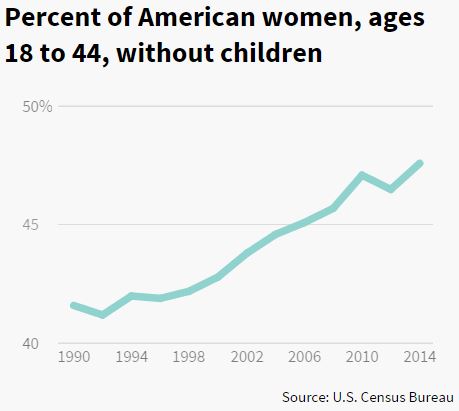
We need to move beyond a survey to quantify this, and this U.S. Census data does that:

Childless by choice, not because of men
Childless by choice, not because of men failing to “man up”

These quotations are very troubling if you are a young man who has been serious about obtaining STEM degrees, saving money by not traveling, and making a plan to have a marriage and family that will serve God. I am seeing real hostility in young, unmarried Christian women to the idea that marriage will impose responsibilities, expectations and obligations on them. And their parents, relatives, friends and co-workers are doing nothing to detect and counter this attitude. As Lindsay argued on this blog before, the marriage / children plan is an excellent way for Christians to make a difference. It will take a lot of work, but it makes much more of a difference for the kingdom than just doing whatever makes you feel happy.

A friend of mine named Bee commented on an early version of this post::

Sad to say this but many Christian voices are encouraging Christian women to travel, date around and delay marriage and childbirth. Here are several negative voices:

Mandy Hale is a Christian woman who is mid 30’s, never married and has wasted years in travel and bad relationships. She has a large twitter following. She promotes her travel oriented, feelings oriented lifestyle.

http://thesinglewoman.net/about/

Christian counselor Stephen Arteburn tells of encouraging his daughter to travel and date around and not think about marriage until her late 20’s. Unfortunately, no one can flip a switch on their 28th birthday and quickly get married to a quality guy. Also, late marriage for women means having more than 1 or 2 children is risky.

[…]Bskillet81 found evangelical american princesses (EAP) obsessed with travel, entitlement, feelings, and personal fulfillment.

https://societyofphineas.wordpress.com/2014/11/24/evangelical-american-princess/

I just read some of Mandy’s quotes from GoodReads and she is certifiably nuts.

Serial sexual relationships, multi-partner fertility, single motherhood and fatherlessness

A man leading a woman upward

Here’s an article from the policy journal National Affairs (editor is Yuval Levin) that has some statistics about single motherhood by choice. When you are reading the article, keep in mind that most people who lean left are so influenced by feminism that they seem to think that women trip and fall accidentally, and end up pregnant from random men. I don’t think that we should minimize the fact that most women freely choose the men who treat them badly.

Excerpt:

Pew Foundation and Centers for Disease Control and Prevention surveys indicate that, on a range of measures, a very large share of fathers who do not live with their children have virtually no meaningful relationship with their non-custodial children. More than one-half report that they had not shared a meal with their non-custodial children in the last four weeks, while nearly two-thirds had not read to their children and a full three-quarters had not done homework with them. Moreover, these are self-reported figures, so the share of fathers with no relationship to their non-custodial children is most likely even higher.

When fathers form new romantic partnerships, their involvement with children from previous relationships declines. Jo Jones and William Mosher report that, while 39% of fathers in new romantic relationships had shared a meal with their non-custodial 5- to 18-year-old children at least once in the past month, 62% of those not in a new romantic relationship had. While 55% of fathers in a new romantic relationship had spoken with their 5- to 18-year-old non-custodial children, 77% of those not in a new romantic relationship had.

In addition, men with less education are more likely to exhibit absent-father behavior. Whereas 70% of fathers with at least some college had talked to their non-custodial 5- to 18-year-old children at least once in the past month, 59% of those with no more than a high-school degree had done so. While 74% of fathers with at least some college had played with their non-custodial child under 5 years old at least once in the past month, only 53% of those fathers with no more than a high-school degree had.

Multi-partner fertility is not only associated with father abandonment, it also adversely impacts child-maltreatment rates. Women attempting to balance work, the demands of new relationships, and the challenges of raising children are faced with a set of chronic stressors that often lead to child abuse and neglect. The shift from welfare to work increased these stresses. Partially as a result, between 1993 and 2005, the rate of overall abuse, physical abuse, sexual abuse, and serious abuse, respectively, rose by 22%, 14%, 49%, and 34% for children living with single mothers. By contrast, for children living in two-parent households, child-abuse rates fell on each of the four measures (by 42%, 24%, 62%, and 37%, respectively). By 2005, the child-abuse rate was 2.9 per 1,000 for children living with married biological parents but 10.2 for those living with a single parent and no partner, according to the U.S. Department of Health and Human Services. This disparity cannot be explained solely by socioeconomic status since the abuse rate for children in families of all kinds in the lowest socioeconomic group was still lower than that for children living in single-parent households.

Multi-partner fertility also increases child-abuse rates in a second way: the presence of non-biological fathers in the house. Child abuse in households with single mothers triples when they live with a man other than the child’s father. Child-maltreatment rates are actually lower in black than white households when the mother lives alone. But unfortunately, many men bring their job and other frustrations into the home, creating abusive situations. As a result, when a partner is present, the black rates on all three measures of child maltreatment — emotional, physical, and endangerment — are almost double the white rates. In addition, rates of intimate violence are over 12 times higher for single mothers than for married mothers.

Edin and Nelson ignore the subject of abusive behavior in men. Instead, despite the fathers’ caring attitudes, we are told, the mothers kick them out because they don’t earn sufficient income. And on the impact of multi-partner fertility on children, Doing the Best I Can offers one benign sentence: “Kids are amazingly resilient, but the rate of family change among children of unwed fathers has become so rapid, and now leads to such complicated family structures, that kids might have a hard time adjusting.”

Academic studies paint a much grimmer picture. After surveying the evidence, Sara McLanahan and Christopher Jencks concluded earlier this year,

[A] father’s absence increases antisocial behavior [among children], such as aggression, rule breaking, delinquency, and illegal drug use. These antisocial behaviors affect high school completion independent of a child’s verbal and math scores. Thus it appears that a father’s absence lowers children’s educational attainment…by disrupting their social and emotional adjustment and reducing their ability or willingness to exercise self-control.

The effects of growing up without both parents when it comes to aggression, rule breaking, and delinquency are also larger for boys than for girls. Marianne Bertrand and Jessica Pan found in 2011 that the behavior of boys is far more dependent upon good parenting practices — spending time with a child, emotional closeness, and avoiding harsh discipline — than that of girls. Such parenting habits are far more common in two-parent families, which helps to explain why boys with absent fathers are more likely to be suspended and have other behavioral problems than boys who have both parents at home.

The evidence also indicates that the outcomes are most negative when a man other than the biological father is present. Cassandra Dorius and Karen Guzzo found that “adolescents with a half-sibling with a different father are about 65 percent more likely to have used marijuana, uppers, inhalants, cocaine, crack, hallucinogens, sedatives, or other drugs by the time of their 15th birthday than those who have only full siblings.” Cynthia Harper and Sara McLanahan reported in 2004 that, among fatherless boys, those who lived with stepfathers were at an even greater risk of incarceration than those who lived with a single mother.

I think in today’s society, there seems to be a lot of fear and trembling to speak about moral standards. And it seems to be especially true that men are not allowed to tell women about their moral obligations. I know that at least when I speak to young women, they are often very rebellious. The attitude I encounter most often is that they feel that they should be able to trust their feelings and act in the way that their feelings dictate. Any destructiveness that results – which I warned them about – is dismissed as “unexpected”.

I can clearly remember the first time this happened to me, when I was in high school. I was friends with a girl named Tara who would come over and speak to me before morning announcements. She would tell me about her stock car driving boyfriend. One day, she told me that she was moving in with him. I warned her against it, and listed off a bunch of statistics about how this would cause problems. She stopped coming to talk to me, and so did her best female friend. Well, a few years later I ran into her again at one of our local universities where I was an undergraduate. She filled me in on what had happened. He had cheated on her with her best friend in their house. He got her pregnant. She had an abortion. She knew better now, but back in high school I was easily dismissed, and all of her friends sided with her.

Whenever I try to produce evidence to say that something is likely to cause harm, the response is usually “well I know a person who broke the rules and nothing happened”. I produce statistics about some likely consequence of following your heart, and it’s dismissed because some Hollywood celebrity managed to escape the probabilities. “Don’t judge me!” they say. Happiness comes first, and the best way to decide how to be happy in the long-term is apparently to do what makes a person feel happy right now. But statistics are there to tell a story of how the world normally works – dismissing it all with individual cases is bad logic. There are consequences to following your feelings and dismissing moral obligations.