
Tag Archives: Feminism

Awakening the “moral sense” of the public in the abortion debate


Young pro-life women protest Planned Parenthood

Scott Klusendorf linked to this article from the Public Discourse. The article talks about the need to augment logical arguments in other ways in order to awaken the moral sense of the public so that they will support the pro-life cause and vote to repeal pro-abortion laws.

Excerpt:

In a manner similar to the case of slavery as outlined by Douglass, there are two simple points that, once admitted, join to condemn clearly the practice of abortion: (1) the embryo is a human being from the moment of conception, and (2) all human beings have a natural right to life.

The second point, as in the case of the natural right to liberty, doesn’t require serious argument on the level of ordinary judgment, even though many pro-choice philosophers have tried to argue that only persons have a right to life, and the unborn, in their view, aren’t persons. To make such arguments, however, requires choosing an arbitrary cut-off point for personhood, as pro-life philosophers such as George, Tollefsen, and Lee have shown.

The first point is more often chosen as promising ground for challenges, but it too is plainly obvious to the unbiased mind.

Once conception occurs, the embryo is something other than the woman who carries it. The fact that the embryo requires the mother’s body to live is no argument against this—dependence does not exclude otherness, otherwise none of us would be distinguishable from everyone and everything else in the world upon which we depend in innumerable ways. The embryo is obviously something other than a part of the mother, but what is it?

This is where it gets easy, despite the messy, abstract philosophical arguments. The more appropriate version of the question is the following: What else could it be besides a human being? Is there a single example in natural history of sexual intercourse between two individuals of the same species resulting in something other than another individual of that species? Is it plausible to guess that sexual intercourse between two human beings might result in a fish, at least initially? Or maybe a frog? Such speculation is entirely fanciful and runs directly contrary to our experience of the world since the beginning of recorded history.

It should be obvious to anyone that the two points hold, and that the embryo is a human being possessing a natural right to life from the moment of its conception. The problem is that the younger and less developed the embryo is, the less it excites what some have called our “moral sense,” our sympathy with it as another human being like us. And as Hume correctly notes, human beings tend to be moved more by their passions and feelings, including the so-called “moral sense,” than by their intellectual understanding of the world when determining their actions. Even if our reason and common sense tell us clearly—as they undoubtedly do—that the embryo is a human being with the right to life, our moral sense or sympathy lets us off the hook.

So where does this leave pro-life advocates? How can we bridge the Humean—and human—gap between intellectual understanding and actual practice in our nation? The answer lies in the parallel between the issue of abortion and those of slavery and subsequent civil rights. The pro-life movement needs to model more closely in its organization and practices the antebellum abolition movement and the civil rights movement in order to achieve similar success in ending the evil of abortion. It needs to take up the mantle of these causes in a manner beyond rhetorical parallel or intellectual analogy and be prepared to undergo similar hardships before achieving its goals.

Both of these historical movements ultimately succeeded not by winning arguments, but by awakening the moral sense or conscience of a majority of the nation. Legislation relating to the provision of an ultrasound prior to an abortion, currently in place in some form in more than twenty states, is very well suited to this purpose. The dissemination of graphic images relating to abortion procedures, though controversial in pro-life circles, is also highly appropriate to this purpose.

The civil rights movement was driven forward significantly by television and photographic coverage of the inhuman treatment of protestors, as well as the publication of vivid written reports of racially motivated cruelties. Moral senses or sympathies are sparked most effectively by distasteful, unsettling, and shocking information; and when intellectual argument has had its day in trying to awaken consciences and has shown itself insufficient, recourse must be had to the level of moral sense and feeling.

There can be no doubt that pro-lifers are the abolitionists of this generation, urging the powerful not to take advantage of the powerless.

This reminds me about the story of Emmett Till. Have you heard of that? Here it is explained in a letter from Gregg Cunningham of CBR, a pro-life group.

Excerpt:

Many pro-lifers have heard about Emmett Till, the fourteen-year-old black boy from Chicago who, while visiting relatives in Mississippi, was tortured to death, allegedly for whistling at a white woman (or bidding her farewell with a flippant “bye baby” – accounts vary). But this tragic civil rights story offers more lessons for effective pro-life activism than is generally understood.

BlackPressUSA.com, August 27, 2001, reported in a story entitled “1955 – Emmett Till Killed in Mississippi” that Emmett’s mother “had insisted that the casket be opened when it arrived in Chicago, although it had been sealed when it left Mississippi.” There was a reason that authorities in Mississippi did not want the world to see the body of Emmett Till.

The Washington Post, August 28, 2005, published a story on the legacy of Emmett Till entitled “Dead End,” with a subhead which read “On the Trail of a Civil Rights Icon, Starting Where He Did”:

…Ahmed A. Rayner Sr., … prepared Emmett’s body for services after it was pulled from the Tallahatchie River – with a cotton-gin fan tied around his neck with barbed wire. Tortured and bruised, with most of his teeth missing, his remains were returned in a sealed box on a train to Chicago.

Ahmed Rayner is dead and the family-owned funeral home is run by his granddaughter [Pamela Rayner].

[…]‘I remember him saying that he had to do something because the way that he [Emmett] was brought up here, he looked so bad that it would probably scare most of the people,’ says Rayner. There was the eye that her grandfather had to put back into Till’s head and the fixing of his swollen tongue that hung out of his mouth – the stitching and patchwork to make the boy presentable in a glass-covered casket.

There was also a reason that Emmett’s mother demanded the unsealing of the crate in which the condition of her son’s body had been hidden:

‘After the body arrived I knew I had to look and see and make sure it was Emmett. That was when I decided that I wanted the whole world to see what I had seen. There was no way I could describe what was in that box. No way. And I just wanted the world to see.’ (BlackPressUSA.com, February 21, 2001, ‘A Disturbing Picture’)

Sounds a lot like abortion: no way it can be described; vital that we show the world how horrifying it looks.

I think the right approach is to give the arguments and the evidence first, and then to show the ultrasound images or the graphical images second (warning people to look away if they are squeamish, first). This is the way that moral people have always argued against injustices. If it worked to change minds then, then it will probably work to change minds now, too. For my own part, I’ve chose not to engage in sexual behavior at all until I am in a position where I can welcome a child into the world. I want to give my future children a safe environment with a committed mother and father. And if I have to give up short-term recreation in order to avoid putting myself in a situation where abortion might be a temptation, then that’s what I’m going to do. It’s called acting responsibly.

Dept. of Education: schools must allow men into women’s bathroom and women’s locker room

Catherine Lhamon, the Education Department’s assistant secretary for civil rights

Here’s the raw story from the radically leftist New York Times.

Excerpt:

Federal education authorities, staking out their firmest position yet on an increasingly contentious issue, found Monday that an Illinois school district violated anti-discrimination laws when it did not allow a transgender student who identifies as a girl and participates on a girls’ sports team to change and shower in the girls’ locker room without restrictions.

[…]In a letter sent Monday, the Office for Civil Rights of the Department of Education told the Palatine district that requiring a transgender student to use private changing and showering facilities was a violation of that student’s rights under Title IX, a federal law that bans sex discrimination. The student, who identifies as female but was born male, should be given unfettered access to girls’ facilities, the letter said.

“All students deserve the opportunity to participate equally in school programs and activities — this is a basic civil right,” Catherine Lhamon, the Education Department’s assistant secretary for civil rights, said in a statement. “Unfortunately, Township High School District 211 is not following the law because the district continues to deny a female student the right to use the girls’ locker room.”

Now remember, even if you pull your kids out of these schools, you are still paying for the public school system, and you are still paying the salaries of these left-wing activists.

Does it really help this young man to go along with his delusion. Shouldn’t we be trying to help him by telling him the truth, and getting him counseling? That seems to me to be more reasonable.

Note that Catherine Lhamon was directing appointed by our far-left President, Barack Obama.

And she was also involved in the false rape charge scandal at the University of Virginia, as the Daily Caller reports:

A top-ranking official at the U.S. Department of Education’s Office for Civil Rights has emerged as a potentially key figure in Rolling Stone’s false article, “A Rape on Campus.”

Catherine Lhamon, who heads the Department’s civil rights wing, was identified in a letter sent last month by University of Virginia Dean of Students Allen Groves to Steve Coll and Sheila Coronel, the two Columbia Journalism School deans who conducted a review of the Nov. 19 article, written by disgraced reporter Sabrina Rubin Erdely.

[…]As the Rolling Stone article fell apart, Lhamon’s involvement has gone virtually unmentioned. But a deeper look reveals her ties to Emily Renda, a University of Virginia employee and activist who put Erdely in touch with Jackie, the student whose claim that she was brutally gang-raped by seven members of a fraternity on Sept. 28, 2012, served as the linchpin for the 9,000-word Rolling Stone article.

These are the kinds of people that Obama appoints – radical leftists. They’re using the power of government to push a left-wing agenda, and if they have to hurt a few people along the way, well, they are willing to do that. We need to be more careful about who we vote for.

A lesson about men for marriage-minded women from the movie “High Noon”

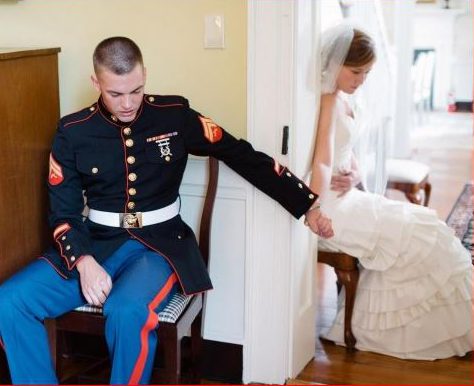
Marine prays with his wife on their wedding day

One of my favorite movies for explaining the differences between men and women is “High Noon” (1952).

Here’s the summary from IMDB:

Former marshal Will Kane (Gary Cooper) is preparing to leave the small town of Hadleyville, New Mexico, with his new bride, Amy (Grace Kelly), when he learns that local criminal Frank Miller has been set free and is coming to seek revenge on the marshal who turned him in. When he starts recruiting deputies to fight Miller, Kane is discouraged to find that the people of Hadleyville turn cowardly when the time comes for a showdown, and he must face Miller and his cronies alone.

The main theme of the film concerns Amy’s decision to break her wedding vows the very day that she makes them. She tells her new husband that he must bow to her will, and give up his male role as protector. When he explains his reasons for standing his ground to her practically (Miller will hunt them down) and morally (he has a duty protect the town), she dismisses both. She tells him that if he doesn’t run away from Miller and his gang with her, that she will get on the train and leave town by herself.

The intro of film shows the member’s of Miller’s gang assembling, and the words of the song explain the central conflict between husband and wife:

Here’s the part of the lyrics we care about:

The noonday train will bring Frank Miller.
If I’m a man I must be brave
And I must face that deadly killer
Or lie a coward, a craven coward,
Or lie a coward in my grave.

O to be torn ‘twixt love and duty!
S’posin’ I lose my fair-haired beauty!
Look at that big hand move along
Nearin’ high noon.

He made a vow while in State’s Prison,
Vow’d it would be my life or his’n
I’m not afraid of death, but O,
What will I do if you leave me?

Do not forsake me O my darlin’
You made that promise when we wed.
Do not forsake me O my darlin’
Although you’re grievin’, I can’t be leavin’
Until I shoot Frank Miller dead.

What’s interesting is that his new wife Amy apparently does not understand the meaning of wedding vows or the natural roles of good men as protectors of the weak, and fighters against evil. Although she vowed to stick by him and help him, the minute anything threatening appears that makes her feel unhappy, she abandons her vows and abandons her man. Let’s break down her mistakes now, using actual conversations from the movie.

First, she doesn’t understand or respect the man she married as a man:

Kane: [while riding out of town] It’s no good. I’ve got to go back, Amy.

Amy: Why?

Kane: This is crazy. I haven’t even got any guns.

Amy: Then let’s go on. Hurry.

Kane: No, that’s what I’ve been thinkin’. They’re making me run. I’ve never run from anybody before.

Amy: I don’t understand any of this.

Kane: [after looking at his vest watch] Well, I haven’t got time to tell ya.

Amy: Then don’t go back, Will.

Kane: I’ve got to. That’s the whole thing. [He turns the buggy around and rides back into town]

Her feelings and her desires for the world to be a happy place for her are so strong that they cloud her judgment.

Second, she doesn’t understand the threat posed by evil men:

More:

Kane: I sent a man up five years ago for murder. He was supposed to hang. But up North, they commuted it to life and now he’s free. I don’t know how. Anyway, it looks like he’s coming back.

Amy: I still don’t understand.

Kane: He was always wild and kind of crazy. He’ll probably make trouble.

Amy: But that’s no concern of yours, not anymore.

Kane: I’m the one who sent him up.

Amy: Well, that was part of your job. That’s finished now. They’ve got a new marshal.

Kane: He won’t be here until tomorrow. Seems to me I’ve got to stay. Anyway, I’m the same man with or without this. [He pins his badge on his vest]

Amy: Oh, that isn’t so.

Kane: I expect he’ll come lookin’ for me. Three of his old bunch are waiting at the depot.

Amy: That’s exactly why we ought to go.

Kane: They’ll just come after us, four of ’em, and we’d be all alone on the prairie.

Amy: We’ve got an hour.

Kane: What’s an hour?…What’s a hundred miles? We’d never be able to keep that store, Amy. They’d come after us and we’d have to run again, as long as we live.

Amy: No we wouldn’t, not if they didn’t know where to find us. Oh Will! Will, I’m begging you, please let’s go.

Kane: I can’t.

Amy: Don’t try to be a hero. You don’t have to be a hero, not for me.

Kane: I’m not trying to be a hero. If you think I like this, you’re crazy.

Instead of recognizing how her feelings are deceiving her about the threat and trusting her husband, she tries to force him to accept her mistaken view of reality by threatening to abandon him.

One of Kane’s ex-girlfriends has a talk with Amy, which helps her to understand who Kane is, and what is expected of her:

Amy: That man downstairs, the clerk, he said things about you and Will. I’ve been trying to understand why he wouldn’t go with me, and now all I can think of is that it’s got to be because of you…Let him go, he still has a chance. Let him go.

Helen: He isn’t staying for me. I haven’t spoken to him for a year – until today. I am leaving on the same train you are…What kind of woman are you? How can you leave him like this? Does the sound of guns frighten you that much?

Amy: I’ve heard guns. My father and my brother were killed by guns. They were on the right side but that didn’t help them any when the shooting started. My brother was nineteen. I watched him die. That’s when I became a Quaker. I don’t care who’s right or who’s wrong. There’s got to be some better way for people to live. Will knows how I feel about it.

Helen: I hate this town. I always hated it – to be a Mexican woman in a town like this.

Amy: I understand.

Helen: You do? That’s good. I don’t understand you. No matter what you say. If Kane was my man, I’d never leave him like this. I’d get a gun. I’d fight.

Amy: Why don’t you?

Helen: He is not my man. He’s yours.

Helen understands the need for a wife to stand by her man. But Amy’s response to evil is to shut her eyes and focus on feeling good and being happy. Notice that her “better way” is unspecified – it’s just a feeling she has that pacificism and no-violence will somehow “work” to stop evil. But in reality, pacifism is not a “better way” of dealing with evil – it does not work. Her pacifist response not only does not make evil go away, it actually encourages more evil. Weakness emboldens evildoers, and laying down your arms provokes them to do more evil. Will Kane knows this, but she won’t listen to him.

You can watch the final gunfight here, as well as Amy’s final decision:

So, this is why I really recommend this movie as a discussion-starter when you like a girl and are thinking of marrying her. It clarifies the essential problem with many young women today not being ready for marriage. To be fair, most women come around to respect their husbands and his different roles after they get married. However, the risk of divorce is so dangerous that it makes sense to bring it up for discussion before the marriage happens. Marriage is supposed to be an engine to serve God, and the success of that enterprise cannot be left to chance. You can’t just rely on the fact that she says the words of the vow, you have to check to see if she has a habit of keeping her promises when it goes against her own self-interest.

Ask yourself: Who are you, as a man? And does your woman accept that you have obligations to stand up to evil and do good ? Will she support you in your battle against evil, or will the marriage just be about her feelings and desires? I would especially beware of women who think that God is speaking to them through their feelings and desires. Look at her friends: are they practical and successful? Or are they irresponsible, unaccountable and reckless? Look at her father: does he have a plan for her, and does he lead her to be practical, frugal and hard-working? If you are not going to get an ally and a supporter in a wife, then you will not be able to serve God well, as a married man. Think about it.