

Tag Archives: Feminism

Christina Hoff Sommers: helping boys succeed in school

Christina Hoff Sommers

An article from the leftist Time magazine by feminist Christina Hoff Sommers.

Excerpt:

Being a boy can be a serious liability in today’s classroom. As a group, boys are noisy, rowdy and hard to manage. Many are messy, disorganized and won’t sit still. Young male rambunctiousness, according to a recent study, leads teachers to underestimate their intellectual and academic abilities. “Girl behavior is the gold standard in schools,” says psychologist Michael Thompson. “Boys are treated like defective girls.”

These “defective girls” are not faring well academically. Compared with girls, boys earn lower grades, win fewer honors and are less likely to go to college. One education expert has quipped that if current trends continue, the last male will graduate from college in 2068. In today’s knowledge-based economy, success in the classroom has never been more crucial to a young person’s life prospects. Women are adapting; men are not.

Some may say, “Too bad for the boys.” The ability to regulate one’s impulses, sit still and pay attention are building blocks of success in school and in life. As one critic told me, the classroom is no more rigged against boys than workplaces are rigged against lazy or unfocused workers. That is absurd: unproductive workers are adults — not 5- and 6-year-old children who depend on us to learn how to become adults. If boys are restive and unfocused, we must look for ways to help them do better.

She introduces three ideas to fix the problem, and here’s the third one:

In his delightful Boy Writers: Reclaiming their Voices, celebrated author and writing instructor Ralph Fletcher advises teachers to consider their assignments from the point of view of boys. Too many writing teachers, he says, take the “confessional poet” as the classroom ideal. Personal narratives full of emotion and self-disclosure are prized; stories describing video games, skateboard competitions or a monster devouring a city are not.

Peg Tyre’s The Trouble With Boys illustrates the point. She tells the story of a third-grader in Southern Californianamed Justin who loved Star Wars, pirates, wars and weapons. An alarmed teacher summoned his parents to school to discuss a picture the 8-year-old had drawn of a sword fight — which included several decapitated heads. The teacher expressed “concern” about Justin’s “values.” The father, astonished by the teacher’s repugnance for a typical boy drawing, wondered if his son could ever win the approval of someone who had so little sympathy for the child’s imagination.

Teachers have to come to terms with the young male spirit. As Fletcher urges, if we want boys to flourish, we are going to have to encourage their distinctive reading, writing, drawing and even joke-telling propensities. Along with personal “reflection journals,” Fletcher suggests teachers permit fantasy, horror, spoofs, humor, war, conflict and, yes, even lurid sword fights.

If boys are constantly subject to disapproval for their interests and enthusiasms, they are likely to become disengaged and lag further behind. Our schools need to work with, not against, the kinetic imaginations of boys to move them toward becoming educated young men.

There’s a short video to go with the article:

Dr. Sommers participated in a recent debate where she argued in favor of allowing all-male schools against a radical feminist. That page has audio and a transcript as well.

My thoughts

I do think that women need to realize that boys have to be encouraged to do the different things that boys do, if we want boys to be engaged. The good things that boys do in society are not free – they need to be encouraged and not dismissed. Playing a wargame or an adventurous boardgame with a boy is good. Firing real guns with a boy is good. Playing adventurous role-playing games with a boy is good. Going to a war museum or on a camping trip with a boy is good. Watching patriotic war movies or adventurous movies with a boy is good. Reading military history and military biographies is good. Reading classical adventure novels with a boy is good. Listening to adventurous music with a boy is good. Even watching the news with a boy is good.

Nothing is free. We have to create the boys we want, and encourage them to be aggressive, active and righteous.
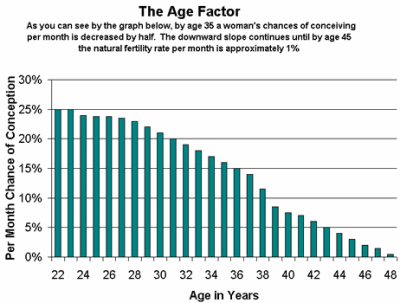
Fertility and pregnancy: how long can a woman wait before having a baby?

Woman's fertility by age
Woman’s fertility by age

This is from Aeon magazine. The author writes for several ultra-leftist publications, including the New York Times, the Los Angeles Times, Salon and Slate.

She writes:

Many studies show that women are not only woefully ignorant when it comes to fertility, conception and the efficacy of assisted reproductive technologies (ART) – but they overestimate their knowledge about the subject. For instance, a 2011 study in Fertility and Sterility surveyed 3,345 childless women in Canada between the ages of 20 and 50; despite the fact that the women initially assessed their own fertility knowledge as high, the researchers found only half of them answered six of the 16 questions correctly. 72.9 per cent of women thought that: ‘For women over 30, overall health and fitness level is a better indicator of fertility than age.’ (False.) And 90.9 per cent felt that: ‘Prior to menopause, assisted reproductive technologies (such as IVF) can help most women to have a baby using their own eggs.’ (Also false.) Many falsely believed that by not smoking and not being obese they could improve their fertility, rather than the fact that those factors simply negatively affect fertility.

Fertility fog infects cultures and nations worldwide, even those that place more of a premium on reproduction than we do in the West. A global study published for World Fertility Awareness Month in 2006 surveyed 17,500 people (most of childbearing age) from 10 countries in Europe, Africa, the Middle East and South America, revealing very poor knowledge about fertility and the biology of reproduction. Take Israel, a country that puts such a premium on children that they offer free IVF to citizens up to age 45 for their first two children. According to a 2011 study in Human Reproduction, which surveyed 410 undergraduate students, most overestimated a women’s chances of spontaneous pregnancy in all age groups, but particularly after receiving IVF beyond age 40. Only 11 per cent of the students knew that genetic motherhood is unlikely to be achieved from the mid-40s onward, unless using oocytes or egg cells frozen in advance. ‘This can be explained by technological “hype” and favourable media coverage of very late pregnancies,’ the authors concluded.

[…]For a woman over 42, there’s only a 3.9 per cent chance that a live birth will result from an IVF cycle using her own, fresh eggs, according to the American Society of Reproductive Medicine (ASRM). A woman over 44 has just a 1.8 per cent chance of a live birth under the same scenario, according to the US National Center for Chronic Disease Prevention and Health Promotion. Women using fresh donor eggs have about a 56.6 per cent chance of success per round for all ages.

Indeed, according to research from the Fertility Authority in New York, 51 per cent of women aged between 35 and 40 wait a year or more before consulting a specialist, in hopes of conceiving naturally first. ‘It’s ironic, considering that the wait of two years will coincide with diminished fertility,’ the group says.

[…]‘No one talks about fertility,’ said [reproductive endocrinologist Janelle Luk, medical director of Neway Fertility in New York City], who does not believe women are really open to hearing about it. ‘I don’t think women know that there’s a limit: the message is equal, equal, equal. Women say: “We want to go to college, we want to work on our careers, we want to be equal to men.” But our biological clock is not.’

[…]Another way women might even out the fertility playing field is by focussing on the so-called male biological clock. But is there one? Although there have been recent news stories about how advanced age in men (over 40 or 50) increases time to conception and the incidence of autism and schizophrenia, the absolute risk is negligible. ‘When you look at the numbers, you have to separate what the absolute risk and the increased risk is,’ said Natan Bar-Chama, director of male reproductive medicine and surgery at Mount Sinai Medical Center in New York. ‘The absolute risk is still really very small.’

I think if I ever have a daughter, I will be sure to urge her to be skeptical of her emotions and intuitions, to learn how to assess probabilities, to disregard exceptional cases when making plans, to resist the feminism in the culture, to get wisdom from older married women with children instead of young unmarried childless women, to accept that she is not so special that laws and rules don’t apply to her, and to accept that the universe is not malleable according to her needs and desires. I hope my wife will see the value of reining our daughter in before the catastrophes like infertility happen.

Where does the organized opposition to educating young women about fertility facts come from?

‘We feel that women should be able to talk to their ob/gyn about fertility,’ said Sandra Carson, ACOG’s vice president for education. ‘We certainly want to remind women gently that, as they get older, fertility is compromised, but we don’t want to do it in such a way that they feel that it might interfere with their career plans or make them nervous about losing their fertility.’ In other words, there are no guidelines for talking to a woman about her fertility unless she herself brings it up.

All this talk of ‘gentle’ reminders and ‘appropriate’ counselling has a history – a political one. Back in 2001, the ASRM devoted a six-figure sum to a fertility awareness campaign, whose goal was to show the effects of age, obesity, smoking and sexually transmitted diseases on fertility. Surprisingly, the US National Organization for Women (NOW) came out against it. ‘Certainly women are well aware of the so-called biological clock. And I don’t think that we need any more pressure to have kids,’ said Kim Gandy, then president of NOW. In a 2002 op-ed in USA Today, she wrote that NOW ‘commended’ doctors for ‘attempting’ to educate women about their health, but thought they were going about it the wrong way by making women feel ‘anxious about their bodies and guilty about their choices’.

We don’t want women to feel bad, so it’s best to let them follow their hearts. That view is not helpful to women! If we want to help women, we must tell them the truth, and take the consequences.

All this talk about fertility could be accompanied by a discussion of the hard fact that a woman’s attractiveness will decline as she ages. This is a troubling lesson that countless women have had to learn the hard way. When you are young, you stand a much better chance of finding a successful male with good values and who is willing to commit to marriage and parenting. Many women will testify that, as you get older, this convenience deteriorates quickly. The good men will be claimed by the responsible women who don’t waste their youthful years seeking thrills.  Men who are contemplating marriage value a woman’s appearance, fertility, vulnerability and submissiveness to his leadership. Women need to be careful not to embark on a course that will reduce their ability in any of these areas that are important to men, e.g. – careerism, premarital promiscuity, etc.

Related posts

Are pious pastors preparing young Christians to defend their moral values?

Younger evangelicals more liberal than older evangelicals... is it just ignorance?
Voting for Obama means abortion, gay marriage and end of religious liberty

You might expect Christians to advocate for values like chastity, life-long natural marriage, protection for unborn and born children, right to work, low taxes, limited government, free speech, religious liberty, and so on. But today, many young evangelicals are embracing  higher taxes, more spending, socialism, retreat from just wars against evil forces, abortion, gay marriage, global warming alarmism, etc.

Why is this happening?

Christianity should make me feel happy and be liked by others?

Here is the first problem. When you advocate for moral causes like protecting the unborn, or school choice, or freeing the slaves, a bunch of people are not going to like you. Christians in the time of Jesus knew that being bold about their Christian convictions would make a lot of people think bad things about them – they expected it. But young evangelicals have gotten the idea that being a Christian should not involve any sort of unhappiness and unpopularity. They’ve been told that God has a wonderful plan for their lives, and that plan involves happiness, fulfillment, travel and adventure. They wouldn’t have learned this from the Bible, because the Bible emphasizes suffering and unpopularity as part of the normal Christian life. Christianity has always been opposed to abortion and homosexuality, but these things are not fun and popular today. Since these young Christians believe in a God of love – a cosmic butler who leads them to happiness through their feelings – of course they are going to find defending traditional Christian values too difficult.

Christianity should be about my private experience of belief?

What young evangelicals learn in many churches is that religion is something that is centered on the Bible and the church building – it is not something that flows into real life. This is actually the goal of the most pious, orthodox pastors, with the exception of people like Pastor Wayne Grudem or Pastor Matt Rawlings who can integrate the Bible with real-world how-to knowledge. Pastors want to protect God from being “judged” by evidence, because they regard evidence as dirty, and unworthy of being allowed to confirm or deny blind faith / tradition. Pastors instead teach young people that you can’t find out anything about God from things like the Big Bang, the DNA, the fossil record, or even from the peer-reviewed research on abortion, divorce, or gay marriage. And they don’t respond to arguments and evidence from non-Christian skeptics, either. Their goal is to insulate belief from evidence. If the Bible says “do this” then they don’t even want to study the way the world works in order to know the best way to do what the Bible asks.

For example, when it comes to politics and social activism, young evangelicals learn in church about helping the poor. But pastors never tell them anything about economics, which shows that the free enterprise system is the best at helping the poor. (Just compare the USA to North Korea or Venezuela or Argentina). Instead, young evangelicals blissfully accept the left’s narrative that free markets and charity don’t work, and that  government must step in to redistribute wealth. Most pastors they never pick up an economic textbook to see which economic system really helps the poor. And that ignorance is passed on to gullible and sentimental young people, who jump on any slick politician who promises to help the poor through redistribution rather than economic growth and innovation. What you learn about in church is that religion is private and has no connection to reality whatsoever., so there is no point in learning anything – science, economics, philosophy. Pious pastors put Christianity outside the realm of truth.

The (young) people perish for lack of knowledge

What follows from having a view that Christianity only lives in the Bible and church, and not out there in the real world of telescopes and microscopes? Well, most young evangelicals will interpret what their pastor is telling them as “our flavor of ice cream” or “our cultural custom”. They don’t link Christianity to the real world, they don’t think that it’s true for everyone. They think that “people in church” just accept what the Bible says on faith, and that’s all. So what happens when topics like abortion, marrige, economics, war, etc. come up in their daily conversations? Well, all the pastors have equipped them with is “the Bible says”, and that’s not enough to be persuasive with non-Christians. They have no way of speaking about their beliefs and values with anyone who doesn’t already believe in the Bible. And that’s why they go left… it’s much easier to just go along with their secular left peers, professors and cultural heroes. And that’s exactly what they do. Without facts and evidence – which they never taught  or even mentioned in church – how can they be expected to stand up for Biblical Christianity? They can’t.

If young Christians never learn how to present a case for traditional values and beliefs apart from the Bible for concepts like pro-life or natural marriage or religious liberty, then they will cave to the secular left culture. And this is exactly what the pious pastors have facilitated by “rescuing” the God and the Bible and the historical Jesus from evidence and knowledge. Young people lack courage to take Biblical positions, because they first lack knowledge. They don’t know how to make the case using evidence that their opponents will accept – mainstream evidence from publicly accessible sources. And that’s how the pastors want it – piety, not evidence.

Christianity is a knowledge tradition

No young evangelical is going to lift a finger to take bold moral stands if they think their worldview is just one option among many – like the flavors of ice cream in the frozen section of the grocery store. They have to know that what they are saying is true – then they will be bold. Boldness is easy when you are aware of facts and evidence for your view. Not just what the pastors and choirs accept, but facts and evidence that are widely accepted.

Positive arguments for Christian theism