First he points out what happened around the time that abortion was legalized:
A sharp increase in pre-marital sex.
A sharp rise in out-of-wedlock births.
A drop in the number of children placed for adoption.
A decline in marriages that occur after the woman is pregnant.
Then he writes this: (links removed)
Many of these changes might seem contradictory. Why would both the number of abortions and out-of-wedlock births go up? If there were more illegitimate births, why were fewer children available for adoption?
For the first puzzle, part of the answer lies in attitudes toward premarital sex. With abortion seen as a backup, women as well as men became less careful in using contraceptives as well as more likely to have premarital sex.
There were more unplanned pregnancies. But legal abortion did not mean every unplanned pregnancy led to abortion. After all, just because abortion is legal does not mean that the decision is an easy one.
Academic studies have found that legalized abortion, by encouraging premarital sex, increased the number of unplanned births, even outweighing the reduction in unplanned births due to abortion.
In the United States from the early 1970s, when abortion was liberalized, through the late 1980s, there was a tremendous increase in the rate of out-of-wedlock births, rising from an average of 5 percent of all births from 1965 to 1969 to more than 16 percent two decades later (1985 to 1989).
For blacks, the numbers soared from 35 percent to 62 percent. While not all of this rise can be attributed to liberalized abortion rules, it was a key contributing factor, nevertheless.
With legalization and a woman not forced to go through with an unplanned pregnancy, a man might well expect his partner to have an abortion if a sexual encounter were to result in an unplanned pregnancy.
But what happens if the woman refuses — say, she is morally opposed or, perhaps, she thought she could have an abortion but upon becoming pregnant decides she can’t go through with it?
Many men, feeling tricked into unwanted fatherhood, likely will wash their hands of the affair altogether, thinking, “I never wanted a baby. It’s her choice, so let her raise the baby herself.”
What is expected of men in this position has changed dramatically in the last four decades. Evidence shows that the greater availability of abortion largely ended “shotgun” marriages, where men felt obligated to marrying the women.
What has happened to these babies of reluctant fathers?
The mothers often raise the children on their own. Even as abortion has led to more out-of-wedlock births it has dramatically reduced adoptions of children born in America by two-parent families.
Before Roe, when abortion was much more difficult, women who would have chosen an abortion but were unable to get one turned to adoption as their backup. After Roe, women who turned down an abortion also were the type who wanted to keep the child.
But all these changes — rising out-of-wedlock births, plummeting adoption rates and the end of shotgun marriages — meant one thing: more single-parent families. With work and other demands on their time, single parents, no matter how “wanted” their child may be, tend to devote less attention to their children than do married couples; after all, it’s difficult for one person to spend as much time with a child as two people can.
From the beginning of the abortion debate, those favoring abortion have pointed to the social costs of “unwanted” children who simply won’t get the attention of “wanted” ones. But there is a trade-off that has long been neglected. Abortion may eliminate “unwanted” children, but it increases out-of-wedlock births and single parenthood. Unfortunately, the social consequences of illegitimacy dominated.
Children born after liberalized abortion rules have suffered a series of problems from difficulties at school to more crime. The saddest fact is that it is the most vulnerable in society, poor blacks, who have suffered the most from these changes.
[…]Liberalized abortion undoubtedly has made life easier for many, but like sex itself sometimes, it has had many unintended consequences.
You can read more about it in Dr. Lott’s book “Freedomnomics“, which is a response to the popular leftist book Freakonomics.
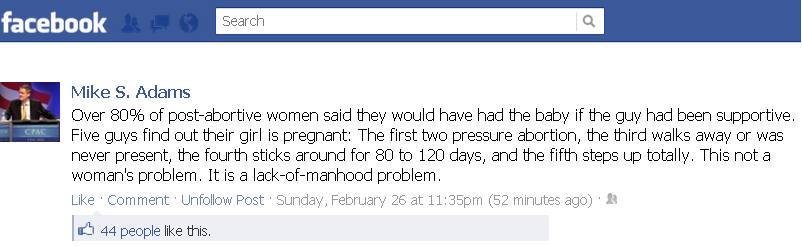
Professor Mike S. Adams is pro-life, but he posted something on Facebook that I must disagree with.
He posted this:
Over 80% of post-abortive women said they would have had the baby if the guy had been supportive. Five guys find out their girl is pregnant: The first two pressure abortion, the third walks away or was never present, the fourth sticks around for 80 to 120 days, and the fifth steps up totally. This not a woman’s problem. It is a lack-of-manhood problem.
Mike has about 5000 friends, and 44 of them liked it. I would think that most of these people would call themselves pro-life conservatives. But I don’t think what he posted promotes the pro-life cause.
I replied to him with this:
Mike I could not disagree more. It’s a woman’s problem unless it is rape, since the woman consents to sex with a man she is not married to. In fact, the cause of abortion is YOUR opinion – namely, the opinion that women should not be obligated to be chaste or to think rationally about who they are having sex with. There is a path to marriage that goes through courtship, and that path has a name: self-control. Stop enabling the poor choices of women, because we have to stop the murder of unborn children.
Many of Mike’s friends supported him. So I wrote this:
Wow. I had no idea that so many of Mike’s friends think that the Bible is a pack of lies when it says that fornication is morally wrong. I guess you guys aren’t Christians then, since you feel so free and easy about revising the Bible when you feel like it.
If fornication is wrong, it’s wrong for women AND men. And you don’t fornicate and then expect happy outcomes from it. There is a word for a person who sins and then expects a good outcome. A FOOL.
Then Mike replied to me:
Sorry Wintery. Where I come from the man leads and is, therefore, responsible.
I replied to that with this:
Mike, I agree with male leading – IF the man is a Christian. But the men that these women chose are not Christians. And you can’t expect men to act morally unless they have a theistic framework that grounds morality.
Women should not be told, by you and others, that they can choose to have sex with immoral men and then expect the immoral men to act morally. That is just enabling abortion by justifying a lack of prudence and wisdom. Instead, we should be holding women accountable to choose men who WILL control themselves.
We should not be supporting the fantasy view of love that says that recreational sex magically leads men to commit to protect, provide and lead women for life. That view is neither wise nor Biblical. On the contrary, recreational sex leads men to NOT commit. Women have to learn how to select men, to evaluate them for marriage, and to make them prove themselves. We need to tell men AND women that sex before marriage is morally wrong. And we need to be convincing by showing them how recreational sex does not lead to stable marriages, and puts children, unborn and born, in harm’s way. Telling the truth about the danger of premarital sex is the best way to stop the killing of unborn children.
Here’s an example to make the point. We do not blame bears for mauling campers. Bears are bears, and they were bears before the campers showed up in their cave. We ought to blame the camper for choosing to wander off the trail and into the bear’s den in order to PET THE BEAR. Wild bears may eat free food that is offered to them, but they are not going to let you pet them and hug them. Women, like campers, need to be responsible. They need to choose the right man for marriage. They need to exercise self control. They need to make the man prove his ability to commit and support a family BEFORE they have sex with him. No one hires an employee without understanding what job they need done and then making sure that the candidate they choose can do the job. And that’s what we need to tell women.
Obviously, I was a little upset when I wrote that, but I hope it wasn’t too bad.
So what’s the point I was trying to make by being critical of Mike? I think the problem we have today is that men who are pro-life are unwilling to hold women accountable for their own poor decisions about sex and marriage. Basically, conservative and/or Christian men think that women don’t need to think through what choices are most likely to avoid abortion and most likely to achieve marriage. These men give tacit approval to the popular trend of trying to achieve marriage through premarital sex (or cohabitation), when the research shows that these behaviors do not result in long-lasting stable marriages. In fact, sex out of wedlock is a good way to get into a situation where an abortion will occur.
In my view, Mike is ainadvertently encouraging women to get into the situations where they will be pressured to abort by reinforcing the idea that there is nothing wrong with their plan to achieve marriage by having premarital sex (or cohabitating), and then expecting men to respond to their pregnancy by MARRYING them. Mike seems to be telling women that it is normal for them to expect that marriage will follow from premarital sex with men who have not been vetted for the roles of provider, protector and leader As if marriage is natural for men who don’t even have jobs and who are surrounded by women willing to have sex with them on the first date. Any man who will have recreational premarital sex with a woman is exactly the kind of person who will not commit to lifelong providing and fidelity – he is having sex before marriage because he wants recreation, without the commitment and self-sacrifice that marriage requires. Rationally speaking, it makes no sense for men to buy the cow, and to keep buying the cow with 40 years of labor, when they can get the milk for free. And that’s what we need to tell women – think with your minds, not with your emotions.
[A] recent study reveals that 88 percent of unmarried young adults (ages 18-29) are having sex. The same study, conducted by The National Campaign to Prevent Teen and Unplanned Pregnancy, reveals the number doesnʼt drop much among Christians. Of those surveyed who self-identify as “evangelical,” 80 percent say they have had sex.
[…]In addition to having premarital sex, an alarming number of unmarried Christians are getting pregnant. Among unmarried evangelical women between the ages of 18 and 29, 30 percent have experienced a pregnancy (a number thatʼs actually 1 percent higher than among those who donʼt claim to be evangelical).
According to the Guttmacher Institute, nearly half of all pregnancies in America are unintended. And of those, 40 percent end in abortion. More than 1 million abortions occur in the United States each year. But perhaps the most disturbing statistic for the Church: 65 percent of the women obtaining abortions identify themselves as either Protestant or Catholic (37 percent Protestant and 28 percent Catholic). Thatʼs 650,000 abortions obtained by Christians every year.
Christian women are not told that premarital sex is wrong by many Christians and conservatives – and out of that refusal by “Christians” and “conservatives” to take a stand, we get 650,000 abortions per year. We need to have more courage to tell women to be more self-controlled and responsible when they choose who to have sex with, and when to have sex. We need to tell women to make good decisions that lead to stable marriages. We need to tell women to study these issues and to support policies that produce strong, moral men who are willing to marry – for example, by reforming education so that our schools produce men who can find jobs, perhaps by having more male teachers in the classroom. We need to tell women to support policies that make marriage more friendly for men, like abolishing no-fault divorce, and promoting shared parenting. Christians in particular need to counteract the views of love and romance that are prevalent in popular culture with a view of relationships built around chastity and love. Although many people today are uncomfortable with moral absolutes and moral judgments, it would be a good be a good idea for women to promote these things, so that the men they are choosing from are more moral.
In the end, I agree with Mike S. Adams in one respect. Abortion may be caused by a lack of manhood problem. Only the lack of manhood doesn’t come from the men that women choose to have premarital sex with. The lack of manhood comes from men who refuse to hold women accountable for their own free foolish decisions that put unborn children in harm’s way. In addition to the abortion problem that results from those foolish decisions, there is also the explosion in out-of-wedlock births to weigh in the balance. Again, the more people tell women that they should expect men who engage in recreational sex to commit to marriage after premarital sex (or cohabitation), the more fatherlessness we get.
Dr Paul Ramchandani, who led the Oxford University study, said behavioural problems in early childhood often lead to health and psychological problems in adulthood which can be difficult to overcome.
But he said most research on how parents affect a baby’s behaviour and development has focused on mothers, when fathers also play an important role. The research team recruited 192 families from maternity units and experts filmed the mothers and fathers separately as they played with their children at home in different situations – looking at how caring or engaged they were.
The parents did psychological tests, while the children’s behaviour was assessed examining whether they were fretful, disobedient, had tantrums or in the worst cases showed aggression by hitting and biting.
‘We found that children whose fathers were more engaged in the interactions had better outcomes, with fewer subsequent behavioural problems,’ said Dr Ramchandani.
‘At the other end of the scale children tended to have greater behavioural problems when their fathers were more remote and lost in their own thoughts, or when their fathers interacted less with them.
‘This association tended to be stronger for boys than for girls, suggesting that perhaps boys are more susceptible to the influence of their father from a very early age.’
The study, which is published today in the Journal of Child Psychology and Psychiatry, found the three-month-olds with less engaged fathers were more likely to be in the 10 per cent of children who displayed the beginnings of behavioural problems at one year old.
This is surprising to me, and it conflicts with my idea of avoiding the little monsters until they are ready to learn apologetics at the age of 6. Now because of this study, I would have to be involved with the children right away, if I ever have any. Well, live and learn!
The economic storms of recent years have raised concerns about growing inequality and questions about a core national faith, that even Americans of humble backgrounds have a good chance of getting ahead. Most of the discussion has focused on labor market forces like falling blue-collar wages and lavish Wall Street pay.
But striking changes in family structure have also broadened income gaps and posed new barriers to upward mobility. College-educated Americans like the Faulkners are increasingly likely to marry one another, compounding their growing advantages in pay. Less-educated women like Ms. Schairer, who left college without finishing her degree, are growing less likely to marry at all, raising children on pinched paychecks that come in ones, not twos.
Estimates vary widely, but scholars have said that changes in marriage patterns — as opposed to changes in individual earnings — may account for as much as 40 percent of the growth in certain measures of inequality. Long a nation of economic extremes, the United States is also becoming a society of family haves and family have-nots, with marriage and its rewards evermore confined to the fortunate classes.
[…]About 41 percent of births in the United States occur outside marriage, up sharply from 17 percent three decades ago. But equally sharp are the educational divides, according to an analysis by Child Trends, a Washington research group. Less than 10 percent of the births to college-educated women occur outside marriage, while for women with high school degrees or less the figure is nearly 60 percent.
[…]While many children of single mothers flourish (two of the last three presidents had mothers who were single during part of their childhood), a large body of research shows that they are more likely than similar children with married parents to experience childhood poverty, act up in class, become teenage parents and drop out of school.
[…]Four decades ago, families in the top income fifth spent about four times as much as those at the bottom fifth on things like sports, music and private schools, according to research byGreg J. Duncan of the University of California, Irvine, and Richard J. Murnane of Harvard. Now affluent families spend seven times as much.
Two parents also bring two parenting perspectives. Ms. Faulkner does bedtime talks. Mr. Faulkner does math. When Ms. Faulkner’s coaxing failed to persuade Jeremy to try hamburgers, Mr. Faulkner offered to jump in a pool fully clothed if he took a bite — an offer Jeremy found too tempting to refuse.
While many studies have found that children of single parents are more likely to grow up poor, less is known about their chances of advancement as adults. But there are suggestions that the absence of a father in the house makes it harder for children to climb the economic ladder.
Scott Winship of the Brookings Institution examined the class trajectories of 2,400 Americans now in their mid-20s. Among those raised in the poorest third as teenagers, 58 percent living with two parents moved up to a higher level as adults, compared with just 44 percent of those with an absent parent.
A parallel story played out at the top: just 15 percent of teenagers living with two parents fell to the bottom third, compared with 27 percent of teenagers without both parents.
“You’re more likely to rise out of the bottom if you live with two parents, and you’re less likely to fall out of the top,” Mr. Winship said.
That article has some poignant illustrations of what fatherlessness does to a child.
Still think that single motherhood by choice is a great idea? Now if you were a legislator, tell me what legislation you would introduce to make sure that the government was encouraging fatherhood and discouraging single motherhood. How would you make marriage and fathers in the home easier for men, and single motherhood harder for women? It’s a policy problem – we have to change the incentives if we want to protect the children. How would you communicate to women that they need to get married before they have children, and how would you help them to know how to evaluate a man so that they can tell if he will make a good husband and father, and perform the traditional male roles in the family?

 WINTERY KNIGHT