
Tag Archives: Father

New large-scale UK study confirms the importance of fathers to children

Dina sent me this article from the UK Daily Mail.

Excerpt:

A father’s love is as important to a child’s emotional development as a mother’s, a large-scale study has confirmed.

Examining the cases of more than 10,000 sons and daughters revealed how a cold or distant father can damage a child’s life, sometimes for decades to come.

The review of 36 studies from around the world concluded that his love is at least as important to youngsters as that of their mothers.

Researcher Professor Ronald Rohner said that fatherly love is key to  development and hopes his findings will motivate more men to become involved in caring for their offspring.

‘In the US, Great Britain and Europe, we have assumed for the past 300 years that all children need for normal healthy development is a loving relationship with their mother,’ he said.

‘And that dads are there as support for the mother and to support the  family financially but are not required for the healthy development of the children.

‘But that belief is fundamentally wrong. We have to start getting away from that idea and realise the dad’s influence is as great, and sometimes greater, than the mother’s.’

His conclusions came after he examined data from studies in which  children and adults were asked how loving their parents were.

Questions included if they were made to feel wanted or needed, if their  parents went out of their way to hurt their feelings and if they felt loved.

Those taking part also answered questions about their personality. These ranged from ‘I think about fighting or being mean’ to ‘I think the world is a good, happy place’.

Tallying the results showed that those rejected in childhood felt more anxious and insecure as well as hostile and aggressive.

Many of the problems carried over into adulthood, reported the study  published in the journal Personality and Social Psychology Review.

Crucially, a father’s love was often just as important as a mother’s. In some cases, it was even more so. One reason for this may be that rejection is more painful when it comes from the parent the child regards as more powerful or respected.

You can read more about how fatherlessness damages children here.

I think the first question we should ask the people who want to redefine marriage is this: “which parent to do you think that a child can do without? the mother or the father?”. We must do everything we can as a society to keep both of a child’s natural parents in the home while the child grows up. If we really care about children, then we should prefer to meet their needs, even if the grown-ups have to be a bit more responsible in their decision making. if the conflict is between innocent children and selfish grown-ups, then the children should win.

We need laws and policies that promote traditional marriage, not laws and policies that break it down and destroy it. Repealing no-fault divorce, lowering subsidies for single motherhood, and making shared parenting the default position, would all help solve the problem. Policies like school choice and lower corporate tax rates helps men to be able to perform in their role as provider. We have to be practical and ask: “what makes men capable of marriage and parenting?” If we want strong fathers, then it makes sense to ask how to make fatherhood more reasonable: what do men need in order to do what we want them to do?

Christians should be especially concerned about the presence of fathers, given the evidence I blogged about before showing how the presence of quality fathers is essential for passing Christian beliefs on to children. Churches need to ask themselves tough questions: Are we teaching women how to choose men based on practical concerns and proven abilities in our churches? And are we doing a good job of attracting men to churches by promoting the masculine, practical aspects of Christianity that men like – like science, apologetics debates, economics and foreign policy?
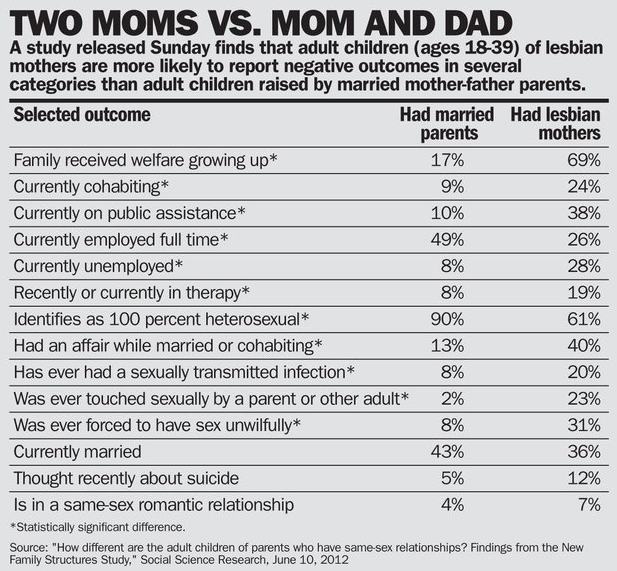
Do children raised by gays and lesbians do as well as those of married parents?

Straight vs. lesbian parenting (click for larger image)

ECM pointed out to me that some more information about the two studies that were just published in the mainstream science journal Social Science Research appeared in National Review.

Excerpt:

The mainstream academic journal Social Science Research has just published two articles that expose and challenge the schlock social science on gay parenting that has been uncritically embraced and propagated by so many people eager to advance the cause of gay marriage.

In “Same-sex parenting and children’s outcomes: A closer examination of the American Psychological Association’s brief on lesbian and gay parenting,” LSU professor Loren Marks addresses a puzzle: On the one hand, studies based on “large, representative samples” have shown that “[c]hildren who grow up in a household with only one biological parent are worse off, on average, than children who grow up in a household with both of their biological parents.” On the other hand, “social science research with small convenience samples has repeatedly reported no significant differences between children from gay/lesbian households and heterosexual households.” (Pp. 735-736 (emphasis added).)

Marks’s essential answer to the puzzle is that the studies “with small convenience samples” are unreliable. Among other things:

1. “[S]ocial researchers examining same-sex parenting have repeatedly selected small, non-representative, homogeneous samples of privileged lesbian mothers to represent all same-sex parents.” (P. 739 (emphasis added).)

2. “[I]n selecting heterosexual comparison groups for their studies, many same-sex parenting researchers have not used marriage-based intact families as heterosexual representatives, but have instead used single mothers.” (P. 741 (emphasis added).) Despite the broad claims made on behalf of the research, “with rare exceptions, the research does not include studies comparing children raised by two-parent, same-sex couples with children raised by marriage-based, heterosexual couples. (P. 742.)

3. The American Psychological Association’s claim that “not a single study has found children of lesbian or gay parents to be disadvantaged” fails to take account of the largest study that actually examined “children’s developmental outcomes.” (Pp. 742-743.)

4. The same-sex parenting studies have failed to address a range of outcomes for children that are usually the focus of national studies on children, including drug and alcohol abuse, truancy, sexual activity, and criminality. (Pp. 743-744.)

These new studies contradict the politically correct pronouncements of the APA. But evidence came out last week that they are “controlled” the gay rights movement, according to a former President of the APA, who is himself pro-same-sex-marriage.

We should not be redefining marriage if it is going to hurt vulnerable children. I made the case before from the research that same-sex unions are not the same as heterosexual married couples. And now we have direct evidence that the differences matter to children.

New study finds that children do best in traditional mother-father families

Straight vs. lesbian parenting (click for larger image)

From the Washington Times. (H/T Jonathan)

Excerpt: (links removed)

Two studies released Sunday may act like brakes on popular social-science assertions that gay parents are the same as — or maybe better than — married, mother-father parents.

“The empirical claim that no notable differences exist must go,” Mark Regnerus, a sociology professor at the University of Texas at Austin, said in his study in Social Science Research.

Using a new, “gold standard” data set of nearly 3,000 randomly selected American young adults, Mr. Regnerus looked at their lives on 40 measures of social, emotional and relationship outcomes.

He found that, when compared with adults raised in married, mother-father families, adults raised by lesbian mothers had negative outcomes in 24 of 40 categories, while adults raised by gay fathers had negative outcomes in 19 categories.

Findings such as these do not support claims that there are “no differences” between gay parenting and heterosexual, married parents, said Mr. Regnerus, who helped develop the New Family Structures Study at the university.

Instead, “children appear most apt to succeed well as adults when they spend their entire childhood with their married mother and father, and especially when the parents remain married to the present day,” he wrote.

Mr. Regnerus‘ study of 2,988 persons ages 18 to 39 — including 175 adults raised by lesbian mothers and 73 adults raised by gay fathers — marks the first research from the new dataset, which initially included some 15,000 persons.

The second study, also in Social Science Research, takes a critical look at the basis of an oft-cited American Psychological Association (APA) report on gay parenting.

The APA brief says, “Not a single study has found children of lesbian or gay parents to be disadvantaged in any significant respect relative to children of heterosexual parents,” said Loren Marks, associate professor at the School of Human Ecology at Louisiana State University.

However, after looking at the 59 studies that undergird this assertion, “the jury is still out,” Mr. Marks said. “The lack of high-quality data leaves the most significant questions [about gay parenting] unaddressed and unanswered.”

Problems with the APA-cited studies were their tiny size; dependence on wealthy, white, well-educated lesbian mothers; and a failure to examine common outcomes for children, such as their education, employment and risks for poverty, criminality, early childbearing, substance abuse and suicide. Instead, the APA studies often looked at children’s gender-role behaviors, emotional functioning and sexual identity.

This story was also reported on Science Daily, with the predictable liberal spin.

Here is my previous post on the data that shows why same-sex unions are not good for raising children.