
Tag Archives: Father

Dennis Prager explains what feminism has achieved for women

Man and woman working on a computer upgrade

Dennis Prager has summarized many of my viewpoints on this blog in a tiny, tiny little article. He calls it “Four Legacies of Feminism“.

Read the whole glorious thing and bask in its wisdom!

Full text:

As we approach the 50th anniversary of the publication of Betty Friedan’s feminist magnum opus, The Feminine Mystique, we can have a perspective on feminism that was largely unavailable heretofore.

And that perspective doesn’t make feminism look good. Yes, women have more opportunities to achieve career success; they are now members of most Jewish and Christian clergy; women’s college sports teams are given huge amounts of money; and there are far more women in political positions of power. But the prices paid for these changes — four in particular — have been great, and outweigh the gains for women, let alone for men and for society.

1) The first was the feminist message to young women to have sex just as men do. There is no reason for them to lead a different sexual life than men, they were told. Just as men can have sex with any woman solely for the sake of physical pleasure, so, too, women ought to enjoy sex with any man just for the fun of it. The notion that the nature of women is to hope for at least the possibility of a long-term commitment from a man they sleep with has been dismissed as sexist nonsense.

As a result, vast numbers of young American women had, and continue to have, what are called “hookups”; and for some of them it is quite possible that no psychological or emotional price has been paid. But the majority of women who are promiscuous do pay prices. One is depression. New York Times columnist Ross Douthat recently summarized an academic study on the subject: “A young woman’s likelihood of depression rose steadily as her number of partners climbed and the present stability of her sex life diminished.”

Long before this study, I had learned from women callers to my radio show (an hour each week — the “Male-Female Hour” — is devoted to very honest discussion of sexual and other man-woman issues) that not only did female promiscuity coincide with depression, it also often had lasting effects on women’s ability to enjoy sex. Many married women told me that in order to have a normal sexual relationship with their husband, they had to work through the negative aftereffects of early promiscuity — not trusting men, feeling used, seeing sex as unrelated to love, and disdaining their husband’s sexual overtures. And many said they still couldn’t have a normal sex life with their husband.

2) The second awful legacy of feminism has been the belief among women that they could and should postpone marriage until they developed their careers. Only then should they seriously consider looking for a husband. Thus, the decade or more during which women have the best chance to attract men is spent being preoccupied with developing a career. Again, I cite woman callers to my radio show over the past 20 years who have sadly looked back at what they now, at age 40, regard as 20 wasted years. Sure, these frequently bright and talented women have a fine career. But most women are not programmed to prefer a great career to a great man and a family. They feel they were sold a bill of goods at college and by the media. And they were. It turns out that most women without a man do worse in life than fish without bicycles.

3) The third sad feminist legacy is that so many women — and men — have bought the notion that women should work outside the home that for the first time in American history, and perhaps world history, vast numbers of children are not primarily raised by their mothers or even by an extended family member. Instead they are raised for a significant part of their childhood by nannies and by workers at daycare centers. Whatever feminists may say about their only advocating choices, everyone knows the truth: Feminism regards work outside the home as more elevating, honorable, and personally productive than full-time mothering and making a home.

4) And the fourth awful legacy of feminism has been the demasculinization of men. For all of higher civilization’s recorded history, becoming a man was defined overwhelmingly as taking responsibility for a family. That notion — indeed the notion of masculinity itself — is regarded by feminism as the worst of sins: patriarchy.

Men need a role, or they become, as the title of George Gilder’s classic book on single men describes them: Naked Nomads. In little more than a generation, feminism has obliterated roles. If you wonder why so many men choose not to get married, the answer lies in large part in the contemporary devaluation of the husband and of the father — of men as men, in other words. Most men want to be honored in some way — as a husband, a father, a provider, as an accomplished something; they don’t want merely to be “equal partners” with a wife.

In sum, thanks to feminism, very many women slept with too many men for their own happiness; postponed marriage too long to find the right man to marry; are having hired hands do much of the raising of their children; and find they are dating boy-men because manly men are so rare.

Feminism exemplifies the truth of the saying, “Be careful what you wish for — you may get it.”

I wish I could add something to this, but I can’t because every time I think of something to add, he says it in the next sentence. I think it’s so important for women to read about feminism, and to understand how women used to approach men and marriage before feminism. Women today don’t realize how their priorities have been changed from older generations, because of the promotion of feminism in the culture. Women today ought to take a step back and think about what works for them in the long term. What kind of man is the best kind? What do men want out of marriage? What should men and women do now to prepare for marriage?

If you like Prager’s short essay, then this medium essay arguing against feminism authored by Barbara Kay would be nice follow-up.

What do research studies say about the bond between fathers and daughters?

Texas senator Ted Cruz, his wife Heidi Cruz and their two daughters

Many people today think that biological fathers are not essential for raising daughters. In fact, we even support this view by passing no-fault divorce laws, single-mother welfare laws, and by opposing shared parenting laws. The story goes that children do fine without their biological father in the home. Having children is something that women decide to do, and the man is superfluous. So I thought it might be a good idea to take a look at the research.

Here is a recent article from the centrist Institute for Family Studies.

It says:

The dynamic between fathers and their daughters has been characterized by one expert as the most “fragile and unstable” when compared to other parent-child relationships.1 It can be further described as one of the most powerful and vital relationships to individuals, communities, and nations. For instance, fathers have a profound impact on their daughters’ body image,clinical depression, eating disorders,self-esteem, and life satisfaction,to name but a few.

But of all the unique contributions a father makes in his daughter’s life, perhaps there is none of greater significance than in the area of sexual development and activity and romantic relationships.

  • Numerous studies have discovered female pubertal timing occurs later in girls whose fathers are consistently present in their life.5
  • An extensive body of research has revealed that early pubertal maturation in girls is associated with a variety of negative biological, psychological, and social outcomes, including, mood disorders,substance abuse,adolescent pregnancy,and a variety of cancers of the reproductive system.9
  • Fatherless daughters are seven times more likely to become pregnant as teens.10

[…]The conditions in our culture of both rampant fatherlessness and sexual promiscuity are incompatible with forming secure and healthy relationships with boys and with establishing stable families for the next generation. A young girl’s sexual development can significantly outpace her neurological and emotional development—the very resources needed to guide her sexual choices.

Herein lies the danger. Much of our culture today promotes sexual activity but void of healthy attachment or true intimacy. There is a great deal of evidence to suggest that high levels of father involvement (regardless of dad’s marital status) are predictive of high levels of intimacy, commitment, and trust in young female adults’ romantic relationships; whereas low levels of father involvement are predictive of the opposite.11

And:

How a father treats both his daughter and her mother can help a young woman feel safe and secure in her relationships with the boys and men in her life, including her future husband. Family scientists and evolutionary psychologists have discovered that girls appear to be born with an emotional, relational, and evolutionary void that a father is designated to fill. If left vacant, girls will be more likely to seek to fill it in with other, unhealthier substitutes. The father-daughter relationship is the one that best teaches young women about true love and intimacy, self-worth, and respect.

Professor Linda Nielsen summarized this in one profound sentence: “[T]he father has the greater impact on the daughter’s ability to trust, enjoy, and relate well to the males in her life.”

So, a father’s love keeps her from getting into relationships with boys before the boys are ready to commit to her. By the way, I don’t think that boys should even be allowed to TALK to girls about a relationship, unless they have a STEM degree, and two years of private sector work experience. I really hate when unemployed, penniless boys waste a girl’s time when they can’t afford to commit to her. People think I am pretty rough on women, but I really am much meaner to men who don’t have STEM degrees and gapless resumes. (I guess a skilled trade would work as well, in place of the STEM degree – something like electrician, for example).

Anyway, back to the research. When a woman is deciding which men to have sex with, she has to be thinking of more than just her own needs. She has to choose a man who is going to stick around long enough to raise her daughters, so that they grow up with the confidence to resist the advances of boys who aren’t ready to commit. To be pro-woman means to be pro-daughter, and that means that women need to be persuaded to be careful about the choice of sex partner, and the timing of sexual activity. This is why people used to keep sex for marriage in the past: to protect children by making sure that they would get the stability and engagement they need from their parents.

Also, I have talked about the research about father-son bond in a different post.

If you want to do right for your children, then you need to control yourself and make wise choices. And if you’re struggling to make good choices, then don’t leave it up to your emotions and peer approval. Disregard your emotions. Disregard peer approval. Instead, let your decision-making be guided by your Christian convictions, and strengthened with scientific evidence. The Bible tells you not to have sex before you’re married, and science tells you why this is good policy. The Bible gives you the goals, and science tells you how to how the world works, so you know how to make plans that will make sure you are never in a place where you are pressured to do the wrong thing. The more science you pack into your head, the easier it will be for you to convince yourself to do the right thing, and to convince your partner to do the right thing. Science takes moral decision-making outside the realm of feelings and opinions.

And if your partner says “I don’t care about the needs of our future children”, then you have a good reason to dump them and move on. You can’t be in a relationship with someone who thinks that children’s needs are less important than adult desires. In fact, the whole design for relationships should start with what children need from the marriage and parents, and work backward from there to the obligations on the man and the woman. And men and women ought to discuss this. What are we trying to achieve with this relationship anyway? And what is the right way to achieve it? This is where the research comes in – it shows you how to do it right.

Research from the Heritage Foundation

A lesson about men for marriage-minded women from the movie “High Noon”

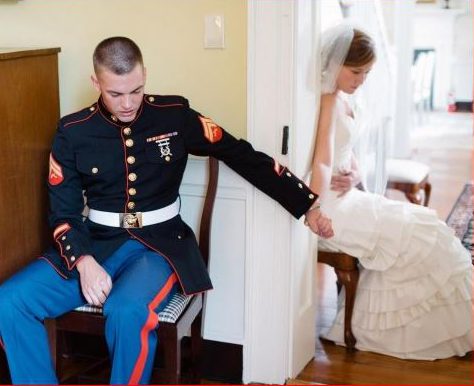
Marine prays with his wife on their wedding day

One of my favorite movies for explaining the differences between men and women is “High Noon” (1952).

Here’s the summary from IMDB:

Former marshal Will Kane (Gary Cooper) is preparing to leave the small town of Hadleyville, New Mexico, with his new bride, Amy (Grace Kelly), when he learns that local criminal Frank Miller has been set free and is coming to seek revenge on the marshal who turned him in. When he starts recruiting deputies to fight Miller, Kane is discouraged to find that the people of Hadleyville turn cowardly when the time comes for a showdown, and he must face Miller and his cronies alone.

The main theme of the film concerns Amy’s decision to break her wedding vows the very day that she makes them. She tells her new husband that he must bow to her will, and give up his male role as protector. When he explains his reasons for standing his ground to her practically (Miller will hunt them down) and morally (he has a duty protect the town), she dismisses both. She tells him that if he doesn’t run away from Miller and his gang with her, that she will get on the train and leave town by herself.

The intro of film shows the member’s of Miller’s gang assembling, and the words of the song explain the central conflict between husband and wife:

Here’s the part of the lyrics we care about:

The noonday train will bring Frank Miller.
If I’m a man I must be brave
And I must face that deadly killer
Or lie a coward, a craven coward,
Or lie a coward in my grave.

O to be torn ‘twixt love and duty!
S’posin’ I lose my fair-haired beauty!
Look at that big hand move along
Nearin’ high noon.

He made a vow while in State’s Prison,
Vow’d it would be my life or his’n
I’m not afraid of death, but O,
What will I do if you leave me?

Do not forsake me O my darlin’
You made that promise when we wed.
Do not forsake me O my darlin’
Although you’re grievin’, I can’t be leavin’
Until I shoot Frank Miller dead.

What’s interesting is that his new wife Amy apparently does not understand the meaning of wedding vows or the natural roles of good men as protectors of the weak, and fighters against evil. Although she vowed to stick by him and help him, the minute anything threatening appears that makes her feel unhappy, she abandons her vows and abandons her man. Let’s break down her mistakes now, using actual conversations from the movie.

First, she doesn’t understand or respect the man she married as a man:

Kane: [while riding out of town] It’s no good. I’ve got to go back, Amy.

Amy: Why?

Kane: This is crazy. I haven’t even got any guns.

Amy: Then let’s go on. Hurry.

Kane: No, that’s what I’ve been thinkin’. They’re making me run. I’ve never run from anybody before.

Amy: I don’t understand any of this.

Kane: [after looking at his vest watch] Well, I haven’t got time to tell ya.

Amy: Then don’t go back, Will.

Kane: I’ve got to. That’s the whole thing. [He turns the buggy around and rides back into town]

Her feelings and her desires for the world to be a happy place for her are so strong that they cloud her judgment.

Second, she doesn’t understand the threat posed by evil men:

More:

Kane: I sent a man up five years ago for murder. He was supposed to hang. But up North, they commuted it to life and now he’s free. I don’t know how. Anyway, it looks like he’s coming back.

Amy: I still don’t understand.

Kane: He was always wild and kind of crazy. He’ll probably make trouble.

Amy: But that’s no concern of yours, not anymore.

Kane: I’m the one who sent him up.

Amy: Well, that was part of your job. That’s finished now. They’ve got a new marshal.

Kane: He won’t be here until tomorrow. Seems to me I’ve got to stay. Anyway, I’m the same man with or without this. [He pins his badge on his vest]

Amy: Oh, that isn’t so.

Kane: I expect he’ll come lookin’ for me. Three of his old bunch are waiting at the depot.

Amy: That’s exactly why we ought to go.

Kane: They’ll just come after us, four of ’em, and we’d be all alone on the prairie.

Amy: We’ve got an hour.

Kane: What’s an hour?…What’s a hundred miles? We’d never be able to keep that store, Amy. They’d come after us and we’d have to run again, as long as we live.

Amy: No we wouldn’t, not if they didn’t know where to find us. Oh Will! Will, I’m begging you, please let’s go.

Kane: I can’t.

Amy: Don’t try to be a hero. You don’t have to be a hero, not for me.

Kane: I’m not trying to be a hero. If you think I like this, you’re crazy.

Instead of recognizing how her feelings are deceiving her about the threat and trusting her husband, she tries to force him to accept her mistaken view of reality by threatening to abandon him.

One of Kane’s ex-girlfriends has a talk with Amy, which helps her to understand who Kane is, and what is expected of her:

Amy: That man downstairs, the clerk, he said things about you and Will. I’ve been trying to understand why he wouldn’t go with me, and now all I can think of is that it’s got to be because of you…Let him go, he still has a chance. Let him go.

Helen: He isn’t staying for me. I haven’t spoken to him for a year – until today. I am leaving on the same train you are…What kind of woman are you? How can you leave him like this? Does the sound of guns frighten you that much?

Amy: I’ve heard guns. My father and my brother were killed by guns. They were on the right side but that didn’t help them any when the shooting started. My brother was nineteen. I watched him die. That’s when I became a Quaker. I don’t care who’s right or who’s wrong. There’s got to be some better way for people to live. Will knows how I feel about it.

Helen: I hate this town. I always hated it – to be a Mexican woman in a town like this.

Amy: I understand.

Helen: You do? That’s good. I don’t understand you. No matter what you say. If Kane was my man, I’d never leave him like this. I’d get a gun. I’d fight.

Amy: Why don’t you?

Helen: He is not my man. He’s yours.

Helen understands the need for a wife to stand by her man. But Amy’s response to evil is to shut her eyes and focus on feeling good and being happy. Notice that her “better way” is unspecified – it’s just a feeling she has that pacificism and no-violence will somehow “work” to stop evil. But in reality, pacifism is not a “better way” of dealing with evil – it does not work. Her pacifist response not only does not make evil go away, it actually encourages more evil. Weakness emboldens evildoers, and laying down your arms provokes them to do more evil. Will Kane knows this, but she won’t listen to him.

You can watch the final gunfight here, as well as Amy’s final decision:

So, this is why I really recommend this movie as a discussion-starter when you like a girl and are thinking of marrying her. It clarifies the essential problem with many young women today not being ready for marriage. To be fair, most women come around to respect their husbands and his different roles after they get married. However, the risk of divorce is so dangerous that it makes sense to bring it up for discussion before the marriage happens. Marriage is supposed to be an engine to serve God, and the success of that enterprise cannot be left to chance. You can’t just rely on the fact that she says the words of the vow, you have to check to see if she has a habit of keeping her promises when it goes against her own self-interest.

Ask yourself: Who are you, as a man? And does your woman accept that you have obligations to stand up to evil and do good ? Will she support you in your battle against evil, or will the marriage just be about her feelings and desires? I would especially beware of women who think that God is speaking to them through their feelings and desires. Look at her friends: are they practical and successful? Or are they irresponsible, unaccountable and reckless? Look at her father: does he have a plan for her, and does he lead her to be practical, frugal and hard-working? If you are not going to get an ally and a supporter in a wife, then you will not be able to serve God well, as a married man. Think about it.