
Tag Archives: Equality

Wage gap: are women paid less than men because of discrimination?

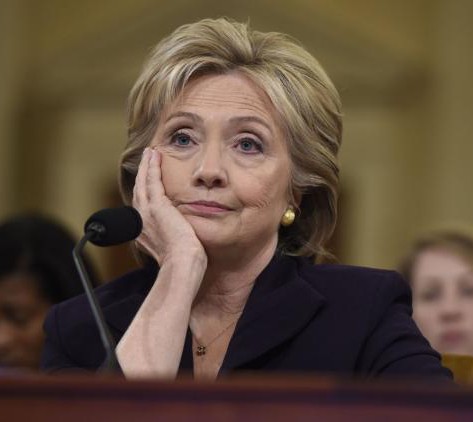
Hillary Clinton look bored about the deaths of 4 Americans who asked for her help
Hillary Clinton thinks that women are not paid fairly compared to men: is it true?

Liberal feminist Hanna Rosin takes a look at this question in the far-left Slate, of all places.

Excerpt:

The official Bureau of Labor Department statistics show that the median earnings of full-time female workers is 77 percent of the median earnings of full-time male workers. But that is very different than “77 cents on the dollar for doing the same work as men.” The latter gives the impression that a man and a woman standing next to each other doing the same job for the same number of hours get paid different salaries. That’s not at all the case. “Full time” officially means 35 hours, but men work more hours than women. That’s the first problem: We could be comparing men working 40 hours to women working 35.

How to get a more accurate measure? First, instead of comparing annual wages, start by comparing average weekly wages. This is considered a slightly more accurate measure because it eliminates variables like time off during the year or annual bonuses (and yes, men get higher bonuses, but let’s shelve that for a moment in our quest for a pure wage gap number). By this measure, women earn 81 percent of what men earn, although it varies widely by race. African-American women, for example, earn 94 percent of what African-American men earn in a typical week. Then, when you restrict the comparison to men and women working 40 hours a week, the gap narrows to 87 percent.

But we’re still not close to measuring women “doing the same work as men.” For that, we’d have to adjust for many other factors that go into determining salary. Economists Francine Blau and Lawrence Kahn did that in a recent paper, “The Gender Pay Gap.”.”They first accounted for education and experience. That didn’t shift the gap very much, because women generally have at least as much and usually more education than men, and since the 1980s they have been gaining the experience. The fact that men are more likely to be in unions and have their salaries protected accounts for about 4 percent of the gap. The big differences are in occupation and industry. Women congregate in different professions than men do, and the largely male professions tend to be higher-paying. If you account for those differences, and then compare a woman and a man doing the same job, the pay gap narrows to 91 percent. So, you could accurately say in that Obama ad that, “women get paid 91 cents on the dollar for doing the same work as men.”

I believe that the remainder of the gap can be accounted for by looking at other voluntary factors that differentiate men and women.

The Heritage Foundation says that a recent study puts the number at 95 cents per dollar.

Excerpt:

Women are more likely than men to work in industries with more flexible schedules. Women are also more likely to spend time outside the labor force to care for children. These choices have benefits, but they also reduce pay—for both men and women. When economists control for such factors, they find the gender gap largely disappears.

A 2009 study commissioned by the Department of Labor found that after controlling for occupation, experience, and other choices, women earn 95 percent as much as men do. In 2005, June O’Neil, the former director of the Congressional Budget Office, found that “There is no gender gap in wages among men and women with similar family roles.” Different choices—not discrimination—account for different employment and wage outcomes.

A popular article by Carrie Lukas in the Wall Street Journal agrees.

Excerpt:

The Department of Labor’s Time Use survey shows that full-time working women spend an average of 8.01 hours per day on the job, compared to 8.75 hours for full-time working men. One would expect that someone who works 9% more would also earn more. This one fact alone accounts for more than a third of the wage gap.

[…]Recent studies have shown that the wage gap shrinks—or even reverses—when relevant factors are taken into account and comparisons are made between men and women in similar circumstances. In a 2010 study of single, childless urban workers between the ages of 22 and 30, the research firm Reach Advisors found that women earned an average of 8% more than their male counterparts. Given that women are outpacing men in educational attainment, and that our economy is increasingly geared toward knowledge-based jobs, it makes sense that women’s earnings are going up compared to men’s.

When women make different choices about education and labor that are more like what men choose, they earn just as much or more than men.

Now back to Hillary Clinton. How much does she pay the women on her staff?

The Washington Times reports:

During her time as senator of New York, Hillary Rodham Clinton paid her female staffers 72 cents for every dollar she paid men, according to a new Washington Free Beacon report.

From 2002 to 2008, the median annual salary for Mrs. Clinton’s female staffers was $15,708.38 less than what was paid to men, the report said. Women earned a slightly higher median salary than men in 2005, coming in at $1.04. But in 2006, they earned 65 cents for each dollar men earned, and in 2008, they earned only 63 cents on the dollar, The Free Beacon reported.

[…]Mrs. Clinton has spoken against wage inequality in the past. In April, she ironically tweeted that “20 years ago, women made 72 cents on the dollar to men. Today it’s still just 77 cents. More work to do. #EqualPay #NoCeilings.”

Think of this next time Hillary Clinton talks about “the wage gap”. She is talking about the women on her staff, and no one else.

New study: Tennessee pre-K program provides no educational benefit over control group

This is the most thorough study that I have ever seen evaluating the effectiveness of pre-K programs. The study was done by researchers at Vanderbilt University. (H/T Brad Wilcox tweet)

The study was reported on by the well-respected but leftist Brookings Institute.

They write:

State investments in center-based school readiness programs for preschoolers (pre-K), whether targeted for poor children or universally implemented, have expanded more rapidly than evaluations of their effects. Given the current interest and continuing expansion of state funded pre-K, it is especially important to be clear about the nature of the available evidence for the effectiveness of such programs. Despite widespread claims about proven benefits from pre-K, there is actually strikingly little credible research about the effectiveness of public pre-K programs scaled for statewide implementation.

Like many states that became interested in scaling up a state funded pre-K program in the early 2000’s, voluntary pre-K (TNVPK) was introduced in Tennessee in 1996 as a way to provide academic enhancement to economically disadvantaged children. It expanded in 2005 to an $85 million-plus statewide investment serving 18,000 Tennessee income-eligible children in 935 classrooms across all 95 counties.

Launched in 2009, the TNVPK Effectiveness Study, a coordinated effort between Vanderbilt’s Peabody Research Institute and the Tennessee Department of Education, is a five-year evaluation study funded by the US Department of Education, Institute for Education Sciences. It includes the first randomized control trial of a scaled up state funded pre-K program and the first well-controlled comparison group study of the effects of program participation as children progress through elementary school..

Policymakers and proponents often cite some of the famous early studies of pre-K programs that have shown long term benefits extending into adulthood for the participating children. But those were studies of especially complex programs that are unlike scaled-up public pre-K in many ways. The Vanderbilt study is the first rigorous controlled longitudinal study to be conducted on a large-scale state-funded pre-K program.

And here is a summary of the results:

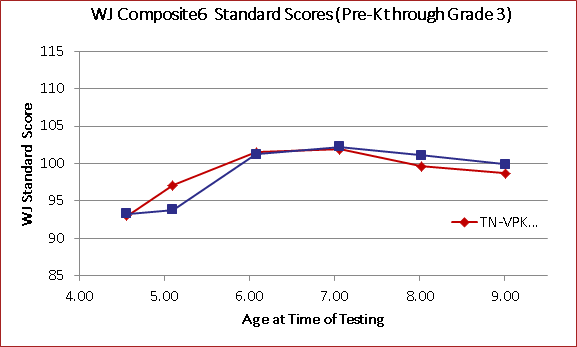
Standard score results from pre-K through 3rd grade on a composite measure that averaged the six achievement subtests are presented from baseline forward in the graph below.

As is evident, pre-K and control children started the pre-K year at virtually identical levels. The TNVPK children were substantially ahead of the control group children at the end of the pre-K year (age 5 in the graph). By the end of kindergarten (age 6 in the graph), the control children had caught up to the TNVPK children, and there were no longer significant differences between them on any achievement measures. The same result was obtained at the end of first grade using two composite achievement measures (the second created with the addition of two more WJIII subtests appropriate for the later grades). In second grade, however, the groups began to diverge with the TNVPK children scoring lower than the control children on most of the measures. The differences were significant on both achievement composite measures and on the math subtests. Differences favoring the control persisted through the end of third grade.

In terms of behavioral effects, in the spring the first grade teachers reversed the fall kindergarten teacher ratings. First grade teachers rated the TNVPK children as less well prepared for school, having poorer work skills in the classrooms, and feeling more negative about school. It is notable that these ratings preceded the downward achievement trend we found for VPK children in second and third grades. The second and third grade teachers rated the behaviors and feelings of children in the two groups as the same; there was a small positive finding for peer relations favoring the TNVPK children by third grade teachers, which did not meet traditional levels of statistical significance.

Results graph:

TNVPK data: pre-K program is in red, baseline is in blue

We are already seeing that cheap daycare in high-tax, big government provinces like Quebec cost a lot, and produce negative results. And of course Hillary Clinton is a longstanding advocate of universal pre-K. As a Senator of New York, she introduced a universal pre-K plan that would cost $10 billion over 5 years. President Barack Obama’s own Preschool for All plan would cost $75 billion over 10 years. This Vanderbilt study should cause us to question whether the policies of the secular left, pushed largely because of emotions and ideology, are worth the tens of billions of dollars they want to take from us. And if you take tens of billions of dollars out of families, then families on the margin will have to give their children to the state to raise. And that includes Christian families, who would no longer be able to afford a stay-at-home mother.

Now, taking children away from parents so that their mothers can work is seen as a worthy goal by those on the secular left. First, communally raising the children is “good” because it removes inequalities between single mothers and traditional working-husband homes. Second, making it easier for women to “go fatherless” is “good” because fathers are not to be trusted to teach their children about morality and religion. That is best left to secular government workers. Third, mothers who choose to marry good providers pay less in taxes if they choose to stay home with their kids and not work. That is “bad” because the government wants more taxes, so they can spend it on vote-buying social programs. Fourth, children who form stable bonds with their parents are less likely to become dependent on the government, meaning their allegiance cannot be bought with government handouts. That is also “bad”. Fifth, it is also “bad” that children who grow up with stay-at-home mothers are more likely to develop empathy and morality, which gives them an independent standard by which to judge the government’s actions.

Related posts

As senator, Hillary Clinton paid women 72 cents for every dollar she paid men

Hillary Clinton and Planned Parenthood

I already knew that Hillary Clinton was pro-gay-marriage, and radically pro-abortion, but it turns out that she is a hypocrite on women’s issues, as well.

The Washington Times reports:

During her time as senator of New York, Hillary Rodham Clinton paid her female staffers 72 cents for every dollar she paid men, according to a new Washington Free Beacon report.

From 2002 to 2008, the median annual salary for Mrs. Clinton’s female staffers was $15,708.38 less than what was paid to men, the report said. Women earned a slightly higher median salary than men in 2005, coming in at $1.04. But in 2006, they earned 65 cents for each dollar men earned, and in 2008, they earned only 63 cents on the dollar, The Free Beacon reported.

[…]Mrs. Clinton has spoken against wage inequality in the past. In April, she ironically tweeted that “20 years ago, women made 72 cents on the dollar to men. Today it’s still just 77 cents. More work to do. #EqualPay #NoCeilings.”

Meanwhile, she is making “equal pay for women” her top priority.

CBS News reports:

Hillary Clinton lamented the number of women in the fields of science, technology, engineering and math at a Silicon Valley women’s conference on Tuesday, and called for more action to close the wage gap.

[…]In advocating for closing the pay gap, Clinton also endorsed the impassioned plea for wage equality made by Patricia Arquette in her Oscars acceptance speech for Best Supporting Actress.

“Up and down the ladder many women are paid less for the same work, which is why we all cheered at Patricia Arquette’s speech at the Oscars — because she’s right, it’s time to have wage equality once and for all,” Clinton said.

All right, let’s take a look at the facts on the so-called “pay gap” between men and women.

The facts

This article is from the very left-wing Slate, of all places.

Excerpt:

The official Bureau of Labor Department statistics show that the median earnings of full-time female workers is 77 percent of the median earnings of full-time male workers. But that is very different than “77 cents on the dollar for doing the same work as men.” The latter gives the impression that a man and a woman standing next to each other doing the same job for the same number of hours get paid different salaries. That’s not at all the case. “Full time” officially means 35 hours, but men work more hours than women. That’s the first problem: We could be comparing men working 40 hours to women working 35.

How to get a more accurate measure? First, instead of comparing annual wages, start by comparing average weekly wages. This is considered a slightly more accurate measure because it eliminates variables like time off during the year or annual bonuses (and yes, men get higher bonuses, but let’s shelve that for a moment in our quest for a pure wage gap number). By this measure, women earn 81 percent of what men earn, although it varies widely by race. African-American women, for example, earn 94 percent of what African-American men earn in a typical week. Then, when you restrict the comparison to men and women working 40 hours a week, the gap narrows to 87 percent.

But we’re still not close to measuring women “doing the same work as men.” For that, we’d have to adjust for many other factors that go into determining salary. Economists Francine Blau and Lawrence Kahn did that in a recent paper, “The Gender Pay Gap.”.”They first accounted for education and experience. That didn’t shift the gap very much, because women generally have at least as much and usually more education than men, and since the 1980s they have been gaining the experience. The fact that men are more likely to be in unions and have their salaries protected accounts for about 4 percent of the gap. The big differences are in occupation and industry. Women congregate in different professions than men do, and the largely male professions tend to be higher-paying. If you account for those differences, and then compare a woman and a man doing the same job, the pay gap narrows to 91 percent. So, you could accurately say in that Obama ad that, “women get paid 91 cents on the dollar for doing the same work as men.”

I believe that the remainder of the gap can be accounted for by looking at other voluntary factors that differentiate men and women.

The Heritage Foundation says that a recent study puts the number at 95 cents per dollar.

Excerpt:

Women are more likely than men to work in industries with more flexible schedules. Women are also more likely to spend time outside the labor force to care for children. These choices have benefits, but they also reduce pay—for both men and women. When economists control for such factors, they find the gender gap largely disappears.

A 2009 study commissioned by the Department of Labor found that after controlling for occupation, experience, and other choices, women earn 95 percent as much as men do. In 2005, June O’Neil, the former director of the Congressional Budget Office, found that “There is no gender gap in wages among men and women with similar family roles.” Different choices—not discrimination—account for different employment and wage outcomes.

A popular article by Carrie Lukas in the Wall Street Journal agrees.

Excerpt:

The Department of Labor’s Time Use survey shows that full-time working women spend an average of 8.01 hours per day on the job, compared to 8.75 hours for full-time working men. One would expect that someone who works 9% more would also earn more. This one fact alone accounts for more than a third of the wage gap.

[…]Recent studies have shown that the wage gap shrinks—or even reverses—when relevant factors are taken into account and comparisons are made between men and women in similar circumstances. In a 2010 study of single, childless urban workers between the ages of 22 and 30, the research firm Reach Advisors found that women earned an average of 8% more than their male counterparts. Given that women are outpacing men in educational attainment, and that our economy is increasingly geared toward knowledge-based jobs, it makes sense that women’s earnings are going up compared to men’s.

When women make different choices about education and labor that are more like what men choose, they earn just as much or more than men.