Tag Archives: Economics

As Christianity declines in Europe, churches are put up for sale

I have a key that will unlock a puzzling mystery

This sad story is from the Wall Street Journal.

Excerpt:

Two dozen scruffy skateboarders launched perilous jumps in a soaring old church building here on a recent night, watched over by a mosaic likeness of Jesus and a solemn array of stone saints.

This is the Arnhem Skate Hall, an uneasy reincarnation of the Church of St. Joseph, which once rang with the prayers of nearly 1,000 worshipers.

It is one of hundreds of churches, closed or threatened by plunging membership, that pose a question for communities, and even governments, across Western Europe: What to do with once-holy, now-empty buildings that increasingly mark the countryside from Britain to Denmark?

[…]The closing of Europe’s churches reflects the rapid weakening of the faith in Europe, a phenomenon that is painful to both worshipers and others who see religion as a unifying factor in a disparate society.

[…]The Church of England closes about 20 churches a year. Roughly 200 Danish churches have been deemed nonviable or underused. The Roman Catholic Church in Germany has shut about 515 churches in the past decade.

But it is in the Netherlands where the trend appears to be most advanced. The country’s Roman Catholic leaders estimate that two-thirds of their 1,600 churches will be out of commission in a decade, and 700 of Holland’s Protestant churches are expected to close within four years.

[…]As communities struggle to reinvent their old churches, some solutions are less dignified than others. In Holland, one ex-church has become a supermarket, another is a florist, a third is a bookstore and a fourth is a gym. In Arnhem, a fashionable store called Humanoid occupies a church building dating to 1889, with racks of stylish women’s clothing arrayed under stained-glass windows.

In Bristol, England, the former St. Paul’s church has become the Circomedia circus training school. Operators say the high ceilings are perfect for aerial equipment like trapezes.

In Edinburgh, Scotland, a Lutheran church has become a Frankenstein-themed bar, featuring bubbling test tubes, lasers and a life-size Frankenstein’s monster descending from the ceiling at midnight.

Jason MacDonald, a supervisor at the pub, says he has never heard complaints about the reuse. “It’s for one simple reason: There are hundreds and hundreds of old churches and no one to go to them,” Mr. MacDonald said. “If they weren’t repurposed, they would just lie empty.”

Many churches, especially smaller ones, are becoming homes, and that has spawned an entire industry to connect would-be buyers with old churches.

The churches of England and Scotland list available properties online, with descriptions worthy of a realty firm. St. John’s church in Bacup, England, for example, is said to feature “a lofty nave as well as basement rooms with stone-vaulted ceilings,” and can be had for about $160,000.

There are many reasons why Christianity has declined in Europe, but surely the widespread embrace of left-wing economic policies – even by evangelical Christians – is one of the largest.

Here’s a fairly recent paper (PDF) that explains it:

What accounts for cross-national variation in religiosity as measured by church attendance and non-religious rates? Examining answers from both secularization theory and the religious economy perspective, we assert that cross-national variation in religious participation is a function of government welfare spending and provide a theory that links macro-sociological outcomes with individual rationality. Churches historically have provided social welfare. As governments gradually assume many of these welfare functions, individuals with elastic preferences for spiritual goods will reduce their level of participation since the desired welfare goods can be obtained from secular sources. Cross-national data on welfare spending and religious participation show a strong negative relationship between these two variables after controlling for other aspects of modernization.

I have many friends in the UK who classify themselves as evangelical Christians. They almost all embrace moderate to leftist economics, and they complain to me about why the church is in decline, why there is no interest in apologetics, why they can’t find Christian girlfriends, why they can’t get speaking engagements. The answer is, of course, that by majoring only in theology and apologetics, they have crafted the rope that their secular allies in government are using to hang them. Leftism is embraced by European Christians in part because they don’t want to be like those dastardly Americans with their free enterprise system and their rule of law and their private property and their law-abiding gun ownership.

It just goes to show you why Christianity suffers when we focus on piety at the expense of practicality. Too much A. W. Tozer, not enough F.A. Hayek. I doubt my well-meaning UK Christian friends – who are so proud of their laughable NHS health care – even know who F.A. Hayek is. To think that Lady Thatcher ones brandished “The Constitution of Liberty” by F.A. Hayek and declared “this is what we believe!”. But ordinary UK Christians do not believe what she believes, and now they must reap what they sowed with their knee-jerk rejection of the free enterprise system. Ignorance of economics killed Christianity in Europe, and pious, risk-averse Christians were willing participants in the murder.
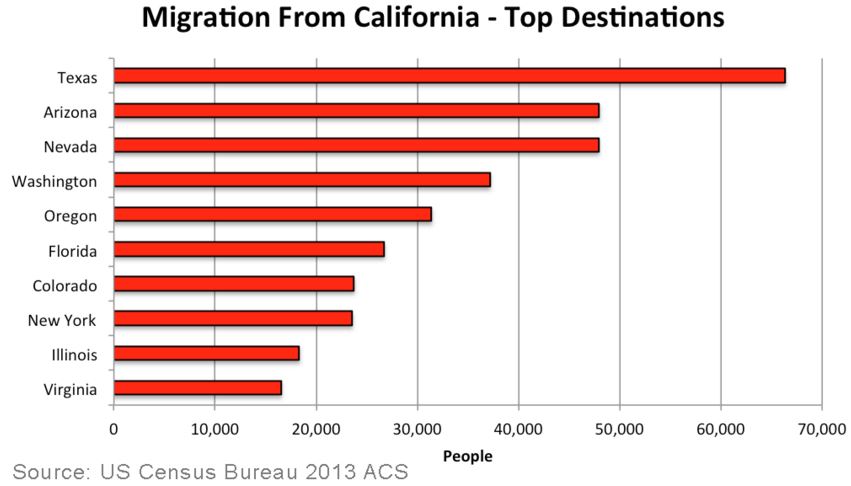
If socialism is so great, why are people moving from blue California to red Texas?

Migration from California to other states
Migration from California to other states – top 3 states are conservative states

A lot of young people seem to be really excited about socialism, and they want the United States to give it a try. They don’t know where socialism has been tried, and they don’t know what happens with it is tried. It just sounds nice to them.

Well, if you were going to pick one of the most socialist states in the United States, no one would fault you for picking California, where Democrats are running everything, and have been for a long time.

The Washington Free Beacon explains what happened next:

The number of Californians leaving the state and moving to Texas is at its highest level in nearly a decade, according to data from the Internal Revenue Service.

According to IRS migration data, which uses individual income tax returns to record year-to-year address changes, over 250,000 California residents moved out of the state between 2013 and 2014, the latest period for which data was available. The tax returns reported more than $21 billion in adjusted gross income to the IRS.

Of the returns, 33,626 reported address changes from California to Texas, which has been the top destination for individuals leaving California since 2007. Californians who moved to Texas between 2013 and 2014 reported $2.19 billion in adjusted gross income.

[…]“California’s taxes and regulations are crushing businesses, and there are more opportunities in Texas for people to start new companies, get good jobs, and create better lives for their families,” said Nathan Nascimento, the director of state initiatives at Freedom Partners. “When tax and regulatory climates are bad, people will move to better economic environments—this phenomenon isn’t a mystery, it’s how marketplaces work. Not only should other state governments take note of this, but so should the federal government.”

According to Tom Gray of the Manhattan Institute, people may be leaving California for the employment opportunities, tax breaks, or less crowded living arrangements that other states offer.

“States with low unemployment rates, such as Texas, are drawing people from California, whose rate is above the national average,” Gray wrote. “Taxation also appears to be a factor, especially as it contributes to the business climate and, in turn, jobs.”

“Most of the destination states favored by Californians have lower taxes,” Gray wrote. “States that have gained the most at California’s expense are rated as having better business climates. The data suggest that may cost drivers—taxes, regulations, the high price of housing and commercial real estate, costly electricity, union power, and high labor costs—are prompting businesses to locate outside California, thus helping to drive the exodus.”

Just recently, I heard some of my Democrat co-workers laughing to each other about “trickle-down economics”, which is the “ridiculous” idea that if you allow businesses and workers to keep what they earn, then you’ll get more economic growth than if the government takes the money to study the drug use patterns of sex workers in the far East. Actually, we’ve been trying socialism-lite in this country for the past 7 years. How has it worked? Well, Obama has averaged 1.2% GDP growth through his presidency, far below average. And in order to get even that little growth, Obama will double the debt from 10 to 20 trillion in just 8 years.

Debt increase under Barack Obama

But what about tax cuts? Do tax cuts create economic growth?

The conservative Heritage Foundation think tank describes the effects of the Bush tax cuts.

Excerpt:

President Bush signed the first wave of tax cuts in 2001, cutting rates and providing tax relief for families by, for example, doubling of the child tax credit to $1,000.

At Congress’ insistence, the tax relief was initially phased in over many years, so the economy continued to lose jobs. In 2003, realizing its error, Congress made the earlier tax relief effective immediately. Congress also lowered tax rates on capital gains and dividends to encourage business investment, which had been lagging.

It was the then that the economy turned around. Within months of enactment, job growth shot up, eventually creating 8.1 million jobs through 2007. Tax revenues also increased after the Bush tax cuts, due to economic growth.

[…]The CBO incorrectly calculated that the post-March 2003 tax cuts would lower 2006 revenues by $75 billion. Revenues for 2006 came in $47 billion above the pre-tax cut baseline.

Here’s what else happened after the 2003 tax cuts lowered the rates on income, capital gains and dividend taxes:

  • GDP grew at an annual rate of just 1.7% in the six quarters before the 2003 tax cuts. In the six quarters following the tax cuts, the growth rate was 4.1%.
  • The S&P 500 dropped 18% in the six quarters before the 2003 tax cuts but increased by 32% over the next six quarters.
  • The economy lost 267,000 jobs in the six quarters before the 2003 tax cuts. In the next six quarters, it added 307,000 jobs, followed by 5 million jobs in the next seven quarters.

The timing of the lower tax rates coincides almost exactly with the stark acceleration in the economy. Nor was this experience unique. The famous Clinton economic boom began when Congress passed legislation cutting spending and cutting the capital gains tax rate.

Regarding the “Clinton economic boom”, that was caused by supply-sider Newt Gingrich passing tax cuts through the House and Senate. Bill Clinton merely signed the bills into law.

Very important to compare times and places where socialism has been tried to times and places where free enterprise and limited government have been tried. We know what works. It may not be what makes us feel smug, but we know what works.

Is cohabitation a better way to prepare for marriage than courting?

Painting: "Courtship", by Edmund Blair Leighton (1888)
Painting: “Courtship”, by Edmund Blair Leighton (1888)

Consider this assessment of cohabitation from the liberal New York Times.

Excerpt:

AT 32, one of my clients (I’ll call her Jennifer) had a lavish wine-country wedding. By then, Jennifer and her boyfriend had lived together for more than four years. The event was attended by the couple’s friends, families and two dogs.

When Jennifer started therapy with me less than a year later, she was looking for a divorce lawyer. “I spent more time planning my wedding than I spent happily married,” she sobbed. Most disheartening to Jennifer was that she’d tried to do everything right. “My parents got married young so, of course, they got divorced. We lived together! How did this happen?”

Cohabitation in the United States has increased by more than 1,500 percent in the past half century. In 1960, about 450,000 unmarried couples lived together. Now the number is more than 7.5 million. The majority of young adults in their 20s will live with a romantic partner at least once, and more than half of all marriages will be preceded by cohabitation. This shift has been attributed to the sexual revolution and the availability of birth control, and in our current economy, sharing the bills makes cohabiting appealing. But when you talk to people in their 20s, you also hear about something else: cohabitation as prophylaxis.

In a nationwide survey conducted in 2001 by the National Marriage Project, then at Rutgers and now at the University of Virginia, nearly half of 20-somethings agreed with the statement, “You would only marry someone if he or she agreed to live together with you first, so that you could find out whether you really get along.” About two-thirds said they believed that moving in together before marriage was a good way to avoid divorce.

That’s a nice idea – wanting protection against divorce. But I think these hopeful attitudes that young people have about cohabitation and the utility / harmlessness of premarital sex, is so much whistling past the graveyard. The fact is that cohabitation does not improve marital stability.

The New York Times author assesses the evidence about cohabitation:

Couples who cohabit before marriage (and especially before an engagement or an otherwise clear commitment) tend to be less satisfied with their marriages — and more likely to divorce — than couples who do not. These negative outcomes are called the cohabitation effect.

Researchers originally attributed the cohabitation effect to selection, or the idea that cohabitors were less conventional about marriage and thus more open to divorce. As cohabitation has become a norm, however, studies have shown that the effect is not entirely explained by individual characteristics like religion, education or politics. Research suggests that at least some of the risks may lie in cohabitation itself.

As Jennifer and I worked to answer her question, “How did this happen?” we talked about how she and her boyfriend went from dating to cohabiting. Her response was consistent with studies reporting that most couples say it “just happened.”

“We were sleeping over at each other’s places all the time,” she said. “We liked to be together, so it was cheaper and more convenient. It was a quick decision but if it didn’t work out there was a quick exit.”

She was talking about what researchers call “sliding, not deciding.” Moving from dating to sleeping over to sleeping over a lot to cohabitation can be a gradual slope, one not marked by rings or ceremonies or sometimes even a conversation. Couples bypass talking about why they want to live together and what it will mean.

Cohabitation is associated with higher risks of divorce because it works to undermine the need for quality communication during courting and the need for commitment that is based on discipline, instead of pleasure. People slide into something that looks like marriage because the sex pulls them in. But they’ve never taken the time to talk about what the relationship is really about, and whether they are intending to commit to the other person for life, and on what terms, and for what reason. Young people find these conversations difficult and scary for a reason – they are not capable of discussing relationships in terms of self-sacrifice, self-control, and self-denial.

The focus on early sex is caused by a focus on wanting to get to pleasure right away. They want relationships to be like a consumer good, where they get their needs met without having to talk about suitability for roles, and acceptance of responsibilities and obligations. In my experience, young people are terrified of the responsibilities, obligations and expectations of a real commitment. They want relationships to be free,easy and fun – where they just get to do whatever they feel like, moment by moment. And somehow, it’s all supposed to work out, without anyone talking seriously about roles and responsibilities and commitment.

But of course that doesn’t work as well as keeping your distance and getting to know each other first. It’s not just compatibility that is important, though – it’s that both people need to prepare for the roles and responsibilities they will have in a marriage, and demonstrate to each other that each is capable of performing those roles.

What’s the answer?

Research has shown that pre-marital chastity produces more stable and higher quality marriages. And that’s because chastity helps people to focus on conversations and obligations instead of the recreational sex which clouds the judgment and glosses over the seriousness of marriage. Premarital sex rushes the relationship to the point where it is harder to break it off because of the sunk costs of sex and the pain of the break-up. Courtship is the time to discuss the things that break up marriages, like finances and division of labor. It is the time to demonstrate self-control and fidelity. Courting doesn’t allow either person to get control of the relationship through sex, so that they can get their needs met without having to care about the other person. When sex is ruled off the table, the only way to have the relationship go on is by serving the other person and showing them that you have what it takes to do the marriage role you’re assigned. That’s hard work, but young people need to accept that and get on with preparing for and practicing their marriage responsibilities.

Why not go back to courting?

If you asked me, I would tell you that courting is protection against a painful break-up as well as protection against a bad marriage. And the aim of courting is to interview the other person so that you can see whether they understand the demands of the marriage and whether they can perform their duties to their spouse and children. In particular, men should investigate whether the woman has prepared (or is willing to prepare now) to perform her roles as wife and mother, and women should investigate whether the man has prepared to perform his roles as protector, provider and moral/spiritual leader (or is willing to prepare now). Courting is not designed to be fun, although it can be fun. It is not meant to make people feel happy, it is mean to prepare them for marriage. And this is because you cannot translate fun and happy into marriage, because marriage is about well-defined roles, self-sacrifice and commitment. Marriage is about following through for the other person, whether you get what you want or not. You’d be surprised how often people give up on courting and show that their real goal for a relationship is not lifelong self-sacrificial love at all, but just using other people for their own happiness while they keep their distance from the responsibilities, obligations and expectations of the marriage covenant.

And that’s why I encourage men to very gently and subtly guide the relationship in a way that will allow both the woman and the man to practice their expected marital duties, see how they feel about their duties and get better at being able to perform them. Men have the most to lose from the divorce courts, if things go south. That’s why it is the man’s the responsibility to detect and reject women who are only interested in fun and thrills.