
Note: this post has a twin! Its companion post on a secular case against abortion rights is here.
Roxeanne de Luca challenged socially conservative bloggers to write a non-religious case against same-sex marriage, so here’s mine.
I can’t possible cover everything, but I will make three arguments.
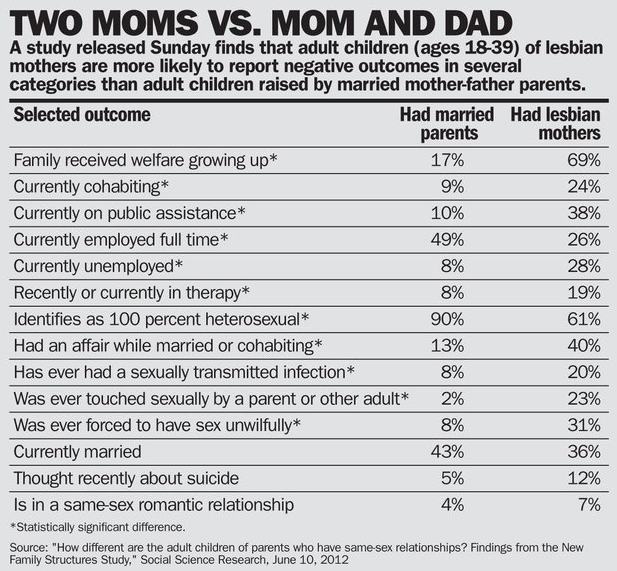
- Same-sex marriage is bad for children
- Same-sex marriage is bad for civil society and business
- Same-sex marriage is bad for public health
Let’s look at these in order.
1. SSM is bad for children
Traditional marriage is beneficial for children for 4 reasons:
- traditional marriages last longer than same-sex unions
- traditional marriages are more peaceful than same-sex unions
- traditional marriages offer children male and female influences
- traditional marriages model life-long love between men and women
Space permits me to only discuss the first two, using this paper from the Family Research Council, which cites data from mainstream sources like the Department of Justice, peer-reviewed studies, etc.
That research paper compares same-sex couples and heterosexual married couples, in the following ways:
- relationship duration
- monogamy vs. promiscuity
- relationship commitment
- number of children being raised
- health risks
- rates of intimate partner violence
It turns out that same-sex unions are not as good for children as traditional marriage, on those measures.
Relationship duration
Claim: about 58% of traditional marriages last longer than 20 years.
Source: National Center for Health Statistics, Centers for Disease Control and Prevention (2001)
Claim: about 5% of same-sex unions last longer than 20 years.
Source: 2003-2004 Gay/Lesbian Consumer Online Census
Monogamy vs Promiscuity
Claim: 85% of married women and 75.5% of married men report being faithful to their spouses. For homosexual males, the number is 4.5%
Sources: Laumann, The Social Organization of Sexuality, 216; McWhirter and Mattison, The Male Couple: How Relationships Develop (1984): 252-253; Wiederman, “Extramarital Sex,” 170.
Rates of intimate partner violence

Married men and women experience significantly less intimate partner violence than do homosexual men and women.
Sources: “Extent, Nature, and Consequences of Intimate Partner Violence,” U.S. Department of Justice: Office of Justice Programs: 30; “Intimate Partner Violence,” Bureau of Justice Statistics Special Report:11.
There is a lot more evidence cited in the research paper. Read the whole thing.
Consider this article by Dr. Trayce Hansen about which family configuration is best for children. The title is “Same-Sex Marriage: Not in the Best Interest of Children”.
Excerpt:
Only mother-father families afford children the opportunity to develop relationships with a parent of the same, as well as the opposite sex. Relationships with both sexes early in life make it easier and more comfortable for a child to relate to both sexes later in life. Overall, having a relationship with both a male and female parent increases the likelihood that a child will have successful social and romantic relationships during his or her life.(5)
Moreover, existing research on children reared by homosexuals is not only scientifically flawed and extremely limited (6,7,8) but some of it actually indicates that those children are at increased risk for a variety of negative outcomes.(6) Other studies find that homosexually parented children are more likely to experiment sexually, experience sexual confusion, and engage in homosexual and bisexual behavior themselves.(5,6,9) And for those children who later engage in non-heterosexual behavior, extensive research reveals they are more likely to suffer from psychiatric disorders, abuse alcohol and drugs, (10) attempt suicide, (11) experience domestic violence and sexual assault, (12) and are at increased risk for chronic diseases, AIDS, and shortened life spans.(13,14,15)
It shouldn’t be surprising that studies find children reared by homosexuals are more likely to engage in homosexual behavior themselves (16,9,17) since extensive worldwide research reveals homosexuality is primarily environmentally induced. Specifically, social and/or family factors, as well as permissive environments which affirm homosexuality, play major environmental roles in the development of homosexual behavior.(18,19,20,21)
The rest of the article, with references, is here.
Research from the Heritage Foundation shows that traditional marriage is the safest place for women and children – women and children are much less likely to be the victims of domestic violence or violent crime when they are in a married home. Another Heritage Foundation research paper shows that child poverty is greatly reduced when children grow up in a married home.
So what do we learn from this? The evidence is clear: traditional marriage is better for children than same-sex marriage.
2. SSM is bad for civil society and business
SSM will increase the power of the state to regulate civil society and business. Let me quickly summarize the evidence for this to give you an idea how it would work, using Dr. Jennifer Roback Morse’s testimony to the Rhode Island legislature.
Excerpt:
Far from limiting the power of the state, your version of equality has become a tool for the hostile takeover of civil society by the state. Churches are already under attack for daring to dissent from the new state-imposed Orthodoxy that marriage is whatever the government says it is.7
Parents are losing the right to direct the education of their own children.8 Foster parents in the UK must submit to the state’s views about marriage.9 Reputable adoption agencies have been put out of business.
And the pettiness of some of the complaints brought by same sex couples is simply staggering. Christian bed and breakfast owners have been sued for not allowing unmarried couples to stay in double rooms. They would have gladly rented them separate rooms, but that was not good enough for the thought police.10 Same sex couples have brought legal complaints against wedding photographers, as if there were a constitutional right to have your picture taken by the person of your choice.11
The details of the events she is describing can be found in the references for her speech.
Here are a few more examples of this infringement on civil society and business:
Notice how same-sex marriage impacts businesses, clergy, non-profits, etc. and even leads to polygamy. Once you decide that marriage is not about putting guidelines around sex and producing and nurturing the next generation, but about letting consenting adults do whatever they want, then there are no rules.
Now consider this article about how the breakdown of marriage changes society and government, written by Dr. Frank Turek.
Excerpt:
The law is a great teacher, and same sex marriage will teach future generations that marriage is not about children but about coupling. When marriage becomes nothing more than coupling, fewer people will get married to have children.
So what? People will still have children, of course, but many more of them out-of wedlock. That’s a disaster for everyone. Children will be hurt because illegitimate parents (there are no illegitimate children) often never form a family, and those that “shack up” break up at a rate two to three times that of married parents. Society will be hurt because illegitimacy starts a chain of negative effects that fall like dominoes—illegitimacy leads to poverty, crime, and higher welfare costs which lead to bigger government, higher taxes, and a slower economy.
Are these just the hysterical cries of an alarmist? No. We can see the connection between same-sex marriage and illegitimacy in Scandinavian countries. Norway, for example, has had de-facto same-sex marriage since the early nineties. In Nordland,the most liberal county of Norway, where they fly “gay” rainbow flags over their churches, out-of-wedlock births have soared—more than 80percent of women giving birth for the first time, and nearly 70 percent of all children, are born out of wedlock! Across all of Norway, illegitimacy rose from 39 percent to 50 percent in the first decade of same-sex marriage.
Anthropologist Stanley Kurtz writes,“When we look at Nordland and Nord-Troendelag — the Vermont and Massachusetts of Norway — we are peering as far as we can into the future of marriage in a world where gay marriage is almost totally accepted. What we see is a place where marriage itself has almost totally disappeared.” He asserts that “Scandinavian gay marriage has driven home the message that marriage itself is outdated, and that virtually any family form, including out-of-wedlock parenthood, is acceptable.” But it’s not just Norway. Blankenhorn reports this same trend in other countries. International surveys show that same-sex marriage and the erosion of traditional marriage tend to go together. Traditional marriage is weakest and illegitimacy strongest wherever same-sex marriage is legal.
You might say, “Correlation doesn’t always indicate causation!” Yes, but often it does. Is there any doubt that liberalizing marriage laws impacts society for the worse? You need look no further than the last 40 years of no-fault divorce laws in the United States (family disintegration destroys lives and now costs taxpayers $112 billion per year!).
No-fault divorce laws began in one state, California, and then spread to rest of the country. Those liberalized divorce laws helped change our attitudes and behaviors about the permanence of marriage. There’s no question that liberalized marriage laws will help change our attitudes and behaviors about the purpose of marriage. The law is a great teacher, and if same-sex marriage advocates have their way, children will be expelled from the lesson on marriage.
So there are financial and social costs to the breakdown of marriage. The more government has to spend to deal with the problems SSM creates, the higher taxes will go, and the less money is left in the hands of working families to accomplish their own plans.
To be fair, I think that sex education and no-fault divorce are worse threats to marriage than same-sex marriage. I would like to see more research to persuade people that chastity before marriage is important, like this research , so that we could see our way clear to push for policies that encourage young people to wait longer before having sex. And I would like to see other measures taken to strengthen marriage from no-fault divorce, such as a shared parenting laws. But SSM is the current topic, so I’ll stick with that here.
3. SSM is bad for public health
Now we come to the sensitive part. We should not be encouraging SSM because it normalizes homosexuality and the homosexual lifestyle is associated with harmful behaviors.
Consider this recent Centers for Disease Control study. Life Site News discusses the findings in this article.
Excerpt:
Students who report being gay or bisexual are more likely than heterosexual students to engage in unhealthy risk behaviors such as tobacco use, alcohol and other drug use, sexual risk behaviors, suicidal behaviors, and violence, according to a study by the Centers for Disease Control and Prevention (CDC).
The study reported: “the prevalence among gay or lesbian students was higher than the prevalence among heterosexual students for a median of 63.8% of all the risk behaviors measured, and the prevalence among bisexual students was higher than the prevalence among heterosexual students for a median of 76.0% of all the risk behaviors measured.”
Specifically, gay or lesbian students had higher rates for seven of the 10 health risk categories (behaviors that contribute to violence, behaviors related to attempted suicide, tobacco use, alcohol use, other drug use, sexual behaviors, and weight management).
The study also found that only 1.3% of students self-identified as gay or lesbian at the eight sites where they were asked their “sexual identity.” A median of 3.7% said they were bisexual.
Researchers analyzed data from Youth Risk Behavior Surveys conducted during 2001–2009 in seven states and six large urban school districts. These sites collected data on high school students’ sexual identity (heterosexual, gay or lesbian, bisexual, or unsure), sex of sexual contacts (sexual contact with the opposite sex only, with the same sex only, or with both sexes), or both.
The study, “Sexual Identity, Sex of Sexual Contacts, and Health Risk Behaviors Among Students in Grades 9–12 in Selected Sites—Youth Risk Behavior Surveillance, United States, 2001–2009,” was published as a Morbidity and Mortality Weekly Report Surveillance Summary.
Dr. Trayce Hansen summarizes some of the previously published research on the health care effects of the gay lifestyle.
Excerpt:
Non-heterosexual behavior leads to increased risk of psychological and physical disorders
Sadly, the research is also clear that individuals who adopt non-heterosexual lifestyles are more likely to suffer from a host of negative outcomes including psychiatric disorders, alcohol and drug abuse, suicide attempts, domestic violence and sexual assault, and increased risk for chronic diseases, AIDS, and shortened lifespan. Schools should not affirm and thereby encourage young people to adopt lifestyles more likely to lead to such devastation. (To review these specific studies see references 5-10 below).
The footnotes she mentions are in the original article. That article also debunks the “gay gene” myth using identical twin studies, which show that only 10-11% of identical twins have the same sexual orientation.
Consider how society treats the practice of cigarette smoking. Certainly, we don’t want to coerce people into not smoking – we want them to have the choice. But we should definitely not lie to people about the health effects of smoking. It does no good to tell people that dangerous things are not really dangerous. I would rather hurt someone’s feelings gently by telling them the truth than see them suffer real harm after telling them lies.
Conclusion
In conclusion, we have seen three reasons why we should not legalize same-sex marriage:
- Same-sex marriage is bad for children
- Same-sex marriage is bad for civil society and business
- Same-sex marriage is bad for public health
Notice that there are no arguments in this post that require a religious worldview or belief in the inerrancy of the Bible.
Further study
For a more academic case against SSM, see this peer-reviewed paper on traditional marriage and same-sex marriage, authored by two guys from Princeton University and one guy from the University of Notredame. One of those guys is the famous Robert P. George. For some simple, practical tips on defending traditional marriage, check out this tip sheet from the National Organization for Marriage. Here’s another good peer-reviewed paper in the Harvard University Journal of Law and Public Policy. And of course there are the two recent large-scale studies on gay parenting outcomes, and responses to the criticisms of those studies.
You can also watch the videos from a formal academic debate on same-sex marriage held at the University of Central Florida, featuring Dr. Michael Brown. Dr. Jennifer Roback Morse also debated same-sex marriage at Columbia University in a formal academic debate. You can see her give a lecture on same-sex marriage at Houston Baptist University here, as well.
Be effective and influential:


 WINTERY KNIGHT