Tag Archives: Chastity

One of the best things about being a Christian is other Christians

I wanted to highlight some of the Christian blogs that I’ve discovered since I started blogging.

The top one in the list is definitely Neil Simpson’s blog. I was just reading over there today and he was really hard on poor Dawn Eden, whose book on chastity I have read. I recommend it, although she doesn’t go as far as I would. Anyway, she’s responded in the comments. She is currently taking classes in philosophy and theology, so it should be a good fight between her and Neil! Dawn’s blog is here.

I also noticed this post over on Laura’s blog, but it’s cross-posted on Hot Air. Laura writes about how the left implicitly doesn’t trust parents to make decisions about how they address the topic of sex when talking to their own children. She writes about the left’s view of parents:

Our teens are political pawns for the left.  They’re helpless victims of our prudery, children that the government needs to provide for at every turn with health insurance and free college tuition (but don’t deserve an adequate secondary education except when it’s time to raise taxes),  socially and technologically savvy enough to make their own entertainment and political choices free from our censorship,  mature and wise enough to choose abortion (but not give birth), and 18 year old babies who need to be protected from sneaky military recruiters and beer.   The rallying cry may be “it’s for the children!” but the only really consistent position I see in the left is that parents do not know best; government does.

Over on Muddling Toward Maturity, he links to a Chuck Colson story on how the self-esteem movement in education and parenting has undermined civility in our children. Here is an excerpt from Chuck Colson:

Whether or not today’s kids are actually “ruder than ever,” the article and others like it reflect the sense that something has gone wrong in the way we raise our children. Specifically, it has to do with “popular parenting movements focusing on self-esteem.”

These movements produce parents who “[respond] with hostility to anyone they perceive as getting in the child’s way.” By “getting in the child’s way,” they mean doing anything that might make the child feel less-than-wonderful about him or herself—in the classroom, among their peers, or on the playing field.

Denyse O’Leary takes on the theistic evolutionists here at Post-Darwinist. I love it when she gets mad at them! She gets right to the heart of the issue: is there objective evidence of intelligent agency active in nature? Intelligent design supporters say YES, atheists and theistic evolutionists (but I repeat myself) say NO.

A video of Denyse talking about her book “The Spiritual Brain” here: (H/T Mindful Hack)

She talks about whether faith is good for people, and how people invent genes to explain their bad behavior.

Kreitsauce writes about the importance of self-denial and self-sacrifice in the Christian worldview, which is neglected these days now that the church has bowed to the society at large and reduced Christianity to feelings of happiness.

Discipleship, in contrast to narcissism, brings true satisfaction with life, because life gains a whole new sense of meaning and purpose. We have real freedom to do what is right, to live a life of intimacy with God. This life of discipleship and self-denial does not mean living without desire or without anything that brings pleasure. God does not call us to the monastery but to live life in the world but not of the world.

Chad at Truthbomb Apologetics has a post up that I will be writing about shortly, because it’s that good. He links to an episode of Casey Luskin’s ID The Future podcast featuring a discussion between a Darwinist and Socrates. He has an excerpt from the dialog here on his blog. The entire dialog is in a PDF on his site.

Tough Questions answered has an analysis showing which “Christian” groups swung from Bush to Obama, as well as this post on post-Christian morality in secular-leftist European nations. TQA cites this article from First Things that argues what I have been arguing recently in my series on atheism and morality.

Over time human rights, now almost universally accepted among Europeans, will themselves come to be seen as so many arbitrary constructions that may, on utilitarian grounds, be revoked—because there is nothing intrinsic about human beings such that they are not to be ill-treated or violated or even killed. Even now, many do not want to be bothered with the infirm elderly or damaged infants, so we devise so-called humane ways to kill them and pretend that somehow they chose (or would have chosen) to die. Elderly patients are being killed in the Netherlands without their consent. A new protocol for euthanizing newborns with disabilities is institutionalized in the Netherlands…

The Australian utilitarian Peter Singer predicts confidently that the superstition that human life is sacred will be definitively put to rest by 2040.

…In an interview for a British magazine during the summer of 2005, Singer said that if he faced the quandary of saving from a raging fire either a mentally disabled child, an orphan child nobody wanted, or normal animals, he would save the animals. If the child had a mother who would be devastated by the child’s death, he would save the child, but unwanted orphans have no such value.

Yes, there is consistent, authentic atheist morality: the happiness of the strong trumps the non-existent human rights of the weak.

My buddy Rich and I scrap over whether chastity is better than marriage over at the Pugnacious Irishman. (He’s getting married shortly, and my friend Robb is getting married tomorrow, so it’s a hot topic for me!)

Over on the Western Experience, Jason has a post up on how Dick Cheney is taking on Obama on his lousy policies. Here’s a clip:

Unqualified teleprompter-reader versus qualified statesman. Nice Deb has a complete round-up here, featuring Michelle Malkin and others. I have to tell you, I am really liking what Liz Cheney has to say these days, as well.

By the way, if you’re into Obama versus the evidence, check out this video on the real value of Obama’s health care reforms, which I found at the Christian blog Verum Serum.

If you have not bookmarked this blog, better do it. They are a new blog, but they are producing high-quality videos and getting linked by major blogs.
Why do people oppose same-sex marriage?

UPDATE: The research paper seems to have expired from the FRC web site, but you can see the whole thing here.

I found this research paper at the Family Research Council web site. The paper compares same-sex couples and heterosexual married couples, in the following ways:

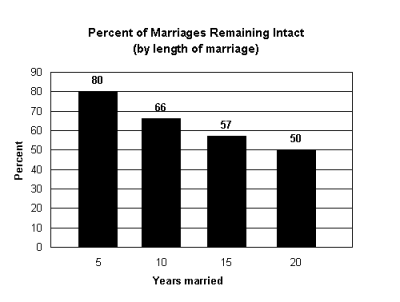
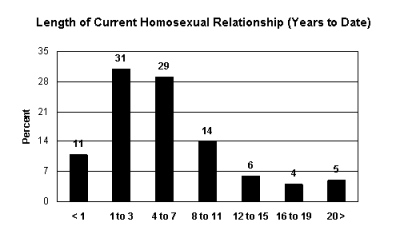
  • relationship duration
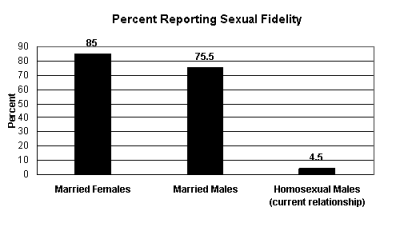
  • monogamy vs. promiscuity
  • relationship commitment
  • number of children being raised
  • health risks
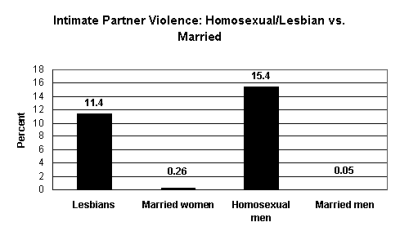
  • rates of intimate partner violence

Are there really significant differences between the two arrangements? Let’s take a look at the some of the data.

Relationship duration

% of Marriages Remaining Intact

Source: National Center for Health Statistics, Centers for Disease Control and Prevention (2001)

Length of Current Homosexual Relationship

Source: 2003-2004 Gay/Lesbian Consumer Online Census

Monogamy vs Promiscuity

% Reporting Sexual Fidelity

Sources:Laumann, The Social Organization of Sexuality, 216; McWhirter and Mattison, The Male Couple: How Relationships Develop (1984): 252-253; Wiederman, “Extramarital Sex,” 170.

Rates of intimate partner violence

Intimate Partner Violence

Sources: “Extent, Nature, and Consequences of Intimate Partner Violence,” U.S. Department of Justice: Office of Justice Programs: 30; “Intimate Partner Violence,” Bureau of Justice Statistics Special Report:11.

Conclusion

Marriage is a relationship that has a specific purpose. That purpose is to bind together two opposite natures and to produce children that are biologically linked to the parents. The children gain the benefits of being parented by the two different natures, so they get two perspectives. The fact that the children are genetically linked to two parents helps to ensure the stability of the commitment, as we see in the animal kingdom where animals protect their young.

The goal of marriage is not to increase the happiness of the adults, or to “recognize” the love of adults. The goal of marriage is have two people enter into a relationship where they understand that it is not about adults being fulfilled. Marriage is about people having a goal of raising children, which are tremendously stressful to raise. Marriage requires self-denial and sacrifice in order to raise those children – that is the main point of it. It also requires fidelity and chastity, so that the environment is kept stable for the children over a long period of time.

Children benefit from the stability that is more common in traditional marriages than it is in other arrangements, including heterosexual co-habitation which is similarly unstable (50% greater chance of divorce, more domestic violence, etc.). Therefore, it is important to keep the concept of marriage separate from other kinds of relationships so that the focus on commitment for the sake of the children is clear to those who contemplate marriage. Society needs to give special recognition to married couples, in view of their child-focused commitment.

I apologize in advance if this post causes anyone any harm or distress, I am just trying to explain why people have that opinion. They could be wrong, but that is the case they make. Obviously, married couples fall short of the goal, but that is their goal.

Further study

Two much bigger challenges to marriage are big-government socialism and especially no-fault divorce. I also wrote about same-sex marriage and co-habitation before, in the context of European states like Sweden and Norway.

You may also be interested in a recent post about whether homosexuality is caused by a “gay gene”.

Is it OK for Christians to marry non-Christians?

I want to draw your attention to a talk given by William Lane Craig. Bill is the ablest defender of the Christian faith operating today. You may remember Bill from such famous debates as “Does God Exist?” with Austin Dacey, “Did Jesus Rise from the Dead?” with Bart Ehrman, or “Is Goodness Without God Good Enough?” with Paul Kurtz.

The 32-minute talk is in MP3 format and is available on his web site Reasonable Faith, here. This was Bill’s chapel address to Biola University students, and he is introduced by his son, John, a Biola grad. As you listen to the talk, and reflect on the quotations that I will reproduce below from his writings, the question “is it OK to marry a non-Christian?” will be answered.

In the talk, it becomes clear that Bill’s wife Jan plays an enormous role in his success. Indeed, you will see that if it were not for her, he never would have gotten either of his doctorates, or even his second Masters degree. Just imagine: Bill Craig with one M.Div pastoring a seeker-sensitive church, instead having 2 MAs and 2 Ph.Ds and stomping Christopher Hitchens with both feet! What a loss!

Here is a quotation that occurs about 11 minutes into the talk, as Bill describes the completion of his Bachelor’s degree at Wheaton:

And it was at Wheaton that my vision began to focus on presenting the gospel in the context of giving an intellectual defense of the faith, to appeal not only to the heart but also to the head, as well. And so I determined that I would go on to seminary for further training.

But, my senior year, in chapel, we heard a speaker who challenged us, before going on to further education, to take a couple of years out, and to wring out the sponge, so to speak, that had been soaking up all that knowledge, and to work with university students while we were still about the same age.

And so I joined the staff of Campus Crusade for Christ for 2 years, and was assigned to Northern Illinois University. And that was where I met my wife Jan. She was a graduate of the University of North Dakota where she had come to faith in Christ. And she had a similar vision for her life of evangelism and discipleship.

And as we worked at NIU together, she with gals and I with the guys, leading students to Christ and discipling them to walk with the Lord, we fell in love. And we decided that we would be more effective if we joined forces and became a team.

It is at this point in the talk where Bill begins to explain just how Jan molded him into the lean, mean debating machine that travels the world striking terror into the hearts of atheists today.

Bill’s first story about Jan occurs early after their marriage while he is working on his first Masters degree at Trinity:

And it was also at that time that I began to see what an invaluable asset the Lord had given me in Jan. I remember I came home from classes one day, and found her at the kitchen table with all the catalogs and schedules and papers spread out in front of her and she said, “look! I’ve figured out how you can get two Masters degrees at the same time that it would normally take to get one! All you have to do is take overloads every semester, go to all full-time summer school and do all these other things, and you can do two MAs in the time it takes to do one!”

And I thought, whoa! Are you sure you really want to make the commitment it takes to do this kind of thing? And she said, “Yeah! Go for it!” And it was then I began to see that God had given me a very special woman who was my supporter – my cheerleader – and who really believed in me. And as long as she believed in me, that gave me the confidence to dream bigger dreams, and to take on challenges that I had never thought of before.

In an article on his web site, he talks about how Jan encouraged him to do his first PhD:

As graduation from Trinity neared, Jan and I were sitting one evening at the supper table in our little campus apartment, talking about what to do after graduation. Neither of us had any clear leading or inclination of what we should do next.

So Jan said to me, “Well, if money were no object, what would you really like to do next?”

I replied, “If money were no object, what I’d really like to do is go to England and do a doctorate under John Hick.”

“Who’s he?” she asked.

“Oh, he’s this famous British philosopher who’s written extensively on arguments for the existence of God,” I explained. “If I could study with him, I could develop a cosmological argument for God’s existence.”

But it hardly seemed a realistic idea.

The next evening at supper Jan handed me a slip of paper with John Hick’s address on it. “I went to the library today and found out that he’s at the University of Birmingham in England,” she said. “Why don’t you write him a letter and ask him if you can do a doctoral thesis under him on the cosmological argument?”

What a woman! So I did, and to our amazement and delight Professor Hick wrote back saying he’d be very pleased to supervise my doctoral work on that subject. So it was an open door!

And in the same article, he explains how Jan encouraged him to get his second Ph.D:

As Jan and I neared the completion of my doctoral studies in Birmingham, our future path was again unclear to us. I had sent out a number of applications for teaching positions in philosophy at American universities but had received no bites. We didn’t know what to do.

I remember it like yesterday. We were sitting at the supper table in our little house outside Birmingham, and Jan suddenly said to me, “Well, if money were no object, what would you really like to do next?”

I laughed because I remembered how the Lord had used her question to guide us in the past. I had no trouble answering the question. “If money were no object, what I’d really like to do is go to Germany and study under Wolfhart Pannenberg.”

“Who’s he?”

“Oh, he’s this famous German theologian who’s defended the resurrection of Christ historically,” I explained. “If I could study with him, I could develop a historical apologetic for the resurrection of Jesus.”

Our conversation drifted to other subjects, but Jan later told me that my remark had just lit a fire under her. The next day while I was at the university, she slipped away to the library and began to research grants-in-aid for study at German universities. Most of the leads proved to be defunct or otherwise inapplicable to our situation. But there were two grants she found that were possibilities. You can imagine how surprised I was when she sprung them on me!

Both of these Ph.D experiences are also described in the talk. And the talk concludes as follows:

I am so thankful to be married to a woman who is tremendously resourceful, tremendously talented and energetic, who could have pursued an independent career in any number of areas, but instead, she has chose to wed her aspirations to mine, and to make it her goal to make me the most effective person I can be, for Christ. And she has been like my right arm in ministry over these many years. And it is a tremendous privilege to be a team with a person like that.

And you young men, I would encourage you, if you marry, to find a gal who shares your vision, not some independent vision, but who is interested in aligning herself with you, and pursuing together a common vision and goal that will draw you [together], so that you will avoid the growing separateness that so often creeps into marriages.

And now you know the rest of Bill’s story. The person you marry will have an enormous influence on the impact you will have for Christ and his Kingdom. It is up to you to decide whether that influence is going to be positive or negative, by deciding if you will marry, and if you do marry, by deciding whom you will marry.

Conclusion

The level of influence of a significant other in a non-platonic relationship greatly impacts your ability to achieve the vocational task that the Lord has set for you. My recommendation is to avoid engaging in any romantic relationship in which self-sacrificial service to the Lord is not the main focus. And remember, physical contact greatly reduces your ability to make objective evaluations.

Today, Christians treat the Christian life as a hobby that we engage in for our benefit. And this includes romantic relationships. One way of screening prospective mates is by assessing how well prepared they are to defend the Lord’s reputation, when it is called into question. An authentic Christian should care enough to have prepared to defend God’s existence and character in public.

UPDATE: New William Lane Craig lecture specifically on the topic of Christian marriage:

  • Healthy Relationships (National Faculty Leadership Conf. 2008) (audio here)

Related posts