Tag Archives: Chastity

Study explains why university women embrace binge-drinking and hook ups

This study is from the Institute for American Values. Despite their name, they are not conservatives. It was done by Norval Glenn and Elizabeth Marquardt.

If you download the 88 page PDF, the first few pages are an executive summary.

There are a couple of things that really struck me about this IAV study on hooking-up.

First, this one from p. 15:

A notable feature of hook ups is that they almost always occur when both participants are drinking or drunk.

A Rutgers University student observed, “You always hear people say, oh my gosh, I was so drunk, I hooked up with so and so…” Perhaps not surprisingly, many noted that being drunk helped to loosen one’s inhibitions and make it easier to hook up. A number of students noted that being drunk could later serve as your excuse for the hook up. A Yale University student said, “Some people like hook up because they’re drunk or use being drunk as an excuse to hook up.” A New York University student observed, “[Alcohol is] just part of an excuse, so that you can say, oh, well, I was drinking.”

A Rutgers University student commented, “If you’re drinking a lot it’s easier to hook up with someone… [and] drugs, it’s kind of like a bonding thing… and then if you hook up with them and you don’t want to speak to them again, you can always blame it on the drinking or the drugs.”

Other women observed that being drunk gives a woman license to act sexually interested in public in ways that would not be tolerated if she were sober. For instance, a University of Michigan student said, “Girls are actually allowed to be a lot more sexual when they are drunk…”

A University of Chicago junior observed, “One of my best friends… sometimes that’s her goal when we go out. Like she wants to get drunk so I guess she doesn’t have to feel guilty about [hooking up].”

Some reported that drinking had led them to do things they later regretted. A University of Virginia student said, “My last random hook up was last October and it was bad. I was drunk and I just regretted it very much.”

And this one from p. 30 on the effects of hooking-up on their future commitments:

A few women did see an unambiguous connection between present relationships and future marriage.

[…]Many women either saw little or no connection between present and future relationships, or their understanding of this connection was curiously flat. A student at New York University said, “[The present and the future are] connected because I will still have the same values and principles that I have now, but I just won’t be single anymore.”A number of women said that the present and the future are connected because whatever heartache or confusion they experience now gives them lessons for the future.

A University of Michigan student said, “Early relationships prepare you for marriage because it’s like, oh, what type of person do I want to be with? Oh, I’ve had these bad experiences. Or, I’ve learned from this relationship that I should do this and I shouldn’t do this.”

A sophomore at Howard University said that “I am kind of learning from a lot of the mistakes that I have made.” At a further extreme, some women saw their future marriage as the reason to experiment widely in the present. A Rutgers University student said,“I think hooking up with different people and seeing what you like and don’t like is a good idea. Because eventually you’re going to have to… marry someone and I’d just like to know that I experienced everything.”

Although it is admirable to take risks and learn from one’s mistakes, these women would probably find it difficult to explain how having your heart broken a few or even many times in your early years — or trying to separate sex from feeling, as in hooking up — is good preparation for a trusting and happy marriage later on.

And on p. 42, we learn what women think marriage is and isn’t for:

For instance, in the on-campus interviews one student complained, “[With] marriage…you have to debate everything… Why do you need a piece of paper to bond a person to you? …But I know if I don’t get married I’ll probably feel like… [a] lonely old woman… If anything, I’d get married [because of] that.”

This student went on to say that she would be satisfied to live with a man, but added that, if the man was committed to her, he would offer to marry her, and that this was the kind of commitment that she wanted. A student at the University of Washington said,“I don’t want to get married right after I graduate from college. I just think that would stunt my growth in every way that there is. I would like to be in a very steady, committed relationship with a guy.”

And on p. 44, we learn that they like co-habitation, which increases the risk of divorce by about 50% (but they don’t know that):

In the national survey, 58 percent of the respondents agreed that “It is a good idea to live with someone before deciding to marry him.” This belief often coexists with a strong desire to marry, because it was embraced by 49 percent of the respondents who strongly agreed that marriage was a very important goal for them.

[…]Women we interviewed on campus reflected a similar range of attitudes about cohabitation. Some women thought that cohabitation was a good way to test whether one could spend a lifetime with a potential partner. In such cases, women often cited fears of divorce as the reason for trying cohabitation first. A senior at the University of Washington said, “I kind of don’t really see marriages work ever, so I want to make sure that everything’s all right before [we get married]. I don’t see how people can get married without living together because I know like I have a best friend and I live with her and we want to kill each other, like, every few months.”

Other women felt that, in an age of divorce, cohabitation was a preferable alternative to marriage. A student at New York University said, “You see so [many] people getting divorces… I just don’t see the necessity [of marriage].” She went on to say, “I think that I don’t have to be married to [the] person that I’m with…. You know like… Goldie Hawn [and Kurt Russell]? They’re not married.”

But let’s get back to the drinking and the hook-up sex…

Once a woman abandons femininity for feminism, then sex is all that she can use to get noticed by a man. Men are like hiring managers, and courting is like a job interview for the job of marriage and mothering. If a woman tries to get the job by having sex with the interviewer, he isn’t going to hire her for the marriage job, since sex has almost nothing to do with the marriage job. Men have to think about things like fidelity and mothering ability when they are choosing a wife. The problem is that thanks to feminism, women have stopped trying to show their ability to be wives and mothers to men, preferring to instead act like bad boys – no emotions, toughness, hardness, binge-drinking, promiscuity. Men may be happy to have sex with women like that, but they do not commit to them for life. They’re just looked upon as feral animals, to be pumped and dumped by every man who isn’t a Christian. And Christian men are disqualified for relationships with young feminists, because we have morals.

Moreover, if a man is constantly being offered sex from feminist women during his 20s and 30s, he basically loses all the time that he could be training for his roles as protector, provider and moral/spiritual leader. He will never take on those roles if he is handed sex before marriage for free. That is the root cause of the “man-up” complaint that women make. Why don’t men grow up? Because they don’t have to. They don’t have to do a thing to audition for husband roles, in order to get sex. They just have to be “hot” and feign liberal political views. Many (most?) teenage women are giving the bad boys oral sex on the first date now. Women aren’t looking for husbands until much later, when their effort to achieve self-esteem through slutty behavior stalls out, and they realize that the whole feminist project was futile and unsustainable.

In a previous post, I explained how feminist leaders wanted to get women to drink like men, have sex like men, and to abolish courtship and marriage. Under the influence of cultural definitions of what makes a good man and a good relationship, women began to choose men to have sex with without any consideration of morality, religion, marriage, etc. This results in a cycle of binge-drinking, one-night-stands, cheating, co-habitating, breaking-up, stalking, aborting, etc., until the woman’s ability to trust and love anyone – including herself – is completely destroyed. And yet these college women somehow believe this is is “fun” and “adventurous”, that it makes them feel “sexy”, and that the experience of being selfish and seeing the worst kind of men acting in the worst possible ways, point blank, somehow prepares them for marriage and motherhood. They are told this, and they are so unable to break out of their need to “fit in” with their peers and culture that by the time they realized they’ve been had, it’s too late to fix it. And yet, they themselves made those decisions. They are responsible, whether they intended the consequences or not. No one was stopping them from investigating what was likely to happen, if they decided to play the fool sexually.

Why you should read “Up From Slavery” by Booker T. Washington

What's the best way to get up from slavery?
What’s the best way to get up from slavery?

Lately, my friends have been very excited that I’m a non-white conservative. They want me to answer the grievances of BLM people, and explain from my own experiences what Christianity and conservative policies have to say about making the lives of non-whites better. My friend Wes recommended “Up From Slavery” by Booker T. Washington to help me focus my thoughts.

Here’s a summary of the book:

Dignity through Labor

Over the course of Up From Slavery, Washington develops the idea and ideal of dignity through labor. For Washington, the gravest aspect of the institution of slavery is the denigration of labor for both blacks and whites. Because the enslaved had no personal investment or return on their labor, they did not complete their work with an attitude toward improvement. Likewise, whites, largely deprived of meaningful labor, were robbed of the ability to achieve self-sufficiency. In both races, this produced personalities and characters that seek to escape labor. Washington emphasizes labor as the only way to make oneself useful in an interdependent, modern society. Throughout the whole of Up From Slavery, Washington searches for and obtains work. Further, once he obtains it, Washington completes all labor to best of his ability, no matter how lowly the task. At the Tuskegee Institute, Washington makes this idea and ideal a foundational ethos. All students who study at the Tuskegee Institute must learn a trade or industry alongside their more traditional academic pursuits. In addition, many of the buildings, most of the furniture, the wagons, and the materials used at the school are produced by students. This level of practical skill and diligence also acts as the foundation of Washington’s theory and program for racial uplift.

Selflessness, Desire to Be Useful to One’s Community

The people that Washington most admires and models himself after are those he labels selfless. Washington defines this as the willingness to work on the behalf of others. For Washington, this is not only about duty or labor, but also about the willingness to do one’s best for the benefit of the collective good. Washington believes that racial prejudice can be overcome if black people make themselves indispensable to their communities and their nation. The brick-making episode provides an example. Though the brick-making enterprise at Tuskegee felled three kilns before successfully producing bricks, the venture eventually proved successful and the school began to sell its bricks on the open market. Washington describes how whites who were unsympathetic or apathetic to the education of blacks and the overall project of the Tuskegee Institute were willing to purchase Tuskegee bricks due to their quality and convenience. Washington suggests that if black race can find their niche in society by fulfilling a need, then they can co-exist peacefully and productively with whites.

Impracticality of Political Agitation

Throughout Up From Slavery, Washington defends his ideas about racial advancement and uplift by subtly undermining the proposals of his critics. Though Washington does not explicitly state his objection to the strategies of specific thinkers like W.E.B. Dubois or even his predecessor, Frederick Douglass, he nevertheless highlights the wastefulness of political agitation for equal rights at every chance he gets. To do this, Washington shows that political agitation results in worse relations and outcomes than those that existed before. For example, when he goes home to Malden after his second year at the Hampton Institute, Washington finds that both the salt-furnace and the coal-mine are not in operation due to worker’s strikes. In Chapter IV, Washington describes how strikers usually spent all their savings during the strikes and returned to work in debt, but at the same wages. He raises the impracticality of political agitation again after his controversial Atlanta Exposition speech. After the success of his speech, he hypothetically asks if a black man would have been invited to give a speech had people agitated to put a black person on the program. He answers in the negative, saying that such opportunities can only arise through merit.

And here’s a summary of his most famous speech:

On September 18, 1895, Booker T. Washington was selected to give a speech that would open the Cotton States and International Exposition in Atlanta, Georgia. The speech, which is often referred to as the “Atlanta Compromise,” was the first speech given by an African American to a racially-mixed audience in the South. In it, Washington suggested that African Americans should not agitate for political and social equality, but should instead work hard, earn respect and acquire vocational training in order to participate in the economic development of the South. By doing so, eventually, he stated, African Americans would gain the respect of white society and be granted the rights of full citizenship.

There’s a free full audio version of the book, and the full text is online. I recommend this book to people of all races, because as the sexual anarchy brought on by feminism becomes widespread, the majority of the children of tomorrow will face the same kinds of challenges.

I see Washington’s ideas as consistent with a Christian worldview, where we don’t expect to be treated fairly. We expect sinful people to treat us badly. What Christianity says is to be patient, and focus on your relationship with God and loving your neighbor. And one way to love your neighbor is to sell them something valuable that you made through your labor. Another way is to work and save, and give to charity.

Government solutions to problems like racism and poverty aren’t a top priority for Christians. Most of all, we need the freedom to be good, and to do good. That’s priority one. You may not make your life better by being moral and diligent, but it’s rare that doing so causes you to harm yourself. It’s very important that you not harm yourself.

So, this dovetails nicely with my own story. My married non-white parents were not smart enough or willing enough to monitor my education, but they were clear that they wanted me to do well in order to find good-paying work. So I completed my BS and MS in a STEM field, and went to work right away, and I’ve been at it continuously for 20 years now. I save most of what I earn for charity and early retirement.

I’ve never experienced any of the racism or police brutality that American blacks complain about. And that’s because I follow what Washington is teaching. I dress in a clean way that doesn’t communicate danger to others. I’m careful to spend my time reading apologetics, economics and military history. I don’t listen to popular music or watch popular TV or movies. I don’t hang out with people who blame other people for their lack of success.

I got my first job by volunteering to do it for free on Saturdays for 7 months. My first full-time job salary after college was $50,000. Then I got a raise of $6,000 and then a raise of $9,000. I used to work 70 hour weeks in my 20s. I graduated college with $9,000 dollars in the black, and my net worth is now about $1.25 million. By the way, the secret to becoming wealthy is to not spend money on showing off. You can be very generous to your friends and still get rich. Just never buy anything that is designed to communicate “status” to anyone. And never spend money on alcohol or chasing sex outside of marriage.

At no time did I accept that the problems defined by the secular left were my real problems. And at no time did I accept their “solutions” as real solutions to anything. As black economist Thomas Sowell writes, the “solutions” of the left are not effective at helping people like me. The “solutions” of the left are designed to make leftists feel better, and look more virtuous to others. You are much better off reading the Bible, Christian apologetics, free market economics, American military history, etc., and then respecting what you learn from that in your decision-making. I think that reading the right stuff is even more important than having good parents or attending church.

New study: women who have fewer premarital sex partners have lower risk of divorce

Consider this article from Family Studies that talks about how the number of pre-marital sex partners that a woman has increases her risk of divorce.

It says:

American sexual behavior is much different than it used to be. Today, most Americans think premarital sex is okay, and will have three or more sexual partners before marrying. What, if anything, does premarital sex have to do with marital stability?

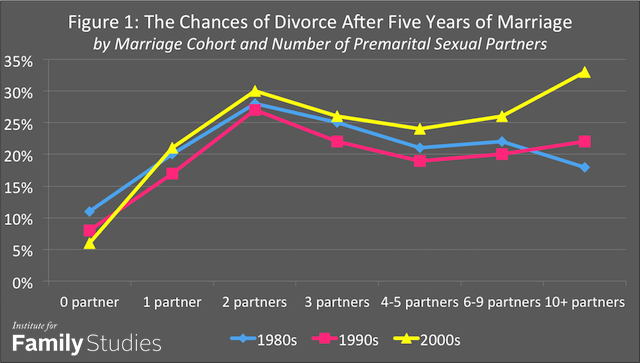
This research brief shows that the relationship between divorce and the number of sexual partners women have prior to marriage is complex. I explore this relationship using data from the three most recent waves of the National Survey of Family Growth (NSFG) collected in 2002, 2006-2010, and 2011-2013. For women marrying since the start of the new millennium:

  • Women with 10 or more partners were the most likely to divorce, but this only became true in recent years;
  • Women with 3-9 partners were less likely to divorce than women with 2 partners; and,
  • Women with 0-1 partners were the least likely to divorce.

Earlier research found that having multiple sex partners prior to marriage could lead to less happy marriages, and often increased the odds of divorce.

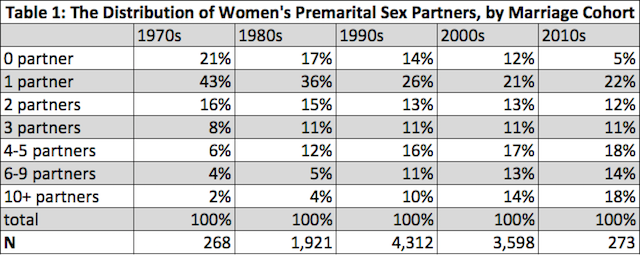
[…]Even more noteworthy has been the decline in the proportion of women who get married having had only one sex partner (in most cases, their future husbands). Forty-three percent of women had just one premarital sex partner in the 1970s.

[…]By the 2010s, only 5 percent of new brides were virgins. At the other end of the distribution, the number of future wives who had ten or more sex partners increased from 2 percent in the 1970s to 14 percent in the 2000s, and then to 18 percent in the 2010s. Overall, American women are far more likely to have had multiple premarital sex partners in recent years (unfortunately, the NSFG doesn’t have full data on men’s premarital sexual behavior, and in any event they recall their own marital histories less reliably than do women).

Here’s the change:

Women have freely chosen to dismiss the Bible and the moral law

And the problem with this, of course, is that more premarital sex partners means a higher risk of divorce:

Even one non-husband premarital sex partner raises risk of divorce

Why is the 2-partner number so high?

In most cases, a woman’s two premarital sex partners include her future husband and one other man. That second sex partner is first-hand proof of a sexual alternative to one’s husband. These sexual experiences convince women that sex outside of wedlock is indeed a possibility. The man involved was likely to have become a partner in the course of a serious relationship—women inclined to hook up will have had more than two premarital partners—thereby emphasizing the seriousness of the alternative.

The Christian Post had an article about some recent numbers from the Centers for Disease Control about virgins.

Excerpt:

A new Centers for Disease Control study examines teenage health behaviors in connection to their self-reported sexual activity and shows those who remain abstinent are much healthier on many fronts than their sexually active peers.

The report, titled “Sexual Identity, Sexual Contacts, and Health-Related Behaviors Among Students in Grades 9-12, United States and Selected Sites,” showcased the results from a 2015 survey that monitored several categories of health-related behaviors like tobacco usage, drug and alcohol use, sexual habits, unhealthy dietary behaviors, and behaviors that contribute to unintentional injuries and violence.

The report concludes “that students who had no sexual contact have a much lower prevalance of most health-risk behaviors compared with students” who had sexual contact.

The article quotes Dr. Jennifer Roback Morse, who I have featured on this blog many times:

In a Monday interview with The Christian Post, Jennifer Roback Morse, founder and president of the Ruth Institute, said, “this study is remarkable because it asks questions and reports the answers, rather than avoiding questions or assuming answers.”

As Glenn Stanton noted last week in The Federalist, the results from those questions and answers are remarkable.

With regard to smoking, teenage virgins are 3,300 percent less likely to smoke daily than their peers who are sexually involved with someone of the opposite sex, Stanton computed from the report’s data. Teen virgins are 9,500 percent less likely to smoke daily than their peers who are sexually involved with someone of the same sex or in a bisexual relationship, he added. Chaste young people are also extremely less likely to use indoor tanning beds, binge drink, smoke marijuana, ride in cars as passengers with a drunk driver, and get into physical fights than their sexually active peers. Abstinent youth are also more likely to get a solid eight hours of sleep every night and eat breakfast daily.

[…]The CDC report also included findings from 25 state surveys, and 19 large, urban school district surveys conducted among students in grades 9–12 which took place between December of 2014 and September of 2015.

Now, many pro traditional marriage people will tell young men “feminism and the sexual revolution change nothing about a woman’s suitability for marriage, so go out there and get married to these women anyway”. In my experience, no one is telling women NOT to follow their hearts, and explaining to them the harm that they do by allowing their feelings to determine who they will engage in relationships.

I would like to see women make better decisions with men before they marry, rather than be influenced by their peers and culture to give themselves to men who are not marriage-minded. Maybe a little skepticism should be shown to “follow your heart”? Women need to understand what they are losing when they choose to have premarital sex.

In my group of friends, the men are aware of the Biblical prohibition on premarital sex. My friends know about the research on marriage, and what it takes to make a marriage work. We don’t follow our hearts, because we do what we know will work to achieve the results we want. We don’t listen to the culture, and we don’t listen to radical feminists. Men generally take an engineering approach to marriage – we want to know what the best practices and tradeoffs are, and then we plan and act to succeed.