Tag Archives: Campus

Research paper explains why college students abandon courtship for hook ups

This study is from the Institute for American Values. It was done by Elizabeth Marquardt.

The PDF of study is here.

If you download the 88 page PDF, the first few pages are an executive summary.

I’d been exposed to this research before when I read Dr. Miriam Grossmann’s book “Unprotected”. (Boundless review here) I just got Dr. Miriam Grossmann’s new book “You’re Teaching My Child What?” and I also got Elizabeth Marquardt’s new book “Between Two Worlds: The Inner Lives of Children of Divorce”. I don’t think either of them is conservative, but I like their research anyway.

There are a couple of things that really struck me about this IAV study on hooking-up.

First, this one from p. 15:

A notable feature of hook ups is that they almost always occur when both participants are drinking or drunk.

A Rutgers University student observed, “You always hear people say, oh my gosh, I was so drunk, I hooked up with so and so…” Perhaps not surprisingly, many noted that being drunk helped to loosen one’s inhibitions and make it easier to hook up. A number of students noted that being drunk could later serve as your excuse for the hook up. A Yale University student said, “Some people like hook up because they’re drunk or use being drunk as an excuse to hook up.” A New York University student observed, “[Alcohol is] just part of an excuse, so that you can say, oh, well, I was drinking.”

A Rutgers University student commented, “If you’re drinking a lot it’s easier to hook up with someone… [and] drugs, it’s kind of like a bonding thing… and then if you hook up with them and you don’t want to speak to them again, you can always blame it on the drinking or the drugs.”

Other women observed that being drunk gives a woman license to act sexually interested in public in ways that would not be tolerated if she were sober. For instance, a University of Michigan student said, “Girls are actually allowed to be a lot more sexual when they are drunk…”

A University of Chicago junior observed, “One of my best friends… sometimes that’s her goal when we go out. Like she wants to get drunk so I guess she doesn’t have to feel guilty about [hooking up].”

Some reported that drinking had led them to do things they later regretted. A University of Virginia student said, “My last random hook up was last October and it was bad. I was drunk and I just regretted it very much.”

And this one from p. 30 on the effects of hooking-up on their future commitments:

A few women did see an unambiguous connection between present relationships and future marriage.

[…]Many women either saw little or no connection between present and future relationships, or their understanding of this connection was curiously flat. A student at New York University said, “[The present and the future are] connected because I will still have the same values and principles that I have now, but I just won’t be single anymore.”A number of women said that the present and the future are connected because whatever heartache or confusion they experience now gives them lessons for the future.

A University of Michigan student said, “Early relationships prepare you for marriage because it’s like, oh, what type of person do I want to be with? Oh, I’ve had these bad experiences. Or, I’ve learned from this relationship that I should do this and I shouldn’t do this.”

A sophomore at Howard University said that “I am kind of learning from a lot of the mistakes that I have made.” At a further extreme, some women saw their future marriage as the reason to experiment widely in the present. A Rutgers University student said,“I think hooking up with different people and seeing what you like and don’t like is a good idea. Because eventually you’re going to have to… marry someone and I’d just like to know that I experienced everything.”

Although it is admirable to take risks and learn from one’s mistakes, these women would probably find it difficult to explain how having your heart broken a few or even many times in your early years — or trying to separate sex from feeling, as in hooking up — is good preparation for a trusting and happy marriage later on.

And on p. 42, we learn what women think marriage is and isn’t for:

For instance, in the on-campus interviews one student complained, “[With] marriage…you have to debate everything… Why do you need a piece of paper to bond a person to you? …But I know if I don’t get married I’ll probably feel like… [a] lonely old woman… If anything, I’d get married [because of] that.”

This student went on to say that she would be satisfied to live with a man, but added that, if the man was committed to her, he would offer to marry her, and that this was the kind of commitment that she wanted. A student at the University of Washington said,“I don’t want to get married right after I graduate from college. I just think that would stunt my growth in every way that there is. I would like to be in a very steady, committed relationship with a guy.”

And on p. 44, we learn that they like co-habitation, which increases the risk of divorce by about 50% (but they don’t know that):

In the national survey, 58 percent of the respondents agreed that “It is a good idea to live with someone before deciding to marry him.” This belief often coexists with a strong desire to marry, because it was embraced by 49 percent of the respondents who strongly agreed that marriage was a very important goal for them.

[…]Women we interviewed on campus reflected a similar range of attitudes about cohabitation. Some women thought that cohabitation was a good way to test whether one could spend a lifetime with a potential partner. In such cases, women often cited fears of divorce as the reason for trying cohabitation first. A senior at the University of Washington said, “I kind of don’t really see marriages work ever, so I want to make sure that everything’s all right before [we get married]. I don’t see how people can get married without living together because I know like I have a best friend and I live with her and we want to kill each other, like, every few months.”

Other women felt that, in an age of divorce, cohabitation was a preferable alternative to marriage. A student at New York University said, “You see so [many] people getting divorces… I just don’t see the necessity [of marriage].” She went on to say, “I think that I don’t have to be married to [the] person that I’m with…. You know like… Goldie Hawn [and Kurt Russell]? They’re not married.”

But let’s get back to the drinking and the hook-up sex…

Once a woman abandons femininity for feminism, then sex is all that she can use to get noticed by a man. Men are like hiring managers, and courting is like a job interview for the job of marriage and mothering. If a woman tries to get the job by having sex with the interviewer, he isn’t going to hire her since sex has nothing to do with the job. There are children involved, you know – he has to think of them when he makes the hiring decision. But women have been taught to think bad things about men (they’re rapists) and marriage (it’s slavery) by feminists – so they don’t even try to understand men, or to respect men, or prepare their character for being a wife and mother. Feminists just don’t understand that hard work is needed to understand men and prepare for marriage.

In a previous post, I explained how feminists wanted to get women to drink like men, have sex like men, and to abolish courtship and marriage. Under the influence of feminism and Hollywood celebrities, women began to choose men to have sex with without any consideration of morality, religion, marriage, etc. They thought that sex was an easy way to trick a man into committing to them without having to treat him like a real person, or to take the demands of marriage and parenting seriously. (They have been taught to value education and careers over husbands and children, you understand). This results in a cycle of binge-drinking, one-night-stands, cheating, co-habitating, breaking-up, stalking, aborting, etc., until the woman’s ability to trust and love anyone but herself is completely destroyed. And yet these college women somehow believe this is “adventurous”, that it makes them feel “sexy”, and that the experience of being selfish and seeing the worst kind of men acting in the worst possible ways, point blank, somehow prepares them for marriage and motherhood.

Often, a young unmarried woman’s biological father was NOT selected by her mother based on his ability to make commitments and moral judgments. Many feminists prefer men who do not judge women morally, nor impose his religion on her. But those very things that young unmarried  women today seem to dislike most about men, because they fear rejection on moral and religious grounds, are exactly the things that make men good husbands and fathers. They don’t want to be judged or led spiritually, so they choose immoral, non-religious men. Men who are not firm on morality and religion do cannot be counted on to act morally and self-sacrificially. And when they fail, and the marriages break up, the children grow up fatherless and may develop negative views of men.

Every young unmarried woman who chooses a bad man, and then has a bad experience with him is pushing away marriage with both hands. The more she destroys her ability to trust, love and care for others, the less she is able to be happy and effective in a marriage.
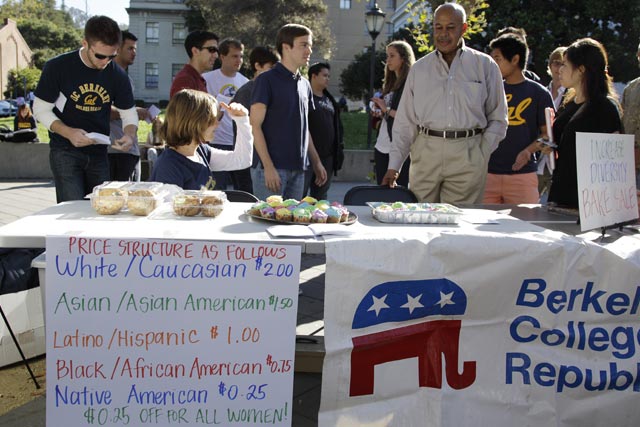
Berkeley College Republicans hold affirmative action bake sale

Berkeley College Republicans affirmative action bake sale

From the NY Daily News.

Excerpt:

A controversy over cupcakes is heating up at UC Berkeley in California, where campus Republicans are planning to hold an affirmative action bake sale on Tuesday.

At the sale, white men will be charged $2 for a baked good, Asians will pay $1.50, Latinos $1, African-Americans 75 cents and 25 cents for Native Americans, KGO-TV reported.

Women will get a 25 cent discount.

“The pricing structure is there to bring attention, to cause people to get a little upset,” Campus Republican president Shawn Lewis told the TV station. “But it’s really there to cause people to think more critically about what this kind of policy would do in university admissions.”

The Campus Democrats immediately slammed the sale, which Lewis said is meant to take a stand against an affirmative action-like bill for the University of California system that is awaiting Gov. Jerry Brown’s signature.

On Friday, the student newspaper reported that the student government could vote to defund the Republican group over the bake sale. A hearing is scheduled for Sunday on the fiery issue.

So the response of the left is to censor the people who offend their feelings. But that’s not all.

Look at the emotional language from the opposition in this CNN article.

Excerpt:

ASUC President Vishalli Loomba said many students who attended a community meeting Monday night expressed disgust that the bake sale would take place.

As a woman of color, when I first saw the event, I was appalled someone would post something like this on the Internet — not only a different pay structure, but also to rank the races,” she said. “It trivializes the struggles that people have been through and their histories.”

Now, for anyone who wants the research on affirmative action, and why it hurts minorities, I recommend two books by my favorite economist Thomas Sowell. (I also have to mention that he’s black, because otherwise the secular leftist commenters will cry racism, which is all they learn to do in four years of college). The first book is “Inside American Education” and the second book is “Affirmative Action Around the World: An Empirical Study“, published by Yale University Press. I only recommend the best to my readers. The first book is better for beginners, the second is more academic. Sowell’s conclusion? Affirmative action certainly doesn’t help minorities, and in many cases it actually hurts minorities. You can read a summary of Sowell’s findings here.

So on the one hand, you have the whiny secular left woman expressing real racism and sexism (“woman of color”), whining, blaming, and being disgusted and appalled. And on the other hand, you have Hoover Institute economist Thomas Sowell and the Yale University Press.

How Vanderbilt persecutes Christian groups on campus

But there’s more! I notice that the secular left is becoming increasingly bold about censoring Christians as well. (H/T Wes from Reason to Stand)

Excerpt:

Is Vanderbilt University flirting with the suppression of religion? Yes, according to Carol Swain, a professor at Vanderbilt’s Law School.

Specifically, Swain is referring to four Christian student groups being placed on “provisional status” after a university review found them to be in non-compliance with the school’s nondiscrimination policy.

Vanderbilt says the student organizations cannot require that leaders share the group’s beliefs, goals and values. Carried to its full extent, it means an atheist could lead a Christian group, a man a woman’s group, a Jew a Muslim group or vice versa.

If they remain in non-compliance, the student organizations risk being shut down.

So what’s behind this? Flashback to last fall. An openly gay undergrad at Vanderbilt complained he was kicked out of a Christian fraternity. The university wouldn’t identify the fraternity, but campus newspaper the “Hustler” reported it was Beta Upsilon Chi. As a result, the school took a look at the constitutions of some 300 student groups and found about a dozen, including five religious groups to be in non-compliance with Vanderbilt’s nondiscrimination policy. All were placed on provisional status.

Among the groups threatened with shut down is the Christian Legal Society. It ran afoul with this language from its constitution. “Each officer is expected to lead Bible studies, prayer and worship at chapter meetings.” CLS President Justin Gunter told me, “We come together to do things that Christians do together. Pray, and have Bible studies.”

[…]Vanderbilt officials refused to be interviewed, and instead released a statement saying in part “We are committed to making our campus a welcoming environment for all of our students.” In regard to the offending student organizations, officials said they “continue to work with them to achieve compliance.”

Some people who are Christians give money to Vanderbilt, and other universities. But they shouldn’t do that. The only two colleges worth giving money to are Hillsdale College and Grove City College.

Should Christians divorce their faith from public square issues?

I have had major problems with IVCF and Campus Crusade as an undergraduate student (IVCF) then as a graduate student (Crusade). Basically, they are totally driven by numbers and refuse to say or do anything that isn’t centered on privatized fideism. They refused to learn apologetics, take positions on economics or politics, or even to discuss the moral questions being discussed in the broader society – for fear of “offending” people. They do this because they think that being saved can be divorced from personal morality as well as engagement with society as a whole. Their focus is on “belief”, not on study, growth or practice. Whatever you believe about abortion, gay rights, environmentalism and socialism is totally fine with them, because Christianity has nothing to say about those kinds of issues.

Scott Klusendorf at the Life Training Institute assesses Campus Crusade for Christ’s decision to rename themselves “CRU”.

Excerpt:

Well, at Cal Poly SLO in May of 2008, the response of Christians to the abortion controversy did in fact turn-off at least one non-Christian, but not for reasons campus fellowship groups might expect. The ASB student leader responsible for organizing an abortion debate at that campus expressed her dismay that Campus Crusade would not attend the event or get behind promoting it with its members.

She asked me directly why I thought that was so. She thought for sure the Christians would show up and she was puzzled that they didn’t. Their refusal to get involved turned her off.

I didn’t know what to tell her. Perhaps CC had good reasons for not attending and I hold out hope it did, though it’s hard for me to imagine what those reasons might be. I suspect she is not the only secular student puzzled by CC’s non-involvement.

Indeed, according to a 2005 TIME Magazine piece, the overall trend is not encouraging. Instead of equipping students to confront the thought structures that determine culture in the first place, many of these groups help students nurture a very private and personal faith, a faith separate from the intellectual climate of the university. The TIME article states:

“But all the groups tend to go about their business quietly. “They kind of operate under the surface,” McKaig says. Josh Sanburn, editor in chief of the Indiana Daily Student, notes that the number of students in the fellowships is roughly the same as the school’s African-American student population, but unlike the Christians, “the black students on this campus are very good about making sure they’re heard.” Evangelical students, however, see their spiritual mission differently. Says sophomore CSF member Emily Hoefling: “We usually believe what affects people more than a newspaper article is to see people living Christian lives.”

Question: Since when does “living Christian lives” mean checking out of the real action on campus?

I fear that the message to Christian students and the campus at large couldn’t be clearer: Christianity is not relevant to the most pressing issues of our day. It’s fine as a personal life enhancement, but irrelevant to the real world of ideas, politics, morality, and law where the rest of the world lives.

Again, is that a good witness for Christ? As Charles Malik pointed out half a century ago, “If you win the whole world [for Christ] and lose the mind of the world, you will soon discover that you have not won the world.”

As I’ve said before, Christian leaders have it all wrong. My own experience suggests that far from turning people off, a persuasive pro-life case, graciously communicated, suggests to non-believers that maybe, just maybe, the Christian worldview has something relevant to say to the key issues of our day. But when we fail to even put in an appearance at key debates, the message to non-Christians is that we simply don’t care about the big stuff.

Including the biggest issue of all, “Christ?”

This reminds me of an article I found on Life News about Michele Bachmann.

Excerpt:

Congresswoman Michele Bachmann is one of the several pro-life advocates seeking the Republican nomination to face pro-abortion President Barack Obama and she cites Christian writer Francis Schaeffer as an influence on her pro-life views.

In a campaign stop to speak to local residents at a church in Cedar Rapids, Iowa, Bachmann shared her testimony and talked about the Christian faith she and her husband share. That faith, which has matured thanks to the writings of Schaeffer, has led Bachman to a pro-life view that has seen her compile a 100% pro-life voting record in Congress and adopt dozens of foster children.

“One thing that Dr. Schaeffer said is that [God is] not just the God of theology. He’s not just the God of the Bible,” Bachmann said, according to the Des Moines Register. “Since he is the Creator God, he’s the father of biology, sociology, of political science, of you name the subject. … And that altered our way of thinking, that God had something to say about our career.”

“Francis Schaeffer also said that life is the watershed issue of our time, and how we come down on how we view human life will impact all other issues,” she said. “And so Marcus and I decided we didn’t want to be pro-life only, just as speaking… We wanted to live a life of being about pro-life.”

The Register indicates Bachmann told the audience that, upon the encouragement to put her pro-life views into action, she and her husband began counseling and praying with single mothers and helping them get to pregnancy and adoption centers to provide further practical support instead of abortion.

One of the reasons why I started this blog is because of my experiences with the campus clubs when I was a student. In many cases, you would not find a dime’s worth of difference between the worldviews of secular leftists and these campus club organizations, at least in my experience. The ones I belonged to were thoroughly compromised by postmodernism, relativism, leftism and anti-intellectualism. They blocked me from introducing apologetics and debates every step of the way, for fear of “offending” people. I will never forget the empty-headed people who proclaimed themselves “Christian communists” or the ones who explained to me how blind faith was more genuine than rational faith, or the science student who told me that Christianity and science were completely separate, etc. Every week it was another testimony or a prayer walk. Never would they even let a scholar come in to talk about the evidence for the resurrection.