Tag Archives: Brain

New study: fewer than one in ten women staying home with children

Dina sent me this article from the UK Daily Mail.

Excerpt:

Fewer than one in ten women stay at home to look after their children

  • Latest census figures show 300,000 fewer staying home than thought
  • Concerns for well-being of mothers and impact on toddlers in day care
  • Stay-at-home figures dropped from 17 per cent of women 20 years ago

The stay-at-home mother is fast becoming consigned to history, according to the latest census figures.

Returns showed there are 300,000 fewer than officials  had previously estimated, with those who devote their lives to bringing up families now reduced to a tiny minority.

Fewer than one in ten women of working age are stay-at-home mothers.

The collapse follows a decade in which governments urged mothers to take jobs on the grounds that working is the route to fulfilment for women and that families with two incomes are much less likely to fall into poverty.

Critics, however, are concerned for the well-being of mothers who might prefer to be with their families, and the impact on increasing numbers of toddlers who spend long hours in day care.

The 2011 census results found there are 1,598,000 women who do not work because they are looking after their home and family – 298,000 fewer than estimates from the Office for National Statistics.

Note that this is applauded by feminist groups, like the UK Labour Party:

The decline in numbers of stay-at-home mothers will be welcomed by ministers as the Labour drive to push mothers into work has continued under the Coalition.

Childcare minister Elizabeth Truss has made a priority of providing cheaper day care to help mothers into jobs.

In an article earlier this year  she said it was ‘vital’ for mothers to work, adding: ‘To power ahead Britain needs to look at best practice from overseas to discover how to increase women’s participation, especially for those who are parents.’

But critics say the sky-high level of house prices and the lack of help for two-parent families in the tax and benefit systems means most mothers have to work, whether they like it or not.

Earlier this week I blogged studies that showed the importance of fathers to children. But it’s important to remember that mothers are also important to children, especially in the first few years of the child’s life. And we have studies to back that up as well.
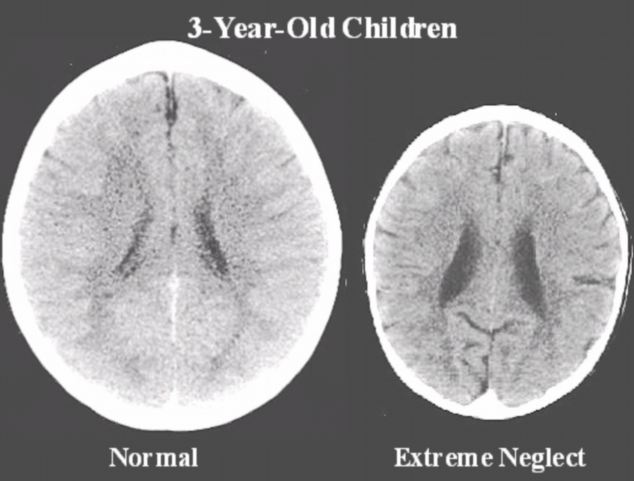
Brain scans of 3-year old children: normal vs neglected

This was discussed before in another article from the UK Daily Mail. (H/T Dina)

Excerpt:

Both of these images are brain scans of a two three-year-old children, but the brain on the left is considerably larger, has fewer spots and less dark areas, compared to the one on the right.

According to neurologists this sizeable difference has one primary cause – the way each child was treated by their mothers.

The child with the larger and more fully developed brain was looked after by its mother – she was constantly responsive to her baby, reported The Sunday Telegraph.

But the child with the shrunken brain was the victim of severe neglect and abuse.

According to research reported by the newspaper, the brain on the right worryingly lacks some of the most fundamental areas present in the image on the left.

The consequences of these deficits are pronounced – the child on the left with the larger brain will be more intelligent and more likely to develop the social ability to empathise with others.

But in contrast, the child with the shrunken brain will be more likely to become addicted to drugs and involved in violent crimes, much more likely to be unemployed and to be dependent on state benefits.

The child is also more likely to develop mental and other serious health problems.

Professor Allan Schore, of UCLA, told The Sunday Telegraph that if a baby is not treated properly in the first two years of life, it can have a fundamental impact on development.

He pointed out that the genes for several aspects of brain function, including intelligence, cannot function.

[…]The study correlates with research released earlier this year that found that children who are given love and affection from their mothers early in life are smarter with a better ability to learn.

The study by child psychiatrists and neuroscientists at Washington University School of Medicine in St. Louis, found school-aged children whose mothers nurtured them early in life have brains with a larger hippocampus, a key structure important to learning, memory and response to stress.

The research was the first to show that changes in this critical region of children’s brain anatomy are linked to a mother’s nurturing, Neurosciencenews.com reports.

The research is published online in the Proceedings of the National Academy of Sciences Early Edition.

Lead author Joan L. Luby, MD, professor of child psychiatry, said the study reinforces how important nurturing parents are to a child’s development.

If we are really interested in providing for the needs of young children, then we have to voluntarily limit the freedom of adults. Traditional marriage is the way that societies have provided for the needs of young children. Marriage puts boundaries on sexual activity (premarital chastity, post-marital fidelity) that are beneficial to children. Children need to have access to their parents over the course of their development.

We should be promoting behaviors and policies that strengthen marriage, like chastity and low tax rates. We should be opposing behaviors and policies that weaken marriages, like hooking-up and no-fault divorce. That’s what we would do if we really had the best interests of children at heart instead of the best interests of adults.

William Lane Craig debates Austin Dacey: Does God Exist?

Here is the video and summary of a debate between Christian theist William Lane Craig and Austin Dacey at Purdue University in 2004 about the existence of God.

The debaters:

The video: (2 hours)

The video shows the speakers and powerpoint slides of their arguments. Austin Dacey is one of the top atheist debaters, and I would put him second to Peter Millican alone, with Walter Sinnott-Armstrong in third place. This is the debate to show people who are new to apologetics. The debate with Peter Millican is better for advanced students, and that’s no surprise since he teaches at Oxford University and is familiar with all of Dr. Craig’s work. The Craig-Dacey debate is the one that I give to my co-workers.

By the way, you can get the DVDs and CDs for the first Craig-Dacey debate and the second Craig-Dacey debate and the second Craig-Sinnott-Armstrong debate. The Peter Millican debate is not available on DVD, but the link above (Peter Millican) has the video and my summary.

Dr. Dacey’s 5 arguments below are all good arguments that you find in the academic literature. He is also an effective and engaging speaker, This is a great debate to watch!

SUMMARY of the opening speeches:

Dr. Craig’s opening statement:

Dr. Craig will present six reasons why God exists:

  1. (Contingency argument) God is the best explanation of why something exists rather than nothing
  2. (Cosmological argument)  God’s existence is implied by the origin of the universe
  3. (Fine-tuning argument) The fine-tuning of the universe for intelligent life points to a designer of the cosmos
  4. (Moral argument) God is the best explanation for the existence of objective moral values and objective moral duties
  5. (Miracles argument) The historical facts surrounding the life, death and resurrection of Jesus
  6. (Religious experience) God’s existence is directly knowable even apart from arguments

Dr. Dacey’s opening argument:

There are two ways to disprove God’s existence, by showing that the concept of God is self-contradictory, or by showing that certain facts about ourselves and the world are incompatible with what we would expect to be true if God did exist. Dr. Dacey will focus on the second kind of argument.

  1. The hiddenness of God
  2. The success of science in explaining nature without needing a supernatural agency
  3. The dependence of mind on physical processes in the brain
  4. Naturalistic evolution
  5. The existence of gratuitous / pointless evil and suffering

One final point:

One thing that I have to point out is that Dr. Dacey quotes Brian Greene during the debate to counter Dr. Craig’s cosmological argument. Dr. Craig could not respond because he can’t see the context of the quote. However, Dr. Craig had a rematch with Dr. Dacey where was able to read the context of the quote and defuse Dr. Dacey’s objection. This is what he wrote in his August 2005 newsletter after the re-match:

The following week, I was off an another three-day trip, this time to California State University at Fresno. As part of a week of campus outreach the Veritas Forum scheduled a debate on the existence of God between me and Austin Dacey, whom I had debated last spring at Purdue University. In preparation for the rematch I adopted two strategies: (1) Since Dacey had come to the Purdue debate with prepared speeches, I decided to throw him for a loop by offering a different set of arguments for God, so that his canned objections wouldn’t apply. I chose to focus on the cosmological argument, giving four separate arguments for the beginning of the universe, and on the evidence for Jesus’ resurrection. (2) I reviewed our previous debate carefully, preparing critiques of his five atheistic arguments. In the process I found that he had seriously misunderstood or misrepresented a statement by a scientist on the Big Bang; so I brought along the book itself in case Dacey quoted this source again. I figured he might change his arguments just as I was doing; but I wanted to be ready in case he used his old arguments again.

[…]The auditorium was packed that night for the debate, and I later learned that there were overflow rooms, too. To my surprise Dr. Dacey gave the very same case he had presented at Purdue; so he really got clobbered on those arguments. Because he wasn’t prepared for my new arguments, he didn’t even respond to two of my arguments for the beginning of the universe, though he did a credible job responding to the others. I was pleased when he attacked the Big Bang by quoting the same scientist as before, because I then held up the book, specified the page number, and proceeded to quote the context to show what the scientist really meant.

If you want to hear Dr. Craig correct Dr. Dacey on the misquote during their second debate, you can click here for the audio.

Man thought to be in a vegetative state able to communicate with doctors

ECM sent me this article from the BBC that may cause you to re-think your beliefs about people in “vegetative” states.

Excerpt:

A Canadian man who was believed to have been in a vegetative state for more than a decade, has been able to tell scientists that he is not in any pain.

It’s the first time an uncommunicative, severely brain-injured patient has been able to give answers clinically relevant to their care.

Scott Routley, 39, was asked questions while having his brain activity scanned in an fMRI machine.

His doctor says the discovery means medical textbooks will need rewriting.

[…]Mr Routley suffered a severe brain injury in a car accident 12 years ago.

None of his physical assessments since then have shown any sign of awareness, or ability to communicate.

But the British neuroscientist Prof Adrian Owen – who led the team at the Brain and Mind Institute, University of Western Ontario – said Mr Routley was clearly not vegetative.

“Scott has been able to show he has a conscious, thinking mind. We have scanned him several times and his pattern of brain activity shows he is clearly choosing to answer our questions. We believe he knows who and where he is.”

[…]Scott Routley’s parents say they always thought he was conscious and could communicate by lifting a thumb or moving his eyes. But this has never been accepted by medical staff.

Prof Bryan Young at University Hospital, London – Mr Routley’s neurologist for a decade – said the scan results overturned all the behavioural assessments that had been made over the years.

[…]”I was impressed and amazed that he was able to show these cognitive responses. He had the clinical picture of a typical vegetative patient and showed no spontaneous movements that looked meaningful.”

It seems to me that an increasing number of people in society are turning away from the idea that human life is sacred because it is made in the image of God, and towards the idea that human life has value so long as powerful people think it has value. You can see it easily in the abortion debate where an entire category of humans are deemed “subhuman” because they impost obligations on a stronger group of people. Basically, the right to happiness of the strong trumps the right to life of the weak. I don’t think that life is about feeling happy thought.  I think that life is about doing the right thing.