
Tag Archives: Brain

Brian Auten interviews Dr. Angus Menuge on philosophy of mind

Click here for the interview. It’s up at Apologetics 315!

Details:

Today’s interview is with Dr. Angus Menuge, Professor of Philosophy  at Concordia University, and author of Agents Under Fire: Materialism and the Rationality of Science. He talks about his background and work, the philosophy of mind, what reason (or reasoning) is, what materialism is as a worldview, things excluded from a materialistic worldview, methodological naturalism and materialism, accounting for free will, materialistic accounts of reason, the epistemological argument from reason, the ontological argument from reason, finding the best explanation for reason, problems with methodological naturalism, implications of materialism, practical application of the argument from reason, advice for apologists, the International Academy of Apologetics, and more.

If what Dr. Menuge says in this interview is true, and I think it is, then a person who believes in materialism can neither ground free will nor rationality! So atheism wouldn’t really be freethought so much as it would be… un-free… non-thought.

In case people don’t want to listen to the podcast, then I’ve got some things for you to read below.

The ontological argument from reason

Dr. Menuge presented a paper at the real Evangelical Philosophical Society conference for students and professors of philosophy, and you can download the paper here in Word format. (here’s a PDF version I made)

Here is the introduction to the paper that Dr. Menuge read at the EPS conference:

The argument from reason is really a family of arguments to show that reasoning is incompatible with naturalism. Here, naturalism is understood as the idea that foundationally, there are only physical objects, properties and relations, and anything else reduces to, supervenes on, or emerges from that. For our purposes, one of the most important claims of naturalism is that all causation is passive, automatic, event causation (an earthquake automatically causes a tidal wave; the tidal wave responds passively): there are no agent causes, where something does not happen automatically but only because the agent exerts his active power by choosing to do it. The most famous version of the argument from reason is epistemological: if naturalism were true, we could not be justified in believing it. Today, I want to focus on the ontological argument from reason, which asserts that there cannot be reasoning in a naturalistic world, because reasoning requires libertarian free will, and this in turn requires a unified, enduring self with active power.

The two most promising ways out of this argument are: (1) Compatibilism—even in a deterministic, naturalistic world, humans are capable of free acts of reason if their minds are responsive to rational causes; (2) Libertarian Naturalism—a self with libertarian free will emerges from the brain. I argue that neither of these moves works, and so, unless someone has a better idea, the ontological argument from reason stands.

The paper is 11 pages long, and it is helpful for those of you looking for some good discussion of one of the issues in the area of philosophy of mind.

You may also be interested in Alvin Plantinga’s epistemological argument from reason, which is related to this argument. It shows that even to have the ability to think, you have to have a certain anthropology and you have to have mental faculties that are designed for reason, not survival.

Methodological naturalism

Dr. Menuge also wrote an article entitled “Is methodological materialism good for science?”.

Intro:

Should science by governed by methodological materialism? That is, should scientists assume that only undirected causes can figure in their theories and explanations? If the answer to these questions is yes, then there can be no such thing as teleological science or intelligent design. But is methodological materialism a defensible approach to science, or might it prevent scientists from discovering important truths about the natural world? In my contribution to The Waning of Materialism (Oxford University Press, 2010), edited by Robert Koons and George Bealer, I consider twelve of the most common arguments in favor of methodological materialism and show that none of them is convincing.

Of these arguments, perhaps the most prevalent is the “God of the gaps” charge, according to which invoking something other than a material cause is an argument from ignorance which, like a bad script writer, cites a deus ex machina to save our account from difficulty. Not only materialists, but also many Christian thinkers, like Francis Collins, worry that appeal to intelligent design commits the God of the gaps fallacy.

As I argue, however, not only is an inference to an intelligent cause not the same as an inference to the supernatural, it is a mistake to assume that all gap arguments are bad, or that only theists make them. If a gap argument is based solely on ignorance of what might explain some phenomenon, then indeed it is a bad argument. But there are many good gap arguments which are made both by scientific materialists and proponents of intelligent design.

So how do you make an argument like that?

As Stephen Meyer has argued in his Signature in the Cell, intelligent design argues in just the same way, claiming not merely that the material categories of chance and necessity (singly or in combination) are unable to explain the complex specified information in DNA, but also that in our experience, intelligent agents are the only known causes of such information. The argument is based on what we know about causal powers, not on what we do not know about them.

Since the inference is based on known causal powers, we learn that the cause is intelligent, but only further assumptions or data can tell us whether that intelligence is immanent in nature or supernatural. It is a serious mistake to confuse intelligent design with theistic science, and the argument that since some proponents of design believe that the designer is God, that is what they are claiming can be inferred from the data, is a sophomoric intensional fallacy.

If you think this is interesting, then do have a listen to the podcast. Dr. Menuge is not an ordinary academic – he is very direct. He calls materialism “a catastrophe” in the podcast! Not a shrinking violet.
Does science support mothers who leave their young children to go to work?

Dina is very concerned about the UK’s leftist coalition government’s attempt to punish women who stay at home with their young children. (H/T Dina)

Excerpt:

Under plans unveiled in the Budget on Wednesday, families will only benefit from the generous new deal, which will come into force in 2015, if ‘all parents’ have a job. If one parent works but the other stays at home looking after their young children, they will get nothing.

It is the second time in just a few months that the Government has triggered controversy with its changes to the tax and benefit systems, which appear to penalise stay-at-home mothers.

As a result of the recent child benefit changes, a couple can both earn £50,000 and keep their child benefit, worth £1,752 a year for two children.

But a couple where one parent earns £60,000 and the other earns nothing – but have a far lower joint income – do not get a penny.

Again, this week’s initiative favours those couples where both parents go out to work. It will even benefit parents who each earn a salary of £149,999.

Note that this plan is being put forward by socialist Liberal Democrat Party, as well as the “Conservative” Party.

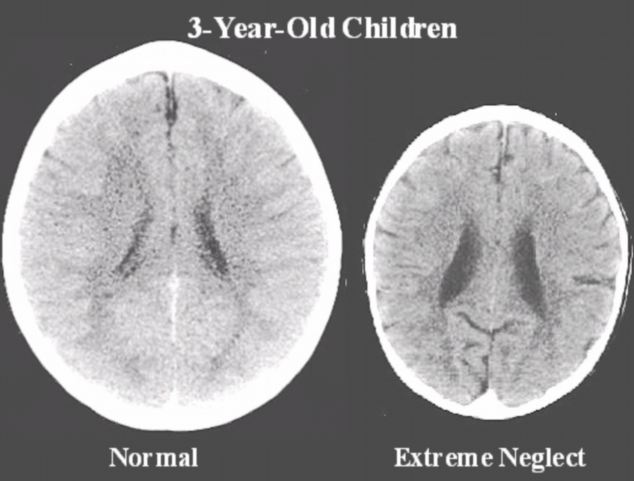
Dina thinks that the science is pretty clear that children suffer if their mothers leave them at a young age. Take a look at the video above, and then the brain scan below.

Brain scans of 3-year old children: normal vs neglected

Here’s the article that goes with the brain scan from the UK Daily Mail.

Excerpt:

Both of these images are brain scans of a two three-year-old children, but the brain on the left is considerably larger, has fewer spots and less dark areas, compared to the one on the right.

According to neurologists this sizeable difference has one primary cause – the way each child was treated by their mothers.

The child with the larger and more fully developed brain was looked after by its mother – she was constantly responsive to her baby, reported The Sunday Telegraph.

But the child with the shrunken brain was the victim of severe neglect and abuse.

According to research reported by the newspaper, the brain on the right worryingly lacks some of the most fundamental areas present in the image on the left.

The consequences of these deficits are pronounced – the child on the left with the larger brain will be more intelligent and more likely to develop the social ability to empathise with others.

But in contrast, the child with the shrunken brain will be more likely to become addicted to drugs and involved in violent crimes, much more likely to be unemployed and to be dependent on state benefits.

The child is also more likely to develop mental and other serious health problems.

Professor Allan Schore, of UCLA, told The Sunday Telegraph that if a baby is not treated properly in the first two years of life, it can have a fundamental impact on development.

He pointed out that the genes for several aspects of brain function, including intelligence, cannot function.

[…]The study correlates with research released earlier this year that found that children who are given love and affection from their mothers early in life are smarter with a better ability to learn.

The study by child psychiatrists and neuroscientists at Washington University School of Medicine in St. Louis, found school-aged children whose mothers nurtured them early in life have brains with a larger hippocampus, a key structure important to learning, memory and response to stress.

The research was the first to show that changes in this critical region of children’s brain anatomy are linked to a mother’s nurturing, Neurosciencenews.com reports.

The research is published online in the Proceedings of the National Academy of Sciences Early Edition.

Lead author Joan L. Luby, MD, professor of child psychiatry, said the study reinforces how important nurturing parents are to a child’s development.

This is why I argue that feminism, which is the ideology that demands that women work outside the home in order to be “equal” to men, is harmful to children. If we really cared about children, then we need to not be subsidizing the child abuse schemes of Liberal Democrats like Nick Clegg. We need to be clear that gender feminism (third-wave feminism) is an anti-child ideology and it should be opposed. The science is settled on this issue. Feminism harms innocent young children. And feminism isn’t just opposed to the rights of born children. They oppose the right to life of unborn children, too.

Jeffrey Schwartz and the effectiveness of “mental effort”

Here’s a summary of the research of UCLA professor Jeffrey Schwartz which appeared in First Things.

Excerpt:

Schwartz provides a nonmaterialist interpretation of neuroscience and argues that this interpretation is more compelling than the standard materialist interpretation. He arrived at this position as a psychiatrist specializing in the treatment of obsessive-compulsive disorder (OCD). OCD sufferers recognize obsessive-compulsive thoughts and urges as separate from their intrinsic selves. For instance, after a few washings, the compulsive hand-washer realizes that his hands are clean and yet feels driven to keep washing them. It was reflection on this difference between the obvious truth (the hands are clean) and the irrational doubts (they might still be dirty) that prompted Schwartz to reassess the philosophical underpinnings of neuroscience.

From brain scans, Schwartz found that certain regions in the brain of OCD patients (the caudate nucleus in particular) exhibited abnormal patterns of activity. By itself this finding is consistent with a materialist view of mind (if, as materialism requires, the brain enables the mind, then abnormal patterns of brain activity are likely to be correlated with dysfunctional mental states). Nonetheless, having found abnormal patterns of brain activity, Schwartz then had OCD patients engage in intensive mental effort through what he called relabeling, reattributing, refocusing, and revaluing (the 4 Rs). In the case of compulsive hand-washing, this involved a patient acknowledging that his hands were in fact clean (relabeling); attributing anxieties and doubts about his hands being dirty to a misfunctioning brain (reattributing); directing his thoughts and actions away from handwashing and toward productive ends (refocusing); and, lastly, understanding at a deep level the senselessness of OCD messages (revaluing).

Schwartz documents not only that patients who undertook this therapy experienced considerable relief from OCD symptoms, but also that their brain scans indicated a lasting realignment of brain-activity patterns. Thus, without any intervention directly affecting their brains, OCD patients were able to reorganize their brains by intentionally modifying their thoughts and behaviors. The important point for Schwartz here is not simply that modified thoughts and behaviors permanently altered patterns of brain activity, but that such modifications resulted from, as he calls it, “mindful attention”-conscious and purposive thoughts or actions in which the agent adopts the stance of a detached observer.

So mind-brain interaction is not a one-way street. Everyone knows that you can alter your consciousness, beliefs, moods, sensations, etc. by changing your brain. But it turns out that you can also will to focus your thoughts on certain things in order to change your brain chemistry. So the causation is not just bottom-up, but top-down. This research falsifies materialism and argues for substance dualism.