Tag Archives: Atheist

Fascism: Canadian court rules that child can change genders without parental consent

In Canada, citizens pay taxes, but the government makes the decisions
In Canada, citizens pay taxes, but the government makes all the decisions

The Federalist reports:

For the past 11 months, Robert Hoogland, a father in Surrey, British Columbia, has been forced to watch as his 14 year-old daughter was “destroyed and sterilized” by court-ordered testosterone injections. After losing his legal appeal to stop the process in January… is making a desperate attempt to bring his case into the courts of public opinion, even though it breaks a court order demanding his silence about the case.

“I had a perfectly healthy child a year ago, and that perfectly healthy child has been altered and destroyed for absolutely no good reason,” Rob said in an exclusive interview. “She can never go back to being a girl in the healthy body that she should have had… She won’t be able to have children…”

[…][T]he courts judged his daughter competent to take testosterone without parental consent… [and] he was convicted of “family violence” by the BC Supreme Court for his “expressions of rejection of [his daughter’s] gender identity.” He was also placed under threat of immediate arrest if he was caught referring to his daughter as a girl again.

[…]Rob remains under a strict gag order forbidding him from speaking about his daughter’s case in public and requiring that he “acknowledge and refer to [his daughter] as male” in private.

The Nazis didn’t want the rest of the world finding out about their bullying of the parents, so they tried to cover up their fascism with publication bans and threats of immediate arrest and imprisonment.

How far would the secular leftist Nazis in Canada go to cover up their coercion of the father with armed police?

This far:

[…]Rob granted two video interviews to Canadian YouTube commentators about his case… [T]he commentators who granted them quickly found themselves under threats of litigation. Rob’s first interview was immediately taken down. Rob’s second interviewer… faced similar threats, but initially refused to take her video (not currently available in Canada) down.

[…]Justice Michael Tammen of the British Columbia Supreme Court ordered that Thompson’s interview and various social media posts be taken down. When Thompson stalled, trying to keep a rapidly sharing copy of her interview available to Canadians on Bitchute, the police were sent to her house to demand she take the video down.

Tammen also harshly reprimanded Rob for speaking about his case to the media, warning him that if he broke his silence again, he would likely be cited for contempt of court.

Canada is not a free country that respects human rights. It is a tyranny ruled by secular leftist fascists. Keep in mind that the Nazis who are doing this to the father are all taxpayer-funded. The father is paying all of their salaries through his mandatory taxes. And he doesn’t get an opt-out. Just like the Jews in 1930s Germany, his only opt-out from tyranny is to leave the country… if he is able to legally immigrate somewhere else.

You can see the actual Nazis behind the attack on the father in the story, you can check out this story from Mass Resistance, where they have photos and names of all the intolerant, bigoted, hate-filled Nazis responsible for this miscarriage of justice. These people have this much power over individuals because Canadians voted for an enormous government to run their lives in education, healthcare, crime prevention, daycare, retirement, etc. The government runs everything, and the individuals are like children – with no space to make their own decisions and run their own lives.

Lest you think that this is just one rogue province, the Canadian legislature has actually introduced a bill (C-8) that allows the government to jail parents who refuse to approve their child’s gender transition for up to 5 years:

Under C-8, parents could spend up to five years in jail for trying to help their son accept himself as a boy, or for helping their daughter to accept herself as a girl. Bill C-8 also would impose prison terms up to five years for doctors, counselors, psychiatrists, psychologists and other paid professionals whose treatment for gender confusion departs from politically correct orthodoxy. Parents would be punished if they do anything other than encourage a confused child to “transition” to the opposite gender. Transitioning is an extreme form of intervention that includes taking puberty blockers, cross-sex hormones, and undergoing permanent surgical sterilization, including the removal of healthy organs such as breasts and testicles.

When government is running something, the taxpayers have no power. They have already paid for the services through taxes, and they are at the mercy of the secular leftist Nazis who run the system. If we don’t defeat the Democrats in elections in America, we should expect the same sort of elimination of human rights under a fascist totalitarian state as we see right now in Canada. Canadian voters (including Canadian Christians) sold out their human rights for government-provided “free stuff” long ago.

We should look at the Canadian experiments with socialism. It seems pretty clear to me that when the secular left gets power, it’s the end of liberty. It’s the end of conscience. It’s the end of human rights. And the same thing could happen here. If the Democrats win enough elections, you will not have a right to run your life as you see fit. You will pay secular leftist Nazis to run your life as they see fit.

And by the way, American public school teacher unions want the exact same rules in place as in this Canadian case, as the Daily Signal reports. Which is why you should support school choice.

One final point. In America, about 75% of young, unmarried women vote for more government control and less freedom when they vote for the Democrat party. Women go through high school and university, and they just adopt the secular left values of their teachers and professors, because it makes them feel good and look good. They don’t think about how these big government policies are perceived by marriage-minded men, and about how it diminishes their opportunities to get married and have a family.

Women need to understand that good men do not get involved in marriage and child-bearing if all they are allowed to do is earn money to pay bureaucrats to rule their family. Men marry when they think that they will have the respect of their wife and children, and when they will be allowed to lead the home. And unfortunately, almost all women today learn nothing about respect for husbands as leaders and fathers as providers. And that includes what Christian women learn from their Christian parents, their Christian schools, and in their Christian churches. It’s almost impossible to find anyone in the Christian culture brave enough to stand up to warn Christian women not to make decisions that will cause men to see the marriage enterprise as an unattractive value proposition.

It’s a huge mistake for young, unmarried women to destroy male leadership by siphoning family money and discretionary power into the hands of secular leftist fascists. Good men will not marry or have children if secular leftists are ruling his marriage and his home. Get that straight. There is no use complaining about “where are all the good men?” and “why are men afraid of commitment?” when your voting is the root cause of the problem of men going on strike against marriage and family. Take responsibility and fix the problem. Or stop complaining.


William Lane Craig debates James Crossley on the resurrection of Jesus

Two horses fight it out, may the best horse win!

This is my favorite debate on the resurrection.

You can watch the debate here:

The MP3 file can be obtained from Apologetics 315.

There is not much snark in this summary, because Crossley is a solid scholar, and very fair with the evidence.

SUMMARY

William Lane Craig’s opening speech

Two contentions:

  • There are four minimal facts that are accepted by most historians
  • The best explanation of the four minimal facts is that God raised Jesus from the dead

Contention 1 of 2:

Fact 1: The burial

  • The burial is multiply attested
    • The burial is based on the early source material that Mark used for his gospel
    • Scholars date this Markan source to within 10 years of the crucifixion
    • The burial is also in the early passage in 1 Cor 15:3-8
    • So you have 5 sources, some of which are very early
  • The burial is credited to a member of the Sanhedrin
    • the burial is probable because shows an enemy of the church doing right
    • this makes it unlikely to to be an invention

Fact 2: The empty tomb

  • The burial story supports the empty tomb
    • the site of Jesus’ grave was known
    • the disciples could not proclaim a resurrection if the body were still in it
    • the antagonists to the early Christians could have produced the body
  • The empty tomb is multiple attested
    • it’s mentioned explicitly in Mark
    • it’s in the separate sources used by Matthew and John
    • it’s in the early sermons documented in Acts
    • it’s implied by 1 Cor 15:3-8, because resurrection requires that the body is missing
  • The empty tomb was discovered by women
    • the testimony of women of women was not normally allowed in courts of law
    • if this story was being made up, they would have chosen male disciples
  • The empty tomb discover lacks legendary embellishment
    • there is no theological or apologetical reflection on the meaning of the tomb
  • The early Jewish response implies that the tomb was empty
    • the response was that the disciples stole the body
    • that requires that the tomb was found empty

Fact 3: The appearances to individuals and groups, some of the them hostile

  • The list of appearances is in 1 Cor 15:3-8
    • this material is extremely early, withing 1-3 years after the cross
    • James, the brother of Jesus, was not a believer when he got his appearance
    • Paul was hostile to the early church when he got his appearance
  • Specific appearances are multiply attested
    • Peter: attested by Luke and Paul
    • The twelve: attested by Luke, John and Paul
    • The women: attested by Matthew and John

Fact 4: The early belief in the resurrection emerged in a hostile environment

  • There was no background belief in a dying Messiah
  • There was no background belief in a single person resurrecting before the general resurrection of all of the righteous at the end of the age
  • The disciples were willing to die for their belief in the resurrection of Jesus
  • The resurrection is the best explanation for the transformation of the disciples from frightened to reckless of death

Contention 2 of 2:

  • The resurrection is the best explanation because it passes C.B. McCullough’s six tests for historical explanations
  • None of the naturalistic explanations accounts for the minimal facts as well as the resurrection

James Crossley’s opening speech

Appeals to the majority of scholars doesn’t prove anything

  • the majority of people in the west are Christians so of course there are a majority of scholars that support the resurrection
  • there are Christian schools where denial of the resurrection can result in termination

The best early sources (1 Cor 15:3-8 and Mark) are not that good

1 Cor 15:3-8 doesn’t support the empty tomb

  • verse 4 probably does imply a bodily resurrection
  • the passage does have eyewitnesses to appearances of Jesus
  • but there are no eyewitnesses to the empty tomb in this source
  • appearances occur in other cultures in different times and places
  • Jesus viewed himself as a martyr
  • his followers may have had hallucinations

Mark 16:1-8

  • Mark is dated to the late 30s and early 40s
  • The women who discover the tomb tell no one about the empty tomb

The gospels show signs of having things added to them

  • Jewish story telling practices allowed the teller to make things up to enhance their hero
  • one example of this would be the story of the earthquake and the people coming out of their graves
  • that story isn’t in Mark, nor any external sources like Josephus
  • if there really was a mass resurrection, where are these people today?
  • so this passage in Matthew clearly shows that at least some parts of the New Testament could involve
  • what about the contradiction between the women tell NO ONE and yet other people show up at the empty tomb
  • the story about Jesus commissioning the early church to evangelize Gentiles was probably added
  • there are also discrepancies in the timing of events and appearances
  • why are there explicit statements of high Christology in John, but not in the earlier sources?

William Lane Craig’s first rebuttal

Crossley’s response to the burial: he accepts it

Crossley’s response to the empty tomb: he thinks it was made up

  • rabbinical stories are not comparable to the gospel accounts
  • the rabbinical stories are just anecdotal creative story-telling
  • the gospels are ancient biographies – the genre is completely different
  • the rabbinic miracle stories are recorded much later than the gospels
  • the rabbi’s legal and moral ideas were written down right away
  • the miracle stories were written down a century or two later
  • in contrast, the miracle stories about Jesus are in the earliest sources, like Mark
  • the rabbinical stories are intended as entertainment, not history
  • the gospels are intended as biography
  • just because there are some legendary/apocalyptic elements in Matthew, it doesn’t undermine things like the crucfixion that are historically accurate

Crossley’s response to the evidence for the empty tomb:

  • no response to the burial
  • the empty tomb cannot be made up, it was implied by Paul early on
  • the women wouldn’t have said nothing forever – they eventually talked after they arrived to where the disciples were
  • no response to the lack of embellishment
  • no response to the early Jewish polemic

Crossley’s response to the appearances

  • he agrees that the first followers of Jesus had experiences where they thought Jesus was still alive

Crossley’s response to the early belief in the bodily resurrection:

  • no response about how this belief in a resurrection could have emerged in the absence of background belief in the death of the Messiah and the resurrection of one man before the general resurrection of all the righteous at the end of the age

What about Crossley’s hallucination theory?

  • Crossley says that the followers of Jesus had visions, and they interpreted these visions against the story of the Maccabean martyrs who looked forward to their own resurrections
  • but the hallucination hypothesis doesn’t account for the empty tomb
  • and the Maccabean martyrs were not expecting the resurrection of one man, and certainly not the Messiah – so that story doesn’t provide the right background belief for a hallucination of a single resurrected person prior to the end of the age
  • if the appearances were non-physical, the disciples would not have applied the word resurrection – it would just have been a vision
  • the visions could easily be reconciled with the idea that somehow God was pleased with Jesus and that he had some glorified/vindicated non-corporeal existence – but not resurrection
  • not only that, the hallucination hypothesis doesn’t even explain the visions, because there were visions to groups, to skeptics and to enemies in several places

What about the argument that only Christians accept the resurrection?

  • it’s an ad hominem attack that avoids the arguments

James Crossley’s first rebuttal

Regarding the burial:

  • I could be persuaded of that the burial account is accurate

Regarding the non-expectation of a suffering/dying Messiah:

  • Jesus thought he was going to die
  • this thinking he was going to die overturned all previous Messianic expectations that the Messiah wouldn’t suffer or die
  • the early Jews could easily reconcile the idea of a suffering, dead man killed by the Romans with the power of the all-powerful Messiah who supposed to reign forever
  • no actually bodily resurrection would have to happen to get them to continue to identify an executed corpse with the role of Messiah

Regarding the belief in the bodily resurrection:

  • it would be natural for Jews, who believed in a general resurrection of all the rigtheous dead at the end of the age, to interpret a non-physical vision of one man after he died as a bodily resurrection, even though no Jew had ever considered the resurrection of one man before the general resurrection before Jesus

Regarding the testimony of the women:

  • Just because women were not able to testify in courts of law (unless there were no male witnesses), the early church might still invent a story where the women are the first witnesses
  • first, the disciples had fled the scene, so only the women were left
  • and it would have been a good idea for the early church to invent women as the first witnesses – the fact that they could not testify in court makes them ideal witnesses and very persuasive
  • also, it’s a good idea to invent women as witnesses, because the Romans had a rule that said that they never killed women, so they wouldn’t have killed these women – Romans only ever kill men
  • in any case, the first witness to the empty tomb is angel, so as long as people could talk to the angel as being the first witness, that’s the best story to invent

Regarding the consensus of Christian scholars:

  • I am not saying that Craig’s facts are wrong, just that appealing to consensus is not legitimate
  • he has to appeal to the evidence, not the consensus

Regarding my naturalistic bias:

  • I don’t know or care if naturalism is true, let’s look at the evidence

Regarding the genre of the gospels:

  • the creative story-telling is common in all genres, it’s not a genre in itself
  • stuff about Roman emperors also has creative story-telling

Regarding the legendary nature of the empty tomb in Mark:

  • First, Christians interpreted the visions as a bodily resurrection
  • Second, they invented the story of the empty tomb to go with that interpretation
  • Third, they died for their invention

William Lane Craig’s second rebuttal

The burial:

  • Bill’s case doesn’t need to know the specifics of the burial, only that the location was known
  • the location is important because it supports the empty tomb
  • to proclaim a resurrection, the tomb would have to be empty
  • a tomb with a known location is easier to check

The empty tomb:

  • creative story telling was common in Judaism: retelling OT stories (midrash), romances/novels, rabbinical anecdotes
  • but the gospels are none of these genres – the gospels are ancient biographies
  • Craig also gave five arguments as to why the tomb was empty
  • the burial story supports the empty tomb
  • there is multiple independent attestation, then it cannot be a creative fiction invented in Mark alone
  • the witnesses were in Jerusalem, so they were in a position to know
  • regarding the women, even though Jesus respected the women, their testimony would not be convincing to others, so why invent a story where they are the witnesses
  • the male disciples did not flee the scene, for example, Peter was there to deny Jesus three times
  • if the story is made up, who cares what the male disciples did, just invent them on the scene anyway
  • the angel is not authoritative, because the angel cannot be questioned, but the women can be questioned
  • there was no response on the lack of embellishment
  • there was no response to the earliest Jewish response implying that the tomb was empty

The appearances:

  • we agree on the appearances

The early belief in the resurrection:

  • he says that Jesus predicted his own death
  • yes, but that would only cause people to think that he was a martyr, not that he was the messiah – something else is needed for them to keep their believe that he was the Messiah even after he died, because the Messiah wasn’t supposed to die
  • and of course, there was no expectation of a single person rising from the dead before the general resurrection, and certainly not the Messiah

The consensus of scholars:

  • Jewish scholars like Geza Vermes and Pinchas Lapide accept these minimal facts like the empty tomb, it’s not just Christian scholars

Against Crossley’s hallucination hypothesis:

  • it doesn’t explain the empty the tomb
  • it doesn’t explain the early belief in the resurrection
  • hallucinations would only lead to the idea that God had exalted/glorified Jesus, not that he was bodily raised from the dead
  • the hallucination theory cannot accommodate all of the different kinds of appearances; individual, group, skeptic, enemy, etc.

The pre-supposition of naturalism:

  • if Crossley is not committed to naturalism, then he should be open to the minimal facts and to the best explanation of those facts
  • the hallucination hypothesis has too many problems
  • the resurrection hypothesis explains everything, and well

James Crossley’s second rebuttal

Religious pluralism:

  • well, there are lots of other religious books
  • those other religious books have late sources, and are filled with legends and myths, and no eyewitness testimony
  • so why should we trust 1 Cor 15 and the early source for Mark and the other early eyewitness testimony in the New Testament?
  • if other religious books can be rejected for historical reasons, then surely the New Testament can be rejected for historical reasons

Genre:

  • the genre of ancient biography can incorporate and commonly incorporates invented legendaryt story-telling
  • this is common in Roman, Greek and Jewish literature and everyone accepts that

Empty tomb: multiple attestation

  • ok, so maybe the empty tomb is multiply attested, but that just gets back to a belief, not to a fact
  • multiple attestation is not the only criteria, and Craig needs to use the other criteria to make his case stronger

Empty tomb: invented

  • if there is a belief in the resurrection caused by the visions, then the empty tomb would have to be invented
  • why aren’t there more reliable stories of people visiting the empty tomb in more sources?

Empty tomb: role of the women

  • there are women who have an important role in the Bible, like Judith and Esther
  • Mark’s passage may have used women who then kept silent in order to explain why no one knew where the empty tomb was
  • if the fleeing of the men is plausible to explain the women, then why not use that? why appeal to the supernatural?
  • we should prefer any explanation that is naturalistic even if it is not as good as the supernatural explanation at explaining everything

Empty tomb: embellishment

  • well there is an angel there, that’s an embellishment
  • anyway, when you say there is no embellishment, what are you comparing it to that makes you say that?

Appearances: anthropology

  • I’ve read anthropology literature that has some cases where people have hallucinations as groups

Appearances: theology

  • the hallucinations would not be interpreted against the background theological beliefs that ruled out the resurrection of one man before then general resurrection of all the righteous dead
  • these hallucinations could have been so compelling that they made the earliest Christians, and skeptics like James, and enemies like the Pharisee Paul abandon all of their previous background beliefs, proclaim the new doctrine of a crucified and resurrected Messiah which no one had ever expected, and then gone on to die for that belief
  • the hallucinations could have changed all of their theology and reversed all of their beliefs about the what the word resurrection meant

William Lane Craig’s conclusion

Supernaturalism:

  • None of the four facts are supernatural, they are natural, and ascertained by historians using normal historical methods
  • the supernatural part only comes in after we decide on the facts when we are deciding which explanation is the best
  • a tomb being found empty is not a miraculous fact

Genre:

  • the gospels are not analagous to these rabbinical stories, the purpose and dating is different

Empty tomb:

  • what multiple attestation shows is that it was not made-up by Mark
  • and the argument was augmented with other criteria, like the criterion of embarrassment and the criterion of dissimilarity
  • Judith and Esther are very rare exceptions, normally women were not viewed as reliable witnesses
  • if the story was invented, whatever purpose the inventors had would have been better served by inventing male witnesses
  • Craig grants that the angel may be an embellishment for the sake of argument, but there are no other embellishments
  • the real embellishments occur in forged gnostic gospels in the second and third centuries, where there are theological motifs added to the bare fact of the empty tomb (e.g. – the talking cross in the Gospel of Peter)
  • he had no response to the earliest jewish response which implied an empty tomb

Belief in the resurrection:

  • there was no way for Jewish people to interpret an appearance as a bodily resurrection before the end of the world, they did not expect that
  • they could have imagined exaltation, but not a bodily resurrection

James Crossley’s conclusion

Supernatural explanation:

  • as long as there is any other other possible naturalistic explanation, we should prefer that, no matter how unlikely

Creative stories:

  • some of these creative stories appear within the lifetimes of the people connected to the events (none mentioned)

Embellishment:

  • you should compare to earlier stories when looking for embellishments, not later
  • and we don’t have any earlier sources, so we just don’t know the extent of the embellishment

Jewish response:

  • they probably just heard about the empty tomb, and didn’t check on it, then invented the stole-the-body explanation without ever checking to see if the tomb was empty or not

Should Christian men expect a wife / mother candidate to know how to defend the Christian worldview?

Is the Christian worldview an accurate picture of the world?
Is the Christian worldview true? Can we know that it is true?

A while back, I was debating some Christian feminists about what men want from a wife and mother. At one point, I asserted that Christian women ought to have some knowledge of how to defend their faith using scientific and historical evidence. Some women asked me: “are you joking?” In this post,  I’ll explain why I’m serious, and then I’ll ask them some questions of my own.

Let’s start with Jesus. Jesus set an example by showing the importance of knowing how to answer questions and challenges from skeptics in the New Testament. His favorite way to answer a challenge was by using evidence to support his truth claims.

So, take this story that’s in Mark 2:1-12, Matthew 9:1-8 and Luke 5:17-26. This story is accepted even by skeptical historians because it’s in three different books, and one of them is early (Mark).

In each version of the story, there are 4 steps:

  1. Jesus forgives the sins of a paralyzed man
  2. The Pharisees say that he doesn’t have authority to forgive sins
  3. Jesus miraculously heals the paralyzed man
  4. Jesus explains the evidence of the healing supports his claim that he has authority to forgive sins

And this is an example that you will find repeated in many places in the life of Jesus. You can see it in the Old Testament as well, where God performs miracles so that people who don’t believe in his existence or respect the Scriptures can still be convinced.

Christian apologetics is the skill of being able to give a defense for the Christian worldview when presented with a challenge from a non-Christian.

So, who has to be ready with a defense?

Look at 1 Peter 3:15-16:

15 But in your hearts revere Christ as Lord. Always be prepared to give an answer to everyone who asks you to give the reason for the hope that you have. But do this with gentleness and respect,

16 keeping a clear conscience, so that those who speak maliciously against your good behavior in Christ may be ashamed of their slander.

This passage applies to every one who claims to be a disciple of Jesus, whether they like to prepare a defense or not. How much work must you put into it? It depends on the sophistication of the challenges you get. In the mountains of Pakistan, you don’t need to know much because there might not be a sophisticated challenge. In an American society filled with college graduates, the challenges are more difficult. So you will need to prepare a lot more, because the challenges will be a lot harder.

Those who take this passage seriously are doing something difficult, and time-consuming, in order to serve Christ. Buying books costs money. Reading books takes time. Debating with non-Christians can make you look bad to others. But the Bible commands us to be ready with answers for the people around us. Sometimes, doing what the Bible says makes us feel bad, or look bad to others. But we have do what the Bible says anyway. Part of being a real Christian is being obedient even if it feels bad or makes you look bad.

William Lane Craig on apologetics and the culture

What’s in an apologetics book?

So, with that said, let’s look at the table of contents of my favorite introduction to Christian apologetics, which is “Is God Just a Human Invention?” written by Sean McDowell and Jonathan Morrow.

In that book, you will find 18 topics.

  1. Is Faith Irrational? (Commentary by: Gregory Koukl)
  2. Are Science and Christianity at Odds? (Commentary by: John Warwick Montgomery)
  3. Are Miracles Possible? (Commentary by: Gary R. Habermas)
  4. Is Darwinian Evolution the Only Game in Town? (Commentary by: William A. Dembski)
  5. How Did the Universe Begin? (Commentary by: R. Douglas Geivett)
  6. How Did Life Begin? (Commentary by: Fazale R. Rana)
  7. Why Is the Universe Just Right for Life? (Commentary by: Jay W. Richards)
  8. Has Science Shown There Is No Soul? (Commentary by: Dale Fincher and Jonalyn Fincher)
  9. Is God Just a Human Invention? (Commentary by: Garry DeWeese)
  10. Is Religion Dangerous? (Commentary by: Douglas Groothuis)
  11. Does God Intend for Us to Keep Slaves? (Commentary by: Paul Copan)
  12. Is Hell a Divine Torture Chamber? (Commentary by: Frank Turek)
  13. Is God a Genocidal Bully? (Commentary by: Clay Jones)
  14. Is Christianity the Cause of Dangerous Sexual Repression? (Commentary by: Kerby Anderson)
  15. Can People Be Good Without God? (Commentary by: Mark D. Linville)
  16. Is Evil Only a Problem for Christians? (Commentary by: Randy Alcorn)
  17. What Good Is Christianity? (Commentary by: Glenn S. Sunshine)
  18. Why Jesus Instead of the Flying Spaghetti Monster? (Commentary by: Darrell L. Bock)

Prominent atheist scholars are quoted in each chapter to introduce the challenges, and then scholarly arguments and evidence are presented to defend the Christian worldview. The language is simple enough, but the material is solid enough to use in a real debate. I would say that introductory books like this one are more than enough to equip you for everyone who will challenge you.

Why are these 18 topics important? Because these are the questions that atheists ask. These are the questions that cause Christians to leave the faith. These are the questions that your children will face in high school and college, which might cause them to leave the faith.

Let’s start with chapter one. One of the most prominent arguments by atheists is that faith is irrational. This chapter allows you to define faith using the Bible’s definition of faith, which relies on logic and evidence.

Atheists also say that Christianity is at war with science. In chapter 2, they discuss the history of science and how Christianity provided the framework that allowed scientific method to take root and flourish.

Atheists like to claim that miracles are impossible. Chapter 3 defends the view that God, if he exists, is capable of interacting with his created world.

Atheists love to put forward Darwinism as means to deny that God is the designer of life. Chapter 4 explains the concept of intelligent design, and why intelligent design is a better explanation for the history of life.

Atheists love to talk about how the universe has always existed, and there’s no need for a Creator. Chapter 5 contains a philosophical argument that is supported by mainstream science to argue that the universe had a beginning, just like the Bible says.

Atheists love to argue that life can emerge from non-life, and the process is simple. Chapter 6 is written by a biochemist, and it takes a look at the real complexity of the simplest living cell.

Atheists like to argue that the universe itself is just an accident, and there is no need for a Designer. Chapter 7 introduces the scientific evidence for fine-tuning and habitability.

Atheists like to say that there is no soul and no afterlife. Chapter 8 gives some arguments for the existence of the soul.

Atheists like to argue that Christians invent God because God makes them feel good. But chapter 9 explains that having an all-powerful God who can hold humans accountable is the last thing any human would want to invent.

Atheists like to talk about how religion, with it’s habit of teaching to believe in things that can’t be tested, causes religious people to do a lot of harm. Chapter 10 takes a look at the real record of Christianity as a force for good in the world.

Atheists like to talk about slavery in the Bible. Chapter 11 talks about what the Bible really says, and provides some rational responses to the accusation.

Atheists like to talk about eternal punishment in Hell isn’t a just punishment for just getting a few questions wrong on a theology exam. Chapter 12 provides an explanation and defense of the concept of Hell.

Atheists love to talk about how God commanded the Israelites to attack their enemies in the Bible. Chapter 13 explains who their enemies really were, and what was really happening in those wars.

Atheists feel that unrestricted sexual activity is very healthy and normal, and that the Biblical prohibitions outside of male-female marriage are repressive and unhealthy.  Chapter 14 explains why God has these rules in place, and supports his rules with evidence.

Atheists love to assert that they don’t need God, because they can behave morally on their own. Chapter 15 explains how to answer this claim by talking about how well atheism grounds objective moral values, objective moral duties, free will and moral accountability: the minimum requirements for objective morality.

Atheists think that the mere existence of natural disasters and human immorality are incompatible with the God of the Bible. Chapter 16 explains why this argument doesn’t work, and why even the concept of evil requires God to exist.

I had an atheist co-worker who couldn’t really defeat the scientific arguments for God’s existence, but he would say that even if God exists, why would that matter to my life? Chapter 17 explains what difference Christianity makes in a person’s life.

Atheists think that the life of Jesus has no relevance to their life, and that he has nothing to offer them anyway. Chapter 18 explains the uniqueness of Jesus and explains why his resurrection is relevant to our lives today.

I guess that many people think that reading a Christian book means reading Christian fiction or Christian devotions – things that are entertaining or produce feelings. But fiction and devotions do not equip you to answer realistic questions from non-Christians.

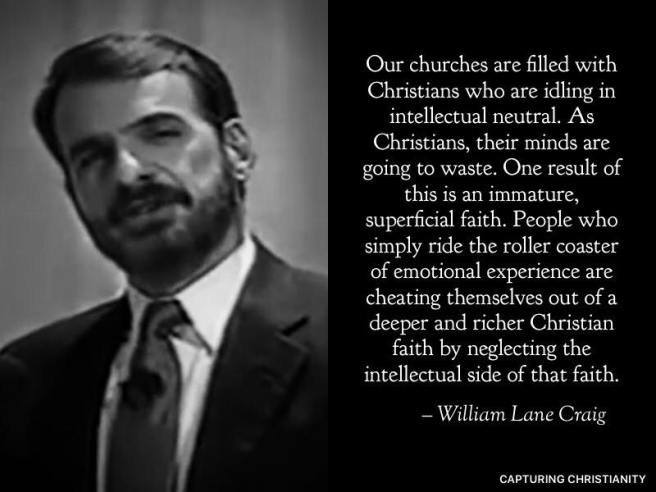
Dr. William Lane Craig says churches aren't preparing Christians to give an answer
Dr. W. L. Craig: churches don’t prepare Christians to answer skeptics

Wife candidates ought to know apologetics

So, back to my original point about how some Christian feminists responded when I said that during courtship, I ask women questions about how much preparation they have done to answer objections from atheists, like the ones answered in this book. Am I joking?

Well, I think the problem is that Christian feminists don’t understand how Christian men view marriage. Christian men are interested in marriage because they think that their marriage will be an enterprise that produces a return for God. They like the idea of having a clean, comfortable home to host debate viewings and discussions over dessert with skeptics. They like the idea of raising children who will be effective and influential. Men don’t see marriage a means of making us feel better, or having fun, or getting our peers to approve of us. We see it as a way to promote Jesus’ agenda in the world. Men are looking for a woman who think that Christianity is true, so that they will have a wife who will act like a Christian when it goes against her self-interest. Men want a wife who knows how to persuade others that Christianity is true – first the children, then others.