Tag Archives: African-American

Coalition of African American Pastors launches national pro-marriage campaign

Here’s some good news from CNS News.

Excerpt:

The Coalition of African American Pastors (CAAP) announced at the National Press Club on Tuesday that  the grassroots group – comprised of the more than 3,000 members – is a launching a national campaign to support marriage between one man and one woman and to oppose the Obama administration’s efforts to advance same-sex marriage.

“The time has come for a broad-based assault against the power that be that wants to change our culture to one of men marrying men and women marrying women,” CAAP President William Owens said at the press conference, held to announce the Marriage Mandate campaign, which includes a petition seeking 100,000 signatures pledging support for traditional marriage.

“Mr. President, I’m not going to stand with you, and there are thousands of others across this country that are not going to stand with you with this foolishness,” Owens said.

In a press release announcing the campaign, Owens encouraged black pastors and the black community to “withdraw their support for [Obama].”

“Today we will be launching a nationwide campaign rallying black pastors and African Americans to voice their opposition to the president’s position on same-sex marriage, and withdraw their support from him,” said Owens, who told reporters he voted for Obama in the 2008 presidential election.

“We will see that the black community is informed that the president is taking them for granted while pandering to the gay community,” Owens said.

Bishop Janice Hollis, presiding Prelate of the Covenant of International Fellowship of Churches, called Obama’s support of gay marriage a “travesty” and said it reflects the “disorder in the highest office in the land.”

Owens said CAAP sent a letter to Obama and Attorney General Eric Holder in May asking for a meeting to discuss the gay marriage issue.

“We wrote the president and Mr. Holder May the second, requesting an audience with him to discuss this very issue,” Owens said. “He has not given us the courtesy of any reply.

“The Coalition of African American Pastors (CAAP) consists of 3,742 African American pastors, and he has totally ignored us,” Owens said.

He said Obama is ignoring the black community “because he feels that he has us in his pocket.”

“Well, we are not in his pocket,” Owens said.

In the 2008 election, black Protestants voted overwhelmingly for the pro-abortion and pro-gay-marriage Obama. (He had a radical pro-abortion record and had come out for gay marriage earlier, so this was all known then).
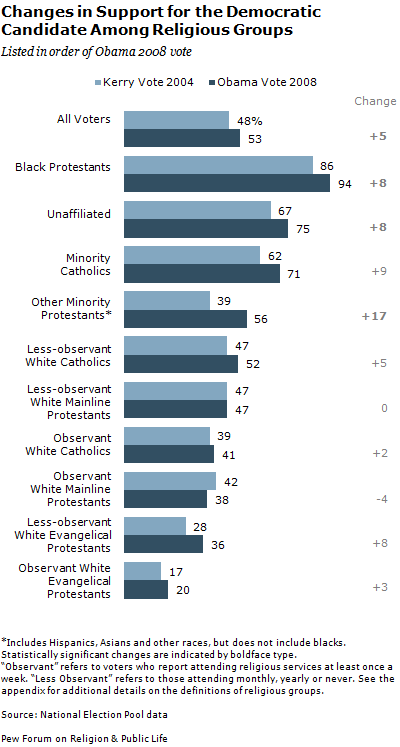
Which religions supported Obama most in 2008?

So 94% of African-American Christians voted for an abortion and gay marriage radical. NINETY-FOUR PERCENT.

I actually believed, based on this voting data, that American black Protestant churches were officially pro-abortion and pro-gay-marriage. I just considered them to be apostate denominations the same way that denominations like the Episcopal Church and the Presbyterian Church United States of America are apostate. (Note: this does not apply to non-American black churches, which are conservative).

These voting numbers confirm my experiences. For example, I remember one African American woman at work who was interested in me who could not understand why I would not join her in working on The United Way workplace partnership initiative. I took her aside in the hallway and told her that the United Way supported abortion and opposed the Boy Scouts, and she was like “So what?“. She attended church weekly and she supported Barack Obama. So I just figured based on these voting numbers and my personal experiences that most African-American churches were pro-abortion, pro-gay-marriage, pro-socialism, etc.

This action by the 3,742 black African-American pastors shocks me as much as if those gay bishops in the Episcopal church had suddenly came out in favor of defending traditional marriage. Maybe these 3,742 pastors will be able to begin to educate their flocks about what the Bible actually says on these issues so that these voting numbers change. I did know about the good African-American pastors like Harry Jackson and Ken Hutcherson who are pro-life and pro-marriage, but I just thought that there were only a handful of faithful black pastors. I guess I was wrong, at least on the marriage issue, and that’s a good thing. Color me surprised.
Romney boldly urges NAACP to embrace free enterprise and reject dependence

From Investors Business Daily.

Excerpt:

Romney knew he’d be booed when he said he’d get rid of ObamaCare, the job- and growth-killing behemoth that is the fruition of the cradle-to-grave nanny state on which many people have become increasingly dependent. He knew his accurate description of minority joblessness in this third recovery summer wouldn’t bring applause. He told the truth anyway, even if it didn’t get him one more black vote, and even if the National Association for the Advancement of Colored People attendees, for whom advancement has been replaced by dependence, couldn’t handle the truth.

“In June,” said Romney, “the overall unemployment rate remained stuck at 8.2%” — but the rate for blacks “actually went up, from 13.6% to 14.4%.”

He noted that black students account for 17% of students nationwide, with 42% of those trapped in failing schools. He spoke of “neighborhoods filled with violence and fear (and) empty of opportunity.”

And on a matter that separates most black church leaders from Obama, he pledged to defend traditional marriage as the president embraces the gay version.

Romney’s speech didn’t pander to anybody.

Nor was it demeaning or insensitive to his audience. He merely pointed out that Obama’s philosophy of dependence on government was not the answer to their need for jobs, education and stable communities.

“The president will say he will do those things, but he will not, he cannot, and his record of the last four years proves it,” Romney told the dubious crowd, adding: “If you want a president who will make things better in the African American community, you’re looking at him.”

Here’s an excerpt from the full text:

Finally, I will address the institutionalized inequality in our education system. And I know something about this from my time as governor.

In the years before I took office our state’s leaders had come together to pass bipartisan measures that were making a difference. In reading and in math, our students were already among the best in the nation — and during my term, they took over the top spot.

Those results revealed what good teachers can do if the system will only let them. The problem was, this success wasn’t shared. A significant achievement gap between students of different races remained. So we set out to close it.

I urged faster interventions in failing schools, and the funding to go along with it. I promoted math and science excellence in schools, and proposed paying bonuses to our best teachers.

I refused to weaken testing standards, and instead raised them. To graduate from high school, students had to pass an exam in math and English — I added a science requirement as well. And I put in place a merit scholarship for those students who excelled: the top 25 percent of students in each high school were awarded a John and Abigail Adams Scholarship — which meant four years tuition-free at any Massachusetts public institution of higher learning.

When I was governor, not only did test scores improve — we also narrowed the achievement gap.

The teachers unions were not happy with a number of these reforms. They especially did not like our emphasis on choice through charter schools, particularly for our inner city kids. Accordingly, the legislature passed a moratorium on any new charter schools.

As you know, in Boston, in Harlem, in Los Angeles, and all across the country, charter schools are giving children a chance, children that otherwise could be locked in failing schools. I was inspired just a few weeks ago by the students in one of Kenny Gamble’s charter schools in Philadelphia. Right here in Houston is another success story: the Knowledge Is Power Program, which has set the standard, thanks to the groundbreaking work of the late Harriet Ball.

These charter schools are doing a lot more than closing the achievement gap. They are bringing hope and opportunity to places where for years there has been none.

Charter schools are so successful that almost every politician can find something good to say about them. But, as we saw in Massachusetts, true reform requires more than talk. As Governor, I vetoed the bill blocking charter schools. But our legislature was 87 percent Democrat, and my veto could have been easily over-ridden. So I joined with the Black Legislative Caucus, and their votes helped preserve my veto, which meant that new charter schools, including some in urban neighborhoods, would be opened.

When it comes to education reform, candidates cannot have it both ways — talking up education reform, while indulging the same groups that are blocking reform. You can be the voice of disadvantaged public-school students, or you can be the protector of special interests like the teachers unions, but you can’t be both. I have made my choice: As president, I will be a champion of real education reform in America, and I won’t let any special interest get in the way.

I think he is right to emphasize the marriage issue, because 1300 black pastors recently expressed grave misgivings about Obama due to his support for gay marriage.

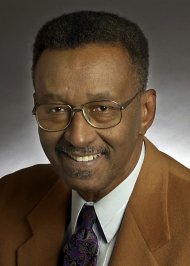
Walter Williams interviewed by libertarian Reason magazine

Walter Williams
Walter Williams

Here’s the video. (H/T The Blog Prof)

He’s my second favorite economist, right behind Thomas Sowell.

In his latest column, he explains the famous “Broken Window Fallacy”.

Excerpt:

Economic lunacy abounds, and often the most learned, including Nobel Laureates, are its primary victims. The most recent example of economic lunacy is found in a Huffington Post article titled “The Silver Lining of Japan’s Quake” written by Nathan Gardels, editor of New Perspectives Quarterly, who has also written articles for The Wall Street Journal, Los Angeles Times, New York Times and Washington Post.

Mr. Gardels says, “No one — least of all someone like myself who has experienced the existential terror of California’s regular tremors and knows the big one is coming here next — would minimize the grief, suffering and disruption caused by Japan’s massive earthquake and tsunami. But if one can look past the devastation, there is a silver lining. The need to rebuild a large swath of Japan will create huge opportunities for domestic economic growth, particularly in energy-efficient technologies, while also stimulating global demand and hastening the integration of East Asia. … By taking Japan’s mature economy down a notch, Mother Nature has accomplished what fiscal policy and the central bank could not.”

[…]Why might Japan’s and Florida’s devastation be seen as “pluses”? French economist Frederic Bastiat (1801-1850) explained it in his pamphlet “What is Seen and What is Not Seen,” saying, “There is only one difference between a bad economist and a good one: the bad economist confines himself to the visible effect; the good economist takes into account both the effect that can be seen and those effects that must be foreseen.”

Bastiat elaborated further in his “Broken Window Fallacy” parable where a vandal smashes a shopkeeper’s window.

A crowd forms, sympathizing with the shopkeeper. Soon, someone in the crowd suggests that instead of a tragedy, there might be a silver lining. Instead of the boy being a vandal, he was a public benefactor, creating economic benefits for everyone in town. Fixing the broken window creates employment for the glazier, who will then buy bread and benefit the baker, who will then buy shoes and benefit the cobbler and so forth.

Bastiat says that’s what’s seen. What is not seen is what the shopkeeper would have done with the money had his window not been smashed. He might have purchased a suit from the tailor. Therefore, an act that created a job for the glazier destroyed a job for the tailor. On top of that, had the property destruction not occurred, the shopkeeper would have had a suit and a window. Now he has just a window and as a result, he is poorer.

I learned a lot about economics from his columns.