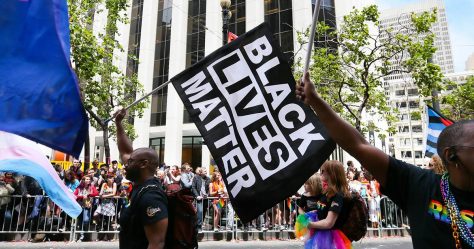
Black UC Berkeley professor writes the best essay on Black Lives Matter ever

My software engineering friend who wrote the last guest post sent me this essay. He said it was better than his (which was enormously popular) and better than my multiple posts on fatherlessness, crime, police, etc. He said it was gold from start to finish. I have to agree. And the most amazing thing about it is – the author of this essay is BLACK himself.

The essay was published anonymously, because otherwise, this professor would lose his job. There is no diversity of opinions in American academia. You’re for communism, or you’re out.

It says:

If we claim that the criminal justice system is white-supremacist, why is it that Asian Americans, Indian Americans, and Nigerian Americans are incarcerated at vastly lower rates than white Americans? This is a funny sort of white supremacy. Even Jewish Americans are incarcerated less than gentile whites. I think it’s fair to say that your average white supremacist disapproves of Jews. And yet, these alleged white supremacists incarcerate gentiles at vastly higher rates than Jews.

And:

The vast majority of violence visited on the black community is committed by black people. There are virtually no marches for these invisible victims, no public silences, no heartfelt letters from the UC regents, deans, and departmental heads. The message is clear: Black lives only matter when whites take them. Black violence is expected and insoluble, while white violence requires explanation and demands solution.

Please look into your hearts and see how monstrously bigoted this formulation truly is. No discussion is permitted for non-black victims of black violence, who proportionally outnumber black victims of non-black violence. This is especially bitter in the Bay Area, where Asian victimization by black assailants has reached epidemic proportions, to the point that the SF police chief has advised Asians to stop hanging good-luck charms on their doors, as this attracts the attention of (overwhelmingly black) home invaders.

And:

The claim that black interracial violence is the product of redlining, slavery, and other injustices is a largely historical claim. It is for historians, therefore, to explain why Japanese internment or the massacre of European Jewry hasn’t led to equivalent rates of dysfunction and low SES performance among Japanese and Jewish Americans respectively. Arab Americans have been viciously demonized since 9/11, as have Chinese Americans more recently. However, both groups outperform white Americans on nearly all SES indices – as do Nigerian Americans, who incidentally have black skin.

Regarding the Democrat party’s “solutions”:

Most troublingly, our department appears to have been entirely captured by the interests of the Democratic National Convention, and the Democratic Party more broadly. To explain what I mean, consider what happens if you choose to donate to Black Lives Matter, an organization UCB History has explicitly promoted in its recent mailers. All donations to the official BLM website are immediately redirected to ActBlue Charities, an organization primarily concerned with bankrolling election campaigns for Democrat candidates. Donating to BLM today is to indirectly donate to Joe Biden’s 2020 campaign. This is grotesque given the fact that the American cities with the worst rates of black-on-black violence and police-on-black violence are overwhelmingly Democrat-run. Minneapolis itself has been entirely in the hands of Democrats for over five decades; the ‘systemic racism’ there was built by successive Democrat administrations.

The patronizing and condescending attitudes of Democrat leaders towards the black community, exemplified by nearly every Biden statement on the black race, all but guarantee a perpetual state of misery, resentment, poverty, and the attendant grievance politics which are simultaneously annihilating American political discourse and black lives. And yet, donating to BLM is bankrolling the election campaigns of men like Mayor Frey, who saw their cities devolve into violence. This is a grotesque capture of a good-faith movement for necessary police reform, and of our department, by a political party. Even worse, there are virtually no avenues for dissent in academic circles. I refuse to serve the Party, and so should you.

Corporate slactivism:

The total alliance of major corporations involved in human exploitation with BLM should be a warning flag to us, and yet this damning evidence goes unnoticed, purposefully ignored, or perversely celebrated. We are the useful idiots of the wealthiest classes, carrying water for Jeff Bezos and other actual, real, modern-day slavers. Starbucks, an organisation using literal black slaves in its coffee plantation suppliers, is in favor of BLM. Sony, an organisation using cobalt mined by yet more literal black slaves, many of whom are children, is in favor of BLM.

The sainting of George Floyd:

As a final point, our university and department has made multiple statements celebrating and eulogizing George Floyd. Floyd was a multiple felon who once held a pregnant black woman at gunpoint. He broke into her home with a gang of men and pointed a gun at her pregnant stomach. He terrorized the women in his community. He sired and abandoned multiple children, playing no part in their support or upbringing, failing one of the most basic tests of decency for a human being. He was a drug-addict and sometime drug-dealer, a swindler who preyed upon his honest and hard-working neighbors. And yet, the regents of UC and the historians of the UCB History department are celebrating this violent criminal, elevating his name to virtual sainthood. A man who hurt women. A man who hurt black women. With the full collaboration of the UCB history department, corporate America, most mainstream media outlets, and some of the wealthiest and most privileged opinion-shaping elites of the USA, he has become a culture hero, buried in a golden casket, his (recognized) family showered with gifts and praise.

Americans are being socially pressured into kneeling for this violent, abusive misogynist. A generation of black men are being coerced into identifying with George Floyd, the absolute worst specimen of our race and species.

This part describes what my reaction has been to the mainstream approach to the experience of blacks in America:

It shouldn’t affect the strength of my argument above, but for the record, I write as a person of color. My family have been personally victimized by men like Floyd. We are aware of the condescending depredations of the Democrat party against our race. The humiliating assumption that we are too stupid to do STEM, that we need special help and lower requirements to get ahead in life, is richly familiar to us. I sometimes wonder if it wouldn’t be easier to deal with open fascists, who at least would be straightforward in calling me a subhuman, and who are unlikely to share my race.

The ever-present soft bigotry of low expectations and the permanent claim that the solutions to the plight of my people rest exclusively on the goodwill of whites rather than on our own hard work is psychologically devastating. No other group in America is systematically demoralized in this way by its alleged allies. A whole generation of black children are being taught that only by begging and weeping and screaming will they get handouts from guilt-ridden whites.

Please read the whole thing and share it! I wish that the mainstream news featured the viewpoints of more black conservatives like this!

Wayne Grudem explains what the Bible says about parents and schools

Theology that hits the spot

This is a must-listen lecture from famous pastor Wayne Grudem.

The MP3 file is here.

The PDF outline is here.

Note: public schools = government-run schools.

Topics:

  • Does God care whether we people marry and have children?
  • Does God care whether Christian parents raise their children to know him?
  • Should government promote bearing children?
  • What are some effects of declining birth rates in other countries?
  • What are the economic effects of declining birth rates?
  • Who has the right to decide how children are trained: government or parents?
  • What does the Bible say about parents having to raise children to know him?
  • Does the government have the responsibility for training children?
  • What do educational bureaucrats think of parents training children?
  • What do school boards think of parents training children?
  • Should school boards be elected by local, state or federal government?
  • Should Christians be opposed to government-run education? (public schools)
  • How should schools be viewed by parents? As a replacement or as a helper?
  • How are schools viewed by those on the left and in communist countries?
  • How can you measure how supporting a government is of parental rights?
  • How is parental authority viewed in left-wing EU countries like Germany?
  • How is parental authority respected in the United States?
  • Should parents have a choice of where their children go to school?
  • What is a voucher program? How is it related to parental autonomy?
  • How does competition (school choice) in education serve parental needs?
  • Why do public school teachers, unions and educrats oppose competitition?
  • How well do public schools do in educating children to achieve?
  • Does the government-run monopoly of public schools produce results?
  • Does paying more and more money to public schools make them perform?
  • How do teacher unions feel about having to compete in a voucher system?
  • Does the public school monopoly penalize the poorest students?
  • Does the public school monopoly penalize children of certain races?
  • Does the public school monopoly cause racial prejudice?
  • What else should parents demand on education policy?
  • Is it good for parents when schools refuse to fire underperforming teachers?

This podcast is just amazing! This is what we need to be teaching in church. Church should be the place where you go to learn and reflect about how to tailor your life plan based on what the Bible says. And I think that this whole notion of free market – of choice and competition benefiting the consumer (parents) – applies to everything that government does, especially education and health care. The genius of America is that our Founding Fathers engineered a system that reflected all of this knowledge of economics, which then made it much easier for individuals and families to enjoy liberty and a higher quality of life. If we want to keep the benefits, we have to remember why these decisions were made at the founding of our nation.

Robin Collins and atheist Peter Millican discuss the fine-tuning of the universe for life

British Spitfire and German Messerschmitt Me 109 locked in a dogfight

You might remember Peter Millican from the debate he had with William Lane Craig. I ranked that debate as one of the 3 best I have ever seen, along with the first Craig  vs Dacey debate and the second Craig vs Sinnott-Armstrong debate.

Details:

Science has revealed that the fundamental constants and forces of the cosmos appear to be exquisitely fine-tuned to allow a universe in which life can develop. Is God the best explanation of the incredibly improbable odds of the universe we live in being a life-permitting one?

Robin Collins is a Christian philosopher and a leading advocate of the argument for God from cosmic design. Peter Millican is an atheist philosopher at Oxford University. They debate the issues.

From ‘Unbelievable?’ on ‘Premier Christian Radio’, Saturday 19th March 2016.

The debate:

As usual when the atheist is an expert, there is no snark or paraphrasing in the summary.

Summary

Brierley: What is the fine-tuning argument?

Collins: the fine-tuning is structure of the universe is extremely precisely set to allow the existing of conscious, embodied agents who are capable of moral behavior. There are 3 kinds of fine-tuning: 1) the laws of nature (mathematical formulas), 2) the constants of physics (numbers that are plugged into the equations), 3) the initial conditions of the universe. The fine-tuning exists not just because there are lots of possibilities, but there is something special about the actual state of affairs that we see. Every set of laws, parameters and initial conditions is equally improbable, but the vast majority of permutations do not permit life. The possible explanations: theism or the multiverse.

Brierley: How improbable are the numbers?

Collins: Once case is the cosmological constant (dark energy density), with is 1 part in (10 raised to 120th power). If larger, the universe expands too rapidly for galaxies and stars to form after the Big Bang. If smaller, the universe collapses in on itself before life could form. Another case is the initial distribution of mass energy to give us the low entropy we have that is necessary for life. The fine-tuning there is 1 part in (10 raised to the 10th power raised to the 123rd power).

Brierley: What do you think of the argument?

Millican: The argument is worth taking very seriously. I am a fan of the argument. The other arguments for God’s existence such as the ontological and cosmological arguments are very weak. But the fine-tuning argument has the right structure to deliver the conclusion that theists want. And it is different from the traditional design argument tended to focus on biological nature, which is not a strong argument. But the fine-tuning argument is strong because it precedes any sort of biological evolution. Although the design is present at the beginning of the universe, it is not visible until much later. The argument points to at least deism, and possibly theism. The argument is not based on ignorance, it is rooted in “the latest results from the frontiers of science” (his phrase).

Brierley: Is this the best argument from natural theology?

Collins: The cosmological argument makes theism viable intuitively, but there are some things that are puzzling, like the concept of the necessary being. But the fine-tuning argument is decisive.

Brierley: What’s are some objections to the fine-tuning argument?

Millican: The argument is based on recent physics, so we should be cautious because we maybe we will discover a natural explanation.

Brierley: Respond to that.

Collins: The cosmological constant has been around since 1980. But the direction that physics is moving in is that there are more constants and quantities being discovered that need to be fine-tuned, not less. Even if you had a grand unified theory, that would have to be have the fine-tuning pushed into it.

(BREAK)

Millican: Since we have no experience of other laws and values from other universes, we don’t know whether these values can be other than they are. Psychologically, humans are prone to seeing purpose and patterns where there is none, so maybe that’s happening here.

Brierley: Respond to that.

Collins: It is possible to determine probabilities on a single universe case, for example using multiple ways of calculating Avogadro’s number all converging on the same number makes it more probable.

Millican: Yes, I willing to accept that these constants can take on other values, (“principle of indifference”). But maybe this principle be applied if the improbability were pushed up into the theory?

Collins: Even if you had a grand theory, selecting the grand theory from others would retain the improbability.

Brierley: What about the multiverse?

Millican: What if there are many, many different universes, and we happen to be in the one that is finely-tuned, then we should not be surprised to observe fine-tuning. Maybe a multiverse theory will be discovered in the future that would allow us to have these many universes with randomized constants and quantities. “I do think that it is a little bit of a promissary note”. I don’t think physics is pointing to this right now.

Brierley: Respond to that.

Collins: I agree it’s a promissary note. This is the strongest objection to the fine-tuning argument. But there are objections to the multiverse: 1) the fine-tuning is kicked back up to the multiverse generator has to be set just right to produce universes with different constants, 2) the multiverse is more likely to produce a small universe with Boltzmann brains that pop into existence and then out again, rather than a universe that contains conscious, embodied intelligent agents. I am working on a third response now that would show that the same constants that allow complex, embodied life ALSO allow the universe to be discoverable. This would negate the observer-selection effect required by the multiverse objection.

Brierley: Respond to that.

Millican: I don’t see why the multiverse generator has to be fine-tuned, since we don’t know what the multiverse generator is. I’m not impressed by the Boltzmann brains, but won’t discuss. We should be cautious about inferring design because maybe this is a case where we are seeing purpose and design where there is none.

Brierley: Can you negate the discoverability of the universe by saying that it might be psychological?

Collins: These things are not psychological. The selected value for the cosmic microwave background radiation is fine-tuned for life and for discoverability. It’s not merely a discoverability selection effect, it’s optimal for discoverability. If baryon-photon value were much smaller, we would have known that it was not optimal. So that judgment cannot be explained by

Millican: That’s a very interesting new twist.

Brierley: Give us your best objection.

Millican: I have two. 1) Even if you admit to the fine-tuning, this doesn’t show a being who is omnipotent and omnisicient. What the fine-tuning shows is that the designer is doing the best it can given the constraints from nature. If I were God, I would not have made the universe so big, and I wouldn’t have made it last 14 billion years, just to make one small area that supports life. An all-powerful God would have made the universe much smaller, and much younger. 2) The fine-tuning allows life to exist in other solar systems in other galaxies. What does this alien life elsewhere mean for traditional Christian theology? The existence of other alien civilizations argues against the truth of any one religion.

Brierley: Respond to those.

Collins: First objection: with a finite Creator, you run into the problem of having to push the design of that creature up one level, so you don’t really solve the fine-tuning problem. An unlimited being (non-material, not composed of parts) does not require fine-tuning. The fine-tuning is more compatible with theism than atheism. Second objection: I actually do think that it is likely that are other universes, and life in other galaxies and stars, and the doctrine of the Incarnation is easily adaptable to that, because God can take on multiple natures to appear to different alien civilizations.

Other resources (from WK)

If you liked this discussion, be sure and check out a full length lecture by Robin Collins on the fine-tuning, and a shorter lecture on his very latest work. And also this the Common Sense Atheism podcast, featuring cosmologist Luke Barnes, who answers about a dozen objections to the fine-tuning argument.