
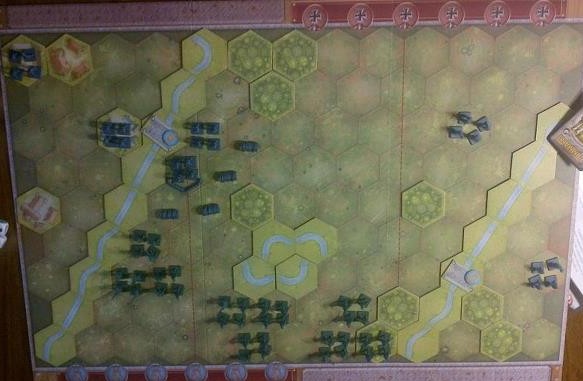
Reposting this old post because Dina and I spent Friday night playing games again! And this is one of my favorite posts. Last night was Portal 2 and Orcs Must Die! 2.
Last night, I played through the Pegasus Bridge scenario from the Memoir ’44 wargame with Dina a few times. We actually played the online version of the game, using Steam. She was very gracious to play a wargame with me, which I don’t think is necessarily the first thing on most women’s lists of things to do on a Thursday night! I appreciated her agreeing to learn how to play and then playing with me several times. I think that Christians need to plan and execute more “together” activities like that – activities that involve interaction, co-operation, communication and engagement. We try to avoid doing things where we are both spectators. Playing wargames is not the only thing we do – we also do Bible study and cooking lessons (for me), for example.
Anyway, the point of this post is to express the deeper meaning behind playing wargames. I think that it is important to recognize and celebrate those who have demonstrated good character, whether it be now, or in the past. I think that it is important for us to search out the best role models ourselves, so that they will influence the way we act in our own lives. The second world war was a clear example of good versus evil. Anyone on the Allied side who demonstrated bravery and courage should be celebrated for safeguarding the security, liberty and prosperity that we enjoy today. In the case of Pegasus bridge, the hero is Major John Howard of the British paratroops.
Here is a quick re-cap of his exploits that day from the New York Times:
Maj. John Howard, the commander of glider-borne British infantrymen who seized the strategically vital Pegasus Bridge in the first battle of the D-Day invasion of Normandy, died Wednesday in a hospital in Surrey, England. He was 86 and had lived in Burford, near Oxford.
Under cover of night on June 6, 1944, six gliders carrying 181 officers and men of the Second Oxfordshire and Buckinghamshire Light Infantry landed on the eastern flank of a 60-mile invasion front on the northern coast of France. The regiment had a heritage going back to the battles of Bunker Hill and New Orleans, to Waterloo and to World War I. Now its soldiers were in the vanguard of the invasion of Hitler’s Europe.
Major Howard’s D Company was ordered to seize two bridges, one over the Caen Canal and the other spanning the parallel Orne River. If the Germans held on to those bridges, panzer units could move across them in a counterattack isolating 10,000 British paratroopers jumping behind the British invasion beach known as Sword, where infantry forces would arrive at daybreak. And Major Howard’s men sought to strike swiftly to prevent the Germans from blowing up the bridges if they were overwhelmed; the British needed those bridges to resupply their airborne units.
British Halifax bombers towed the gliders over the English Channel, then cut them loose.
Major Howard’s lead glider landed at 12:16 A.M., only 50 yards from the Caen Canal bridge, but the glider’s nose collapsed on impact, knocking everybody aboard unconscious for a few seconds. The soldiers quickly emerged, and over the next five minutes the men directly under Major Howard killed the surprised German defenders.
The nearby Orne River bridge was captured by other troops in Major Howard’s unit, and soon the words ”Ham and Jam,” signifying mission accomplished, were radioed to the airborne.
Two British soldiers were killed and 14 wounded in the operation.
Over the next 12 hours, British paratroopers and commandos reinforced Major Howard’s men, and British forces were able to move toward the city of Caen, their flank having been protected by the capture of the bridges.
On July 16, Major Howard received the Distinguished Service Order, Britain’s second-highest award for valor. On the 10th anniversary of D-Day, he received the Croix de Guerre Avec Palme from the French Government, which had renamed the Caen Canal span Pegasus Bridge, for the flying horse symbolizing the British airborne. The road crossing the bridge was later renamed Esplanade Major John Howard.
Why is this important? Well, it’s important to think on the things that are excellent. There are so many things in the culture that are not excellent that we are confronted with every day. We have to make it our business to do things together where goodness is celebrated. Especially when manly virtues like courage are celebrated. We don’t do that much anymore. And I think there’s a connection between wargames and Christian apologetics that we need to deliberately encourage.
Here’s an excellent passage from Shakespeare’s “Henry V” that makes the point:
This day is called the feast of Crispian:
He that outlives this day and comes safe home,
Will stand a tip-toe when this day is named,
And rouse him at the name of Crispian.
He that shall live this day, and see old age,
Will yearly on the vigil feast his neighbours,
And say, ‘To-morrow is Saint Crispian:’
Then will he strip his sleeve and show his scars,
And say, ‘These wounds I had on Crispin’s day.’
Old men forget: yet all shall be forgot,
But he’ll remember with advantages
What feats he did that day. Then shall our names,
Familiar in his mouth as household words,
Harry the King, Bedford and Exeter,
Warwick and Talbot, Salisbury and Gloucester,
Be in their flowing cups freshly remembered.
This story shall the good man teach his son;
And Crispin Crispian shall ne’er go by,
From this day to the ending of the world,
But we in it shall be rememberèd;
We few, we happy few, we band of brothers;
For he to-day that sheds his blood with me
Shall be my brother; be he ne’er so vile
This day shall gentle his condition:
And gentlemen in England, now a-bed
Shall think themselves accursed they were not here,
And hold their manhoods cheap whiles any speaks
That fought with us upon Saint Crispin’s day. (4.3.43)
This is from the famous speech in which King Henry charges his men to fight well before the famous Battle of Agincourt.
You can read more about the history of the British Airborne division and Pegasus bridge. The famous historian of the second world war Stephen E. Ambrose also wrote a history of the Pegasus bridge battle, called “Pegasus Bridge: June 6, 1944“. You won’t find many military historians better than Stephen E. Ambrose!
You might be surprised how many men are interested in military history and wargames, precisely because men instinctively look up to men like John Howard who embody qualities like bravery and courage. We have a dearth of moral character in this society. And we don’t do much to teach young men about manly virtues, even in the church. I think that it is important for us to think of creative ways for us to present good character to our young men. Young women should also learn about good character, because they must separate out the good men from the bad when they are courting.
Thanks to Dina for helping me to edit this post!


 WINTERY KNIGHT