Category Archives: Polemics

Does the “legacy of slavery” explain black women’s 72% out-of-wedlock birth rate?

James White asks: does the Bible apply to black women?

I don’t like Calvinist theologian James White very much, but at least he’s willing to defend the moral teachings of the Bible against the woke identity politics that is taking over Christian churches. A few months ago he tweeted something very controversial (see above), and got into a lot of hot water with fake Christians. In this post, I’ll explain why he is right.

So, as you can see above, James is concerned that black women are having so many abortions, and he thinks that the solution to this is to encourage black women to take the Bible’s advice on sexual morality. Shocking, I know.

If you read the replies to his tweet on Twitter, you’ll see millions and millions of comments calling him a racist, and telling him that slavery is to blame for EVERYTHING that black women do wrong. Basically, the James haters say that black women can do anything they want, and should never be told that it’s wrong according to the Bible, because their bad choices are all the fault of slavery. So the Bible doesn’t even apply to them, or something.

Here is an example from a radical feminist progressive named Karen Swallow Prior:
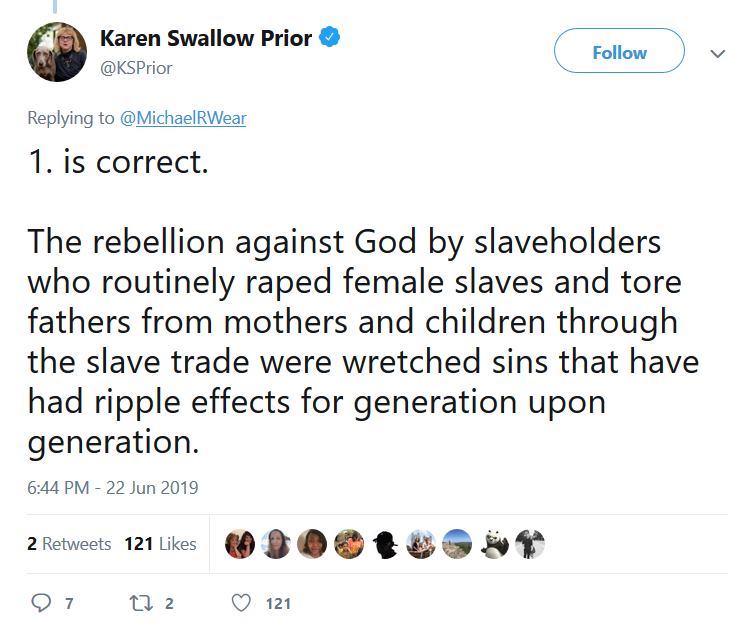
Karen Swallow Prior says that black people have no moral agency
Karen Swallow Prior says that unlike whites, blacks have no moral agency

According to the fake Christians, it’s not that black women make poor choices with sex, it’s that the ghosts of white slavers who raped their great-great-great grandmothers reach through time with magic and force them to have sex with hunky bad boys who won’t commit to them before sex. It’s not rap music calling black women hoes! It’s the ghosts of slavery past. And even if this ghost theory isn’t true, we shouldn’t tell black women not to sin, because… it would hurt their feelings. After all, the Bible isn’t a book that’s designed to set boundaries to prevent self-destructive behaviors. It encourages us to listen to our hearts, be reckless, and sin as much as we can.

So when did black community problems with sex and abortion start? Did it start with slavery times? Actually, blacks were doing GREAT at marriage and sexual matters just 50 years ago.

This reply to James White explained:

Blacks married at rates comparable to whites before welfare

That’s true. Black children weren’t fatherless, so they weren’t having early sex outside of marriage, and so they weren’t getting abortions.

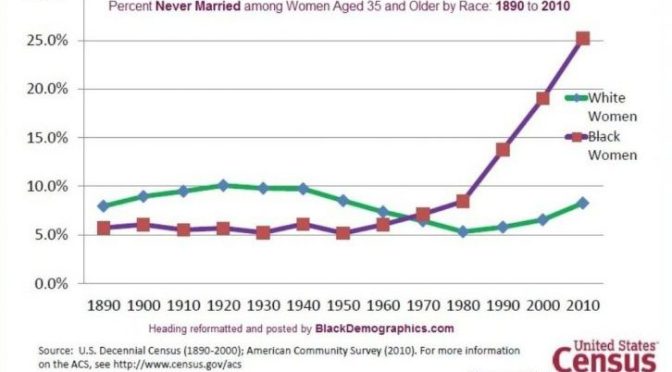
As the header graphic shows, black women were just as likely to be married as white women in the 1960s,  FAR AFTER the days of slavery.

The reason that the graph is going upward is because daughters raised in fatherless homes tend to engage in sexual activity at younger ages, because they are seeking approval from a man which their (single) mother cannot give them. It’s a tragic downwards spiral, and it affects all races. The only way to stop it is to tell women to choose marriage-minded men (not hot bad boys) and marry before having sex, like the Bible says. But woke fake Christians think the Bible is too mean, and better to allow sin by saying that sin is inevitable because slavery ghosts or something.

What’s neat is that black men who take Christianity seriously are totally on board with the facts:
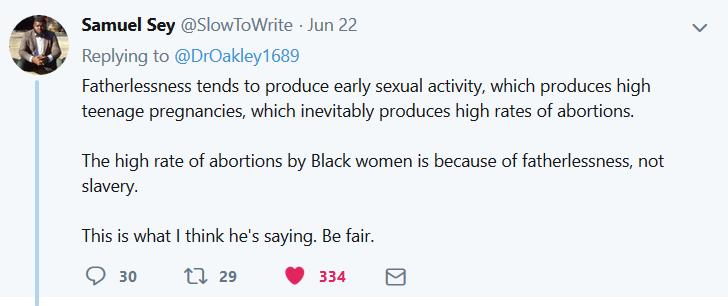
Black man here. Can confirm that the Bible applies to black women.

On this blog, I don’t talk about my ethnicity myself, for confidentiality reasons, but I have said that my skin is darker than Barack Obama. I’m not white or Asian. And the reason that I don’t fall into this trap of causing babies to be born out of wedlock is because I think that when the Bible says that sex outside of marriage is a sin, that this is true. I don’t make excuses or shift blame. It’s incumbent on me to obey, since I claim to be a follower of Jesus.I’m not interested in identity politics. I’m not interested in racial divisions. I’m not interested in blame-shifting. The rules are the rules. And my following of the rules caused me to not cause abortions, according to Christian specifications. Period.

When it comes to sex outside of marriage, the answer of every Bible believing Christian is simple: I’m against it. That is the correct answer, and anything more or less than this answer is demonic. If you are a Christian, sex outside of marriage is always morally wrong. And if you try to justify it, or blame someone else, in order to excuse it, then you’re not a Christian at all. If you try to make excuses for why someone did it, you’re not a Christian. Whether you have had it and been forgiven, or never had it, the answer is always the same: it’s morally wrong. Don’t do it. Never do it.

What I am seeing from people who are critical of James White’s tweet is that they are basically trying to attack those who make moral judgments based on what the Bible says. They want to make room for sinners to sin. The root of abortion sin is sexual sin. Real  Christians discourage sexual sin, and therefore protect unborn children. Fake Christians want to be liked by appearing compassionate, so they make excuses for sexual sin. If you take the Bible seriously on morality, you won’t be liked. Those who try to excuse sin do so because their need to be liked is more important than their need to promote what the Bible teaches.

Some fake Christians will say “oh, but I do think the Bible is right about sex and marriage, but we have to care about slavery reparations and global warming and refugees and illegal immigrants and trasnsgender rights, too”. Baloney. An authentic Christian is concerned about the things that the Bible teaches are “major” things. Drunkenness is a major thing. Sexual immorality is a major thing. Divorce is a major thing. Homosexuality is a major thing. If you meet a Christian who treats those issues as minor issues, and instead majors in what the secular left tells them are major issues, then you’re talking to a fake Christian.

Christianity isn’t a brain-dead faith. You get your priorities from the Bible, and you argue those priorities using facts. The facts about marriage rates are clear and they show that the problems in the black community aren’t caused by slavery. They’re caused by single mother welfare programs. Those welfare programs taught women of all races that they didn’t have to listen to their fathers when choosing men. Those welfare programs taught women that feelings were a better guide in relationships than the Bible. Those welfare programs taught women that their eyes were a better judge of character than performance of traditional marriage roles. Those welfare programs taught women that recreational sex was a way to get a man to commit and stop being a bad boy. We need to go back to the root cause of the problem. The root cause of the problem was making excuses for disobedience to the Bible, and transferring money from married homes to out-of-control women. Of all races.

Why is America so much more prosperous than other nations?

It occurred to me that young people are being taught in government-run schools that central planning of the economy by the federal government works better than allowing states to decide policy for themselves. Naturally, the students – lacking life experience and at the mercy of the unionized teacher’s grading pen – have no choice except to be indoctrinated. But what are the facts?

The genius of America is that the Founding Fathers allowed the federal government to only have power in certain areas of life. Other areas of policy were delegated to the states. This allows states to try different policies to see what works best, or even just what works best for them. Then the other states have the option to emulate that success, or continue doing what doesn’t work. States that do what works will see more success, with more businesses and people migrating to their states. States that persist in doing what doesn’t work will see business and taxpayers flee. That is the genius of America’s design.

Federalism encourages states to operate according to the “principle of subsidiarity”, which is an economic principle that states that problems are best solved at the lowest level possible (individual -> family -> church – > business -> community -> local government -> state government -> federal government). This is because the people at the lowest level have the most KNOWLEDGE about how to solve the problem.

Case study: right-to-work laws

Let’s look at an example – unions and right to work laws. Starting after world war 2, some states decided to pass right to work laws. These laws allowed workers to decide for themselves whether to join a union or not. Since workers had the choice about whether to join the union, the union had to care about the workers and advocate for them, instead of enriching themselves at the expense of the workers via corruption and thuggery.

Here is how different states adopted right to work laws at different times:

Map of states showing adoption of right-to-work laws

What happened in these states? Well job creating businesses started to move from forced-union-membership states to right-to-work states. Why? Because unions were stopping them from innovating. Companies would figure out new ways to improve productivity, such as using machines and computers. But the unions would step in and insist that the old ways were best. The unions wanted their union members to just be able to do the same job, e.g. – pulling a lever over and over, for the entire 35 years of their career. And the unions wanted their members to be paid like a software engineer or a doctor for pulling a lever over and over. The unions also wanted to make sure that underperforming workers could never be fired, or replaced. And so on. Companies realized that they couldn’t compete in a global market like this, so they got up and left for right-to-work states.

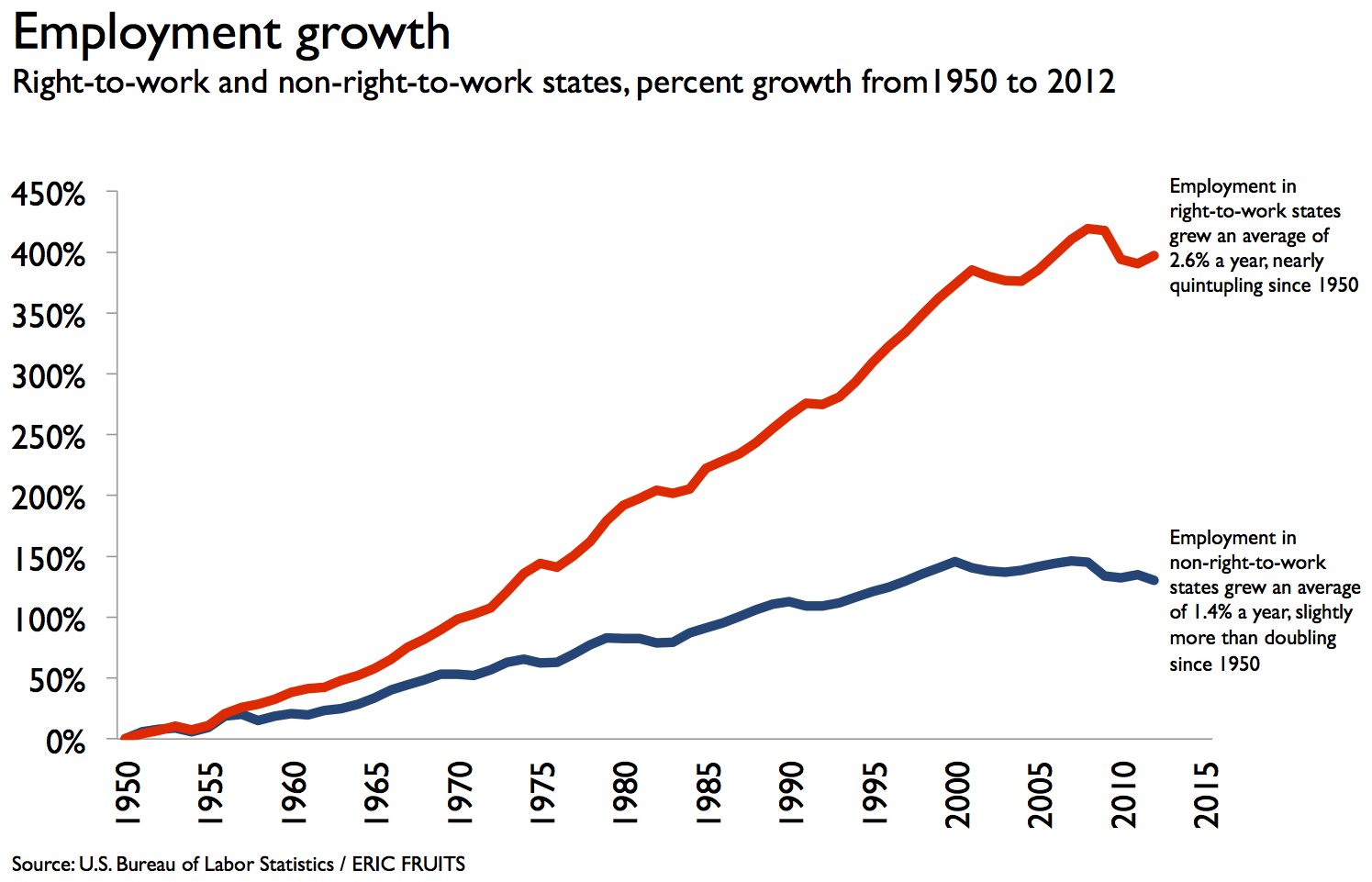
Here’s what happened next:

Rates of employment in forced union states vs right to work states

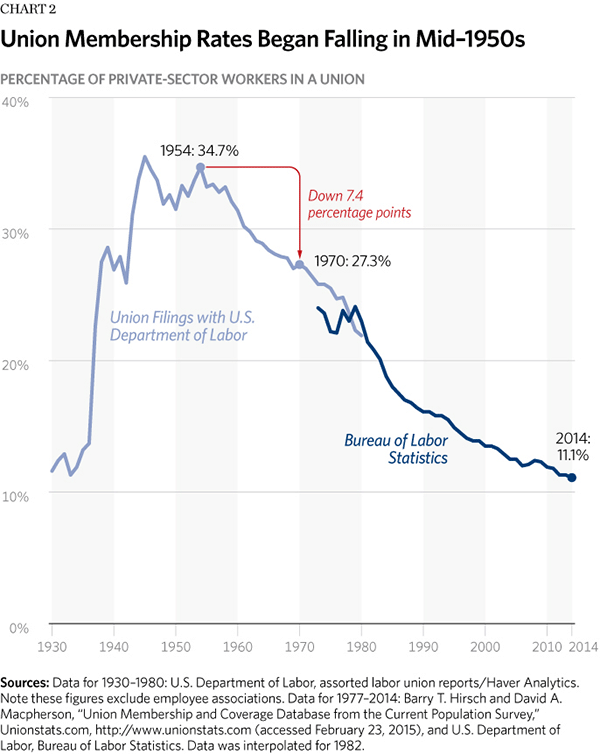
States with right-to-work laws never said that there couldn’t be unions, only that workers wouldn’t have to join a union to work. And in right-to-work states, not only did workers not join unions, they voted not to unionize at all. This resulted in a massive decline in private sector unions in America:

Decline in private sector union membership

As a result of job creating businesses not being hampered by union corruption and thuggery, American businesses quickly outpaced their rivals in forced union membership states in productivity, as measured by GDP. They also outpaced the productivity per worker in other economically illiterate countries. Why? Because allowing companies to innovate meant that workers were using more machinery and computers to do their jobs. They learned new skills. Underperforming workers could be replaced with workers who were willing to grow and adapt. Non-union workers higher productivity allowed them to find other jobs if they were laid off.

Right to work states innovate, creating more skilled workers

The job security of the American worker comes from his improved worker productivity – not from the union. Not only did unemployment go down in right to work states (more jobs!) but salaries and benefits also increases, as companies had to compete with each other for workers. However, companies were ok with paying more for workers, because they would rather pay ONLY the workers who deserved it, rather than pay one rate for all union workers, regardless of performance.

This article from the far-left New York Times explains how slaries and benefits rise when job creators move to right-to-work states: Income Rises When Right-to-Work Laws Are Passed because job creators must offer workers a lot in order to get them to sign. Not just salaries and benefits, but realistic development plans to grow the workers skills, making them even more resistant to layoffs and economic downturns.

Quote:

While some persons may favor right-to-work laws largely on philosophical grounds (people should have the freedom to decide whether they want to belong to a union or not), the major reason I support such laws is that they seem to promote prosperity — specifically, higher incomes. Real personal income in the right-to-work states rose nearly twice as much as in other states from 1970 and 2013.

To be sure, most of that reflected higher population growth in right-to-work states — there was massive in-migration to these states from the states denying workers the right to not join a union. Yet even after correcting for population growth, income per person on average rose somewhat more in the right to work jurisdictions. Capital moves to right-to-work states with a more stable labor environment, and that increases labor demand and, ultimately, income and wages.

Although unions mostly died out in the private sector, the ones that remained actually functioned well as unions – focusing on their workers instead of enriching union bosses. They had to, because if they didn’t, then the workers would just opt out of them. The only places where unions still survive is in the public sector, i.e. – government. This is because government is (by law) a monopoly, where consumers have no choice except to accept the garbage that they are offered. They can’t go anywhere else for a lower price, or a better product, or a better service. Public sector unions are immune to innovation, because they lobby the government to prevent any improvement or accountability.

Here is an example of a public sector union’s effort to “help the customer”:

Political contributions by the American Federation of Teachers union

And here’s what those efforts to “help the customer” produced for the customer:

Education spending has tripled since 1970

They aren’t really helping the customer, are they? What they do is collect dues, enrich their union leaders, intimidate their opponents with threats and force, and then give money to secular left politicians to prevent their customers from opting out of a system that doesn’t produce higher quality and lower prices for the customer. The secular left politicians pass laws that prevent the customers (parents) from being able to get a better product (education for their children) for a lower price. We should abolish public sector unions in order to get the benefits for the customer that we see in the private sector.

Should Christian men expect a wife / mother candidate to know how to defend the Christian worldview?

C.S. Lewis has some words to live by for you

Over the weekend I debated with Christian feminists about marriage on The Transformed Wife Facebook page. At one point, I asserted that Christian women ought to have some knowledge of how to defend their faith using scientific and historical evidence. Some women asked me: “are you joking?” In this post,  I’ll explain why I’m serious, and then I’ll ask them some questions of my own.

Let’s start with Jesus. Jesus set an example by showing the importance of knowing how to answer questions and challenges from skeptics in the New Testament. His favorite way to answer a challenge was by using evidence to support his truth claims.

So, take this story that’s in Mark 2:1-12, Matthew 9:1-8 and Luke 5:17-26. This story is accepted even by skeptical historians because it’s in three different books, and one of them is early (Mark).

In each version of the story, there are 4 steps:

  1. Jesus forgives the sins of a paralyzed man
  2. The Pharisees say that he doesn’t have authority to forgive sins
  3. Jesus miraculously heals the paralyzed man
  4. Jesus explains the evidence of the healing supports his claim that he has authority to forgive sins

And this is an example that you will find repeated in many places in the life of Jesus. You can see it in the Old Testament as well, where God performs miracles so that people who don’t believe in his existence or respect the Scriptures can still be convinced.

Christian apologetics is the skill of being able to give a defense for the Christian worldview when presented with a challenge from a non-Christian.

So, who has to be ready with a defense?

Look at 1 Peter 3:15-16:

15 But in your hearts revere Christ as Lord. Always be prepared to give an answer to everyone who asks you to give the reason for the hope that you have. But do this with gentleness and respect,

16 keeping a clear conscience, so that those who speak maliciously against your good behavior in Christ may be ashamed of their slander.

This passage applies to every one who claims to be a disciple of Jesus, whether they like to prepare a defense or not. How much work must you put into it? It depends on the sophistication of the challenges you get. In the mountains of Pakistan, you don’t need to know much because there might not be a sophisticated challenge. In an American society filled with college graduates, the challenges are more difficult. So you will need to prepare a lot more, because the challenges will be a lot harder.

Those who take this passage seriously are doing something difficult, and time-consuming, in order to serve Christ. Buying books costs money. Reading books takes time. Debating with non-Christians can make you look bad to others. But the Bible commands us to be ready with answers for the people around us. Sometimes, doing what the Bible says makes us feel bad, or look bad to others. But we have do what the Bible says anyway. Part of being a real Christian is being obedient even if it feels bad or makes you look bad.

William Lane Craig on apologetics and the culture

What’s in an apologetics book?

So, with that said, let’s look at the table of contents of my favorite introduction to Christian apologetics, which is “Is God Just a Human Invention?” written by Sean McDowell and Jonathan Morrow.

In that book, you will find 18 topics.

  1. Is Faith Irrational? (Commentary by: Gregory Koukl)
  2. Are Science and Christianity at Odds? (Commentary by: John Warwick Montgomery)
  3. Are Miracles Possible? (Commentary by: Gary R. Habermas)
  4. Is Darwinian Evolution the Only Game in Town? (Commentary by: William A. Dembski)
  5. How Did the Universe Begin? (Commentary by: R. Douglas Geivett)
  6. How Did Life Begin? (Commentary by: Fazale R. Rana)
  7. Why Is the Universe Just Right for Life? (Commentary by: Jay W. Richards)
  8. Has Science Shown There Is No Soul? (Commentary by: Dale Fincher and Jonalyn Fincher)
  9. Is God Just a Human Invention? (Commentary by: Garry DeWeese)
  10. Is Religion Dangerous? (Commentary by: Douglas Groothuis)
  11. Does God Intend for Us to Keep Slaves? (Commentary by: Paul Copan)
  12. Is Hell a Divine Torture Chamber? (Commentary by: Frank Turek)
  13. Is God a Genocidal Bully? (Commentary by: Clay Jones)
  14. Is Christianity the Cause of Dangerous Sexual Repression? (Commentary by: Kerby Anderson)
  15. Can People Be Good Without God? (Commentary by: Mark D. Linville)
  16. Is Evil Only a Problem for Christians? (Commentary by: Randy Alcorn)
  17. What Good Is Christianity? (Commentary by: Glenn S. Sunshine)
  18. Why Jesus Instead of the Flying Spaghetti Monster? (Commentary by: Darrell L. Bock)

Prominent atheist scholars are quoted in each chapter to introduce the challenges, and then scholarly arguments and evidence are presented to defend the Christian worldview. The language is simple enough, but the material is solid enough to use in a real debate. I would say that introductory books like this one are more than enough to equip you for everyone who will challenge you.

Why are these 18 topics important? Because these are the questions that atheists ask. These are the questions that cause Christians to leave the faith. These are the questions that your children will face in high school and college, which might cause them to leave the faith.

Let’s start with chapter one. One of the most prominent arguments by atheists is that faith is irrational. This chapter allows you to define faith using the Bible’s definition of faith, which relies on logic and evidence.

Atheists also say that Christianity is at war with science. In chapter 2, they discuss the history of science and how Christianity provided the framework that allowed scientific method to take root and flourish.

Atheists like to claim that miracles are impossible. Chapter 3 defends the view that God, if he exists, is capable of interacting with his created world.

Atheists love to put forward Darwinism as means to deny that God is the designer of life. Chapter 4 explains the concept of intelligent design, and why intelligent design is a better explanation for the history of life.

Atheists love to talk about how the universe has always existed, and there’s no need for a Creator. Chapter 5 contains a philosophical argument that is supported by mainstream science to argue that the universe had a beginning, just like the Bible says.

Atheists love to argue that life can emerge from non-life, and the process is simple. Chapter 6 is written by a biochemist, and it takes a look at the real complexity of the simplest living cell.

Atheists like to argue that the universe itself is just an accident, and there is no need for a Designer. Chapter 7 introduces the scientific evidence for fine-tuning and habitability.

Atheists like to say that there is no soul and no afterlife. Chapter 8 gives some arguments for the existence of the soul.

Atheists like to argue that Christians invent God because God makes them feel good. But chapter 9 explains that having an all-powerful God who can hold humans accountable is the last thing any human would want to invent.

Atheists like to talk about how religion, with it’s habit of teaching to believe in things that can’t be tested, causes religious people to do a lot of harm. Chapter 10 takes a look at the real record of Christianity as a force for good in the world.

Atheists like to talk about slavery in the Bible. Chapter 11 talks about what the Bible really says, and provides some rational responses to the accusation.

Atheists like to talk about eternal punishment in Hell isn’t a just punishment for just getting a few questions wrong on a theology exam. Chapter 12 provides an explanation and defense of the concept of Hell.

Atheists love to talk about how God commanded the Israelites to attack their enemies in the Bible. Chapter 13 explains who their enemies really were, and what was really happening in those wars.

Atheists feel that unrestricted sexual activity is very healthy and normal, and that the Biblical prohibitions outside of male-female marriage are repressive and unhealthy.  Chapter 14 explains why God has these rules in place, and supports his rules with evidence.

Atheists love to assert that they don’t need God, because they can behave morally on their own. Chapter 15 explains how to answer this claim by talking about how well atheism grounds objective moral values, objective moral duties, free will and moral accountability: the minimum requirements for objective morality.

Atheists think that the mere existence of natural disasters and human immorality are incompatible with the God of the Bible. Chapter 16 explains why this argument doesn’t work, and why even the concept of evil requires God to exist.

I have an atheist friend in my office who can’t defeat my scientific arguments for the origin of the universe, the fine-tuning and the origin of life. But still, he says to me, even if God exists, why would that matter to my life? Chapter 17 explains what difference Christianity makes in a person’s life.

Atheists think that the life of Jesus has no relevance to their life, and that he has nothing to offer them anyway. Chapter 18 explains the uniqueness of Jesus and explains why his resurrection is relevant to our lives today.

It’s important to understand that this book is not on the level of A. W. Tozer, G.K. Chesterton, Francis Chan, John Piper, etc. Those authors write for a Christian audience and therefore they do not equip you to answer realistic challenges from non-Christians. But the apologetics book we looked at actually equips you to answer challenges from non-Christians using logical arguments and evidence from mainstream history and science. You can use the material in that book in discussions outside the confines of your home and your church.

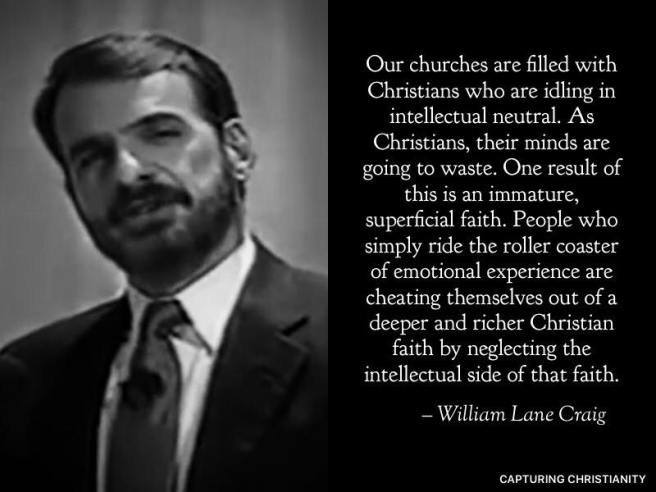
Dr. William Lane Craig says churches aren't preparing Christians to give an answer
Dr. W. L. Craig: churches don’t prepare Christians to answer skeptics

Wife candidates ought to know apologetics

So, back to my original point about how some Christian feminists responded when I said that during courtship, I ask women questions about how much preparation they have done to answer objections from atheists, like the ones answered in this book. Am I joking?

Well, I think the problem is that Christian feminists don’t understand how Christian men view marriage. Christian men are interested in marriage because they think that their marriage will be an enterprise that produces a return for God. They like the idea of having a clean, comfortable home to host debate viewings and discussions over dessert with skeptics. They like the idea of raising children who will be effective and influential. Men don’t see marriage a means of making us feel better, or having fun, or getting our peers to approve of us. We see it as a way to promote Jesus’ agenda in the world. A Christian man loves his wife precisely because she is his partner in serving God.

So, some questions for all the Christian feminists out there. Are you aware of the actual objections that non-Christians have to the Christian worldview? Have you ever put in any effort to prepare to respond to these objections? Have you trained yourself to be calm and persuasive during discussions about Christianity?

Reading devotions or authors like Rachel Hollis, Beth Moore, and Jen Hatmaker won’t teach a Christian woman anything useful about defending the Christian worldview against atheist objections. And those books also won’t teach you how to evaluate a man to see whether he knows how to defend the Christian worldview, either. You have to study apologetics to know how to evaluate how much a candidate for husband and father roles knows about defending his faith. You have to protect yourself from men who lie about being Christians.

Having a rationally-grounded Christian worldview is essential to the roles of wife and mother. A Christian man cannot be confident about the trustworthiness of a Christian woman’s convictions unless she demonstrates her ability to defend those convictions to non-Christians in the ordinary way that she can surely defend other truth claims in areas where she does have the knowledge. If I ask a Christian nurse to defend the claim that germs are real, she will appeal to logic and evidence. I expect her to have put in as much work into defending the claims of Christianity, and to use the same methods: logic and evidence.