
All posts by Wintery Knight

https://winteryknight.com/

Carrie Lukas does the math on the male-female pay gap

Carrie Lukas
Carrie Lukas

A popular article by Carrie Lukas, writing in the Wall Street Journal. (H/T Mary)

Excerpt:

The unemployment rate is consistently higher among men than among women. The Bureau of Labor Statistics reports that 9.3% of men over the age of 16 are currently out of work. The figure for women is 8.3%. Unemployment fell for both sexes over the past year, but labor force participation (the percentage of working age people employed) also dropped. The participation rate fell more among men (to 70.4% today from 71.4% in March 2010) than women (to 58.3% from 58.8%). That means much of the improvement in unemployment numbers comes from discouraged workers—particularly male ones—giving up their job searches entirely.

Men have been hit harder by this recession because they tend to work in fields like construction, manufacturing and trucking, which are disproportionately affected by bad economic conditions. Women cluster in more insulated occupations, such as teaching, health care and service industries.

[…]The Department of Labor’s Time Use survey shows that full-time working women spend an average of 8.01 hours per day on the job, compared to 8.75 hours for full-time working men. One would expect that someone who works 9% more would also earn more. This one fact alone accounts for more than a third of the wage gap.

Choice of occupation also plays an important role in earnings. While feminists suggest that women are coerced into lower-paying job sectors, most women know that something else is often at work. Women gravitate toward jobs with fewer risks, more comfortable conditions, regular hours, more personal fulfillment and greater flexibility. Simply put, many women—not all, but enough to have a big impact on the statistics—are willing to trade higher pay for other desirable job characteristics.

Men, by contrast, often take on jobs that involve physical labor, outdoor work, overnight shifts and dangerous conditions (which is also why men suffer the overwhelming majority of injuries and deaths at the workplace). They put up with these unpleasant factors so that they can earn more.

Recent studies have shown that the wage gap shrinks—or even reverses—when relevant factors are taken into account and comparisons are made between men and women in similar circumstances. In a 2010 study of single, childless urban workers between the ages of 22 and 30, the research firm Reach Advisors found that women earned an average of 8% more than their male counterparts. Given that women are outpacing men in educational attainment, and that our economy is increasingly geared toward knowledge-based jobs, it makes sense that women’s earnings are going up compared to men’s.

My favorite book on feminism, economics and marriage is Carrie Lukas’ “The Politically Incorrect Guide to Women, Sex and Feminism“. If you don’t have the book, then please go out and buy one for you, and one for a young, unmarried woman in your life. Books like this one are for women who are serious about making their marriages last. And men can read them, too – so that we’ll know what to look for in women. There is nothing more attractive to a marriage-minded man than a fiscally conservative woman.

Here’s an interview of Carrie Lukas conducted by famous men’s rights activist Bernard Chapin. The next time you see men reading the Sports Illustrated Swimsuit Issue, take a closer look. On the inside of that magazine we are often concealing a copy of Carrie Lukas’ book. When Carrie Lukas talks about economics and policy, men think about marriage.
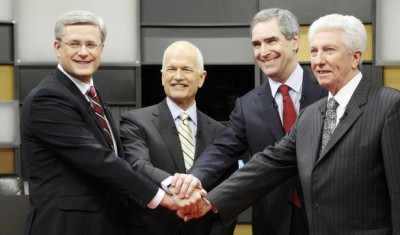
Stephen Harper wins English-language election debate

Stephen Harper shakes hands with petulant children

From left-wing Global TV, a university professor scores the first English-language debate in the Canadian Federal election.

Excerpt:

How well did the four leaders present their points?

Dr. Royce Koop: Harper is very effective at getting his message across. He is very clear, disciplined, and it’s tough to knock him off his game. Ignatieff is not communicating as well as I thought he would. He’s clearly new to this debate format.

Who were the clear aggressors and/or defenders throughout the debate?

Dr. Royce Koop: As can be expected, the three opposition leaders are the aggressors and Harper is the defender. However, Duceppe has distinguished himself as an aggressor. His opening comment was a strong, sharp attack of Harper. However, Harper is effectively defending himself in this debate. His strength is being disciplined, and he’s keeping his cool very well.

Who preformed best?

Dr. Royce Koop: Harper behaved like the PM-in-waiting. These debate formats actually favour the incumbent PM. Everyone is attacking them, and so they are able to rise above it all and act prime-ministerial. This is how Chretien survived the debates in 1997 and 2000, by riding above all the attacks, and Harper is doing so very effectively tonight.

What was your impression of the Harper-Ignatieff face-off? Who won that tete-a-tete?

Dr. Royce Koop: I think that Harper won that exchange, but it was a close call. Ignatieff has to be able to knock Harper off his game, and he hasn’t been able to do so effectively. He came close at the conclusion of the first exchange between them, but Harper came out on top.

A left-wing report from the Markdale Standard.

Excerpt:

Harper projected calm competence and self-assurance from the outset. He carried that through, almost without interruption, to his closing statement two hours later.

There was one moment when Ignatieff had an opening. That was in the prolonged section on democracy. Ignatieff was pressing hard. He scored some good hits on Stephen Harper, branding him a control freak who disrespects democratic institutions and, by extension, Canadians. It was a compelling segment and for a few moments it seemed like Ignatieff might turn the tide.

It didn’t happen. The debate moved on to other topics and ended, advantage Harper, on health care. Here Harper was very strong, looking pragmatic and sensible as the others sought in vain to breach his defence.

Harper’s debating skills, designed for TV, outmatched all three of the other contestants. Most tellingly, he looked constantly at the camera when answering questions, not at his opponents. He was the only one to do so consistently, though NDP leader Jack Layton also used this technique towards the end.

But Harper was rock-solid with it, constantly gazing into the camera, speaking directly Canadians in reassuring tones. With his body language he projected calm confidence. He kept his gestures small and controlled and within the circumference of his body – an effective technique on television.

[…]Tomorrow, look for Harper’s numbers in English Canada to rise sharply, into the low 40s. This will come as bitter brew to Liberal supporters across Canada, but it’s the simple reality: A Conservative majority is back on the table.

How did Harper win the debate? By using evidence.

Excerpt:

Canada’s good economic standing relative to its G8 counterparts, and the country’s relatively quick emergence from recession, can, in part, be credited to encouraging investment in the corporate sector, Mr. Harper said.

While in power, the Stephen Harper Conservatives have cut the corporate tax rate from 22.5% to 16.5%, with a further reduction to 15% scheduled for 2012.

To then foist a sudden reversal in policy on corporate Canada would send the wrong message to investors, Mr. Harper said on Tuesday. He quoted Jack Mintz, a public policy expert at the University of Calgary, as saying that the additional taxes proposed by the Liberals would cost the Canadian economy 200,000 jobs and $40-billion in business investment over the long run.

“Every credible economic analyst, every major business group in this country, says that if you raise taxes, you will hurt growth, hurt jobs and hurt revenue,” Mr. Harper said.

He must be the only politician I know who actually EXPLAINS why corporate tax-hikes are a bad idea. The government needs to cut taxes to attract corporations to move to their country, and to encourage their people to start or grow businesses. That’s where jobs COME FROM. And when people are working, because they have lots of jobs to choose from, they are happier and they pay more in taxes than if they were unemployed. And when people are employed, the government spends less on unemployment and other welfare programs. Notice that our corporate tax rate down here is 36%. More than double the Canadian corporate tax rate. Compared to the Canadians, we spend way too much, and we create far fewer jobs.

If the left-wing newspapers are calling it a victory for Harper, then it was a landslide victory for Harper. I am talking William Lane Craig vs Christopher Hitchens landslide victory. I can hardly wait to see the poll numbers from up north tomorrow. The latest pre-debate poll has Harper leading the socialist Liberal party by 12 points. (H/T Jeanie)

UPDATE: Post-debate poll shows that Harper won the debate.

Related posts

Should pastors preach against false ideas and false ideologies in church?

From Thinking Christian.

Excerpt:

Justin Buzzard tells this story:

About ten years ago I heard Ben Patterson, campus pastor of Westmont College, say something that I will never forget. Ben told the story of a retired pastor who began noticing that his former congregation was sliding away from orthodoxy. The pastor saw this as his fault, noting the one thing he thought he did most poorly as a pastor. The pastor stated, in two sentences, his great failure as a pastor:

I always told people what to believe. My great mistake is that I never told my people what NOT to believe.

It’s possible to be so “biblical” that we’re unbiblical.

I’m referring to pastors, churches, and individual Christians who say, “we’re sticking to the Bible, and we don’t ever need to study anything but the Bible.” The great men and women of the Bible didn’t say that. They didn’t just preach in support of God’s truth. They knew the lies that were current in their cultures, they named those lies—with very contemporary examples—and they exposed what was false about them. When Isaiah ripped apart idol worship so sarcastically in Isaiah 44:9-20, he knew what he was talking about. So those who only study the Bible are failing to follow its example!

I think the reason for this is because the church is so focused on providing a happy music show every week, so that people can feel happy and affirmed, that they would never want to be negative and exclusive. That might make the people in the audience feel offended or excluded. That’s why pastors never set up Christianity as being true in distinction to other views that are false. And pastors surely would not appeal to external evidence from science and history – that might make people who don’t know any science and history feel bad, and spoil their happy feelings. It seems to me that pastors need to get back into the habit of connecting the Christian to real life. False ideas are harmful, and the pastor’s job is to stand up to wolves that might harm his flock – not to ignore the wolves. A very good place to start would be in the area of capitalism and taxation, or maybe in the area of sexual ethics and marriage.