Tag Archives: Sex

New study: couples that delay sexual activity experience higher quality relationships

Relationship stability, quality, communication, satisfaction

From Family Studies, news about TWO new studies.

Excerpt: (links removed)

[T]wo recently published studies call into question the validity of testing sexual chemistry early in dating.

My colleagues and I published the first study a few years ago in the American Psychological Association’s Journal of Family Psychology. This study involved a national sample of 2,035 married individuals who participated in the popular online couple assessment survey called “RELATE.” We found that the longer a dating couple waits to have sex, the better their relationship is after marriage. In fact, couples who wait until marriage to have sex report higher relationship satisfaction (20% higher), better communication patterns (12% better), less consideration of divorce (22% lower), and better sexual quality (15% better) than those who started having sex early in their dating (see Figure 2). For couples in between—those that became sexually involved later in their dating, but prior to marriage—the benefits were about half as strong.

[…]These patterns were statistically significant even when controlling for a variety of other variables such as respondents’ number of prior sexual partners, education levels, religiosity, and relationship length.

The second study, by Sharon Sassler and her colleagues at Cornell University, also found that rapid sexual involvement has adverse long-term implications for relationship quality. Using data from the Marital and Relationship Survey, which provides information on nearly 600 low- to moderate-income couples living with minor children, their study examined the tempo of sexual intimacy and subsequent relationship quality in a sample of married and cohabiting men and women. Their analyses also suggest that delaying sexual involvement is associated with higher relationship quality across several dimensions.

They discovered that the negative association between sexual timing and relationship quality is largely driven by a link between early sex and cohabitation. Specifically, sexual involvement early in a romantic relationship is associated with an increased likelihood of moving more quickly into living together, which in turn is associated with lower relationship quality. This finding supports Norval Glenn’s hypothesis that sexual involvement may lead to unhealthy emotional entanglements that make ending a bad relationship difficult. As Sassler and her colleagues concluded, “Adequate time is required for romantic relationships to develop in a healthy way. In contrast, relationships that move too quickly, without adequate discussion of the goals and long-term desires of each partner, may be insufficiently committed and therefore result in relationship distress, especially if one partner is more committed than the other” (p. 710).

The rest of the post talks about two reasons why this works: improved partner selection and prioritizing communication and commitment.

That’s two studies, and there’s a third. Dina sent me this article from the UK Daily Mail about a new study showing the importance of chastity for relationship quality and stability.

Excerpt:

New couples who jump into bed together on the first date do not last as long in relationships as those who wait a new study has revealed.

Using a sample of almost 11,000 unmarried people, Brigham Young University discovered a direct correlation between the length and strength of a partnership and the amount of time they took to have first have sex.

The study showed that those who waited to initiate sexual intimacy were found to have longer and more positive outcomes in their relationships while those who couldn’t help themselves reported that their dalliances struggled to last more than two years.

‘Results suggested that waiting to initiate sexual intimacy in unmarried relationships was generally associated with positive outcomes,’ said the report authored published by the U.S. National Library of Medicine National Institutes of Health.

‘This effect was strongly moderated by relationship length, with individuals who reported early sexual initiation reporting increasingly lower outcomes in relationships of longer than two years.’

The study examined four sexual-timing patterns: Having sex prior to dating, initiating sex on the first date or shortly after, having sex after a few weeks of dating, and sexual abstinence.

Each one of these fields yielded different results in relationship satisfaction, stability and communication in dating situations.

Here’s another recent study that shows that if a woman has more than her husband as a premarital sex partner, her risk of divorce increases.

His findings:

Using nationally representative data from the 1995 National Survey of Family Growth, I estimate the association between intimate premarital relationships (premarital sex and premarital cohabitation) and subsequent marital dissolution. I extend previous research by considering relationship histories pertaining to both premarital sex and premarital cohabitation. I find that premarital sex or premarital cohabitation that is limited to a woman’s husband is not associated with an elevated risk of marital disruption.However, women who have more than one intimate premarital relationship have an increased risk of marital dissolution.

Here’s another study that makes it even more clear.

Findings:

Data from the 1988 US National Survey of Family Growth (NSFG) were utilized to assess the impact of premarital sexual activity on subsequent marital stability. Among white NSFG subjects first married in 1965-85, virgin brides were significantly less to have become separated or divorced (25%) than women who had not been virgins at marriage (35%).

[…]The lower risk of divorce on the part of white women with no premarital sexual experience persisted even after numerous intervening and background variables were controlled.

This study supports what the Bible says about chastity and premarital sex:

1 Cor. 7:8-9:

8 To the unmarried and the widows I say that it is good for them to stay single as I am.

9 But if they cannot exercise self-control, they should marry. For it is better to marry than to burn with passion.

The idea of “burning” here has to do with sexual desire. Here Paul tells all unmarried people that if they cannot control their sexual desires, they need to get married. Why? Because Paul assumes that one cannot fulfill this sexual desire outside of the marital bed. While Paul would love for them to remain single (1 Cor. 7:7), he believes that sex outside of marriage is a destructive sin and cannot be used as a gratifying release of our sexual passions.

Although young people like to complain about “manipulation” and “controlling” when they are approached with facts, presenting evidence is really the only way to persuade them. Although they may respond with anecdotes to refute studies, studies are important because they represent LOTS of data points, not just one or two cherry-picked cases. Hit them with the evidence before they make the wrong decisions.
Are churchgoing people who accept same-sex marriage really Christians?

Here’s a bit of research from Mark Regnerus to shed some light on what else they believe. (H/T Chris)

Excerpt:

Churchgoing Christians who support same-sex marriage are more likely to think pornography, cohabitation, hook-ups, adultery, polyamory, and abortion are acceptable. And it’s reasonable to expect continued change in more permissive directions.

As mainline Protestant denominations increasingly accept the ordination of gay clergy and publicly affirm same-sex unions, the sociologist in me wishes to understand what this development means for people in those denominations. I’m not talking about subtle linguistic shifts. While the difference between speaking of marriage as a “civil contract between a woman and a man” and as “a unique commitment between two people” is obvious to those who pay attention to church documents, the impact of such changes on congregants’ attitudes and internalized paradigms—their hearts, I suppose—is seldom considered.

What is the sexual and relational morality of Christians who accept the moral legitimacy of same-sex marriages? Some questions naturally arise. Does adultery mean the same thing for both same-sex and opposite-sex unions? Does it make sense to speak of premarital sex in such a context? Historically, the fear of pregnancy was enough to scare many love-struck Christians into taking things slow, but same-sex pregnancies are an accomplishment, not an accident, and most Christians use contraception now anyway.

Integrating homosexual relationships into Christian moral systems is not simple, and has ramifications for how heterosexual relationships are understood, too. What exactly do pro-same-sex-marriage Christians think about sex and relationships in general?

So he’s done some research on this, and here’s a snip:

To do this, I rely on the Relationships in America survey, a data collection project I oversaw that interviewed 15,738 Americans, ages 18-60, in early 2014. It’s a population-based sample, meaning that its results are nationally representative. The survey asked respondents to indicate their level of agreement or disagreement with these seven statements:

  1. Viewing pornographic material is OK.
  2. It is a good idea for couples considering marriage to live together in order to decide whether or not they get along well enough to be married to one another.
  3. It is OK for two people to get together for sex and not necessarily expect anything further.
  4. If a couple has children, they should stay married unless there is physical or emotional abuse.
  5. It is sometimes permissible for a married person to have sex with someone other than his/her spouse.
  6. It is OK for three or more consenting adults to live together in a sexual/romantic relationship.
  7. I support abortion rights.

There is more to sexual and relationship morality than just these seven items, to be sure, but they do offer us a glimpse into how people perceive various practices and relationships. In order to ensure this is not just an exercise in documenting the attitudes of Christians “in name only,” I’ve restricted the analysis to churchgoing Christians—here defined as those who report they attend religious services at least three times a month and who self-identified with some sort of Christian affiliation. And I’ve restricted the analysis to those who report a position either for or against same-sex marriage. (I’ve excluded the one-in-four who reported they are undecided.)

[…]The table above displays the share of each group who either “agree” or “strongly agree” with the seven statements listed above. At a glance, there is a pretty obvious fissure between Christians who do and do not oppose same-sex marriage. More than seven times as many of the latter think pornography is OK. Three times as many back cohabiting as a good idea, six times as many are OK with no-strings-attached sex, five times as many think adultery could be permissible, thirteen times as many have no issue with polyamorous relationships, and six times as many support abortion rights. The closest the two come together is over the wisdom of a married couple staying together at all costs (except in cases of abuse).

Churchgoing Christians who support same-sex marriage look very much like the country as a whole—the population average (visible in the third column). That answers my original question. What would a pro-SSM Christian sexual morality look like? The national average—the norm—that’s what.

Click on through for the rest of it.

As a Christian man, my view is that all sex outside of marriage is wrong. When you hear a church-going person talk about changing the definition of marriage and turning a blind eye to cohabitation. divorce, etc. it’s important to understand that they are just flat out rejecting the no sex outside marriage view. We now have a view of sex in culture that “love makes it right”. And now even “marriage is for anyone who loves someone else”. It’s baloney. That’s not the Christian view, and these church-going people ought to know better.

Should women who get pregnant after premarital sex expect the men to marry them?

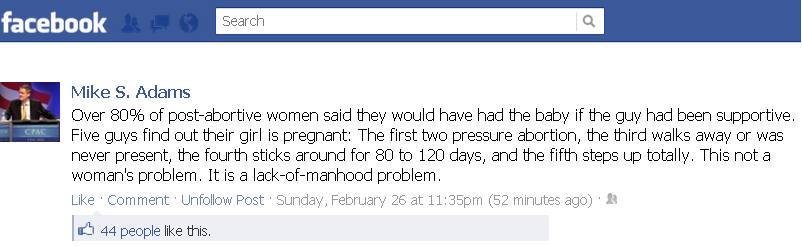
Mike Adams on abortion: click for larger image.

Professor Mike S. Adams is pro-life, but he posted something on Facebook that I must disagree with.

He posted this:

Over 80% of post-abortive women said they would have had the baby if the guy had been supportive. Five guys find out their girl is pregnant: The first two pressure abortion, the third walks away or was never present, the fourth sticks around for 80 to 120 days, and the fifth steps up totally. This not a woman’s problem. It is a lack-of-manhood problem.

Mike has about 5000 friends, and 44 of them liked it. I would think that most of these people would call themselves pro-life conservatives. But I don’t think what he posted promotes the pro-life cause.

I replied to him with this:

Mike I could not disagree more. It’s a woman’s problem unless it is rape, since the woman consents to sex with a man she is not married to. In fact, the cause of abortion is YOUR opinion – namely, the opinion that women should not be obligated to be chaste or to think rationally about who they are having sex with. There is a path to marriage that goes through courtship, and that path has a name: self-control. Stop enabling the poor choices of women, because we have to stop the murder of unborn children.

Many of Mike’s friends supported him. So I wrote this:

Wow. I had no idea that so many of Mike’s friends think that the Bible is a pack of lies when it says that fornication is morally wrong. I guess you guys aren’t Christians then, since you feel so free and easy about revising the Bible when you feel like it.

If fornication is wrong, it’s wrong for women AND men. And you don’t fornicate and then expect happy outcomes from it. There is a word for a person who sins and then expects a good outcome. A FOOL.

Then Mike replied to me:

Sorry Wintery. Where I come from the man leads and is, therefore, responsible.

I replied to that with this:

Mike, I agree with male leading – IF the man is a Christian. But the men that these women chose are not Christians. And you can’t expect men to act morally unless they have a theistic framework that grounds morality.

Women should not be told, by you and others, that they can choose to have sex with immoral men and then expect the immoral men to act morally. That is just enabling abortion by justifying a lack of prudence and wisdom. Instead, we should be holding women accountable to choose men who WILL control themselves.

We should not be supporting the fantasy view of love that says  that recreational sex magically leads men to commit to protect, provide and lead women for life. That view is neither wise nor Biblical. On the contrary, recreational sex leads men to NOT commit. Women have to learn how to select men, to evaluate them for marriage, and to make them prove themselves. We need to tell men AND women that sex before marriage is morally wrong. And we need to be convincing by showing them how recreational sex does not lead to stable marriages, and puts children, unborn and born, in harm’s way. Telling the truth about the danger of premarital sex is the best way to stop the killing of unborn children.

Here’s an example to make the point. We do not blame bears for mauling campers. Bears are bears, and they were bears before the campers showed up in their cave. We ought to blame the camper for choosing to wander off the trail and into the bear’s den in order to PET THE BEAR. Wild bears may eat free food that is offered to them, but they are not going to let you pet them and hug them. Women, like campers, need to be responsible. They need to choose the right man for marriage. They need to exercise self control. They need to make the man prove his ability to commit and support a family BEFORE they have sex with him. No one hires an employee without understanding what job they need done and then making sure that the candidate they choose can do the job. And that’s what we need to tell women.

Obviously, I was a little upset when I wrote that, but I hope it wasn’t too bad.

So what’s the point I was trying to make by being critical of Mike? I think the problem we have today is that men who are pro-life are unwilling to hold women accountable for their own poor decisions about sex and marriage. Basically, conservative and/or Christian men think that women don’t need to think through what choices are most likely to avoid abortion and most likely to achieve marriage. These men give tacit approval to the popular trend of trying to achieve marriage through premarital sex (or cohabitation), when the research shows that these behaviors do not result in long-lasting stable marriages. In fact, sex out of wedlock is a good way to get into a situation where an abortion will occur.

In my view, Mike is inadvertently encouraging women to get into the situations where they will be pressured to abort by reinforcing the idea that there is nothing wrong with their plan to achieve marriage by having premarital sex (or cohabitating), and then expecting men to respond to their pregnancy by MARRYING them. Mike seems to be telling women that it is normal for them to expect that marriage will follow from premarital sex with men who have not been vetted for the roles of provider, protector and leader As if marriage is natural for men who don’t even have jobs and who are surrounded by women willing to have sex with them on the first date. Any man who will have recreational premarital sex with a woman is exactly the kind of person who will not commit to lifelong providing and fidelity – he is having sex before marriage because he wants recreation, without the commitment and self-sacrifice that marriage requires. Rationally speaking, it makes no sense for men to buy the cow, and to keep buying the cow with 40 years of labor, when they can get the milk for free. And that’s what we need to tell women – think with your minds, not with your emotions.

Here is an interesting statistic from Relevant Magazine:

[A] recent study reveals that 88 percent of unmarried young adults (ages 18-29) are having sex. The same study, conducted by The National Campaign to Prevent Teen and Unplanned Pregnancy, reveals the number doesnʼt drop much among Christians. Of those surveyed who self-identify as “evangelical,” 80 percent say they have had sex.

[…]In addition to having premarital sex, an alarming number of unmarried Christians are getting pregnant. Among unmarried evangelical women between the ages of 18 and 29, 30 percent have experienced a pregnancy (a number thatʼs actually 1 percent higher than among those who donʼt claim to be evangelical).

According to the Guttmacher Institute, nearly half of all pregnancies in America are unintended. And of those, 40 percent end in abortion. More than 1 million abortions occur in the United States each year. But perhaps the most disturbing statistic for the Church: 65 percent of the women obtaining abortions identify themselves as either Protestant or Catholic (37 percent Protestant and 28 percent Catholic). Thatʼs 650,000 abortions obtained by Christians every year.

Christian women are not told that premarital sex is wrong by many Christians and conservatives – and out of that refusal by “Christians” and “conservatives” to take a stand, we get 650,000 abortions per year. We need to have more courage to tell women to be more self-controlled and responsible when they choose who to have sex with, and when to have sex. We need to tell women to make good decisions that lead to stable marriages. We need to tell women to study these issues and to support policies that produce strong, moral men who are willing to marry – for example, by reforming education so that our schools produce men who can find jobs, perhaps by having more male teachers in the classroom. We need to tell women to support policies that make marriage more friendly for men, like abolishing no-fault divorce, and promoting shared parenting. Christians in particular need to counteract the views of love and romance that are prevalent in popular culture with a view of relationships built around chastity and love. Although many people today are uncomfortable with moral absolutes and moral judgments, it would be a good be a good idea for women to promote these things, so that the men they are choosing from are more moral.

In the end, I agree with Mike S. Adams in one respect. Abortion may be caused by a lack of manhood problem. Only the lack of manhood doesn’t come from the men that women choose to have premarital sex with. The lack of manhood comes from men who refuse to hold women accountable for their own free foolish decisions that put unborn children in harm’s way. In addition to the abortion problem that results from those foolish decisions, there is also the explosion in out-of-wedlock births to weigh in the balance. Again, the more people tell women that they should expect men who engage in recreational sex to commit to marriage after premarital sex (or cohabitation), the more fatherlessness we get.