Tag Archives: Norway

Are Nordic countries succeeding with socialism like Bernie Sanders says?

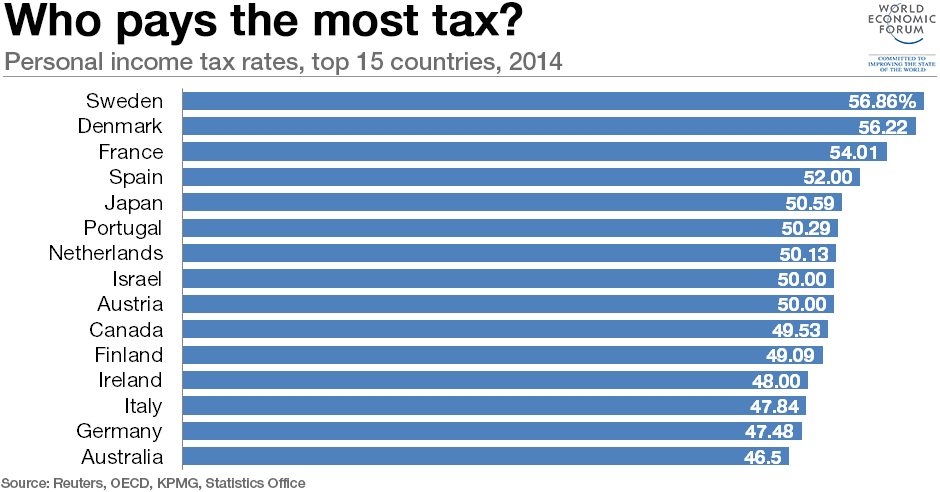
Individials pay extremely high income taxes in Nordic countries

Last week, I saw back to back studies on Nordic countries reported by the far-left UK Independent and Barron’s magazine. We’re probably going to hear more about how great socialism is from socialists, and since they seem to point to Nordic countries as proof, we should probably look at the studies and see what the truth is.

Let’s start with the report from Barron’s. You’ll have heard of Barron’s if you’re an investor.

It says:

Although there are areas—especially in taxes and labor market regulation—where socialist elements still exist in the Nordics, the region is by no means socialist today. In fact, according to the Heritage Foundation’s index of economic freedom, Sweden, Norway, Finland, Iceland, and Denmark rank among the 30 most capitalist countries in the world.

These countries used to be socialist in the 1970s and 1980s. Socialism means a huge government work force, high taxes, massive regulation of private sector businesses, and massive spending on welfare programs. You didn’t have to marry before having children, the government would give you welfare. You didn’t have to take care of yourself, the government would give you free health care. You didn’t have to save for retirement, the government would give you a pension.

The article mentions one country in particular – Sweden. And here is what socialism looked like in Sweden:

In 1960, for every 100 “market-financed” Swedes (i.e. those who derived their income predominantly from private enterprise), there were 38 who were “tax-financed” (i.e. dependent on the public sector for their income, whether as civil servants or as recipients of payments from the state). Thirty years later, that number had risen to 151—in other words, there were significantly more people living off of the state than paying into the system. This reflects Sweden’s move away from a capitalist free-market economy to a socialist model.

When people talk about socialism, they mean more people living off the state than paying into the system.

But socialism can’t last forever. Eventually, the people in the private sector realize that they are keeping less and less of what they earn, and they stop working, or just leave. The article notes that IKEA, which started out in Sweden, moved out to avoid paying the 57% corporate tax rate.

Eventually, and this is the part that Bernie Sanders is ignorant about, Sweden slashed or eliminated taxes across the board, then cut their government spending on welfare, subsidies and gv:

A major tax reform in 1990/91 slashed corporate taxes from 57% to 30%. Income from shares was exempted from taxation, while capital gains from shares were taxed at only 12.5%.

The top marginal income-tax rate was set at around 50%, a reduction by 24 to 27 percentage points for the majority of the workforce. The proportion of earners taxed at a marginal rate of over 50% dropped from over half to only 17% paying income tax to the central government.

The reforms continued over the following years: in 2004, the estate tax of up to 30% was scrapped. Today, there is no estate tax in Sweden. The abolition of the wealth tax, which had already been cut, came into effect retroactively as of 1 January 2007. The corporate tax rate continued to decline, getting cut from 30% to 26.3% in 2009 and to 22% in 2013. Property tax rates were also cut substantially.

Between 1993 and 2000, social spending dropped from 22.2% to 16.9% of GDP, economic subsidies from 8.7% to 1.8% and public-sector payroll costs from 18.2% to 15.6%.

Sweden might be a little further ahead of some of the other Nordic countries. Over in Finland, they are still climbing out of it, and the massive government spending is so hard for socialists to cut.

Here’s a story from Finland about their government-run health care system – the same kind that Bernie is always bragging about, and telling us how well it works in Finland.

Far-left Reuters reports:

Finland’s coalition government resigned on Friday a month ahead of a general election, saying it could not deliver on a healthcare reform package that is widely seen as crucial to securing long-term government finances.

Healthcare systems across much of the developed world have come under increasing stress in recent years as treatment costs soar and people live longer, meaning fewer workers are supporting more pensioners.

Nordic countries, where comprehensive welfare is the cornerstone of the social model, have been among the most affected. But reform has been controversial and, in Finland, plans to cut costs and boost efficiency have stalled for years.

The very health care systems that Bernie lectures American voters about are all in decline and failing:

Other Nordic countries have also grappled with the need to cut costs. Sweden is to gradually raise its retirement age and has opened up parts of the healthcare system to the private sector in a bid to boost efficiency.

Denmark will gradually increase the retirement age to 73 – the highest in the world – while cutting taxes and unemployment benefits to encourage people to work more.

If you learned anything from this article, I’d like you to do me a favor. Please share and/or tweet this post, or share and/or tweet the posts from Barron’s and Reuters. We have an election coming up in 2020, and right now, the people are being lied to by foolish socialist politicians who talk and talk about things they have no knowledge about. We need to correct the views of the American people with facts. We can’t make the mistake of electing Democrats who are terrible at health care, and only good at making promises to spending taxpayer money. They have no idea how economics actually works in the real world, and we need to do everything we can to keep them out of power.


Are Nordic countries succeeding with socialism like Bernie Sanders says?

Individials pay extremely high income taxes in Nordic countries

Last week, I saw back to back studies on Nordic countries reported by the far-left UK Independent and Barron’s magazine. We’re probably going to hear more about how great socialism is from socialists, and since they seem to point to Nordic countries as proof, we should probably look at the studies and see what the truth is.

Let’s start with the report from Barron’s. You’ll have heard of Barron’s if you’re an investor.

It says:

Although there are areas—especially in taxes and labor market regulation—where socialist elements still exist in the Nordics, the region is by no means socialist today. In fact, according to the Heritage Foundation’s index of economic freedom, Sweden, Norway, Finland, Iceland, and Denmark rank among the 30 most capitalist countries in the world.

These countries used to be socialist in the 1970s and 1980s. Socialism means a huge government work force, high taxes, massive regulation of private sector businesses, and massive spending on welfare programs. You didn’t have to marry before having children, the government would give you welfare. You didn’t have to take care of yourself, the government would give you free health care. You didn’t have to save for retirement, the government would give you a pension.

The article mentions one country in particular – Sweden. And here is what socialism looked like in Sweden:

In 1960, for every 100 “market-financed” Swedes (i.e. those who derived their income predominantly from private enterprise), there were 38 who were “tax-financed” (i.e. dependent on the public sector for their income, whether as civil servants or as recipients of payments from the state). Thirty years later, that number had risen to 151—in other words, there were significantly more people living off of the state than paying into the system. This reflects Sweden’s move away from a capitalist free-market economy to a socialist model.

When people talk about socialism, they mean more people living off the state than paying into the system.

But socialism can’t last forever. Eventually, the people in the private sector realize that they are keeping less and less of what they earn, and they stop working, or just leave. The article notes that IKEA, which started out in Sweden, moved out to avoid paying the 57% corporate tax rate.

Eventually, and this is the part that Bernie Sanders is ignorant about, Sweden slashed or eliminated taxes across the board, then cut their government spending on welfare, subsidies and gv:

A major tax reform in 1990/91 slashed corporate taxes from 57% to 30%. Income from shares was exempted from taxation, while capital gains from shares were taxed at only 12.5%.

The top marginal income-tax rate was set at around 50%, a reduction by 24 to 27 percentage points for the majority of the workforce. The proportion of earners taxed at a marginal rate of over 50% dropped from over half to only 17% paying income tax to the central government.

The reforms continued over the following years: in 2004, the estate tax of up to 30% was scrapped. Today, there is no estate tax in Sweden. The abolition of the wealth tax, which had already been cut, came into effect retroactively as of 1 January 2007. The corporate tax rate continued to decline, getting cut from 30% to 26.3% in 2009 and to 22% in 2013. Property tax rates were also cut substantially.

Between 1993 and 2000, social spending dropped from 22.2% to 16.9% of GDP, economic subsidies from 8.7% to 1.8% and public-sector payroll costs from 18.2% to 15.6%.

Sweden might be a little further ahead of some of the other Nordic countries. Over in Finland, they are still climbing out of it, and the massive government spending is so hard for socialists to cut.

Here’s a story from Finland about their government-run health care system – the same kind that Bernie is always bragging about, and telling us how well it works in Finland.

Far-left Reuters reports:

Finland’s coalition government resigned on Friday a month ahead of a general election, saying it could not deliver on a healthcare reform package that is widely seen as crucial to securing long-term government finances.

Healthcare systems across much of the developed world have come under increasing stress in recent years as treatment costs soar and people live longer, meaning fewer workers are supporting more pensioners.

Nordic countries, where comprehensive welfare is the cornerstone of the social model, have been among the most affected. But reform has been controversial and, in Finland, plans to cut costs and boost efficiency have stalled for years.

The very health care systems that Bernie lectures American voters about are all in decline and failing:

Other Nordic countries have also grappled with the need to cut costs. Sweden is to gradually raise its retirement age and has opened up parts of the healthcare system to the private sector in a bid to boost efficiency.

Denmark will gradually increase the retirement age to 73 – the highest in the world – while cutting taxes and unemployment benefits to encourage people to work more.

If you learned anything from this article, I’d like you to do me a favor. Please share and/or tweet this post, or share and/or tweet the posts from Barron’s and Reuters. We have an election coming up in 2020, and right now, the people are being lied to by foolish socialist politicians who talk and talk about things they have no knowledge about. We need to correct the views of the American people with facts. We can’t make the mistake of electing Democrats who are terrible at health care, and only good at making promises to spending taxpayer money. They have no idea how economics actually works in the real world, and we need to do everything we can to keep them out of power.


Kevin DeYoung’s article opposing gay marriage has broad appeal

Marriage and family
Marriage and family

In my own secular case against gay marriage from a while back, I argued for 3 points:

  • same-sex marriage is bad for liberty, especially religious liberty
  • same-sex marriage is bad for children
  • same-sex marriage is bad for public health

My hope when I wrote that was that pastors and other Christian leaders would learn to argue for what the Bible says by using evidence from outside the Bible, so that they would be able to appeal to more people instead of only appealing to the minority of people who accept the Bible. I think that Christians who argue for their views by citing the Bible only will only be convincing to people who already accept the Bible. But there is not a majority of people who do accept the Bible as an authority, so I think that pastors have to make another plan. They need to argue using the Bible to those who accept the Bible, and without the Bible to those who don’t accept it.

Now with that said, take a look at this article by pastor Kevin DeYoung that Dina sent me. It’s from earlier this week. The article makes the same exact three points as I made in my article last year. Let’s take a look at how Kevin does that.

My first point was liberty, especially religious liberty. He writes:

[I]n the long run, the triumph of gay marriage (should it triumph as a cultural and legal reality) will mean the restriction of freedoms for millions of Americans.

This will happen in obvious ways at first–by ostracizing those who disagree, by bullying with political correctness, and by trampling on religious liberty. Surely, Christians must realize that no matter how many caveats we issue, not matter how much we nuance our stance, no matter how much we encourage or show compassion for homosexuals, it will not be enough to ward off the charges of hatred and homophobia.

[G]ay marriage will challenge our freedoms in others way too. It’s not just Evangelicals, traditional Catholics, and Mormons who will be threatened. Once the government gains new powers, it rarely relinquishes them. There will be a soft tyranny that grows as the power of the state increases, a growth that is intrinsic to the  notion of gay marriage itself.

My second point was bad for children. He writes:

[T]he state has an interest in promoting the familial arrangement which has a mother and a father raising the children that came from their union. The state has been in the marriage business for the common good and for the well-being of the society it is supposed to protect. Kids do better with a mom and a dad. Communities do better when husbands and wives stay together. Hundreds of studies confirm both of these statements (though we all can think of individual exceptions I’m sure). Gay marriage assumes that marriage is re-definable and the moving parts replaceable.

My third point was bad for public health. He writes:

The unspoken secret, however, is that homosexual behavior is not harmless. Homosexuals are at a far greater risk for diseases like syphilis, HIV/AIDS, hepatitis, gonorrhea, HPV, and gay bowel syndrome. The high rate of these diseases is due both to widespread promiscuity in the gay community and the nature of anal and oral intercourse itself. Homosexual relationships are usually portrayed as a slight variation on the traditional “norm” of husband-wife monogamy. But monogamy is much less common among homosexual relationships, and even for those who value monogamy the definition of fidelity is much looser.

He also talks about the definition of marriage, and more.

I’ve criticized pastors before for dealing with social issues by only citing the Bible, like John Piper does. That approach won’t work on enough people to change society, because not enough people consider the Bible to be an authority in their decision-making. We have to use evidence from outside the Bible – like Wayne Grudem does in his “Politics According to the Bible”.

I think that pastor Kevin’s article is quality work, because it follows the pattern of taking an all-of-the-above approach to persuasion. He uses all means to persuade so that he might win some over to his side. I hope that many more pastors will do the same thing on this issue of marriage and other issues – even fiscal issues. Fiscal issues do have an impact on moral issues – think of how abortion subsidies and single mother welfare lower the penalties of recreational premarital sex. We can do this, we just have to do what works, instead of what makes us feel “holier-than-thou”.