Tag Archives: Libertarian

Why doesn’t God make his existence more obvious to people?

Sherlock Holmes and John Watson are going to take a look at the data

Have you ever heard someone say that if God existed, he would give us more evidence? This is called the “hiddenness of God” argument. It’s also known as the argument from “rational non-belief”.

Basically the argument is something like this:

  1. God is all powerful
  2. God is all loving
  3. God wants all people to know about him
  4. Some people don’t know about him
  5. Therefore, there is no God.

In this argument, the atheist is saying that he’s looked for God real hard and that if God were there, he should have found him by now. After all, God can do anything he wants that’s logically possible, and he wants us to know that he exists. To defeat the argument we need to find a possible explanation of why God would want to remain hidden when our eternal destination depends on our knowledge of his existence.

What reason could God have for remaining hidden?

Dr. Michael Murray, a brilliant professor of philosophy at Franklin & Marshall College, has found a reason for God to remain hidden.

His paper on divine hiddenness is here:
Coercion and the Hiddenness of God“, American Philosophical Quarterly, Vol 30, 1993.

He argues that if God reveals himself too much to people, he takes away our freedom to make morally-significant decisions, including responding to his self-revelation to us. Murray argues that God stays somewhat hidden, so that he gives people space to either 1) respond to God, or 2) avoid God so we can keep our autonomy from him. God places a higher value on people having the free will to respond to him, and if he shows too much of himself he takes away their free choice to respond to him, because once he is too overt about his existence, people will just feel obligated to belief in him in order to avoid being punished.

But believing in God just to avoid punishment is NOT what God wants for us. If it is too obvious to us that God exists and that he really will judge us, then people will respond to him and behave morally out of self-preservation. But God wants us to respond to him out of interest in him, just like we might try to get to know someone we admire. God has to dial down the immediacy of the threat of judgment, and the probability that the threat is actual. That leaves it up to us to respond to God’s veiled revelation of himself to us, in nature and in Scripture.

(Note: I think that we don’t seek God on our own, and that he must take the initiative to reach out to us and draw us to him. But I do think that we are free to resist his revelation, at which point God stops himself short of coercing our will. We are therefore responsible for our own fate).

The atheist’s argument is a logical/deductive argument. It aims to show that there is a contradiction between God’s will for us and his hiding from us. In order to derive a contradiction, God MUST NOT have any possible reason to remain hidden. If he has a reason for remaining hidden that is consistent with his goodness, then the argument will not go through.

When Murray offers a possible reason for God to remain hidden in order to allow people to freely respond to him, then the argument is defeated. God wants people to respond to him freely so that there is a genuine love relationship – not coercion by overt threat of damnation. To rescue the argument, the atheist has to be able to prove that God could provide more evidence of his existence without interfering with the free choice of his creatures to reject him.

Murray has defended the argument in works published by prestigious academic presses such as Cambridge University Press, (ISBN: 0521006104, 2001) and Routledge (ISBN: 0415380383, 2007).

Positive arguments for Christian theism

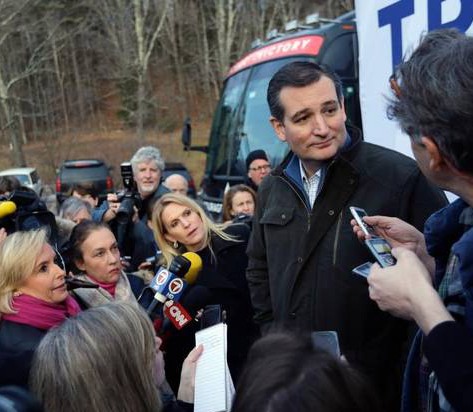
Ted Cruz emphasizes libertarian credentials to Rand Paul supporters in New Hampshire

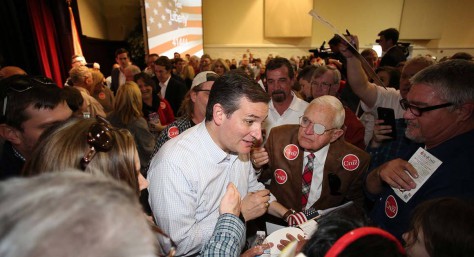
Ted Cruz meets the voters at a campaign stop

New Hampshire is well-known as one of the most secular states in the union. They are very liberal on social issues, and socialist candidate Bernie Sanders is polling about 15 points higher than socialist-lite candidate Hillary Clinton. Cruz is in a 4-way tie for second place right now with three moderate, establishment candidates: John Kasich, Jeb Bush and Marco Rubio.

Cruz is trying to emphasize his libertarian credentials so that be broadens his appeal to a different class of voters.

The Washington Post explains how he’s doing it:

Less than two days before the polls opened, Sen. Ted Cruz (R-Tex.) was still working to land the libertarian-minded GOP presidential primary voters who were prodded into politics by Ron Paul and who are deeply unsure about what to do next. At Cruz’s first post-church stop of the day, in the western New Hampshire town of Peterborough, his audience included more than a few voters who planned to support Sen. Rand Paul (R-Ky.), and wanted to hear a specific pitch.

Cruz aimed right at them, elongating his standard riff about the risks a Democratic president would pose to the Supreme Court, and saying that his justices would end eminent-domain abuse.

“Many people here are familiar with the case of Kelo v. New London,” Cruz said. “Kelo was a disgrace.”

This was not the first time Cruz had attacked Kelo and eminent domain in a New Hampshire speech, but a debate moment that Cruz had no part of seemed to give him an opening. In rival Jeb Bush’s best moment from Saturday night, the former Florida governor tore into Donald Trump for his legal campaign to seize property from an elderly woman and use it to expand parking at one of his Atlantic City properties.

I blogged before about Donald Trump’s support for eminent domain, which was used to try to seize an elderly woman’s house so that Trump could put up a parking lot for his limousines.

Here was the exchange from the debate where Trump defended his support for eminent domain in the ABC News debate last Saturday night:

What a disastrous response from Trump – he got boo’d multiple times by the audience for it, and it rattled him.

Cruz is also a co-sponsor of Rand Paul’s legislation to audit the Federal Reserve, something that I would like to see done, as well. There’s too much meddling with the value of the dollar when the Federal Reserve prints money willy nilly.

The New Hampshire Union Leader reports that Cruz has had some success at winning over libertarians:

Republican presidential hopeful Ted Cruz has won over five state representatives who were part of Rand Paul’s New Hampshire leadership team.

Paul, who ended his campaign last week, had amassed a large coalition of liberty Republicans and conservative activists who are now migrating to other candidates ahead of Tuesday’s primary.

The six state lawmakers endorsing Cruz are: Rep. Max Abramson of Seabrook, Rep. Eric Eastman of Nashua, Rep. Harold French of Franklin, Rep. Larry Gagne of Manchester, and Rep. Mark McLean of Manchester.

This outreach foreshadows how Cruz would appeal to the American people as a whole, should he win the nomination. He wouldn’t have to become more liberal, he would just have to give the libertarians what they want in fiscal areas, and maybe in national security.

Ted Cruz meets voters at a campaign event

Cruz also has a solid ground game that may make a difference.

The Daily Caller reports:

Former New Hampshire Republican Sen. Bob Smith, a Cruz campaign ally, expressed full confidence about the campaign’s ground game overcoming present poll expectations.

[…]“We’ve been ID’ing voters who are leaners, people who are not sure, and we’ve been knocking on thousands and thousands of doors for literally months and I’ll tell you it feels good out there.”

Smith says it is a tradition in New Hampshire to be on the ground and meet people. “And that’s what Cruz has been doing now for several weeks. I’ve been on the bus with him all this week and a week or so a go, he was up for another five-day bus trip,” he said.

“He was meeting two three four hundred people one night. 1300 people at stop after stop after stop. So he’s met thousands of voters here one on one,” said Smith.

[…]Cruz surrogate Steve Lonegan, a New Jersey Republican activist, agreed with Smith telling TheDC Saturday night, “It’s over a 100 people right now. I think we have more than any other candidate. Our headquarter phones are going non-stop. We’re setting up 40 satellite offices in people’s homes and around the state for election day to get out the vote. So this campaign is superb about building a grassroots movement and so we will outperform people’s expectations.”

The Cruz campaign’s volunteers include college students who often stay at the dormitories of Chester College, a now-closed school.

“I came up this Friday but I was up a couple of weekends ago, so I’m going to stay here until the primary,” said Kareena, a 19-year old student at the University of Rhode Island.

Kareena, like many of the students working on the campaign, are phone banking and door knocking for the first time on a political campaign.

[…]“We go door to door, and we have walk books for different cities in New Hampshire, so it’s really great. It’s incredible. You don’t have to carry around a bunch of papers and clip boards. So it’s really convenient,” she said.

Fellow Cruz volunteer Mary Brown, an 18-year-old from the University of Tulsa, also enjoys door knocks.

“It’s fun to see the different areas of New Hampshire. It’s kind of like phone banking. You get a lot of different answers. It’s kind of really exciting when you see someone with a Ted Cruz sign or Ted Cruz sticker,” she says.

I guess we’ll know tomorrow at this time how well this appeal to libertarians, coupled with this volunteer-driven ground game, worked out for Cruz. I’m hoping for third place, but it’s going to be tough. Kasich, Rubio and Bush have a lot of momentum.


Wage gap: are women paid less than men because of discrimination?

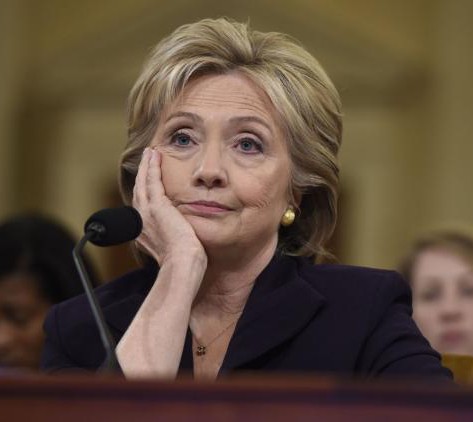
Hillary Clinton look bored about the deaths of 4 Americans who asked for her help
Hillary Clinton thinks that women are not paid fairly compared to men: is it true?

Liberal feminist Hanna Rosin takes a look at this question in the far-left Slate, of all places.

Excerpt:

The official Bureau of Labor Department statistics show that the median earnings of full-time female workers is 77 percent of the median earnings of full-time male workers. But that is very different than “77 cents on the dollar for doing the same work as men.” The latter gives the impression that a man and a woman standing next to each other doing the same job for the same number of hours get paid different salaries. That’s not at all the case. “Full time” officially means 35 hours, but men work more hours than women. That’s the first problem: We could be comparing men working 40 hours to women working 35.

How to get a more accurate measure? First, instead of comparing annual wages, start by comparing average weekly wages. This is considered a slightly more accurate measure because it eliminates variables like time off during the year or annual bonuses (and yes, men get higher bonuses, but let’s shelve that for a moment in our quest for a pure wage gap number). By this measure, women earn 81 percent of what men earn, although it varies widely by race. African-American women, for example, earn 94 percent of what African-American men earn in a typical week. Then, when you restrict the comparison to men and women working 40 hours a week, the gap narrows to 87 percent.

But we’re still not close to measuring women “doing the same work as men.” For that, we’d have to adjust for many other factors that go into determining salary. Economists Francine Blau and Lawrence Kahn did that in a recent paper, “The Gender Pay Gap.”.”They first accounted for education and experience. That didn’t shift the gap very much, because women generally have at least as much and usually more education than men, and since the 1980s they have been gaining the experience. The fact that men are more likely to be in unions and have their salaries protected accounts for about 4 percent of the gap. The big differences are in occupation and industry. Women congregate in different professions than men do, and the largely male professions tend to be higher-paying. If you account for those differences, and then compare a woman and a man doing the same job, the pay gap narrows to 91 percent. So, you could accurately say in that Obama ad that, “women get paid 91 cents on the dollar for doing the same work as men.”

I believe that the remainder of the gap can be accounted for by looking at other voluntary factors that differentiate men and women.

The Heritage Foundation says that a recent study puts the number at 95 cents per dollar.

Excerpt:

Women are more likely than men to work in industries with more flexible schedules. Women are also more likely to spend time outside the labor force to care for children. These choices have benefits, but they also reduce pay—for both men and women. When economists control for such factors, they find the gender gap largely disappears.

A 2009 study commissioned by the Department of Labor found that after controlling for occupation, experience, and other choices, women earn 95 percent as much as men do. In 2005, June O’Neil, the former director of the Congressional Budget Office, found that “There is no gender gap in wages among men and women with similar family roles.” Different choices—not discrimination—account for different employment and wage outcomes.

A popular article by Carrie Lukas in the Wall Street Journal agrees.

Excerpt:

The Department of Labor’s Time Use survey shows that full-time working women spend an average of 8.01 hours per day on the job, compared to 8.75 hours for full-time working men. One would expect that someone who works 9% more would also earn more. This one fact alone accounts for more than a third of the wage gap.

[…]Recent studies have shown that the wage gap shrinks—or even reverses—when relevant factors are taken into account and comparisons are made between men and women in similar circumstances. In a 2010 study of single, childless urban workers between the ages of 22 and 30, the research firm Reach Advisors found that women earned an average of 8% more than their male counterparts. Given that women are outpacing men in educational attainment, and that our economy is increasingly geared toward knowledge-based jobs, it makes sense that women’s earnings are going up compared to men’s.

When women make different choices about education and labor that are more like what men choose, they earn just as much or more than men.

Now back to Hillary Clinton. How much does she pay the women on her staff?

The Washington Times reports:

During her time as senator of New York, Hillary Rodham Clinton paid her female staffers 72 cents for every dollar she paid men, according to a new Washington Free Beacon report.

From 2002 to 2008, the median annual salary for Mrs. Clinton’s female staffers was $15,708.38 less than what was paid to men, the report said. Women earned a slightly higher median salary than men in 2005, coming in at $1.04. But in 2006, they earned 65 cents for each dollar men earned, and in 2008, they earned only 63 cents on the dollar, The Free Beacon reported.

[…]Mrs. Clinton has spoken against wage inequality in the past. In April, she ironically tweeted that “20 years ago, women made 72 cents on the dollar to men. Today it’s still just 77 cents. More work to do. #EqualPay #NoCeilings.”

Think of this next time Hillary Clinton talks about “the wage gap”. She is talking about the women on her staff, and no one else.