Tag Archives: Intelligence

Does science support mothers who leave their young children to go to work?

Dina is very concerned about the UK’s leftist coalition government’s attempt to punish women who stay at home with their young children. (H/T Dina)

Excerpt:

Under plans unveiled in the Budget on Wednesday, families will only benefit from the generous new deal, which will come into force in 2015, if ‘all parents’ have a job. If one parent works but the other stays at home looking after their young children, they will get nothing.

It is the second time in just a few months that the Government has triggered controversy with its changes to the tax and benefit systems, which appear to penalise stay-at-home mothers.

As a result of the recent child benefit changes, a couple can both earn £50,000 and keep their child benefit, worth £1,752 a year for two children.

But a couple where one parent earns £60,000 and the other earns nothing – but have a far lower joint income – do not get a penny.

Again, this week’s initiative favours those couples where both parents go out to work. It will even benefit parents who each earn a salary of £149,999.

Note that this plan is being put forward by socialist Liberal Democrat Party, as well as the “Conservative” Party.

Dina thinks that the science is pretty clear that children suffer if their mothers leave them at a young age. Take a look at the video above, and then the brain scan below.
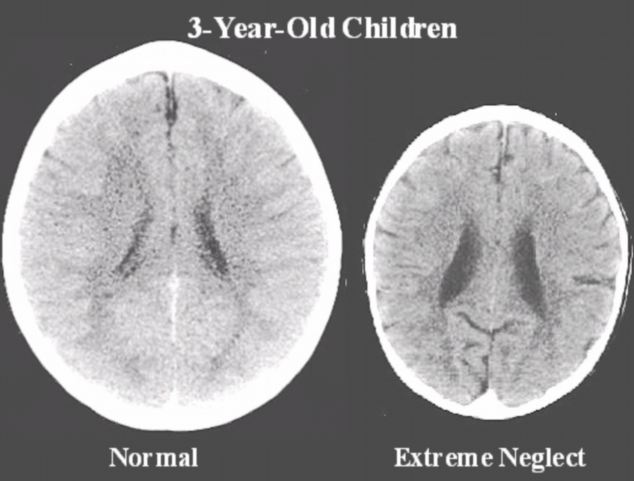
Brain scans of 3-year old children: normal vs neglected

Here’s the article that goes with the brain scan from the UK Daily Mail.

Excerpt:

Both of these images are brain scans of a two three-year-old children, but the brain on the left is considerably larger, has fewer spots and less dark areas, compared to the one on the right.

According to neurologists this sizeable difference has one primary cause – the way each child was treated by their mothers.

The child with the larger and more fully developed brain was looked after by its mother – she was constantly responsive to her baby, reported The Sunday Telegraph.

But the child with the shrunken brain was the victim of severe neglect and abuse.

According to research reported by the newspaper, the brain on the right worryingly lacks some of the most fundamental areas present in the image on the left.

The consequences of these deficits are pronounced – the child on the left with the larger brain will be more intelligent and more likely to develop the social ability to empathise with others.

But in contrast, the child with the shrunken brain will be more likely to become addicted to drugs and involved in violent crimes, much more likely to be unemployed and to be dependent on state benefits.

The child is also more likely to develop mental and other serious health problems.

Professor Allan Schore, of UCLA, told The Sunday Telegraph that if a baby is not treated properly in the first two years of life, it can have a fundamental impact on development.

He pointed out that the genes for several aspects of brain function, including intelligence, cannot function.

[…]The study correlates with research released earlier this year that found that children who are given love and affection from their mothers early in life are smarter with a better ability to learn.

The study by child psychiatrists and neuroscientists at Washington University School of Medicine in St. Louis, found school-aged children whose mothers nurtured them early in life have brains with a larger hippocampus, a key structure important to learning, memory and response to stress.

The research was the first to show that changes in this critical region of children’s brain anatomy are linked to a mother’s nurturing, Neurosciencenews.com reports.

The research is published online in the Proceedings of the National Academy of Sciences Early Edition.

Lead author Joan L. Luby, MD, professor of child psychiatry, said the study reinforces how important nurturing parents are to a child’s development.

This is why I argue that feminism, which is the ideology that demands that women work outside the home in order to be “equal” to men, is harmful to children. If we really cared about children, then we need to not be subsidizing the child abuse schemes of Liberal Democrats like Nick Clegg. We need to be clear that gender feminism (third-wave feminism) is an anti-child ideology and it should be opposed. The science is settled on this issue. Feminism harms innocent young children. And feminism isn’t just opposed to the rights of born children. They oppose the right to life of unborn children, too.

New study: smoking marijuana raises risk of having a stroke

Fox News reports:

Excerpt:

Recent research from Duke University in Durham, N.C., found teenagers who smoked marijuana habitually during their adolescence showed a decrease in their general intellectual ability as they progressed into adulthood.

But now, there is an even more chilling possible side effect of cannabis use – an increased risk of stroke.

According to a new study from the University of Auckland in New Zealand, marijuana may double the risk of ischemic stroke and transient ischemic attack (TIA) in young adults – even those who had no risk factors that often contribute to an attack.

The study’s lead author, Dr. P. Alan Barber, a professor of clinical neurology at the University of Auckland, said he was interested in studying the link between stroke and marijuana after a curious incident of stroke occurred in one of his younger patients.

“I look after people with strokes,” Barber told FoxNews.com, “and we had a patient come in with stroke; they were young, but they didn’t have high blood pressure or high cholesterol, and they were reasonably fit and well.  They were clean from a risk factor point of view, but they had a stroke while smoking marijuana.  So we looked at the literature and saw sporadic stroke reports among marijuana users.”

Conducting the first case-controlled study of its kind, Barber and his colleagues studied 160 ischemic stroke/TIA patients between the ages of 18 to 55 (an average age of 45), who had their urine samples screened when they entered the hospital.  As a comparison, the researchers examined urine samples of 160 control subjects who had been admitted to the hospital for other medical reasons.

Of the 160 stroke patients, 16 percent tested positive for marijuana use within the past couple of days, compared to only 8.1 percent of the control patients.  According to Barber, the stroke patients were very well matched to the controls, with no differences in age, mechanisms for stroke or other vascular risk factors.

This is in addition to the study from last year that found that smoking marijuana can permanently damage intelligence.

From the UK Telegraph.

Excerpt:

Teenagers who regularly smoke cannabis are putting themselves at risk of permanently damaging their intelligence, according to a landmark study.

Researchers found persistent users of the drug, who started smoking it at school, had lower IQ scores as adults.

They were also significantly more likely to have attention and memory problems in later life, than their peers who abstained.

Furthermore, those who started as teenagers and used it heavily, but quit as adults, did not regain their full mental powers, found academics at King’s College London and Duke University in the US.

They looked at data from over 1,000 people from Dunedin in New Zealand, who have been followed through their lives since being born in 1972 or 1973.

[…]Professor Terrie Moffitt, of KCL’s Institute of Psychiatry, who contributed to the study, published in the journal Proceedings of the National Academy of Sciences, said “persistent users” who started as teenagers suffered a drop of eight IQ points at the age of 38, compared to when they were 13.

In addition to looking at studies, it’s important to look at countries that have legalized marijuana, so that we can see the results.

Other countries have tried permissive drug policies have been tried and they have failed.

Excerpt:

Amsterdam authorities say they are to halve the number of brothels and marijuana shops in the city’s “red light” district and surrounding area

The city announced plans to clean up the area a year ago and since then 109 sex “windows”, from which prostitutes attract customers, have been closed. The new measures aim to reduce the number of windows to 243 from 482 last year, a city spokesman said.

Amsterdam also wants to close half of the 76 cannabis shops in the city centre.

“Money laundering, extortion and human trafficking are things you do not see on the surface but they are hurting people and the city. We want to fight this,” deputy mayor of Amsterdam Lodewijk Asscher told Reuters.

The Family Research Council explains how permissive drug policies don’t actually work.

Excerpt:

History provides evidence that legalization of drugs in foreign nations has not been successful. For example, opium was legalized in China earlier this century. That decision resulted in 90 million addicts and it took a half-century to repair the damage.[59]

Egypt allowed unrestricted trade of cocaine and heroin in the 1920s. An epidemic of addiction resulted. Even in Iran and Thailand, countries where drugs are readily available, the prevalence of addiction continues to soar.[60]

Modern-day Netherlands is often cited as a country which has successfully legalized drugs. Marijuana is sold over the counter and police seldom arrest cocaine and heroin users. But official tolerance has led to significant increases in addiction. Amsterdam’s officials blame the significant rise in crime on the liberal drug policy. The city’s 7,000 addicts are blamed for 80 percent of all property crime and Amsterdam’s rate of burglary is now twice that of Newark, New Jersey.[61] Drug problems have forced the city to increase the size of the police force and the city fathers are now rethinking the drug policy.[62]

Dr. K. F. Gunning, president of the Dutch National Committee on Drug Prevention, cites some revealing statistics about drug abuse and crime. Cannabis use among students increased 250 percent from 1984 to 1992. During the same period, shootings rose 40 percent, car thefts increased 62 percent, and hold-ups rose 69 percent.[63]

Sweden legalized doctor prescriptions of amphetamines in 1965. During the first year of legalization, the number of intravenous”speed” addicts rose 88.5 percent. A study of men arrested during the legalization period showed a high correlation between intravenous use and a variety of crimes.[64]

Dr. Nils Bejorot, director of the Swedish Carnegie Institute and professor of social medicine at the Karolinska Institute in Stockholm, believes the solution to the growing drug problem is consistent social and legal harassment of both users and dealers.[65]

Great Britain experimented with controlled distribution of heroin between 1959 and 1968. According to the British Medical Journal, the number of heroin addicts doubled every sixteen months and the increase in addicts was accompanied by an increase in criminal activity as well.[66] And British authorities found that heroin addicts have a very good chance of dying prematurely. On the crime front, Scotland Yard had to increase its narcotics squad 100 percent to combat the crime caused by the “legal” addicts.[67]

The Swiss opened a “legalized drug” area in Zurich seven years ago and local addicts were given drugs, clean needles, and emergency medical care. Unfortunately, the liberal policy backfired and the number of addicts surged to 3,500; violence surged, too. “Needle Park,” as it came to be known, was a place of open warfare among rival gangs, and even police faced gunfire. Their cars were attacked and overturned. In February 1995, officials ended the experiment, conceding that it had evolved into a grotesque spectacle.[68]

Why does legalizing drugs increase crime? Because drugs are addictive and they cost money to obtain, even if they are legal. Addiction reduces the ability to hold down a job, which is a legal way of getting money. Therefore, addicts will resort to crime in order to get the money to buy their drugs.

Stephen Meyer debates Peter Ward on intelligent design vs Darwinism

The speakers

Stephen C. Meyer is director of the Discovery Institute’s Center for Science and Culture (CSC) and a founder both of the intelligent design movement and of the CSC, intelligent design’s primary intellectual and scientific headquarters. Dr. Meyer is a Cambridge University-trained philosopher of science, the author of peer-reviewed publications in technical, scientific, philosophical and other books and journals. His signal contribution to ID theory is given most fully in Signature in the Cell: DNA and the Evidence for Intelligent Design, published by HarperOne in June 2009.

Graduating from Whitworth College in Spokane, Washington, in 1981 with a degree in physics and earth science, he later became a geophysicist with Atlantic Richfield Company (ARCO) in Dallas, Texas. From 1981 to 1985, he worked for ARCO in digital signal processing and seismic survey interpretation. As a Rotary International Scholar, he received his training in the history and philosophy of science at Cambridge University, earning a PhD in 1991. His thesis offered a methodological interpretation of origin-of-life research.

Peter D. Ward, Ph.D., is a paleontologist and professor in the Departments of Geology and Biology at the University of Washington in Seattle. He also serves as an adjunct professor of zoology and astronomy. His research specialties include the Cretaceous–Tertiary extinction event and mass extinctions generally. His books include the best-selling “Rare Earth: Why Complex Life Is Uncommon in the Universe” (co-author Donald Brownlee, 2000), “Under a Green Sky: Global Warming, the Mass Extinctions of the Past, and What They Can Tell Us About Our Future” (2007), and “The Medea Hypothesis: Is Life on Earth Ultimately Self-Destructive?” (2009).

The debate

Here’s the video of the debate:

The debate itself starts at around 8:19, after all the moderators have spoken.

There is a review of this debate here on Evolution News, and I include a snip to encourage you to watch it:

Last night, the Seattle Times Talk of the Times at Town Hall Seattle featured a debate over evolution and intelligent design between CSC Director Stephen Meyer and US paleontologist Peter Ward. The event was sold out with 800+ in attendance for what turned out to be a really good debate.

[…]The debate last night was almost ALL about science–from gene sequencing, to nanotechnology, to the Cambrian explosion, to the philosophy of science that decides how to define the terms in the first place. Both scientists are experts in their fields and the audience was eager to hear what they had to say. No matter how much Darwinists claim there is no debate, and that intelligent design somehow kills curiousity, you can’t argue with hundreds of people showing up to eagerly hear what both sides have to say about the issue. Clearly they were curious about the debate that doesn’t exist.

That article also includes a blow-by-blow summary by a person sympathetic to ID who attended the debate. This is probably the best debate on intelligent design out there, and it was only recently uploaded to Youtube in September last year. When I watch a great debate like this, it really makes me hope that we who do believe that life is designed are raising up the next generation of scientists who ask questions, and don’t assume this philosophical assumption of naturalism. Do the science first. Don’t assume anything religious. Don’t let the religion of naturalism determine what science can and cannot discover. That’s the burden of our side, anyway.

And now a surprise! There is actually a transcript of this debate that I found on the Discovery Institute web site. Isn’t it amazing that intelligent design has been out there for such a long time, yet almost no one can define it, and no one has ever seen a debate where both sides come out to debate it. You can download the audio here, but it’s 90 Mb.

Even though Peter Ward is an atheist, he has co-written a fabulous book that I own and have read called “Rare Earth: Why Complex Life is Uncommon in the Universe“. I really recommend getting this book, as it is a great book by two non-theists on the habitability argument. It’s sort of a secular precursor to Jay Richards’ and Guillermo Gonzalez’s “The Privileged Planet: How Our Place in the Cosmos is Designed for Discovery“. The habitability argument is a really neglected argument, but it’s a good one.