Tag Archives: GLBTQ

What causes homosexuality? Is there a gay gene?

160x199photo

Here is an article from Trayce Hansen, Ph.D. She summarizes the evidence on homosexuality in response to proposed changes to a California school board’s curriculum that would promote and normalize homosexual behavior.

Excerpt:

ENVIRONMENT IS PRIMARY FACTOR IN DEVELOPMENT OF SEXUAL PREFERENCE AND GENDER IDENTITY

Decades of research confirm that sexual orientation and gender identity are not inborn but are primarily shaped by environmental influences during childhood and adolescence. The proposed school curriculum will affect the sexual preference and gender identity formation of some children exposed to it because it teaches that all sexual and gender variations are equally acceptable. Sexual preference and gender identity formation are fragile developmental processes that can be disrupted and altered by environmental influences such as the lessons in the proposed school curriculum.

SEXUAL ORIENTATION IS NOT INBORN

Many people continue to believe that sexual orientation is inborn, although that is not true. Extensive, worldwide research reveals that homosexuality is predominately influenced by environmental factors. For instance, recent large-scale studies compared rates of homosexual behavior in sets of identical twins. If homosexual behavior were inborn, every time one identical twin was homosexual, the other identical twin would also be homosexual 100% of the time. But this is not what the research revealed. Rather, every time one identical twin was homosexual the other twin was homosexual only 10% or 11% of the time. Homosexual behavior is clearly not genetic.

In fact, an accumulation of extensive research utilizing millions of research subjects finds that environment, not genetics, is the main factor in the development of non-heterosexual behavior. (To review these research studies see references 1-4 listed below).

[…]NON-HETEROSEXUAL BEHAVIOR LEADS TO INCREASED RISK OF PSYCHOLOGICAL AND PHYSICAL DISORDERS

Sadly, the research is also clear that individuals who adopt non-heterosexual lifestyles are more likely to suffer from a host of negative outcomes including psychiatric disorders, alcohol and drug abuse, suicide attempts, domestic violence and sexual assault, and increased risk for chronic diseases, AIDS, and shortened lifespan. Schools should not affirm and thereby encourage young people to adopt lifestyles more likely to lead to such devastation. (To review these specific studies see references 5-10 below).

GENDER IDENTITY DISORDER IS A PSYCHIATRIC DISORDER THAT SHOULD NOT BE NORMALIZED TO CHILDREN

The proposed school curriculum also teaches that transgendered lifestyles are a healthy and acceptable alternative to the norm. That is not true. Many transgendered individuals suffer from a psychiatric disorder known as Gender Identity Disorder (GID) that is recognized by the American Psychiatric Association as a mental disorder in need of psychological treatment… (For a thorough understanding of Gender Identity Disorder, see reference number 11 below authored by world-renowned GID experts).

Read the whole thing here, at the Ruth blog. The references to medical research publications are at the bottom of the article. The majority of the research papers cited are from 2005 to the present.

You may also be interested in a recent post discussing why people oppose same-sex marriage.
Why do people oppose same-sex marriage?

UPDATE: The research paper seems to have expired from the FRC web site, but you can see the whole thing here.

I found this research paper at the Family Research Council web site. The paper compares same-sex couples and heterosexual married couples, in the following ways:

  • relationship duration
  • monogamy vs. promiscuity
  • relationship commitment
  • number of children being raised
  • health risks
  • rates of intimate partner violence

Are there really significant differences between the two arrangements? Let’s take a look at the some of the data.

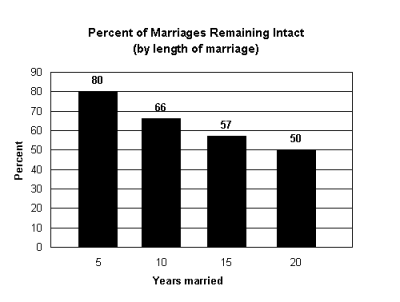
Relationship duration

% of Marriages Remaining Intact

Source: National Center for Health Statistics, Centers for Disease Control and Prevention (2001)

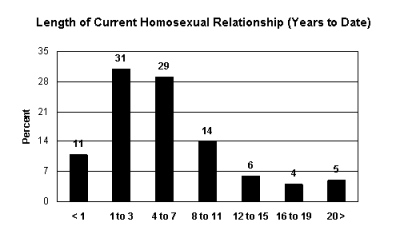
Length of Current Homosexual Relationship

Source: 2003-2004 Gay/Lesbian Consumer Online Census

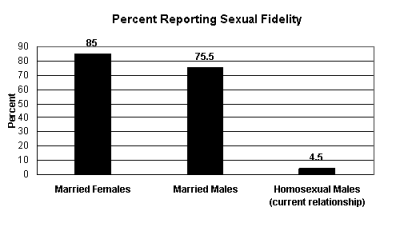
Monogamy vs Promiscuity

% Reporting Sexual Fidelity

Sources:Laumann, The Social Organization of Sexuality, 216; McWhirter and Mattison, The Male Couple: How Relationships Develop (1984): 252-253; Wiederman, “Extramarital Sex,” 170.

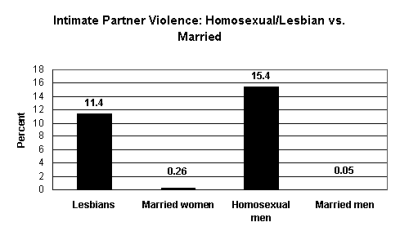
Rates of intimate partner violence

Intimate Partner Violence

Sources: “Extent, Nature, and Consequences of Intimate Partner Violence,” U.S. Department of Justice: Office of Justice Programs: 30; “Intimate Partner Violence,” Bureau of Justice Statistics Special Report:11.

Conclusion

Marriage is a relationship that has a specific purpose. That purpose is to bind together two opposite natures and to produce children that are biologically linked to the parents. The children gain the benefits of being parented by the two different natures, so they get two perspectives. The fact that the children are genetically linked to two parents helps to ensure the stability of the commitment, as we see in the animal kingdom where animals protect their young.

The goal of marriage is not to increase the happiness of the adults, or to “recognize” the love of adults. The goal of marriage is have two people enter into a relationship where they understand that it is not about adults being fulfilled. Marriage is about people having a goal of raising children, which are tremendously stressful to raise. Marriage requires self-denial and sacrifice in order to raise those children – that is the main point of it. It also requires fidelity and chastity, so that the environment is kept stable for the children over a long period of time.

Children benefit from the stability that is more common in traditional marriages than it is in other arrangements, including heterosexual co-habitation which is similarly unstable (50% greater chance of divorce, more domestic violence, etc.). Therefore, it is important to keep the concept of marriage separate from other kinds of relationships so that the focus on commitment for the sake of the children is clear to those who contemplate marriage. Society needs to give special recognition to married couples, in view of their child-focused commitment.

I apologize in advance if this post causes anyone any harm or distress, I am just trying to explain why people have that opinion. They could be wrong, but that is the case they make. Obviously, married couples fall short of the goal, but that is their goal.

Further study

Two much bigger challenges to marriage are big-government socialism and especially no-fault divorce. I also wrote about same-sex marriage and co-habitation before, in the context of European states like Sweden and Norway.

You may also be interested in a recent post about whether homosexuality is caused by a “gay gene”.