

Tag Archives: Feminism

Two UK pre-teens suspended from school for asking to be exempted from LGBT indoctrination

Susan Papas, Headteacher at Heavers Farmer Primary School

A long time ago, non-Christians would respond to moral judgments  by saying “don’t force your morality on me”. At the time, you might have thought that secular leftists thought that it was wrong to force morality on other people, and they wanted to force that rule on those who judged them. But we now know that secular leftists LOVE to force THEIR morality on other people who disagree with them.

Here’s what happened:

On June 20, Farrell, sitting next to his friend Kaysey in class, asked his year 5 class teacher, “Sir, please may I not take part in this lesson?” when the teacher handed out LGBT material for colouring. The teacher refused permission saying that the LGBT lesson was part of the curriculum.

After class, the form teacher is said to have accused Farrell of using “homophobic language” for allegedly saying, “LGBT sucks and LGBT’s dumb,” which the child denies.

Farrell, who was sitting with female pupil Kasey says he is a Christian and told a “visitor teacher” he did not “accept LGBT” because of his religion.

The teacher asked the two children, “Do you want them to die?” “We said no,” Farrell replied. If, however, they went back to their countries, they would be punished for being gay, Farrell told the teacher.

The teacher asked Farrell where he was from. Farrell said he was of “African Jamaican” heritage, and because there “everybody is Christian and Catholic, so they don’t accept LGBT.”

The head of the school, Susan Papas, suspended the two children from school for five days for asking not to take part in the LGBT indoctrination.

But she did more than that:

Later, Ms Papas shouted at the two children in front of the class, according to Kaysey. “How dare you? You are a disappointment to the school,” Papas told the two children outside the classroom.

Papas then put the children in different rooms and asked Kasey [sic]: “How dare you say that you want to kill LGBT people?” Kasey replied: “I didn’t say kill.” Papas then shouted at her and said, “Yes, you did, and don’t lie.”

Kaysey, a pentecostal Christian, says she was kept in detention for five hours from 10am to 3pm.

So, if you say to a secular leftist “I disagree”, what they hear is a threat of violence. They feel that disagreeing with them makes you an evil person, and they are entitled to use force to stop you from being evil. There is no “agree to disagree” with a secular leftist.

Life Site News reports:

Kaysey’s and Farrell’s version of the story, which differs widely from what their teacher and the head of their school alleged, has been corroborated by their classmates.

Elsewhere:

Kaysey also noted that Papas’ daughter, School Manager and Deputy Safeguarding Officer Attie Copeman-Papas, is a lesbian, and that Assistant Headteacher Robert Askey is gay.

[…]This isn’t the first time Papas’ militant promotion of the LGBT agenda has roused the ire of parents at the school, which educates 750 pupils in a highly multicultural and multi-religious borough of London.

In June 2018, parents threatened to protest at a Gay Pride parade organized by the school on its playground.

Papas had invited parents to watch the “Proud to Be Me!” parade and join in celebrating “the rainbow of things that make them and their family special.”

Alas, there is no space in that rainbow for anyone who disagrees with Susan Papas.

So, the first thing to note is that this school is a “community school”, which is the UK way of saying “public school”. This is a government-run school. Government schools do not compete in a free market. They are funded by mandatory taxes. Parents are taxed, and then they access to the schools that the government provides to them. It’s a monopoly. They get paid regardless of how they perform.

So, if you want to be able to buy the education for your children that fits your values, then you should vote for lower taxes and less government, so that money for education stayed in your hands. When the parents keep the money they earn, then they can choose how the children are educated. When the government taxes your money, then Susan Papas decides what your children will believe.

Unfortunately, even the majority of Christians now believe that the secular leftists in government make better decisions about moral issues than Christian parents do. That’s why so many of us vote for higher taxes, and more government spending.

Who should feed the children? Who should treat illnesses? Who should care for refugees and illegal immigrants? Who should give money to the poor? Who should care for the environment? Who should teach people about sex  and abortion? Many Christians today say government should do all these things. Young Christians don’t care about preventing government from trampling on Christian values. The priorities of young Christians are whatever the secular left says they are: refugees, illegal immigrants, global warming, free government education, gay rights, government-run health care.

When you vote for higher taxes and bigger government, you’re voting to let Susan Papas decide what your children will believe. You’re voting to let her to punish your children if they don’t believe what Susan Papas believes. We can do better.
If we seriously want men to marry and become fathers, let’s repeal no-fault divorce

I saw a very good article at the Heritage Foundation web site about the importance of fathers for children. The author Virginia Allen listed out some of the benefits that fathers provide to children:

Studies have found that children raised without a father are:

  • At a higher risk of having behavioral problems.
  • Four times more likely to live in poverty.
  • More likely to be incarcerated in their lifetime.
  • Twice as likely to never graduate high school.
  • At a seven times higher risk of teen pregnancy.
  • More vulnerable to abuse and neglect.
  • More likely to abuse drugs and alcohol.
  • Twice as likely to be obese.

From education to personal health to career success, children who lack a father find themselves at a disadvantage to their peers raised in a two-parent household.

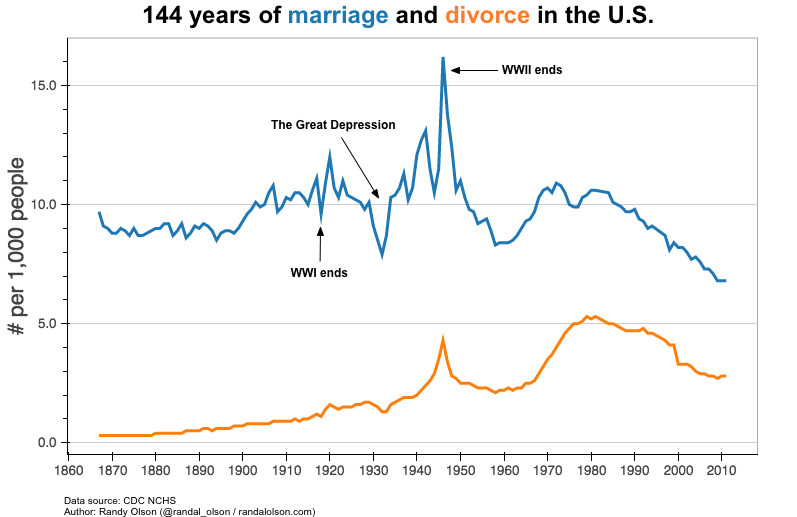
I was looking for a good analysis of why there’s been a decline of marriage and fatherhood, and I found an article by Joe Carter on The Gospel Coalition, of all places. By looking at marriage rates and historical events that changed the marriage rate, he was able to identify the cause of the decline of marriage – and fatherhood.

Marriage and divorce rates per capita

I’ll spare you the statistical analysis, which is excellent, and give you the conclusion – although you can guess it from the graph above:

Now that we’ve explored the data, what year should we use as the marker for the beginning of the decline of marriage in the United States? I would argue for 1985, the last year that the marriage rate topped 10 percent.

[…]What changed in 1985 that could have led to the decline in marriage? There are likely numerous factors—which we’ll examine in future articles—but one stands out in particular: By 1985, all states (except for New York) had enacted no-fault divorce legislation.

The most helpful book I know of about no-fault divorce is “Taken Into Custody”, by Dr. Stephen Baskerville. He wrote a column  for Crisis magazine that summarizes some of his ideas.

Excerpt:

Feminists were drafting no-fault divorce laws in the 1940s, which the National Association of Women Lawyers now describes as “the greatest project NAWL has ever undertaken.”

The result effectively abolished marriage as a legal contract. Today it is not possible to form a binding agreement to create a family.

The new laws did not stop at removing the requirement of citing grounds for a divorce, to allow divorce by mutual consent, as deceptively advertised at the time. Instead they created unilateral and involuntary divorce, so that one spouse may dissolve a marriage without any agreement or fault by the other.

Here’s what divorce does to the spouse who is the victim of the unilateral “no-fault” divorce:

Though marriage is a civil matter, the logic quickly extended into the criminal, including a presumption of guilt against the involuntarily divorced spouse (“defendant”). Yet formal due process protections of criminal proceedings did not apply, so forcibly divorced spouses became quasi-criminals not for recognized criminal acts but for failing or refusing to cooperate with the divorce by continuing to claim the protections and prerogatives of family life: living in the common home, possessing the common property, or—most vexing of all—parenting the common children.

Following from this are the horrendous civil liberties violations and flagrant invasions of family and individual privacy that are now routine in family courts. A personalized criminal code is legislated by the judge around the forcibly divorced spouse, controlling their association with their children, movements, and finances. Unauthorized contact with their children can be punished with arrest. Involuntarily divorced parents are arrested for running into their children in public, making unauthorized telephone calls, and sending unauthorized birthday cards.

In my conversations with men, no-fault divorce laws, and anti-male divorce courts are the main reasons given for why they do not pursue marriage and fatherhood. Men do not want to be coerced in a marriage with the threat of divorce by an unhappy wife. Men do not want to be subject to the government in so many areas of their lives if the wife does carry out the threat. They especially don’t want to be separated from their children. One my secular male friends told me that he would not marry unless the woman had evidence in her past of hating radical feminism and no-fault divorce. This was the main criteria. He actually was able to find a woman who was a men’s rights activist who hated divorce. But that was the only way he would marry.

Statistically speaking, the wife is more likely to initiate divorce than the husband. Women initiate 70% of divorces, the majority of those just because she is “unhappy”. I think this is because women get into marriage based on their feelings, and they think that it is the husband’s job to make them feel good. They see their happiness as the primary goal of the marriage, and see a marriage that does not make them happy as a marriage that needs to be ended.

Are we going to repeal no-fault divorce, then?

No-fault divorce was seen as a boon to women who had married the wrong men by following their hearts. It’s an interesting question to ask whether women really would want no-fault repealed. It would mean that they would have to get serious about who they marry, instead of just getting into marriage based on feelings. They would have to evaluate men according to expectations of what a man does in a marriage, instead of on feelings. They would have to think about what men want out of a marriage, and prepare themselves to provide for his needs. They would have to say no to their feelings, when choosing a man, and in keeping a man after the wedding.

If women aren’t willing to demand the repeal of no-fault divorce laws and get serious about men and marriage, then what’s the point of complaining that men don’t want to marry and become fathers? If you’re not willing to fix the root cause of the problem, then don’t complain about the problem.

Wage gap: are women paid less than men because of discrimination?

The pay gap is caused by women's own choices
The pay gap is caused by women’s preference for having children

Liberal feminist Hanna Rosin takes a look at this question in the far-left Slate, of all places.

Excerpt:

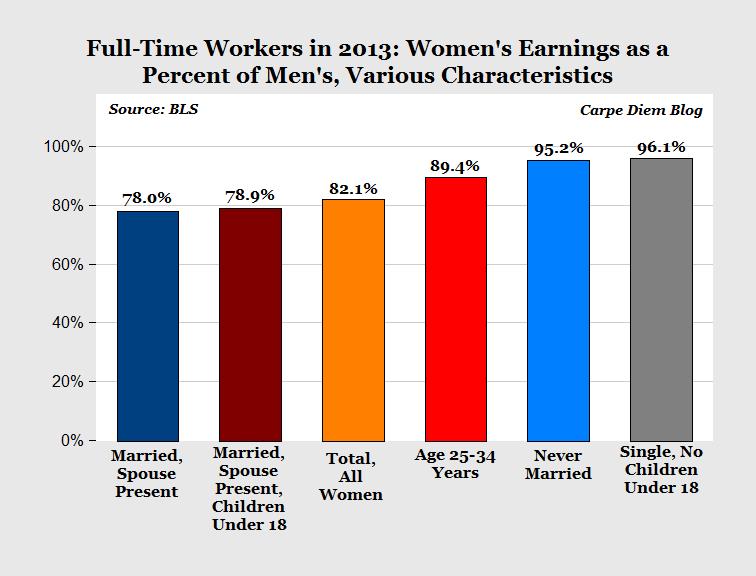
The official Bureau of Labor Department statistics show that the median earnings of full-time female workers is 77 percent of the median earnings of full-time male workers. But that is very different than “77 cents on the dollar for doing the same work as men.” The latter gives the impression that a man and a woman standing next to each other doing the same job for the same number of hours get paid different salaries. That’s not at all the case. “Full time” officially means 35 hours, but men work more hours than women. That’s the first problem: We could be comparing men working 40 hours to women working 35.

How to get a more accurate measure? First, instead of comparing annual wages, start by comparing average weekly wages. This is considered a slightly more accurate measure because it eliminates variables like time off during the year or annual bonuses (and yes, men get higher bonuses, but let’s shelve that for a moment in our quest for a pure wage gap number). By this measure, women earn 81 percent of what men earn, although it varies widely by race. African-American women, for example, earn 94 percent of what African-American men earn in a typical week. Then, when you restrict the comparison to men and women working 40 hours a week, the gap narrows to 87 percent.

But we’re still not close to measuring women “doing the same work as men.” For that, we’d have to adjust for many other factors that go into determining salary. Economists Francine Blau and Lawrence Kahn did that in a recent paper, “The Gender Pay Gap.”.”They first accounted for education and experience. That didn’t shift the gap very much, because women generally have at least as much and usually more education than men, and since the 1980s they have been gaining the experience. The fact that men are more likely to be in unions and have their salaries protected accounts for about 4 percent of the gap. The big differences are in occupation and industry. Women congregate in different professions than men do, and the largely male professions tend to be higher-paying. If you account for those differences, and then compare a woman and a man doing the same job, the pay gap narrows to 91 percent. So, you could accurately say in that Obama ad that, “women get paid 91 cents on the dollar for doing the same work as men.”

I believe that the remainder of the gap can be accounted for by looking at other voluntary factors that differentiate men and women.

The Heritage Foundation says that a recent study puts the number at 95 cents per dollar.

Excerpt:

Women are more likely than men to work in industries with more flexible schedules. Women are also more likely to spend time outside the labor force to care for children. These choices have benefits, but they also reduce pay—for both men and women. When economists control for such factors, they find the gender gap largely disappears.

A 2009 study commissioned by the Department of Labor found that after controlling for occupation, experience, and other choices, women earn 95 percent as much as men do. In 2005, June O’Neil, the former director of the Congressional Budget Office, found that “There is no gender gap in wages among men and women with similar family roles.” Different choices—not discrimination—account for different employment and wage outcomes.

A popular article by Carrie Lukas in the Wall Street Journal agrees.

Excerpt:

The Department of Labor’s Time Use survey shows that full-time working women spend an average of 8.01 hours per day on the job, compared to 8.75 hours for full-time working men. One would expect that someone who works 9% more would also earn more. This one fact alone accounts for more than a third of the wage gap.

[…]Recent studies have shown that the wage gap shrinks—or even reverses—when relevant factors are taken into account and comparisons are made between men and women in similar circumstances. In a 2010 study of single, childless urban workers between the ages of 22 and 30, the research firm Reach Advisors found that women earned an average of 8% more than their male counterparts. Given that women are outpacing men in educational attainment, and that our economy is increasingly geared toward knowledge-based jobs, it makes sense that women’s earnings are going up compared to men’s.

When women make different choices about education and labor that are more like what men choose, they earn just as much or more than men.