Tag Archives: Father

A lesson about men for marriage-minded women from the movie “High Noon”

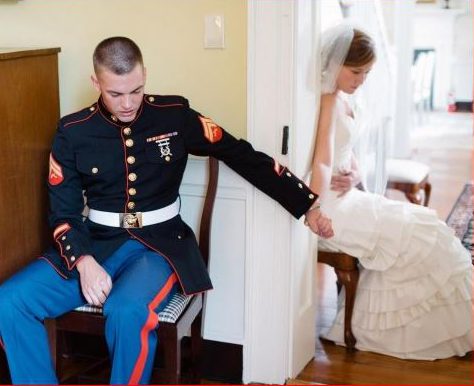
Marine prays with his wife on their wedding day

One of my favorite movies for explaining the differences between men and women is “High Noon” (1952).

Here’s the summary from IMDB:

Former marshal Will Kane (Gary Cooper) is preparing to leave the small town of Hadleyville, New Mexico, with his new bride, Amy (Grace Kelly), when he learns that local criminal Frank Miller has been set free and is coming to seek revenge on the marshal who turned him in. When he starts recruiting deputies to fight Miller, Kane is discouraged to find that the people of Hadleyville turn cowardly when the time comes for a showdown, and he must face Miller and his cronies alone.

The main theme of the film concerns Amy’s decision to break her wedding vows the very day that she makes them. She tells her new husband that he must bow to her will, and give up his male role as protector. When he explains his reasons for standing his ground to her practically (Miller will hunt them down) and morally (he has a duty protect the town), she dismisses both. She tells him that if he doesn’t run away from Miller and his gang with her, that she will get on the train and leave town by herself.

The intro of film shows the member’s of Miller’s gang assembling, and the words of the song explain the central conflict between husband and wife:

Here’s the part of the lyrics we care about:

The noonday train will bring Frank Miller.
If I’m a man I must be brave
And I must face that deadly killer
Or lie a coward, a craven coward,
Or lie a coward in my grave.

O to be torn ‘twixt love and duty!
S’posin’ I lose my fair-haired beauty!
Look at that big hand move along
Nearin’ high noon.

He made a vow while in State’s Prison,
Vow’d it would be my life or his’n
I’m not afraid of death, but O,
What will I do if you leave me?

Do not forsake me O my darlin’
You made that promise when we wed.
Do not forsake me O my darlin’
Although you’re grievin’, I can’t be leavin’
Until I shoot Frank Miller dead.

What’s interesting is that his new wife Amy apparently does not understand the meaning of wedding vows or the natural roles of good men as protectors of the weak, and fighters against evil. Although she vowed to stick by him and help him, the minute anything threatening appears that makes her feel unhappy, she abandons her vows and abandons her man. Let’s break down her mistakes now, using actual conversations from the movie.

First, she doesn’t understand or respect the man she married as a man:

Kane: [while riding out of town] It’s no good. I’ve got to go back, Amy.

Amy: Why?

Kane: This is crazy. I haven’t even got any guns.

Amy: Then let’s go on. Hurry.

Kane: No, that’s what I’ve been thinkin’. They’re making me run. I’ve never run from anybody before.

Amy: I don’t understand any of this.

Kane: [after looking at his vest watch] Well, I haven’t got time to tell ya.

Amy: Then don’t go back, Will.

Kane: I’ve got to. That’s the whole thing. [He turns the buggy around and rides back into town]

Her feelings and her desires for the world to be a happy place for her are so strong that they cloud her judgment.

Second, she doesn’t understand the threat posed by evil men:

More:

Kane: I sent a man up five years ago for murder. He was supposed to hang. But up North, they commuted it to life and now he’s free. I don’t know how. Anyway, it looks like he’s coming back.

Amy: I still don’t understand.

Kane: He was always wild and kind of crazy. He’ll probably make trouble.

Amy: But that’s no concern of yours, not anymore.

Kane: I’m the one who sent him up.

Amy: Well, that was part of your job. That’s finished now. They’ve got a new marshal.

Kane: He won’t be here until tomorrow. Seems to me I’ve got to stay. Anyway, I’m the same man with or without this. [He pins his badge on his vest]

Amy: Oh, that isn’t so.

Kane: I expect he’ll come lookin’ for me. Three of his old bunch are waiting at the depot.

Amy: That’s exactly why we ought to go.

Kane: They’ll just come after us, four of ’em, and we’d be all alone on the prairie.

Amy: We’ve got an hour.

Kane: What’s an hour?…What’s a hundred miles? We’d never be able to keep that store, Amy. They’d come after us and we’d have to run again, as long as we live.

Amy: No we wouldn’t, not if they didn’t know where to find us. Oh Will! Will, I’m begging you, please let’s go.

Kane: I can’t.

Amy: Don’t try to be a hero. You don’t have to be a hero, not for me.

Kane: I’m not trying to be a hero. If you think I like this, you’re crazy.

Instead of recognizing how her feelings are deceiving her about the threat and trusting her husband, she tries to force him to accept her mistaken view of reality by threatening to abandon him.

One of Kane’s ex-girlfriends has a talk with Amy, which helps her to understand who Kane is, and what is expected of her:

Amy: That man downstairs, the clerk, he said things about you and Will. I’ve been trying to understand why he wouldn’t go with me, and now all I can think of is that it’s got to be because of you…Let him go, he still has a chance. Let him go.

Helen: He isn’t staying for me. I haven’t spoken to him for a year – until today. I am leaving on the same train you are…What kind of woman are you? How can you leave him like this? Does the sound of guns frighten you that much?

Amy: I’ve heard guns. My father and my brother were killed by guns. They were on the right side but that didn’t help them any when the shooting started. My brother was nineteen. I watched him die. That’s when I became a Quaker. I don’t care who’s right or who’s wrong. There’s got to be some better way for people to live. Will knows how I feel about it.

Helen: I hate this town. I always hated it – to be a Mexican woman in a town like this.

Amy: I understand.

Helen: You do? That’s good. I don’t understand you. No matter what you say. If Kane was my man, I’d never leave him like this. I’d get a gun. I’d fight.

Amy: Why don’t you?

Helen: He is not my man. He’s yours.

Helen understands the need for a wife to stand by her man. But Amy’s response to evil is to shut her eyes and focus on feeling good and being happy. Notice that her “better way” is unspecified – it’s just a feeling she has that pacificism and no-violence will somehow “work” to stop evil. But in reality, pacifism is not a “better way” of dealing with evil – it does not work. Her pacifist response not only does not make evil go away, it actually encourages more evil. Weakness emboldens evildoers, and laying down your arms provokes them to do more evil. Will Kane knows this, but she won’t listen to him.

You can watch the final gunfight here, as well as Amy’s final decision:

So, this is why I really recommend this movie as a discussion-starter when you like a girl and are thinking of marrying her. It clarifies the essential problem with many young women today not being ready for marriage. To be fair, most women come around to respect their husbands and his different roles after they get married. However, the risk of divorce is so dangerous that it makes sense to bring it up for discussion before the marriage happens. Marriage is supposed to be an engine to serve God, and the success of that enterprise cannot be left to chance. You can’t just rely on the fact that she says the words of the vow, you have to check to see if she has a habit of keeping her promises when it goes against her own self-interest.

Ask yourself: Who are you, as a man? And does your woman accept that you have obligations to stand up to evil and do good ? Will she support you in your battle against evil, or will the marriage just be about her feelings and desires? I would especially beware of women who think that God is speaking to them through their feelings and desires. Look at her friends: are they practical and successful? Or are they irresponsible, unaccountable and reckless? Look at her father: does he have a plan for her, and does he lead her to be practical, frugal and hard-working? If you are not going to get an ally and a supporter in a wife, then you will not be able to serve God well, as a married man. Think about it.
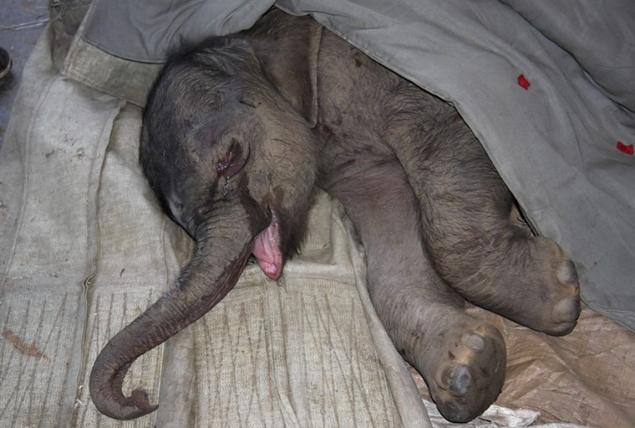

Baby elephant in China cries for 5 hours after being stomped by his mom

Baby elephant rejected by his mother
Baby elephant cries after being attacked by his own mother

From the New York Daily News. (Printable version linked)

Excerpt:

Little Zhuangzhuang, a newborn elephant at a wildlife refuge in China, was inconsolable after his mother rejected him and then tried to stomp him to death.

Tears streamed down his gray trunk for five hours as zookeepers struggled to comfort the baby elephant.

They initially thought it was an accident when the mom stepped on him after giving birth, according to the Central European News agency.

Employees removed him, cleaned him up and treated his injuries, then reunited the baby with his momma.

But she was having none of it, and began stomping him again.

So the game keepers stepped in once more and permanently separated the two.

“We don’t know why the mother turned on her calf but we couldn’t take a chance,” an employee told CEN.

“The calf was very upset and he was crying for five hours before he could be consoled,” he said.

“He couldn’t bear to be parted from his mother and it was his mother who was trying to kill him.”

The petite pachyderm, born in August, is now doing well. The zookeeper who rescued him from his violent mother adopted him and helped him thrive at the Shendiaoshan wild animal reserve in Rong-cheng, China.

I found another photo of the baby elephant here:

Baby elephant's birthday is supposed to be happy
A baby elephant’s birthday is supposed to be happy

So, in this post, I wanted to take about the duty that parents have to their children.

I guess a lot of my views on ethics are rooted in the obvious needs that children have. When I look at an unborn baby, I can tell what it needs. So, I am careful not to cause a pregnancy before I can supply its needs. The needs of the little unborn creature are driving these moral boundaries on me. And the same with born children. I oppose gay marriage because when I look at little children, I want them to have a stable environment to grow up in with a mother and father who are biologically related to them (in the best case). I permit lots of arrangements, but I promote one arrangement over the others because that’s what’s best for children. Anyone can look at unborn and born children and see that, just like anyone can look at a crying baby elephant and understand – “I have to govern my behavior so that I don’t hurt you”. If that means cutting off the premarital sex and making decisions that are likely to produce a stable marriage, then that’s what we should do.

Children cry too, you know. They cry when we hurt them. They cry when we make bad decisions and when we don’t provide them with what they need. Children need mothers and fathers who care about them. Making a safe environment for a child isn’t an accident. It isn’t random and unpredictable. We have to control our desires before we have children, so that we provide children with what they need. It would be nice if men and women were more thoughtful and unselfish about children and marriage before they started in with sex.

Does reading science fiction predispose people to atheism?

A conflict of worldviews

In my investigations of atheists, I have found that the science fiction that people read when they are younger causes them to believe that the religion is anti-science and that the progress of science always disproves religion. The stories they read colors their views of science and religion for life, before they ever get to assessing evidence. And that’s why when we produce evidence for them in debates, they will believe in speculations rather than go where the evidence leads.

So, I’ve seen atheists in formal debates claiming that maybe unobservable aliens caused the origin of life, and that maybe the untestable multiverse theory explains the fine-tuning of cosmological constants, and that maybe this universe has existed eternally despite the well-supported Big Bang theory which shows that the universe began to exist. Maybe, maybe, maybe. They seem to think that untestable speculations are “good enough” to refute observational evidence – and maybe it’s because of all the science fiction that they’ve read.

Here’s an article in the American Spectator that talks a bit about it.

Excerpt:

A magazine I frequently write for (not this one) recently published a review of a book of essays advocating atheism. The reviewer pointed out with some enthusiasm that a large number of the contributors were science-fiction writers.

This left me somewhat nonplussed. I publish a good deal of science fiction myself, I have also read quite a lot of it, and I am quite unable to see why writing it should be held to particularly qualify anyone to answer the question of whether or not there is a God.

[…]Historically the contribution of the Catholic Church to astronomy was massive and unequalled. Without it astronomy might very well never have grown out of astrology at all. Cathedrals in Bologna, Florence, Paris, Rome and elsewhere were designed in the 17th and 18th centuries to function as solar observatories. Kepler was assisted by a number of Jesuit astronomers, including Father Paul Guldin and Father Zucchi, and by Giovanni Cassini, who had studied under Jesuits. Cassini and Jesuit colleagues were eventually able to confirm Kepler’s theory on the Earth having an elliptical orbit. J.L. Heilbron of the University of California has written:

The Roman Catholic Church gave more financial aid and social support to the study of astronomy over six centuries, from the recovery of ancient learning during the late Middle Ages into the Enlightenment, than any other, and, probably, all other, institutions.

Science fiction is, by definition, fiction, that is, it deals with things which are the product of a writer’s imagination and are not literally true. In any event, what is and what is not science fiction is hard to define. Simply to say it is about science is meaningless, and while some science-fiction writers are qualified scientists, many are not. Probably even fewer are trained theologians.

Science fiction makes the mysteries of the universe seem easy to an atheist. Everything can be easily explained with fictional future discoveries. Their speculations about aliens, global warming and eternal universes are believed without evidence because atheists want and need to believe in those speculations. In the world of science fiction, the fictional characters can be “moral” and “intelligent” without having to bring God or the evidence for God into the picture. That’s very attractive to an atheist who wants the feeling of being intelligent and moral without having to weight actual scientific evidence or ground their moral values and behavior rationally. The science fiction myths are what atheists want to believe. It’s a placebo at the worldview level. They don’t want cosmic microwave background radiation – they want warp drives. They don’t want WMAP satellite confirmation of nucleosynthesis – they want holodecks.

Why do people become atheists?

My theory is mainly that atheists adopt atheism because they want pleasure, especially sexual pleasure, without any restraints or guilt. They want to believe that sex without commitment has no consequences, especially a consequence like God judging them for it. Another contributing factor may be that atheists want to be thought of as smart by “the right people” – to sort of blindly accept whatever the “smart people” accept without really searching out reasons or dissenting views. They do this so that they are able to look down at some other group of people so they can feel better about themselves and be part of the right group – without actually having to weigh the evidence on both sides. And lastly, atheism may also be caused by weak fathers or abandoning fathers. But I think that ECM’s science fiction theory has merit, as well. I think that all four of these factors help to explain why atheists believe in a discredited worldview in the teeth of scientific progress.

I wonder if my readers would take some time out to investigate whether their atheist friends have been influenced by reading science fiction and whether they still read it.