Tag Archives: Education

ID critics do not read ID books before reviewing them

From Evolution News.

Excerpt:

As a friend of ours puts it, Jonathan Wells’s The Myth of Junk DNA is in the process of being “Ayala’ed.” To “Ayala” a book is to attack it in review without having bothered to read or even read much about it, simply on the basis of what you think it probably says given your uninformed preconceptions about the author. The term comes from the wonderful instance where distinguished biologist Francisco Ayala pompously “reviewed” Stephen Meyer’s Signature in the Cell for the Biologos Foundation website while giving clear evidence of not having cracked the book open or even looked at the table of contents.

Thus we have several posts from University of Toronto biochemist Larry Moran, criticizing Myth while being totally open about not having read it first. Moran wrote no fewer than four posts on the book in this fashion, claiming as an excuse that Myth would not be published in Canada until May 31. (In fact, the book was available for purchase from Amazon since early May.) And now, as Casey already noted, we have Forbes science writer John Farrell, citing Moran as his source — a “double Ayala,” so to speak, where you attack a book without reading it citing as justification a review by someone else who also hasn’t read it.

Farrell thinks the myth of junk DNA is itself a myth — that “scientists never dismissed junk DNA in the literature.” In other words, Wells has set up a straw man. Of course, not having looked at the book, Farrell can’t have consulted Dr. Wells’s fifty pages of notes documenting his argument. The notes may be downloaded for free here. (Also available in Canada.)

So this is what criticism of intelligent design amounts to… denouncing a book before reading it.

Biophysicist Cornelius Hunter explains why reading the book is not necessary for Darwinists – because Darwinism is impervious to evidential concerns.

Excerpt:

This centuries old framework for naturalism is key to understanding evolution today. Science writers such as Farrell report that scientists have discovered, for instance, “just how not-so-intelligently designed the human genome actually is,” but this is not a scientific conclusion. For unlike the target of his criticism (the ID theory) which refers to complexity rather than goodness of design, evolutionary thought and its underlying naturalism framework refer to the design’s metaphysics. As Farrell explains:

Many mutations are neutral, or can be easily overcome by technology. And some of them cause a great deal of psychological suffering, such as the mutation that causes trimethylaminuria, which is physically harmless but causes the victims to smell like rotten fish no matter how clean they are. But many other mutations are deadly or, worse yet, can cause a person to have a lifetime of suffering. Perhaps the most disturbing mutation is the one that causes Lesch-Nyhan syndrome. This one mutation, of a single amino acid in a protein, causes the victim to have an uncontrollable compulsion for self-mutilation: they chew their own lips and fingers, and find sharp objects to stab their faces and eyes. The victims are fully able to feel their pain and they know what they are doing, but cannot control it.

Obviously to argue such mutations are the product of intentional design is to suggest the deity or intelligence responsible, is something of a monster.

Indeed. Leibniz was concerned about the evil in the world, but he had no idea how deeply it runs. It is truly abominable, and it makes for a moving and powerful argument that no good creator who has the power to create a universe would ever create this one.

Whether by the Epicurean’s swerving atoms, or science’s natural laws, the world must have arisen on its own.

How could anyone deny this obvious conclusion? This and other metaphysical arguments leave no room for debate. Evolution must be true. We may not know how it occurred, but it is a fact.

The powerful theory of evolution hangs on this framework of thought that mandates naturalism. The science is weak but the metaphysics are strong. This is the key to understanding evolutionary thought. The weak arguments are scientific and the strong arguments, though filled with empirical observation and scientific jargon, are metaphysical. The stronger the argument, the more theological or philosophical.

(Emphasis is in the original)

And I recommend you read the whole post, especially if you’ve never read anything by Cornelius Hunter.

So the reason why Darwinists don’t care about evidence is because evidence is irrelevant once you pre-suppose the religion of naturalism. And you presuppose the religion of naturalism because of the problem of evil and suffering. I.e. – “based on my childhood caricature of God as the cosmic Santa Claus, I now see that evolution must be true, because my cosmic Santa Claus God cannot have any purpose for allowing the evil and suffering I see in nature.” Science has nothing to do with it. Nature is not nice, and so God didn’t make nature. And that’s the end of the discussion.

These Darwinian critics of ID are really just close-minded religious fundamentalists whose principal response to experimental science is uninformed religious bluster. You don’t get an education when you take classes from the Darwinbots – you get indoctrinated. And if you dissent you get failed or fired. It’s that simple. They don’t debate you – they censor you. They don’t produce evidence for their views, they insult you. How dare you call their religion into question by appealing to facts? Darwinists don’t like facts. They don’t like evidence.

Related posts

The Wintery Knight demands that Michele Bachmann run for President

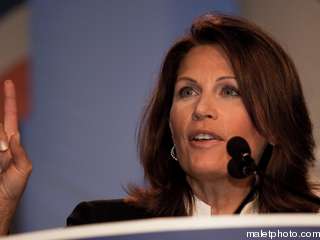
Rep. Michele Bachmann

Michele Bachmann still hasn’t announced that she is willing to run for President!

I have therefore decided to protest her tarrying by posting two interviews that she did this past week, so that you can all tell me if you think that she would make a good President, or not. Maybe she will stop by and read our comments and realize how badly she is needed, and how well she would do as President.

First, Bret Baier spends some time with Michele going over her pluses and minuses: (MP3 version here – 3 Mb)

If you have Fox News, Bret Baier’s show is the best thing on that entire network.

Second, here is an interview with popular social conservative Mike Huckabee: (MP3 version here – 3 Mb)

And for those who do not want to watch videos or listen to MP3s, I found this brand new profile of Michele Bachmann.

Excerpt:

Michele Bachmann was a self-styled “education researcher” making a run for a Minnesota school board seat in 1999 when the question came up at a candidate forum: If elected, would she serve all four years?

Maybe not, she said.

Bachmann, now a three-term congresswoman and tea party favorite who may run for president in 2012, opened up about a confrontation she’d had with a state senator over Minnesota’s new school standards.

“I told him that if he’s not willing to be more responsive to the citizens, that I may have to run for his seat or find someone else who would do so,” she said, according to a newspaper account of the meeting.

Bachmann lost the school board race, but then knocked off the senator, a fellow Republican, just months later using the standards as her primary issue.

It was an early indicator of a recurring theme: Bachmann often wins by losing.

[…]The race would test her resilience because she would start far back. But as a little-known House member only a few years ago, Bachmann became hero of the conservative tea party movement in part by fighting losing battles with the GOP establishment. Her path to Congress was paved by failed efforts to pass a ban on gay marriage in the Minnesota Legislature.

“She is very good at turning lemons into lemonade all the time,” said Sal Russo, a California political consultant who came to know Bachmann through the tea party.

[…]From her first involvement in politics, the 55-year-old Bachmann has shown a determination to keep pressing forward and find opportunities, even when the way seemed blocked.

In the late 1990s, Bachmann was a stay-at-home mother of five in Stillwater, a scenic St. Croix River town east of St. Paul. Then she was drawn into a revolt over education standards.

[…]”People had been predicting her demise since Day One: ‘Oh, she’s a radical, she’s too far right, she’s too outspoken, she’s too inflammatory,'” Pulkrabek said. “The fact of the matter is, with the exception of the first race, she wins.”

Parlaying her school board defeat into a victorious legislative campaign, she moved to the state Senate and seized on a new issue.

Around Thanksgiving 2003, justices in Massachusetts ruled the commonwealth couldn’t prevent same-sex marriage. Bachmann hit the phones, reaching out to fellow conservatives about making sure gay marriage would stay illegal in Minnesota.

[…]Jeff Davis heard her public appeal through his car radio. Not politically involved at the time, Davis came to the Capitol and pledged to help Bachmann.

[…]”She’s an energizer. She influences people around her,” Davis said. The drive instantly elevated Bachmann’s political profile, he said. “It was a launch point.”

[…]Bachmann’s victory in that race brought her to the national stage and prompted a new focus on fiscal issues. She harnessed the outrage of the tea party, a fledgling political force inflamed by debates over government bailouts and a far-reaching health law pursued by President Barack Obama.

Her outspoken opposition did not stop the health law, but it got her much more television exposure and helped make her a face of the new resistance. In one Fox News interview, Bachmann urged viewers to flood Washington and “go up and down through the halls, find members of Congress, look at the whites of their eyes and say, ‘Don’t take away my health care.'”

Amy Kremer remembers seeing Bachmann’s television plea while on a Tea Party Express bus heading between rallies in Washington state. The next week, Kremer joined Bachmann in the nation’s capital for a big tea party protest.

“You can tell the ones who have the passion, the fire in the belly and are truly speaking from the heart. She’s one of those,” Kremer said. “That comes through.”

The article goes on to explain how Michele got to be a three-term Congresswoman in one of the most liberal states in the entire country.

About Michele Bachmann:

Congresswoman Bachmann is a leading advocate for tax reform, a staunch opponent of wasteful government spending, and a strong proponent of adherence to the Constitution, as intended by the Founding Fathers. She believes government has grown exponentially, with ObamaCare being the most recent example of its uninhibited growth. Congresswoman Bachmann wants government to make the kind of serious spending decisions that many families and small businesses have been forced to make. She is a champion of free markets and she believes in the vitality of the family as the first unit of government. She is also a defender of the unborn and staunchly stands for religious liberties.

Prior to serving in the U.S. Congress, Bachmann served in the Minnesota State Senate.  She was elected to the Minnesota State Senate in 2000 where she championed the Taxpayers Bill of Rights.  Before that, she spent five years as a federal tax litigation attorney, working on hundreds of civil and criminal cases.  That experience solidified her strong support for efforts to simplify the Tax Code and reduce tax burdens on family and small business budgets. Congresswoman Bachmann also led the charge on education issues in Minnesota calling for the abolishment of Goals 2000 and the Profiles of Learning in its school. She recognized the need for quality schools and subsequently started a charter school for at-risk kids in Minnesota.

Congresswoman Bachmann sits on the Financial Services Committee (FSC) and the Permanent Select Committee on Intelligence. The FSC is tasked with oversight of numerous financial sectors including housing, real estate and banking. This gave the Congresswoman keen insight into the housing crisis and credit crunch, leading her to be a staunch opponent of the taxpayer-funded bailout of Wall Street and the Dodd-Frank legislation. Serving on the Intelligence Committee was a welcomed opportunity for Congresswoman Bachmann as she has consistently advocated peace through strength to ensure America’s national security. As a mother of five children and 23 foster children, she has a deep appreciation for that portion of the Oath of Office in which members of Congress vow to support and defend the Constitution of the United States against all enemies, foreign and domestic.

In July 2010 Congresswoman Bachmann hosted the first Tea Party Caucus meeting because she saw the need for Tea Partiers to have a listening ear in Congress. She is seen as a champion of Tea Party values including the call for lower taxes, renewed focus on the Constitution and the need to shrink the size of government.

You can learn even more in the links below, particularly this one that contains the best speech I have ever heard from her. That speech covers her Christian faith in some detail, and mentions her interest in Francis Schaeffer’s apologetics, which also formed the views of famous worldview scholar Nancey Pearcey. Did you know that Michele once introduced famous Indian apologist Ravi Zacharias when he was giving a MacLaurin lecture? She is a big fan of Christian apologetics – she asked to go see Ravi Zacharias for her birthday present. A woman after my own heart. She doesn’t want clothes and jewelry – she wants to be able to defend her faith! You can listen to the lecture right here (14 Mb), and hear her gushing about apologetics and Ravi Zacharias. The topic is “Christian Apologetics in the 21st century”. The lecture was delivered in March 2002 in Minnesota, when Michele was a state senator.

You can contribute to her campaign right here. You can be her friend on Facebook here and also here.

Related posts

New Jersey per-pupil cost is $17,800

Eastern United States Map

From the Wall Street Journal. (H/T Michele Bachmann)

Excerpt:

The Christie administration has recalculated the amount it says New Jersey public school districts spend per pupil, increasing the state average rate by several thousand dollars to more than $17,800.

The figure, from the 2009-10 school year, has been adjusted to include costs such as transportation, federal funding, debt payments and legal judgments that can vary greatly from district to district. In the 2008-09 school year, using the previous calculation, the state average was $13,200 per student.

The Christie administration says the new figure is more transparent and complete.

[…]Gov. Chris Christie has frequently said that Newark schools spend nearly $25,000 per student, despite what he calls failing results. The new spending guide shows Newark’s spending at nearly $23,000 per student, up from about $17,600 under previous estimates.

Compare that with the average tuition with higher-performing private or parochial schools.

Excerpt:

AVERAGE PRIVATE SCHOOL TUITION: $8,549

Elementary: $6,733
Secondary: $10,549
Combined: $10,045
(Digest 2009, Chapter 2, Table 59)

AVERAGE CATHOLIC SCHOOL TUITION: $6,018

Elementary: $4,944
Secondary: $7,826
Combined: $9,066
(Digest 2009, Chapter 2, Table 59)

I think we need to put in a national voucher system, or, failing that, we should abolish the federal Department of Education completely and leave education to the states and municipalities.

This post was linked by:

Must-see videos on education policy

Related posts