Tag Archives: Education

Zack Kopplin debates Casey Luskin on science education

Two Rams butting heads: may the best ram win!

The Michael Medved show is a national radio show broadcast out of Seattle, Washington. According to Talkers magazine, he has the fifth largest radio audience.

The MP3 file is available for download. (38 minutes)

The description is:

On this episode of ID the Future, the Medved Show hosts the CSC’s Casey Luskin and student Zack Kopplin, a leading activist in the effort to repeal the Louisiana Science Education Act. Luskin and Kopplin debate the implications of the Louisiana law for science education standards and whether or not the law promotes the teaching of creationism.

Topics:

  • Medved: Should teachers be forced to teach creationism in public schools?
  • Luskin: The Discovery Institute has never advocated that creationism be taught in public schools
  • Medved: Does the Louisiana law mandate that creationism be taught in public schools
  • Kopplin: Yes, the bill does because Bobby Jindal said that the bill teaches creationism
  • Luskin: (Reads the actual text of the law) the law EXPLICITLY STATES that teaching creationism is forbidden
  • Luskin: Governor Jindal is misinformed about the law, but if you look at the law it says NO CREATIONISM
  • Kopplin: I don’t care about what the law actually says, I’ll just repeat that Bobby Jindal thinks it’s creationism
  • Kopplin: Thirty years ago, there was an attempt to mandate creationism, therefore this law is doing the same thing
  • Medved: Are there any complaints that creationism is being taught in any schools after this law has been passed
  • Kopplin: No, I don’t know of any, but that’s not because there are none! Maybe there are some that I haven’t heard about yet
  • Medved: If you are taught something that you think is stupid, then is that automatically a violation of your rights?
  • Kopplin: Because you cannot allow the progress of science to call the religion of naturalism into question
  • Luskin: About that Jindal quote – he was talking about what he wanted to pass, not the law that actually passed
  • Luskin: (reads the text of the law again) The law explicitly says that teaching creationism in the classroom is prohibited
  • Luskin: Intelligent design is not creationism. Creationism starts with the Bible. Intelligent Design starts with science
  • Luskin: The law only supports teaching both sides of things that are already in the curriculum
  • Luskin: ID is not already in the curriculum, therefore, the law does not allow it to be discussed
  • Medved: Take Stephen C. Meyer’s book on the origin of life, could that be used in the classroom?
  • Kopplin: I am not very familiar with Meyer’s book, but if it is critical of Darwinism and naturalism, then it should not be taught. I don’t need to read it before I can censor it
  • Luskin: Meyer’s book advocates for ID, so it should not be taught in science classrooms
  • Luskin: non-ID science papers that are critical of Darwinism should be allowed in science classroom so students get both sides
  • Medved: Consider this brand new Oxford University Press book that is critical of Darwinian mechanisms, authored by Masatoshi Nei who is at Penn State University professor (written up on Evolution News)
  • Medved: Should this research critical of Darwinism be allowed in science classrooms?
  • Kopplin: I don’t know if this book should be allowed in science classrooms
  • Kopplin: I already know without reading anything though that there will never be evidence that supports intelligent design
  • Kopplin: There is no evidence against Darwinism and there is no controversy and there is no disagreement among scientists
  • Luskin: There are hundreds of papers in mainstream science peer-reviewed publications critical of Darwinism
  • Luskin: (lists a stack of papers critical of core tenets of Darwinian theory from respect science journals in the last few years)
  • Luskin: Masatoshi Nei recently posted a comment critical of the usefulness of the mutation-selection mechanism
  • Luskin: The real issue is whether students are allowed to hear mainstream scientific criticisms of Darwinism in the science classroom
  • Medved: Is it OK for a teacher to admit that on a specific issue in science, that there is no credible naturalistic explanation?
  • Kopplin: I am a history major, so I don’t want to comment on whether it is OK to admit that naturalism doesn’t explain everything
  • Luskin: A Harvard chemist says that the origin of life is an open issue in this peer-reviewed journal article
  • Luskin: Teachers should be allowed to say that there is no accepted naturalistic explanation for the origin of life
  • Luskin: teachers should NOT be teaching religion, or creationism, or even intelligent design in science classrooms
  • Luskin: but teachers should be allowed to say what the Harvard chemist said in that peer-reviewed article in the science classroom
  • Kopplin: there was a creationist woman who sat next to the Discovery Institute person when the law was being debated
  • Kopplin: so based on that there is a scary hidden creationist agenda behind the law which is not reflected in the actual text law
  • Luskin: Um, that woman has no connection to the Discovery Institute
  • Luskin: seating arrangement at the hearings were pre-determined, not selected by those in attendance
  • Luskin: what about people who are pushing Darwinism, who are anti-religious atheists and humanists? should they be disqualified?
  • Luskin: we should not discredit the arguments of either side based on speculations about their motives – what counts is the evidence
  • Kopplin: but I have a letter signed by lots of Nobel-prize winning scientists that opposes the Louisiana science education law
  • Luskin: but that letter never actually quotes from the law, it is critiquing views that have nothing to do with the actual law
  • Medved: Summarize your views
  • Kopplin: Criticism of Darwinism and naturalism using mainstream scientific evidence SHOULD NOT be allowed in the science classroom
  • Luskin: Criticism of Darwinism and naturalism using mainstream scientific evidence SHOULD be allowed in the science classroom

And there is a period of questions from the callers.

This episode features a debate, so it is not to be missed. it is always a good idea to hear both sides. Unfortunately, ID people are the only ones who think that both sides should be heard.

I subscribe to the ID the Future podcast, and I really recommend that you do as well!

Wayne Grudem explains what the Bible says about parents and schools

Theology that hits the spot

This is a must-listen lecture from famous pastor Wayne Grudem.

The MP3 file is here.

The PDF outline is here.

Note: public schools = government-run schools.

Topics:

  • Does God care whether we people marry and have children?
  • Does God care whether Christian parents raise their children to know him?
  • Should government promote bearing children?
  • What are some effects of declining birth rates in other countries?
  • What are the economic effects of declining birth rates?
  • Who has the right to decide how children are trained: government or parents?
  • What does the Bible say about parents having to raise children to know him?
  • Does the government have the responsibility for training children?
  • What do educational bureaucrats think of parents training children?
  • What do school boards think of parents training children?
  • Should school boards be elected by local, state or federal government?
  • Should Christians be opposed to government-run education? (public schools)
  • How should schools be viewed by parents? As a replacement or as a helper?
  • How are schools viewed by those on the left and in communist countries?
  • How can you measure how supporting a government is of parental rights?
  • How is parental authority viewed in left-wing EU countries like Germany?
  • How is parental authority respected in the United States?
  • Should parents have a choice of where their children go to school?
  • What is a voucher program? How is it related to parental autonomy?
  • How does competition (school choice) in education serve parental needs?
  • Why do public school teachers, unions and educrats oppose competitition?
  • How well do public schools do in educating children to achieve?
  • Does the government-run monopoly of public schools produce results?
  • Does paying more and more money to public schools make them perform?
  • How do teacher unions feel about having to compete in a voucher system?
  • Does the public school monopoly penalize the poorest students?
  • Does the public school monopoly penalize children of certain races?
  • Does the public school monopoly cause racial prejudice?
  • What else should parents demand on education policy?
  • Is it good for parents when schools refuse to fire underperforming teachers?

This podcast is just amazing! This is what we need to be teaching in church. Church should be the place where you go to learn and reflect about how to tailor your life plan based on what the Bible says. And I think that this whole notion of free market – of choice and competition benefiting the consumer (parents) – applies to everything that government does, especially education and health care. The genius of America is that our Founding Fathers engineered a system that reflected all of this knowledge of economics, which then made it much easier for individuals and families to enjoy liberty and a higher quality of life. If we want to keep the benefits, we have to remember why these decisions were made at the founding of our nation.

New York judge rules that it is racist to expect teachers to be functionally literate

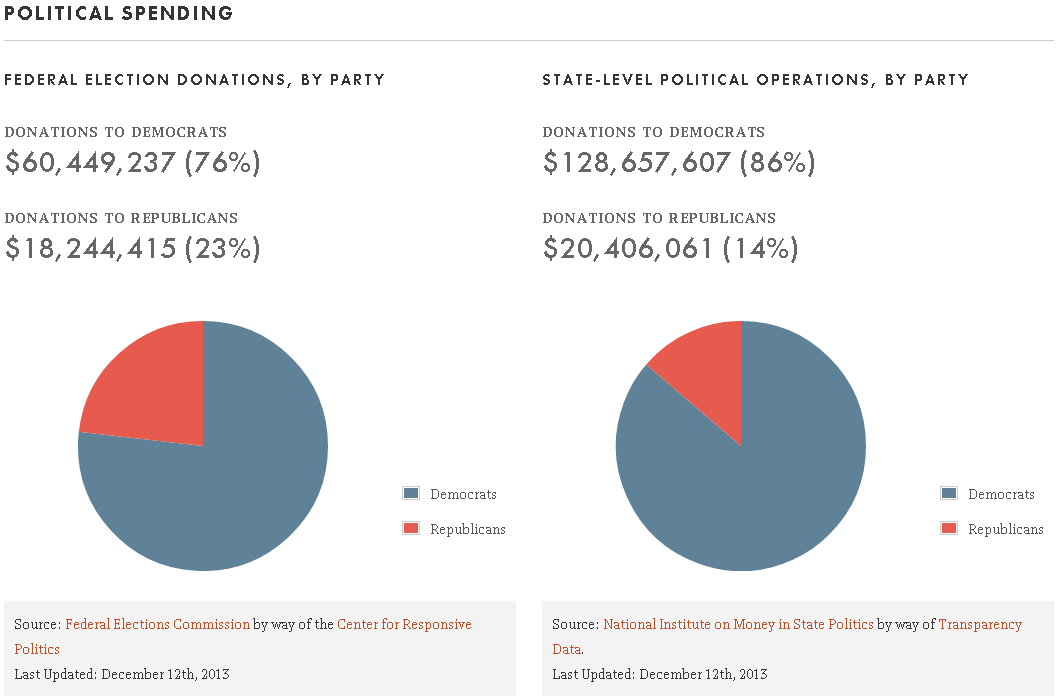
Political spending by the NEA in 2013
Political spending by the NEA union in 2013

This story is from The Stream.

Excerpt:

A federal judge in New York has struck down a test used by New York City to vet potential teachers, finding the test of knowledge illegally discriminated against racial minorities due to their lower scores.

[…][T]he city’s second Liberal Arts and Science Test (LAST-2) …[is]… simply a test to make sure that teachers had a basic high school-level understanding of both the liberal arts and the sciences.

One sample question from the test asked prospective educators to identify the mathematical principle of a linear relationship when given four examples; another asked them to read four passages from the Constitution and identify which illustrated checks and balances. Besides factual knowledge, the test also checks basic academic skills, such as reading comprehension and the ability to read basic charts and graphs.

Nevertheless, this apparently neutral subject matter contained an insidious kernel of racism, because Hispanic and black applicants had a passage rate only 54 to 75 percent of the passage rate for whites.

Once their higher failure rate was established, the burden shifted to New York to prove that LAST-2 measured skills that were essential for teachers and therefore was justified in having a racially unequal outcome. While it might seem obvious that possessing basic subject knowledge is a key skill for a teacher, District Judge Kimba Wood said the state hadn’t met that burden.

“Instead of beginning with ascertaining the job tasks of New York teachers, the two LAST examinations began with the premise that all New York teachers should be required to demonstrate an understanding of the liberal arts,” Wood wrote in her opinion, according to The New York Times.

LAST-2 hasn’t been used in New York since 2012, but the ruling will still have repercussions. Minorities who failed the exam (who number in the thousands) may be owed years of back pay totaling millions of dollars, and those who were relegated to substitute teaching jobs could be promoted to having their own classrooms. In addition, while Wood’s ruling only applies to New York City, the test was used statewide, and it could serve as a precedent for further lawsuits.

The ruling could also pave the way for another ruling finding New York’s current teacher test, the Academic Literacy Skills Test (ALST), to be discriminatory as well. That test is even harder than LAST-2, with a strong focus on literacy skills such as writing and reading comprehension, and like LAST-2 it has a very large gap in scores between whites and minorities. A lawsuit, once again being heard by Wood, is already pending, with the plaintiffs arguing that there is no clear evidence strong literacy skills are essential for a teacher.

See this is why you shouldn’t send your children to public schools without checking them out first. Places like New York and Chicago are especially notorious for hiring poorly-performing teachers – and for refusing to fire them, no matter what they do. What does the government care whether the kids learn or not? Unionized teachers do not get paid based on their ability to get students to perform. They get paid based on the contracts that are negotiated between their union and the government. If it’s a Democrat government, then a fair amount of the union dues are going to be funneled into Democrat coffers, anyway. So why would the Democrats take on the teacher unions that get them elected? They would not. And that’s one major reason why so many kids in these public schools cannot read, write, or do math. It’s by design. The goals of the public education system are 1) to make sure teachers get paid regardless of performance, and 2) to get Democrats elected. Parents and children are no part of the equation.

It seems to me that the real racism is when judges privilege the interests of grown-ups over the interests of poor, minority students. We should be focused on making sure that students have the best teachers, not protecting the jobs of the worst teachers for political gain.