
Tag Archives: Dependence

What working at Wal-Mart taught a young conservative woman about the poor

My friend Jose sent me this wonderful article from The College Conservative.

Excerpt:

During the 2010 and 2011 summers, I was a cashier at Wal-Mart #1788 in Scarborough, Maine. I spent hours upon hours toiling away at a register, scanning, bagging, and dealing with questionable clientele. These were all expected parts of the job, and I was okay with it. What I didn’t expect to be part of my job at Wal-Mart was to witness massive amounts of welfare fraud and abuse.

I understand that sometimes, people are destitute. They need help, and they accept help from the state in order to feed their families. This is fine. It happens. I’m not against temporary aid helping those who truly need it. What I saw at Wal-Mart, however, was not temporary aid. I witnessed generations of families all relying on the state to buy food and other items.  I literally witnessed mothers of small children asking their mothers if they could borrow their EBT cards. I once had a man show me his welfare card for an ID to buy alcohol. The man was from Massachusetts. Governor Michael Dukakis’ signature was on his welfare card. Dukakis’ last gubernatorial term ended in January of 1991. I was born in June of 1991. The man had been on welfare my entire life. That’s not how welfare was intended, but sadly, it is what it has become.

Here are just two short anecdotes:

a) People ignoring me on their iPhones while the state paid for their food. (For those of you keeping score at home, an iPhone is at least $200, and requires a data package of at least $25 a month. If a person can spend $25+ a month so they can watch YouTube 24/7, I don’t see why they can’t spend that money on food.)

d) A man who ran a hotdog stand on the pier in Portland, Maine used to come through my line. He would always discuss his hotdog stand and encourage me to “come visit him for lunch some day.” What would he buy? Hotdogs, buns, mustard, ketchup, etc. How would he pay for it? Food stamps. Either that man really likes hotdogs, or the state is paying for his business. Not okay.

I urge you with every fiber of my body to click through and read the true story of Welfare Queen #1 and Welfare Queen #2. Read them, and weep. Just because someone is poor, it doesn’t mean that they are automatically a good person. Maybe they are poor because they are irresponsible and selfish. Had you ever considered that? In any case, it’s not the government’s job to hand out money without knowing anything about the person who is getting the money. Government should leave the money in the hands of people who earn it, and let us decide who deserves to receive charity. (At the most, they should give us a tax deduction for charity up to 10% of our gross income to encourage more private charity)

But wait! There’s more!

From Human Events, toll workers being paid over $100,000 a year by the government.

Excerpt:

Ladies and gentlemen, meet Princesella Smith, who raked in $89,599 for operating the toll lanes at the George Washington Bridge in 2011.

Smith isn’t alone.  An investigation by the New York Post revealed that another toll booth operator pulled in a whopping $102,670 in 2011, $40K of that money coming in overtime.  In total, as the Post notes, there are at least 24 New York and New Jersey workers who have raked in more than $80,000 as “public” workers at a job that requires us to hand them even more of our money.

[…]Besides excessive wages to people whose only skill requirement is to sit on a stool and count and collect dollar bills, tax dollars reserved for transportation uses have gone to a panoply of nonessential programs.  As Ronald Utt of The Heritage Foundation points out, the “highway trust fund” has been raided to pay for Indian reservations, historic preservation sites, Appalachian and Mississippi Delta development, roadside beautification, bicycles, hiking paths, university research, and—the granddaddy of all expenses—feeding the $425 million beast that is the Department of Transportation.

The Port Authority (PA), for instance, employees a gardener for $94,000 and a blacksmith for $146,000 a year.  Heck, there are even retired PA employees who are making around that amount by cashing in on unused vacation and comp time.  (Here’s an idea:  As we’re facing budget deficits well into our future, how about requiring public employees to use their vaca time … or lose it.  No cashing in allowed.)

The larger problem highlighted with transportation spending, as Ronald Utt underscores, is the concept of public ownership.  A paltry 65% of highway taxes collected actually go to making driving a more pleasant experience for commuters.  The rest is squandered on whatever fancies a politician’s spending appetite at a given moment.  As the number of people driving has increased on the nation’s roads and highways (up 71% since 1970), lawmakers in Washington, D.C., and around the country have funneled money to stupid bike lines and high-speed rail debacles.

If I were President, I would immediately cancel all pensions for retired public sector workers and outlaw public sector unions.  What a colossal waste of money.

UPDATE: John Hawkins just posted a column entitled “The Five Things You Can Learn From Wal-Mart“.
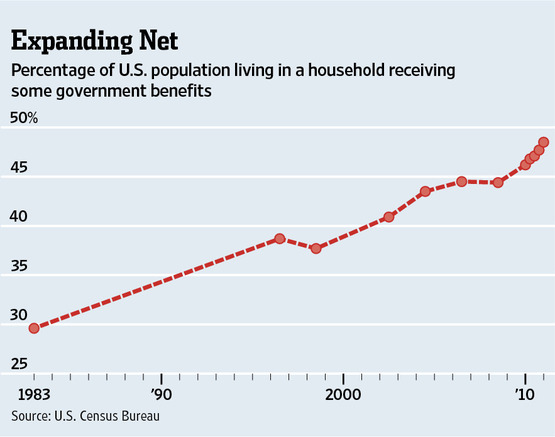
Nearly half of U.S. households are receiving some government benefits

Percentage of households receiving some government benefits

(Click for larger image)

This is the top story on the Wall Street Journal at the time I am writing this (Thursday at midnight).

Excerpt:

Families were more dependent on government programs than ever last year.

Nearly half, 48.5%, of the population lived in a household that received some type of government benefit in the first quarter of 2010, according to Census data. Those numbers have risen since the middle of the recession when 44.4% lived households receiving benefits in the third quarter of 2008.

The share of people relying on government benefits has reached a historic high, in large part from the deep recession and meager recovery, but also because of the expansion of government programs over the years. (See a timeline on the history of government benefits programs here.)

Means-tested programs, designed to help the needy, accounted for the largest share of recipients last year. Some 34.2% of Americans lived in a household that received benefits such as food stamps, subsidized housing, cash welfare or Medicaid (the federal-state health care program for the poor).

Another 14.5% lived in homes where someone was on Medicare (the health care program for the elderly). Nearly 16% lived in households receiving Social Security.

High unemployment and increased reliance on government programs has also shrunk the nation’s share of taxpayers. Some 46.4% of households will pay no federal income tax this year, according to the nonpartisan Tax Policy Center. That’s up from 39.9% in 2007, the year the recession began.

A plan like Herman Cain’s 9-9-9 plan would make sure that everybody is paying their fair share of taxes, and maybe then people who collect these benefits without paying their fair share would have a reason to want to cut government spending.

Greek men deprived of provider role commit suicide in record numbers

From the Wall Street Journal, a reminder that recessions hit men the hardest. (H/T Tom)

Excerpt:

]Gross domestic product in the second quarter was down more than 7% from a year before, amid government spending cuts and tax increases that, combined, will add up to about 20% of GDP. Unemployment is over 16%. Crime, homelessness, emigration and personal bankruptcies are on the rise.The most dramatic sign of Greece’s pain, however, is a surge in suicides.

Recorded suicides have roughly doubled since before the crisis to about six per 100,000 residents annually, according to the Greek health ministry and a charitable organization called Klimaka.

[…]Suicide has also risen in much of the rest of Europe since the financial crisis began, according to a recent study published in the British medical journal The Lancet, which said Greece is among the hardest hit.Suicide has also risen in much of the rest of Europe since the financial crisis began, according to a recent study published in the British medical journal The Lancet, which said Greece is among the hardest hit.

[…]A suicide help line at Klimaka, the charitable group, used to get four to 10 calls a day, but “now there are days when we have up to 100,” says a psychologist there, Aris Violatzis.

The caller often fits a certain profile: male, age 35 to 60 and financially ruined. “He has also lost his core identity as a husband and provider, and he cannot be a man any more according to our cultural standards,” Mr. Violatzis says.

Heraklion, commercial center of the island of Crete, has had a spate of such deaths.

[…]Victims once were typically adolescent males or old people facing severe illness, and in normal times suicide cases often involve a mixture of factors including mental illness, says local psychiatrist Eva Maria Tsapaki.

But the economic crash has created a “new phenomenon of entrepreneurs with no prior history of mental illness who are found dead every other week,” she says. “It’s very unusual.”

Hans Bader had a recent post about Obama’s stimulus bill that is relevant.

Excerpt: (links removed)

A logical place to have financed road and bridge repairs would have been Obama’s $800 billion stimulus package. But the stimulus package was purged of most investments in roads and bridges, and filled instead with welfare and social spending, out of political correctness, after feminist leaders complained that building and repairing roads and bridges would put unemployed blue-collar men to work, rather than women.

Christina Hoff Sommers points out that “of the 5.7 million jobs Americans lost between December 2007 and May 2009, nearly 80 percent had been held by men,” because men “predominate in manufacturing and construction, the hardest-hit sectors, which have lost more than 3 million jobs since December 2007.” But when some administration officials floated the concept of “an ambitious . . . stimulus program to modernize roads, bridges, schools, electrical grids, public transportation, and dams” as a way of “reinvigorating the hardest-hit sectors of the economy,” “Women’s groups were appalled,” asking “Where are the New Jobs for Women?” and denouncing what they called “The Macho Stimulus Plan.”

As Sommers notes, the Obama administration quickly knuckled under to this pressure, replacing its recovery package with an $800 billion stimulus package that instead “skews job creation somewhat towards women” by spending money instead on social services like welfare that are administered mostly by female employees.

As a 2009 Associated Press story reported, “Stimulus Funds Go to Social Programs Over ‘Shovel-ready’ Projects.” A team of six AP reporters who have been tracking the funds find that the $300 billion sent to the states is being used mainly for health care, education, unemployment benefits, food stamps, and other social services.” Or, as another AP report put it, “Stimulus Aid Favors Welfare, Not Work, Programs.”

The stimulus package also repealed welfare reform, as Slate’s Mickey Kaus and the Heritage Foundation have noted. (In 2008, Obama ran campaign ads claiming to support welfare reform, even though he had sought to undermine welfare reform as an Illinois legislator. The stimulus package largely repealed the 1996 welfare-reform law.)

Men: don’t vote for this man in 2012.

Related posts