Tag Archives: Cohabitation

Should women who get pregnant after premarital sex expect the men to marry them?

Mike Adams on abortion: click for larger image.

Professor Mike S. Adams is pro-life, but he posted something on Facebook that I must disagree with.

He posted this:

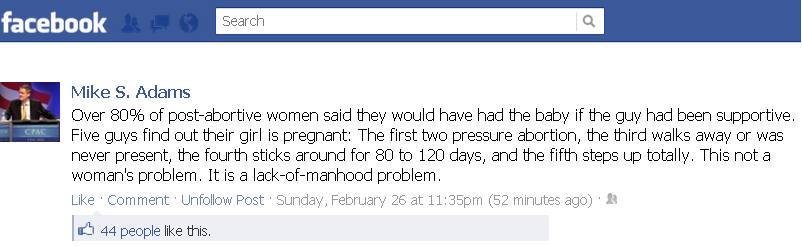
Over 80% of post-abortive women said they would have had the baby if the guy had been supportive. Five guys find out their girl is pregnant: The first two pressure abortion, the third walks away or was never present, the fourth sticks around for 80 to 120 days, and the fifth steps up totally. This not a woman’s problem. It is a lack-of-manhood problem.

Mike has about 5000 friends, and 44 of them liked it. I would think that most of these people would call themselves pro-life conservatives. But I don’t think what he posted promotes the pro-life cause.

I replied to him with this:

Mike I could not disagree more. It’s a woman’s problem unless it is rape, since the woman consents to sex with a man she is not married to. In fact, the cause of abortion is YOUR opinion – namely, the opinion that women should not be obligated to be chaste or to think rationally about who they are having sex with. There is a path to marriage that goes through courtship, and that path has a name: self-control. Stop enabling the poor choices of women, because we have to stop the murder of unborn children.

Many of Mike’s friends supported him. So I wrote this:

Wow. I had no idea that so many of Mike’s friends think that the Bible is a pack of lies when it says that fornication is morally wrong. I guess you guys aren’t Christians then, since you feel so free and easy about revising the Bible when you feel like it.

If fornication is wrong, it’s wrong for women AND men. And you don’t fornicate and then expect happy outcomes from it. There is a word for a person who sins and then expects a good outcome. A FOOL.

Then Mike replied to me:

Sorry Wintery. Where I come from the man leads and is, therefore, responsible.

I replied to that with this:

Mike, I agree with male leading – IF the man is a Christian. But the men that these women chose are not Christians. And you can’t expect men to act morally unless they have a theistic framework that grounds morality.

Women should not be told, by you and others, that they can choose to have sex with immoral men and then expect the immoral men to act morally. That is just enabling abortion by justifying a lack of prudence and wisdom. Instead, we should be holding women accountable to choose men who WILL control themselves.

We should not be supporting the fantasy view of love that says  that recreational sex magically leads men to commit to protect, provide and lead women for life. That view is neither wise nor Biblical. On the contrary, recreational sex leads men to NOT commit. Women have to learn how to select men, to evaluate them for marriage, and to make them prove themselves. We need to tell men AND women that sex before marriage is morally wrong. And we need to be convincing by showing them how recreational sex does not lead to stable marriages, and puts children, unborn and born, in harm’s way. Telling the truth about the danger of premarital sex is the best way to stop the killing of unborn children.

Here’s an example to make the point. We do not blame bears for mauling campers. Bears are bears, and they were bears before the campers showed up in their cave. We ought to blame the camper for choosing to wander off the trail and into the bear’s den in order to PET THE BEAR. Wild bears may eat free food that is offered to them, but they are not going to let you pet them and hug them. Women, like campers, need to be responsible. They need to choose the right man for marriage. They need to exercise self control. They need to make the man prove his ability to commit and support a family BEFORE they have sex with him. No one hires an employee without understanding what job they need done and then making sure that the candidate they choose can do the job. And that’s what we need to tell women.

Obviously, I was a little upset when I wrote that, but I hope it wasn’t too bad.

So what’s the point I was trying to make by being critical of Mike? I think the problem we have today is that men who are pro-life are unwilling to hold women accountable for their own poor decisions about sex and marriage. Basically, conservative and/or Christian men think that women don’t need to think through what choices are most likely to avoid abortion and most likely to achieve marriage. These men give tacit approval to the popular trend of trying to achieve marriage through premarital sex (or cohabitation), when the research shows that these behaviors do not result in long-lasting stable marriages. In fact, sex out of wedlock is a good way to get into a situation where an abortion will occur.

In my view, Mike is inadvertently encouraging women to get into the situations where they will be pressured to abort by reinforcing the idea that there is nothing wrong with their plan to achieve marriage by having premarital sex (or cohabitating), and then expecting men to respond to their pregnancy by MARRYING them. Mike seems to be telling women that it is normal for them to expect that marriage will follow from premarital sex with men who have not been vetted for the roles of provider, protector and leader As if marriage is natural for men who don’t even have jobs and who are surrounded by women willing to have sex with them on the first date. Any man who will have recreational premarital sex with a woman is exactly the kind of person who will not commit to lifelong providing and fidelity – he is having sex before marriage because he wants recreation, without the commitment and self-sacrifice that marriage requires. Rationally speaking, it makes no sense for men to buy the cow, and to keep buying the cow with 40 years of labor, when they can get the milk for free. And that’s what we need to tell women – think with your minds, not with your emotions.

Here is an interesting statistic from Relevant Magazine:

[A] recent study reveals that 88 percent of unmarried young adults (ages 18-29) are having sex. The same study, conducted by The National Campaign to Prevent Teen and Unplanned Pregnancy, reveals the number doesnʼt drop much among Christians. Of those surveyed who self-identify as “evangelical,” 80 percent say they have had sex.

[…]In addition to having premarital sex, an alarming number of unmarried Christians are getting pregnant. Among unmarried evangelical women between the ages of 18 and 29, 30 percent have experienced a pregnancy (a number thatʼs actually 1 percent higher than among those who donʼt claim to be evangelical).

According to the Guttmacher Institute, nearly half of all pregnancies in America are unintended. And of those, 40 percent end in abortion. More than 1 million abortions occur in the United States each year. But perhaps the most disturbing statistic for the Church: 65 percent of the women obtaining abortions identify themselves as either Protestant or Catholic (37 percent Protestant and 28 percent Catholic). Thatʼs 650,000 abortions obtained by Christians every year.

Christian women are not told that premarital sex is wrong by many Christians and conservatives – and out of that refusal by “Christians” and “conservatives” to take a stand, we get 650,000 abortions per year. We need to have more courage to tell women to be more self-controlled and responsible when they choose who to have sex with, and when to have sex. We need to tell women to make good decisions that lead to stable marriages. We need to tell women to study these issues and to support policies that produce strong, moral men who are willing to marry – for example, by reforming education so that our schools produce men who can find jobs, perhaps by having more male teachers in the classroom. We need to tell women to support policies that make marriage more friendly for men, like abolishing no-fault divorce, and promoting shared parenting. Christians in particular need to counteract the views of love and romance that are prevalent in popular culture with a view of relationships built around chastity and love. Although many people today are uncomfortable with moral absolutes and moral judgments, it would be a good be a good idea for women to promote these things, so that the men they are choosing from are more moral.

In the end, I agree with Mike S. Adams in one respect. Abortion may be caused by a lack of manhood problem. Only the lack of manhood doesn’t come from the men that women choose to have premarital sex with. The lack of manhood comes from men who refuse to hold women accountable for their own free foolish decisions that put unborn children in harm’s way. In addition to the abortion problem that results from those foolish decisions, there is also the explosion in out-of-wedlock births to weigh in the balance. Again, the more people tell women that they should expect men who engage in recreational sex to commit to marriage after premarital sex (or cohabitation), the more fatherlessness we get.

What does the new Guzzo study tell us about the instability of cohabitation?

I blogged about a new study on cohabitation earlier in the month, but I only had the abstract. Now more details are out, from Family-Studies.org.

First, some context:

In a new paper, Bowling Green State University sociologist Karen Guzzo analyzes how the odds of cohabitation leading to either getting married or breaking up have changed over the years. Before getting to her findings, let’s review some of the cohabitation trends she highlights in her report (based on prior studies).

  1. The majority of people in their 30s have lived with someone outside of marriage.
  2. Cohabitation, rather than marriage, is now the more common form of first union.
  3. Fewer marriages than in the past start out with the couple having intentions to marry.
  4. People are more likely than ever to cohabit with multiple partners in succession—what I have called “CohabiDating.”
  5. More children than ever before are born to cohabiting couples, and this explains most of the rise in the number of children being born out of wedlock.

Guzzo notes, as have others, that cohabiting has become a normative experience in the romantic and sexual lives of young adults. As young adults put off marriage until later in life, cohabitation has inhabited much of the space that used to be made up of married couples. I think this dramatic change in how relationships form matters for at least two reasons. First, many cohabiting couples have children, but they are less likely than married couples to have planned to have children and they are much less likely to remain together after having children… Second, most people want lasting love in life, and most people still intend to accomplish that in marriage.

Here is the main finding of the new paper:

To simplify and summarize, what Guzzo found is that the increasing diversity in the types of cohabitation and cohabiters does not explain much about why things are so different from the past when it comes to increased odds that cohabiting couples will break up or not marry. Rather, on average, all types of cohabiting couples have become more likely than in the past to break up or not transition into marriage.

Here’s a quote from her paper (pg. 834):

Relative to cohabitations formed between 1990 and 1994, cohabitations formed from 1995–1999, 2000–2004, and 2005 and later were 13%, 49%, and 87%, respectively, more likely to dissolve than remain intact. The lower risk of marriage over remaining intact occurred only for the last two cohabitation cohorts (2000–2004 and 2005 and later), which were about 18% and 31% less likely to marry than remain intact, respectively.

Moving in together is becoming less and less likely to lead to having a future together. That’s not to say that all cohabiters are in the same boat regarding their destination. Those who are engaged (or have clear plans to marry) before moving in together are far more likely to eventually marry—but as Guzzo shows, even they are becoming less likely to do so. Related to this, my colleagues and I have shown, in numerous studies, that couples with clear plans to marry before cohabiting, along with those who marry without cohabiting, tend to have happier marriages and lower odds of divorce than those who move in together before having a clearly settled commitment to the future in marriage. (We believe this is largely because, while cohabiting unions obviously break up often, they are harder to break off than dating relationships because it becomes harder to move out and move on. So some people get stuck in a relationship they would otherwise have not remained in.)

[…]Cohabitation is fundamentally ambiguous. In fact, that is part—but just part—of why I believe it has become so popular. Sure, there are many cohabiting couples for whom living together was understood as a step-up in commitment, but, on average, research shows it is not associated with an increase in dedication to one’s partner.

So those are the findings from the latest study. You can find more studies on cohabitation linked here in my previous post on this topic.

New study: cohabitation more likely to dissolve, less likely to lead to marriage

All I have on this is the abstract, but if someone can send me the study, I’d love to see the results section.

Abstract:

Cohabitation is now the modal first union for young adults, and most marriages are preceded by cohabitation even as fewer cohabitations transition to marriage. These contrasting trends may be due to compositional shifts among cohabiting unions, which are increasingly heterogeneous in terms of cohabitation order, engagement, and the presence of children, as well as across socioeconomic and demographic characteristics. The author constructs 5-year cohabitation cohorts for 18- to 34-year-olds from the 2002 and 2006–2010 cycles of the National Survey of Family Growth (n = 17,890 premarital cohabitations) to examine the outcomes of cohabitations over time. Compared to earlier cohabitations, those formed after 1995 were more likely to dissolve, and those formed after 2000 were less likely to transition to marriage even after accounting for the compositional shifts among individuals in cohabiting unions. Higher instability and decreased chances of marriage occurred among both engaged and non-engaged individuals, suggesting society-wide changes in cohabitation over time.

Evidence Unseen has collected some of the other studies together.

Excerpt

Hall and Zhao (from the University of Western Ontario) studied 8,177 individuals who were ever-married. They write, “Premarital cohabitors in Canada have over twice the risk of divorce in any year of marriage when compared with noncohabitors.”[13]

Manning (et al.) writes, “Over 50% of cohabiting unions in the US, whether or not they are eventually legalized by marriage, end by separation within five years compared to roughly 20% for marriages.”[14]

Daniel Lichter and Zhenchao Qian (from Cornell University and The Ohio State University) write, “If serial cohabitors married, divorce rates were very high—more than twice as high as for women who cohabited only with their eventual husbands.”[15]

And finally, there’s this study from Life Site News.

Excerpt:

Couples who reserve sex for marriage enjoy greater stability and communication in their relationships, say researchers at Brigham Young University.

A new study from the Mormon college found that those couples who waited until marriage rated their relationship stability 22 percent higher than those who started having sex in the early part of their relationship. The relationship satisfaction was 20 percent higher for those who waited, the sexual quality of the relationship was 5 percent better, and communication was 12 percent better.

The study, published in the American Psychological Association’s Journal of Family Psychology, involved 2,035 married individuals who participated in a popular online marital assessment called “RELATE.” From the assessment’s database, researchers selected a sample designed to match the demographics of the married American population. The extensive questionnaire included the question “When did you become sexual in this relationship?”

Couples that became sexually involved later in their relationship – but prior to marriage – reported benefits that were about half as strong as those who waited for marriage.

[…]Sociologist Mark Regnerus of the University of Texas at Austin, who was not involved in the study, responded to its findings, saying that “couples who hit the honeymoon too early – that is, prioritize sex promptly at the outset of a relationship – often find their relationships underdeveloped when it comes to the qualities that make relationships stable and spouses reliable and trustworthy.” Regnerus is the author of Premarital Sex in America, a book forthcoming from Oxford University Press.

Because religious belief often plays a role for couples who choose to wait, Busby and his co-authors controlled for the influence of religious involvement in their analysis.

“Regardless of religiosity, waiting helps the relationship form better communication processes, and these help improve long-term stability and relationship satisfaction,” Busby said.

Young men and women growing up really need to be informed by their parents what they are going to want to be doing long term, and what they should be doing today to accomplish those goals. Young people benefit greatly from the guidance of older and wiser people, but in defining goals and defining the steps to reach those goals. To be a convincing parent, you have to be convinced yourself. And to be convinced yourself, you need to be seen as having knowledge, not just opinions, but knowledge. Having the right peer-reviewed papers at hand will help you to be a better parent.